Blade Connector Market Insights
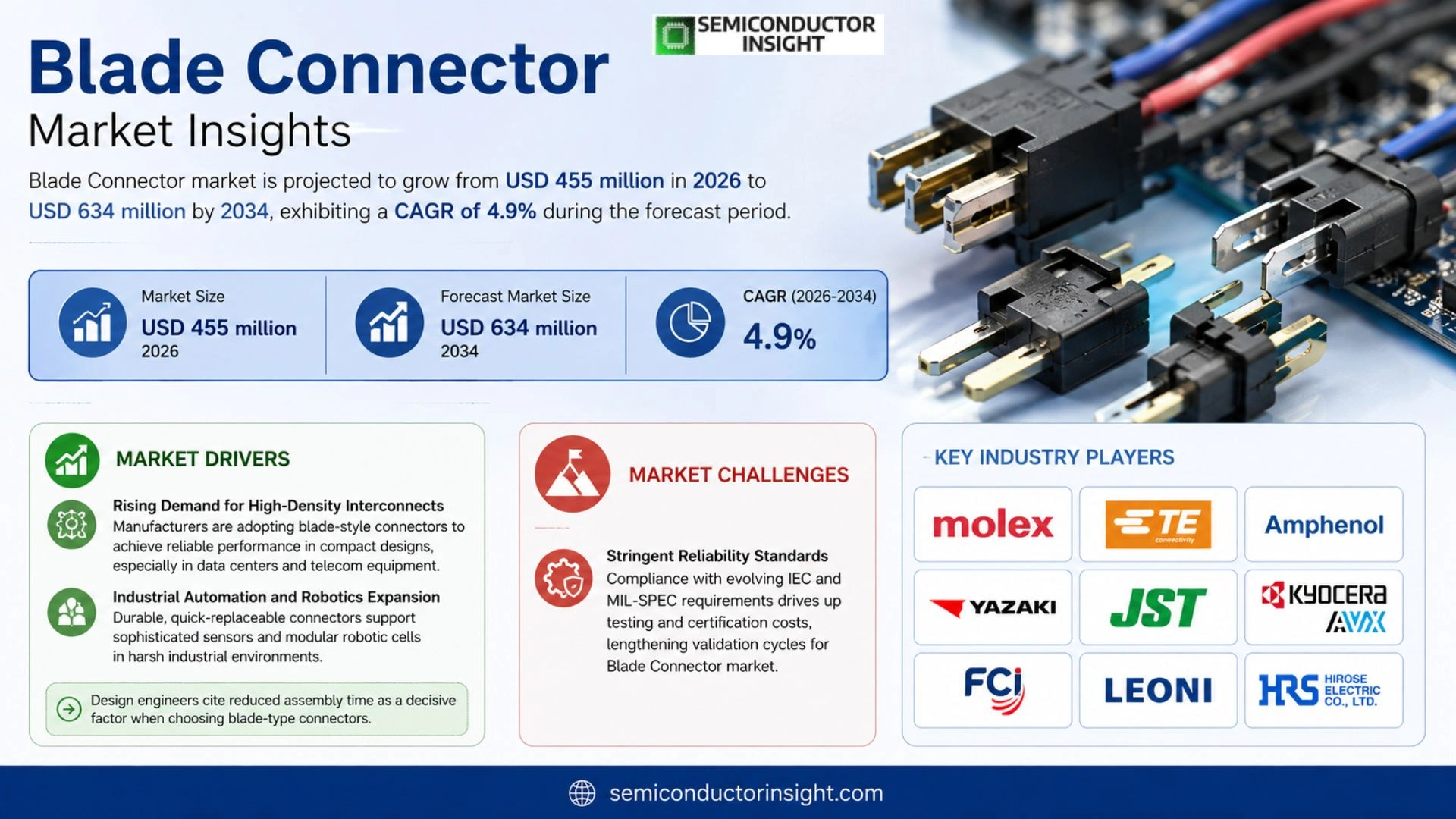
Blade Connector market is projected to grow from USD 455 million in 2026 to USD 634 million by 2034, exhibiting a CAGR of 4.9% during the forecast period.
Blade Connector is a power and signal interconnection device that uses flat blade‑type terminals to achieve low‑resistance, high‑current transmission and stable electrical contact in compact systems. It is widely applied in automotive and industrial equipment where cost efficiency, mechanical robustness, and reliable conductivity are required. The product offers advantages such as simple structure, high current‑carrying capability, low contact resistance, and ease of assembly, making it suitable for high‑volume electrical distribution applications.
The market is experiencing growth because vehicle electrification, expansion of power electronics, and higher current loads in industrial equipment increase demand for cost‑oriented interconnect solutions. However, competition from higher‑density connector architectures and rising expectations for compactness and thermal management are pushing manufacturers toward improved contact materials, precision stamping processes, and enhanced system‑level integration performance.
MARKET DRIVERS
Rising Demand for High‑Density Interconnects
Blade Connector market benefits from manufacturers seeking to pack more functionality into smaller footprints. As data‑center servers and telecom equipment shrink, designers favor blade‑style connectors that offer reliable signal integrity while consuming minimal board area. This shift is reshaping component selection criteria across the electronics supply chain.
Industrial Automation and Robotics Expansion
Automation platforms are integrating increasingly sophisticated sensor arrays, which rely on durable, quick‑replaceable connectors. Blade connectors provide the mechanical robustness required for harsh factory floors, encouraging OEMs to standardize on these components for modular robotic cells.
➤ Design engineers cite reduced assembly time as a decisive factor when choosing blade‑type connectors over traditional pins.
Manufacturers also appreciate the lower total cost of ownership: fewer installation errors translate into less rework, and the modular nature of blade systems eases future upgrades without extensive redesign.
MARKET CHALLENGES
Stringent Reliability Standards
Compliance with evolving IEC and MIL‑SPEC requirements forces suppliers to invest heavily in testing infrastructure. Blade Connector market therefore faces cost pressures as certification cycles lengthen and validation protocols become more exacting.
Other Challenges
Material Cost Volatility
Fluctuations in copper and alloy prices erode margin buffers, prompting manufacturers to explore alternative conductive alloys while maintaining performance thresholds.
Design Complexity
As systems incorporate higher pin counts, routing density escalates, demanding sophisticated CAD libraries and tighter tolerances. Smaller design windows increase the risk of electromagnetic interference, compelling engineers to balance density against signal fidelity.
MARKET RESTRAINTS
Limited Adoption in Legacy Equipment
Older machinery, particularly in aerospace and defense, continues to rely on legacy connector families. Retrofit projects are often hampered by certification bottlenecks, making the transition to blade connectors slower than anticipated. Consequently, Blade Connector market encounters pockets of stagnation where equipment turnover is infrequent.
Supply‑Chain Fragmentation
The global sourcing network for precision‑machined components remains vulnerable to geopolitical tensions and logistics disruptions. Manufacturers that depend on single‑source suppliers may experience lead‑time extensions, curbing the market’s overall growth momentum.
MARKET OPPORTUNITIES
Emergence of Edge‑Computing Infrastructure
Edge devices demand compact, high‑performance interconnect solutions to support real‑time analytics. Blade connectors, with their space‑saving profile and robust mating cycles, are well‑positioned to become the default interface for next‑generation edge gateways, opening a new revenue stream for suppliers.
Customizable Modular Systems
OEMs are increasingly designing product families that share a common blade‑connector backbone while varying peripheral modules. This modular philosophy reduces engineering overhead and accelerates time‑to‑market, encouraging broader adoption of blade connectors across diverse sectors.
Blade Connector Market Trends
Electrification of Vehicles Fuels Blade Connector Demand
Vehicle power‑train electrification is reshaping Blade Connector market. As electric and hybrid models increase their share of global fleets, designers face higher current requirements for onboard charging, propulsion, and auxiliary systems. Blade connectors, with their low contact resistance and robust mechanical profile, meet these demands while keeping assembly costs modest. The shift also pushes automotive OEMs such as Toyota, Volkswagen, and BYD to source larger volumes, driving a measurable rise in unit production that reached approximately 166 million units in the most recent year. Because the component’s simple geometry allows rapid insertion into wiring harnesses, manufacturers can sustain high throughput without sacrificing reliability, a critical advantage in high‑volume vehicle platforms.
Other Trends
Material Innovations Reduce Contact Resistance
Upstream suppliers are responding to tighter electrical performance specifications by refining copper alloys and engineering‑plastic formulations. A modest increase in copper purity, combined with surface‑treatment techniques that improve micro‑roughness, has lowered average contact resistance by a few milliohms per blade. This improvement translates into better thermal management for dense power modules and supports the push for higher current ratings in industrial equipment. The marginal cost impact is offset by an uplift in gross margins, which have stabilized around 25 % as manufacturers capture added value from performance‑enhanced offerings.
Manufacturing Automation Enhances Capacity Utilization
Midstream processes are increasingly automated, with precision stamping and robotic handling becoming standard on high‑volume lines. Automation reduces cycle time and variability, allowing Blade Connector market’s capacity utilization to climb from the mid‑50 % range to roughly 60 % in recent periods. Higher utilization improves economies of scale, enabling suppliers to keep the average unit price near USD 3 while investing in quality‑control upgrades. Downstream, industrial customers such as Siemens and Schneider Electric benefit from the steadier supply and consistent electrical characteristics, which simplify system integration and lower total cost of ownership. The combined effect of material advances and process automation positions blade connectors as a competitive choice amid emerging high‑density connector architectures.
COMPETITIVE LANDSCAPE
Key Industry Players
Blade Connector Market: Competitive Overview
The upper tier of the Blade Connector arena is dominated by a handful of multinational firms that have leveraged decades of experience in high‑current interconnects to lock in the majority of automotive and industrial contracts. Amphenol Corporation, TE Connectivity, and ITT Cannon together account for roughly 55 % of global revenue, a concentration that stems from their extensive engineering resources, global production footprints, and long‑standing relationships with tier‑1 automobile OEMs such as Toyota and Volkswagen. Their strategies converge on scaling stamping capacity, investing in low‑resistance copper alloys, and offering modular families that address both single‑blade and multi‑blade configurations. This focus on cost‑efficient mass production provides a defensible moat against new entrants, while their ability to integrate connector design into broader wiring‑harness solutions creates cross‑selling opportunities that reinforce market share.
Beyond the core trio, a diverse set of specialist manufacturers occupies niche segments where performance nuances outweigh pure cost considerations. Glenair and Omnetics have carved out reputations for high‑frequency signal integrity, making them preferred suppliers for data‑center and aerospace customers. Airborn and Smiths Interconnect excel in ruggedized designs demanded by off‑highway equipment, whereas European players such as Souriau, Nicomatic, and Axon’ Cable sustain a foothold through advanced contact‑surface treatments and compliance with stringent EU automotive standards. Asian firms,including JAE Electronics, Hosiden Corporation, Jonhon Optronic Technology, Guizhou Space Appliance, and Sichuan Huafeng Technology,benefit from proximity to emerging electric‑vehicle supply chains and increasingly competitive pricing models. Collectively, these companies sustain a vibrant second tier that pressures the market leader’s pricing while driving incremental innovation in material science and mounting architectures.
List of Key Blade Connector Companies Profiled
- Amphenol Corporation
- TE Connectivity
- ITT Cannon
- Glenair
- Omnetics Connector
- AirBorn
- Smiths Interconnect
- Souriau
- Nicomatic
- Axon’ Cable
- JAE Electronics
- Hosiden Corporation
- Jonhon Optronic Technology
- Guizhou Space Appliance
- Sichuan Huafeng Technology
Segment Analysis:
| Segment Category | Sub-Segments | Key Insights |
| By Type |
|
Single Blade Connector
|
| By Application |
|
Automotive
|
| By End User |
|
Vehicle Manufacturers
|
| By Mounting |
|
PCB Mount
|
| By Material |
|
Copper
|
Regional Analysis: Blade Connector Market
Asia‑Pacific
Nations such as Vietnam and the Philippines have upgraded their electronic‑fabrication ecosystems, offering streamlined customs procedures and tax rebates that directly lower component cost. This environment encourages blade connector producers to establish localized fabs, shortening lead times for regional customers and enhancing supply‑chain visibility.
Recent disruptions have prompted buyers to diversify sourcing across multiple Asian hubs. By maintaining parallel production lines, manufacturers mitigate risk and preserve inventory fluidity, a strategy that has become a de‑facto standard in Blade Connector market’s sourcing playbook.
Harmonised safety standards, especially under the IEC 60950 framework, simplify cross‑border certification. Companies that embed compliance early in design capture market share more efficiently, as customers favour partners with proven regulatory track records.
Growth in edge‑computing nodes and AI‑accelerated servers in the region creates a fresh demand wave for compact, high‑performance interconnects, nudging vendors to tailor blade connector specifications for low‑latency, high‑throughput environments.
North America
In the United States and Canada, Blade Connector market is shaped by a mature aerospace and defense sector that prioritises reliability and stringent quality assurance. OEMs favor domestic suppliers capable of delivering traceable material certifications, which drives niche premium pricing. Meanwhile, the push toward modular data‑center design in hyperscale facilities fuels demand for connectors that can support rapid re‑configuration without compromising signal integrity. Companies that combine robust engineering support with agile manufacturing are better positioned to win contracts from the federal procurement pipeline.
Europe
European adoption hinges on the continent’s rigorous sustainability directives and a strong emphasis on circular‑economy principles. Blade connector manufacturers are investing in recyclable alloys and low‑lead finishes to satisfy EU ecological standards, an effort that resonates with OEMs seeking greener supply chains. Additionally, the ongoing rollout of 5G infrastructure across Germany, the UK, and France creates a steady stream of projects where high‑density interconnect solutions become indispensable for compact base‑station designs.
South America
Brazil and Chile lead regional activity, where telecom expansion and renewable‑energy installations are the primary growth engines for Blade Connector market. Local producers often collaborate with multinational firms to transfer technology, thereby elevating component quality while keeping costs competitive. Market participants that can navigate complex import tariffs and provide localized technical support gain a decisive edge in winning contracts for large‑scale solar‑farm inverters and telecom backhaul equipment.
Middle East & Africa
The Gulf Cooperation Council’s vision for smart‑city initiatives accelerates demand for modular server farms, prompting a modest rise in blade connector procurement. African nations, meanwhile, are upgrading data‑centers to support burgeoning fintech ecosystems. Suppliers that embed remote diagnostics and modular repair kits into their offerings can differentiate themselves in markets where on‑site service resources are limited, thereby securing longer‑term service agreements.
Report Scope
This market research report provides a comprehensive analysis of the Blade Connector Market , covering the forecast period 2026–2034. It offers detailed insights into market dynamics, technological advancements, competitive landscape, and key trends shaping the industry.
Key focus areas of the report include:
- Market Overview: The report begins with an overview outlining its current market scenario, key growth indicators, and industry transformation drivers. It discusses macroeconomic factors, demand–supply balance, regulatory landscape, and the strategic role of semiconductors in powering advancements across industries such as automotive, telecommunications, consumer electronics, and industrial automation
- Market Size & Forecast: Historical data and future projections for revenue, unit shipments, and market value across major regions and segments.
- Segmentation Analysis: Detailed breakdown by product type, technology, application, and end-user industry to identify high-growth segments and investment opportunities.
- Regional Insights: Insights into market performance across North America, Europe, Asia-Pacific, Latin America, and the Middle East & Africa, including country-level analysis where relevant.
- Competitive Landscape: Profiles of leading market participants, including their product offerings, R&D focus, manufacturing capacity, pricing strategies, and recent developments such as mergers, acquisitions, and partnerships.
- Technology Trends & Innovation: Assessment of emerging technologies, integration of AI/IoT, semiconductor design trends, fabrication techniques, and evolving industry standards.
- Market Drivers & Restraints: Evaluation of factors driving market growth along with challenges, supply chain constraints, regulatory issues, and market-entry barriers.
- Stakeholder Insights: Insights for component suppliers, OEMs, system integrators, investors, and policymakers regarding the evolving ecosystem and strategic opportunities.
Primary and secondary research methods are employed, including interviews with industry experts, data from verified sources, and real-time market intelligence to ensure the accuracy and reliability of the insights presented.
FREQUENTLY ASKED QUESTIONS:
What is the current market size of Blade Connector Market?
-> Blade Connector market is projected to grow from USD 455 million in 2026 to USD 634 million by 2034, exhibiting a CAGR of 4.9% during the forecast period.
Which key companies operate in Blade Connector Market?
-> Key players include Amphenol Corporation, TE Connectivity, ITT Cannon, Glenair, Omnetics Connector, AirBorn, Smiths Interconnect, Souriau, Nicomatic, Axon’ Cable, JAE Electronics, Hosiden Corporation, Jonhon Optronic Technology, Guizhou Space Appliance, Sichuan Huafeng Technology.
What are the key growth drivers?
-> Key growth drivers include vehicle electrification, expansion of power electronics, and increasing current demands in industrial equipment.
Which region dominates the market?
-> Asia dominates the market, with Asia‑Pacific being the fastest‑growing region.
What are the emerging trends?
-> Emerging trends include development of higher‑density connector architectures, advanced contact materials, precision stamping processes, and enhanced system‑level integration for thermal management.
Get Sample Report PDF for Exclusive Insights
Report Sample Includes
- Table of Contents
- List of Tables & Figures
- Charts, Research Methodology, and more...
 Download Sample Report PDF