Latching Connector Market Insights
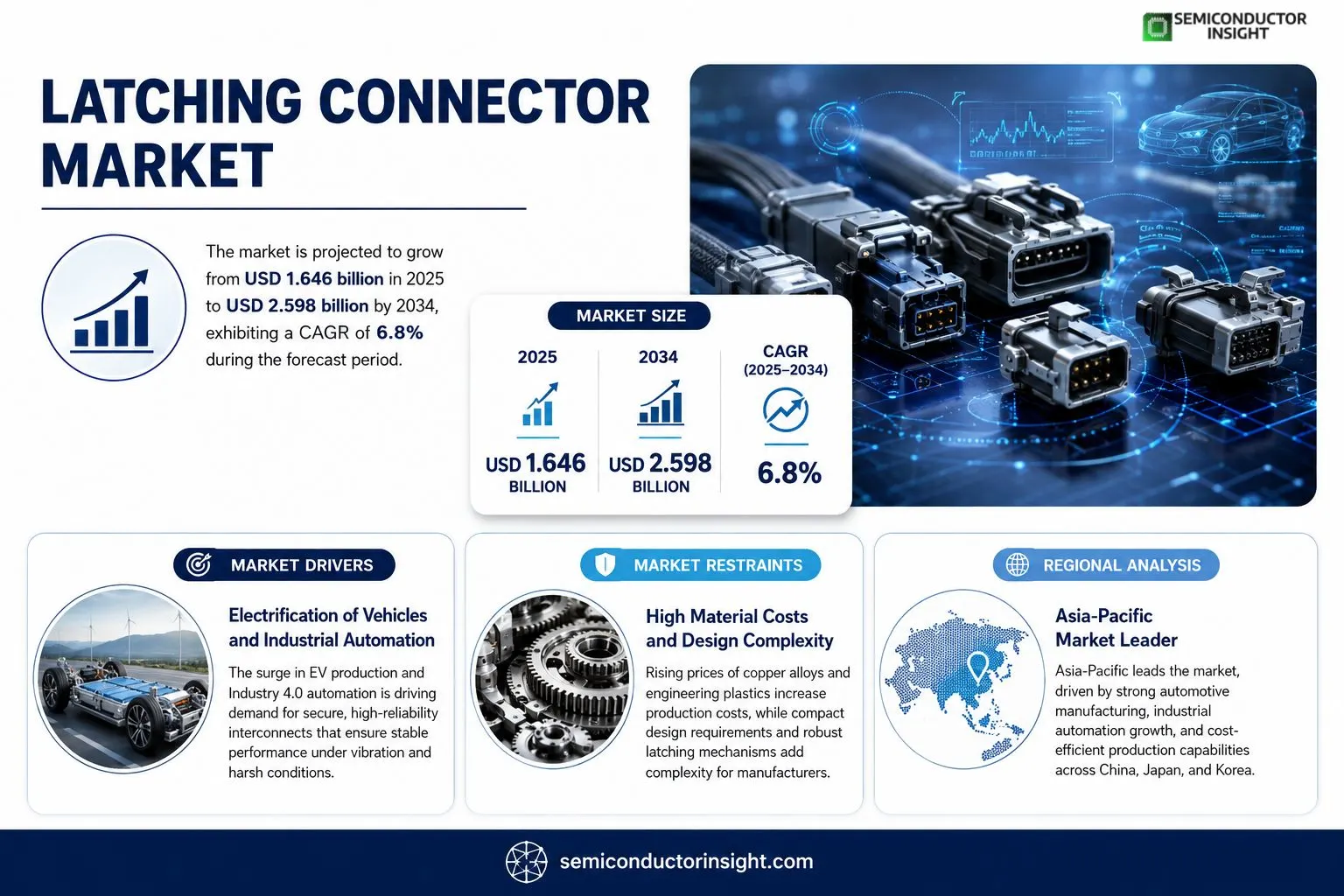
Latching Connector market size was valued at USD 1.646 billion in 2025. The market is projected to reach USD 2.598 billion by 2034, exhibiting a CAGR of 6.8 % during the forecast period.
Latching Connectors are secure interconnection devices equipped with an integrated locking mechanism that ensures stable electrical and signal transmission under high‑vibration and high‑reliability conditions. They are widely deployed in automotive electronics and industrial control systems where mechanical retention, contact stability, and resistance to shock and thermal stress are essential. The solution delivers enhanced connection security, improved durability, and simplified assembly while maintaining a compact footprint compatible with modern vehicle architectures.The market expands because automotive electrification and the rise of intelligent industrial equipment increase demand for robust interconnects capable of withstanding vibration, thermal cycling, and mechanical stress. At the same time, cost pressures in mass‑production drive manufacturers to optimise material usage and streamline assembly processes. Leading suppliers such as Amphenol Corporation, TE Connectivity, ITT Cannon, Glenair and JAE Electronics are advancing locking‑structure designs and pursuing partnerships with OEMs like Tesla, Toyota and Siemens to capture growth opportunities.
MARKET DRIVERS
Electrification of Vehicles and Industrial Automation
The surge in electric‑vehicle production and the acceleration of Industry 4.0 factories are compelling system designers to adopt lock‑secure interconnects. Latching Connector Market participants that can guarantee repeatable mating cycles see immediate preference from OEMs seeking to reduce downtime on assembly lines.
Regulatory Push for Safety Standards
Recent updates to international safety directives require connectors to sustain higher pull‑out forces and to retain performance under vibration. Suppliers that embed compliant latching mechanisms are positioned to capture contracts that were previously awarded to generic connector providers.
➤ Secure locking mechanisms cut field failure rates by an estimated 25‑30 % across automotive and aerospace programs.
When these two forces converge, manufacturers experience a noticeable shift toward premium‑grade latching solutions, prompting Latching Connector Market growth that exceeds the pace of broader electronic component segments.
MARKET CHALLENGES
Complexity of Design Integration
Design engineers often wrestle with limited board real‑estate while trying to accommodate the additional space that a robust latch requires. This tension forces trade‑offs that can lengthen product development cycles, especially in compact consumer electronics where every millimeter counts.Cost sensitivity adds another layer of difficulty; the premium materials that deliver longer service life also inflate bill‑of‑materials, making price‑conscious buyers hesitant to switch from legacy connector families.
Other Challenges
Supply Chain Bottlenecks
Fluctuations in copper and alloy availability have introduced lead‑time volatility. Companies that lack diversified sourcing strategies risk missing critical project windows, which can erode confidence in new connector introductions.
MARKET RESTRAINTS
High Material Costs
Elevated prices for copper, tin‑bronze, and high‑performance polymers directly raise the production cost of latching connectors. End users, particularly in cost‑driven sectors such as telecommunications, often opt for lower‑priced alternatives, tempering overall market momentum.
MARKET OPPORTUNITIES
Smart‑Grid and Renewable Energy Integration
The transition toward decentralized power generation demands connectors that can endure harsh outdoor conditions while maintaining a secure lock. Firms that engineer latching solutions with corrosion‑resistant alloys and self‑diagnostic features stand to win a growing share of Latching Connector Market tied to solar, wind, and micro‑grid deployments.
Latching Connector Market Trends
Growing Demand from Electrified Vehicles
The surge in electrified vehicle platforms has turned the secure interconnect segment into a strategic component for automakers. As power‑train architectures shift from internal combustion to battery‑electric designs, the number of electronic control modules per vehicle climbs from dozens to well over a hundred. Each module relies on a connection that can survive relentless vibration, rapid temperature swings, and shock events typical of automotive operation. In 2025 manufacturers produced roughly 212 million latching connectors at an average price of $8.5, while overall capacity utilization lingered at 60 percent, delivering a gross margin near 38 percent. The combination of higher module density and the need for reliable lock‑in mechanisms is forcing OEMs such as Tesla, Toyota and BYD to source larger volumes of these components, thereby reshaping the demand curve for the sector. Beyond automobiles, the industrial control segment is expanding its reliance on secure interconnects as factories adopt modular automation lines, where downtime caused by connector failure translates directly into lost production.
Other Trends
Material Cost Pressures and Margin Management
Material cost volatility has emerged as a parallel challenge for producers. Copper prices have oscillated between $8,500 and $9,200 per metric ton over the past two years, while engineering‑plastic feedstock costs have risen roughly 7 percent due to raw‑material scarcity. Leading suppliers such as Freeport‑McMoRan, Southwire and BASF are negotiating longer‑term contracts to dampen price swings, yet the midstream must still absorb a portion of the expense to keep unit pricing competitive. Consequently, manufacturers are intensifying efforts to trim scrap rates, adopt additive‑manufacturing for complex locking structures, and redesign housings for thinner walls without compromising strength. These initiatives have helped sustain the sector’s 38 percent gross margin despite the upward pressure on input costs.
Smart Manufacturing Adoption in the Midstream
The midstream is responding with a noticeable shift toward smart manufacturing. Advanced CNC machining, real‑time torque monitoring and AI‑driven defect detection are being integrated into assembly lines to ensure terminal precision and repeatable lock engagement. Automation reduces human‑error‑related rework, shortens cycle time, and feeds directly into higher capacity utilization, nudging the 60 percent figure upward. For customers, the outcome is a more predictable lead‑time and a product that meets tighter reliability specifications demanded by safety‑critical automotive and industrial applications. These dynamics shape the outlook for the broader Latching Connector Market, encouraging suppliers to revisit their product roadmaps.
COMPETITIVE LANDSCAPE
Key Industry Players
Latching Connector Market – Competitive Overview
Amphenol Corporation dominates the latching connector arena, leveraging a broad portfolio that spans automotive, industrial and high‑vibration domains. Its scale enables deep integration of copper‑based conductors and engineered plastics, delivering a gross margin that comfortably exceeds the industry average. By consolidating design, testing and high‑volume assembly under one roof, Amphenol cushions customers such as Tesla and Siemens against supply‑chain disruptions while preserving price competitiveness. The firm’s strategic focus on precision‑terminal engineering and modular locking mechanisms has entrenched it as the reference supplier for OEMs requiring both compact form factors and rugged performance.Beyond the flagship players, a cohort of specialist manufacturers adds depth to the market. TE Connectivity and ITT Cannon retain sizable shares through advanced material science initiatives and a strong presence in European automotive clusters. Smaller but technically adept firms such as Glenair, Omnetics, AirBorn and Smiths Interconnect carve niches in aerospace and defense where certification rigor outweighs volume considerations. European entrants like Souriau, Nicomatic and Axon’ Cable capitalize on regional standards, while Asian contributorsJAE Electronics, Hosiden, Jonhon Optronic, Guizhou Space Appliance and Sichuan Huafengdrive cost‑effective scaling for mass‑market vehicle platforms.
List of Key Latching Connector Companies Profiled
- Amphenol Corporation
- TE Connectivity
- ITT Cannon
- Glenair
- Omnetics Connector
- AirBorn
- Smiths Interconnect
- Souriau
- Nicomatic
- Axon’ Cable
- JAE Electronics
- Hosiden Corporation
- Jonhon Optronic Technology
- Guizhou Space Appliance
- Sichuan Huafeng Technology
Segment Analysis:
| Segment Category | Sub-Segments | Key Insights |
| By Type |
|
Micro Latching Connectors dominate early‑stage adoption due to their compact footprint and ease of integration in high‑density modules. • Preferred for space‑constrained automotive electronic control units where reliability under vibration is paramount. • Offer a balance of mechanical robustness and cost‑effective manufacturing, driving broader acceptance across new vehicle architectures. • Enable streamlined assembly processes, reducing time‑to‑market for innovative safety‑critical systems. |
| By Application |
|
Automotive Electronics represent the most compelling growth avenue, fueled by electrification and advanced driver‑assistance systems. • Latching mechanisms secure high‑current pathways essential for power‑train and sensor networks. • Enhanced thermal stability supports the rigorous temperature cycles typical of vehicle operation. • The shift toward modular vehicle architectures amplifies demand for connectors that simplify wiring harness design while maintaining safety standards. |
| By End User |
|
Automotive OEMs prioritize connector reliability to meet stringent safety certifications and warranty expectations. • Preference for designs that tolerate extreme vibration, shock, and thermal expansion. • Integration of locking features reduces field failure rates, reinforcing brand reputation for durability. • OEMs are collaborating closely with connector suppliers to co‑engineer solutions that align with emerging vehicle electrification platforms. |
| By Mounting Style |
|
Wire‑to‑Board is gaining traction as system designers seek higher integration density while maintaining serviceability. • Provides robust mechanical retention for board‑level interconnects in compact modules. • Simplifies routing complexity, lowering overall harness weight in electric vehicles. • Supports rapid prototyping cycles, enabling quicker iteration of electronic architectures. |
| By Data Rate |
|
10‑25 Gbps segment is the focal point for emerging high‑speed data links in autonomous vehicle sensor suites. • Enables reliable transmission of radar, lidar, and camera feeds under harsh environmental conditions. • The locking functionality mitigates signal degradation caused by micro‑vibrations. • Manufacturers are investing in material innovations to sustain performance at elevated frequencies without compromising mechanical strength. |
Regional Analysis: Latching Connector Market
Europe
Suppliers are transitioning from traditional brass alloys to advanced polymer‑metal composites, a move driven by the demand for lighter yet highly conductive connectors that suit electric drivetrain architectures.
ISO‑26262 and IEC‑61076 certifications have become non‑negotiable, compelling vendors to embed rigorous testing protocols early in the design phase, thereby shortening time‑to‑market for compliant products.
To mitigate geopolitical risk, manufacturers are increasingly sourcing raw materials and sub‑assemblies from nearby European hubs, fostering a more resilient and transparent supply chain.
The adoption of PLM platforms that integrate 3D modeling with electrical performance simulation is enhancing cross‑functional collaboration and reducing design iteration cycles.
North America
North America remains a formidable arena for Latching Connector Market, propelled by an aggressive push toward autonomous vehicle platforms that require ultra‑reliable interconnects. U.S. manufacturers prioritize connectors capable of sustaining high‑frequency signal integrity, a requirement that fuels investment in precision machining and protective coating technologies. Simultaneously, the region’s venture capital ecosystem encourages start‑ups to explore novel connector geometries, fostering a climate of disruptive innovation. However, the fragmented supplier landscape intensifies price competition, compelling incumbents to differentiate through service excellence and rapid prototyping capabilities. The net effect is a market where technical performance and agility are the primary levers of competitive advantage.
Asia‑Pacific
In Asia‑Pacific, rapid industrialization and expanding middle‑class mobility are generating sizable demand for Latching Connector solutions across automotive and consumer electronics segments. Countries such as China, Japan, and South Korea are amplifying production capacities while also adopting stricter environmental standards that push manufacturers toward greener manufacturing practices. The region’s cost‑focused mindset encourages the use of high‑volume, low‑cost connector designs, yet emerging aftermarket services are gradually elevating expectations for reliability. This dichotomy creates a nuanced environment where volume‑driven suppliers must balance price pressure with incremental quality enhancements to stay relevant.
South America
South America’s Latching Connector Market is influenced heavily by the region’s infrastructure development agendas, particularly in Brazil and Argentina, where new vehicle assembly plants are being established. Local OEMs exhibit a preference for connectors that can endure humid and dusty operating conditions, leading suppliers to prioritize robust sealing solutions. While the market size remains modest compared to mature regions, the trajectory points toward steady growth as supply chain localization initiatives reduce dependence on imported components, offering domestic players an opportunity to capture niche segments.
Middle East & Africa
The Middle East & Africa region presents a distinct set of challenges and opportunities for Latching Connector Market. Harsh climatic extremes and expanding aerospace programs demand connectors that combine corrosion resistance with high mechanical strength. Investment in oil‑and‑gas infrastructure and emerging renewable energy projects is prompting a diversification of connector applications beyond traditional automotive use. Though the market is fragmented, strategic alliances between manufacturers and regional distributors are facilitating technology transfer, thereby raising the overall competency level and paving the way for higher‑value contracts.
Report Scope
This market research report provides a comprehensive analysis of the Latching Connector Market , covering the forecast period 2026–2034. It offers detailed insights into market dynamics, technological advancements, competitive landscape, and key trends shaping the industry.
Key focus areas of the report include:
- Market Overview: The report begins with an overview outlining its current market scenario, key growth indicators, and industry transformation drivers. It discusses macroeconomic factors, demand–supply balance, regulatory landscape, and the strategic role of semiconductors in powering advancements across industries such as automotive, telecommunications, consumer electronics, and industrial automation.
- Market Size & Forecast: Historical data and future projections for revenue, unit shipments, and market value across major regions and segments.
- Segmentation Analysis: Detailed breakdown by product type, technology, application, and end-user industry to identify high-growth segments and investment opportunities.
- Regional Insights: Insights into market performance across North America, Europe, Asia-Pacific, Latin America, and the Middle East & Africa, including country-level analysis where relevant.
- Competitive Landscape: Profiles of leading market participants, including their product offerings, R&D focus, manufacturing capacity, pricing strategies, and recent developments such as mergers, acquisitions, and partnerships.
- Technology Trends & Innovation: Assessment of emerging technologies, integration of AI/IoT, semiconductor design trends, fabrication techniques, and evolving industry standards.
- Market Drivers & Restraints: Evaluation of factors driving market growth along with challenges, supply chain constraints, regulatory issues, and market-entry barriers.
- Stakeholder Insights: Insights for component suppliers, OEMs, system integrators, investors, and policymakers regarding the evolving ecosystem and strategic opportunities.
Primary and secondary research methods are employed, including interviews with industry experts, data from verified sources, and real-time market intelligence to ensure the accuracy and reliability of the insights presented.
FREQUENTLY ASKED QUESTIONS:
What is the current market size of Latching Connector Market?
-> Latching Connector Market was valued at USD 1646 million in 2025 and is expected to reach USD 2598 million by 2034 at a CAGR of 6.8%.
Which key companies operate in Latching Connector Market?
-> Key players include Amphenol Corporation, TE Connectivity, ITT Cannon, Glenair, Omnetics Connector, AirBorn, Smiths Interconnect, Souriau, Nicomatic, Axon’ Cable, JAE Electronics, Hosiden Corporation, Jonhon Optronic Technology, Guizhou Space Appliance, Sichuan Huafeng Technology.
What are the key growth drivers?
-> Key growth drivers include rising demand for automotive electronics, expansion of industrial control systems, vehicle electrification, increasing connector density requirements, and the need for reliable high‑vibration interconnections.
Which region dominates the market?
-> Asia‑Pacific holds the largest market share, driven by major automotive manufacturers and strong industrial automation growth, while Europe and North America also show significant activity.
What are the emerging trends?
-> Emerging trends include miniaturization of Micro and Nano Latching Connectors, higher data‑rate solutions for advanced automotive and IoT applications, and enhanced locking mechanisms for safety‑critical systems.

Get Sample Report PDF for Exclusive Insights
Report Sample Includes
- Table of Contents
- List of Tables & Figures
- Charts, Research Methodology, and more...
 Download Sample Report PDF