High Speed Board-to-Board Connector Market Insights
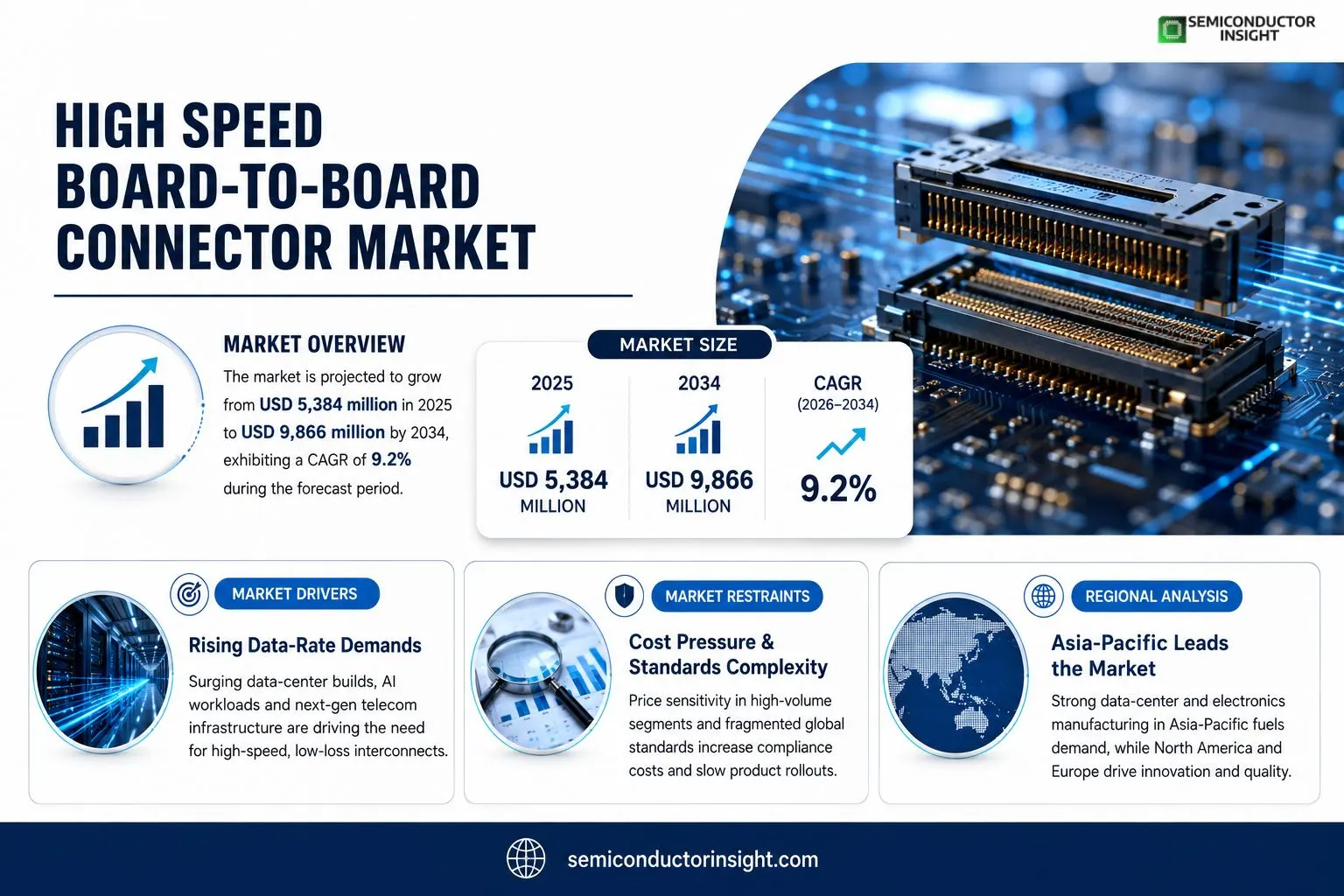
High Speed Board-to-Board Connector market size was valued at USD 5,384 million in 2025 and will grow to USD 9,866 million by 2034, reflecting a CAGR of 9.2% over the period.
High Speed Board-to-Board Connector is a high‑density interconnection device designed to enable rapid signal and power transmission between printed circuit boards in compact electronic systems. It serves data centers and communication base stations where signal integrity, low loss and mechanical precision are essential. Key advantages include wide transmission bandwidth, low impedance, strong electromagnetic shielding and dependable mating stability.The expansion is fueled by data‑center proliferation, AI computing workloads and next‑generation telecom infrastructure that demand higher bandwidth and lower insertion loss. At the same time, increasing PCB layering complexity and thermal constraints push manufacturers toward tighter impedance control and enhanced shielding performance. Leading suppliers such as Amphenol Corporation, TE Connectivity, ITT Cannon and JAE Electronics are broadening their portfolios to satisfy these requirements.
MARKET DRIVERS
Rising Data‑Rate Demands
Servers and high‑performance computing platforms are pushing signaling speeds beyond 25 Gb/s, forcing designers to adopt interconnects that preserve integrity across dense PCB stacks. High Speed Board-to-Board Connector Market benefits because manufacturers that can deliver low‑loss, impedance‑controlled solutions become indispensable partners in these architectures.
Miniaturization & System Complexity
Mobile, automotive and aerospace devices continue to shrink while integrating more functions per module. This trend translates into tighter pitch requirements and the need for stacks of multiple connectors within a limited footprint. Companies that engineer robust, space‑efficient designs are gaining traction among OEMs seeking to reduce weight and assembly steps.
➤ “Design teams that embed high‑speed connector expertise early in product development cut time‑to‑market by up to 20 %.”
Strategic collaborations between connector suppliers and semiconductor firms are amplifying these effects, as co‑engineered solutions align electrical performance with emerging packaging technologies.
MARKET CHALLENGES
Cost Pressure in High‑Volume Segments
While performance specifications tighten, price‑sensitive consumer electronics demand aggressive margin management. Supplier pricing models that rely on premium materials can clash with OEM cost targets, prompting a search for cost‑effective alternatives without compromising signal fidelity.
Other Challenges
Supply Chain Volatility
Raw‑material shortages and logistics bottlenecks have introduced lead‑time uncertainty. Manufacturers that diversify sourcing and invest in inventory buffers are better positioned to honor delivery commitments.
MARKET RESTRAINTS
Regulatory & Standards Fragmentation
Compliance with divergent regional standardsranging from automotive safety certifications to aerospace electromagnetic compatibility rulesadds engineering overhead. The necessity to certify each connector variant slows product rollout and inflates development budgets, tempering market pace.
MARKET OPPORTUNITIES
AI Edge & Autonomous Systems
Edge‑AI processors and autonomous vehicle controllers rely on dense, high‑bandwidth interconnects to move data between sensors, compute modules and power‑management units. The emerging demand for rugged, low‑latency connectors creates a niche where innovative materials and 3D‑stacked architectures can capture premium market share.
High Speed Board-to-Board Connector Market Trends
Data‑Center Expansion Accelerates Connector Adoption
High Speed Board-to-Board Connector Market is set to reach US$9.9 billion by 2034, up from US$5.4 billion in 2025. The surge stems from the relentless scaling of cloud workloads and AI‑driven compute clusters, which demand interconnects capable of handling 25 Gbps‑plus data rates with minimal loss. In 2025, manufacturers produced roughly 737 million units at an average price of USD 8, delivering a gross margin of about 35 percent. Capacity utilization hovered at 80 percent, indicating that factories are operating near optimal throughput yet still retain headroom for incremental volume. As server chassis become denser and PCB layering deepens, the need for precision‑aligned, low‑impedance connectors grows proportionally, compelling OEMs to source higher‑performance parts.
Other Trends
Thermal Management and Signal Integrity Challenges
Elevated power densities in modern data‑center racks and telecom base stations intensify thermal stress on interconnects. Designers are therefore prioritizing copper alloys with superior conductivity and engineering plastics that sustain mechanical stability under temperature excursions. Enhanced electromagnetic shielding, achieved through multilayered shielding foils, mitigates crosstalk that can otherwise degrade high‑frequency signals. These engineering refinements translate into lower insertion loss and tighter impedance control, attributes that end‑users value when building next‑generation networking equipment. Suppliers that invest in rigorous reliability validation gain a competitive edge, as customers seek assurance that connectors will survive the thermal cycling inherent to 24/7 operation.
Geographic Shift and Supplier Consolidation
Asia‑Pacific accounts for the largest share of High Speed Board-to-Board Connector Market, driven by the concentration of data‑center builds in China, Japan, and South Korea. Meanwhile, North American and European operators are reshaping their supply chains to reduce lead times, prompting a wave of mergers among mid‑size distributors and a tightening of relationships with key upstream providers such as Freeport‑McMoRan and BASF. This consolidation reduces pricing volatility and streamlines logistics, enabling end‑users to lock in component costs as they scale out new infrastructure. Companies that can align their engineering roadmaps with regional rollout schedules stand to capture incremental revenue while mitigating exposure to geopolitical supply disruptions.
COMPETITIVE LANDSCAPE
Key Industry Players
High Speed Board-to-Board Connector Competitive Overview
Amphenol Corporation dominates the high‑speed board‑to‑board segment, leveraging a broad portfolio that spans vertical, horizontal and stacking configurations. Its extensive footprint, strong relationships with OEMs in data‑center and telecom infrastructure, and sustained investment in precision‑alignment tooling give it a pricing advantage and enable economies of scale. The company’s ability to integrate copper and advanced polymer assemblies from upstream suppliers such as Freeport‑McMoRan and BASF underpins a margin profile that outpaces many peers, reinforcing its role as a market bellwether. Competitive pressure is amplified by TE Connectivity’s aggressive expansion into 25‑56 Gbps product lines, which has prompted a modest reshuffling of market share among the top five firms.The remainder of the landscape is populated by a mix of specialist manufacturers and regional challengers. European firms like Smiths Interconnect and Souriau focus on niche applications requiring ultra‑low insertion loss, while French players Nicomatic and Axon’ Cable differentiate through modular, space‑constrained designs for aerospace and defense. Asian contributors such as JAE Electronics, Hosiden Corporation, Jonhon Optronic Technology, Guizhou Space Appliance and Sichuan Huafeng Technology benefit from proximity to high‑density PCB assemblers, allowing rapid iteration on impedance‑control innovations. Smaller but technically adept companies – Glenair, Omnetics Connector, ITT Cannon and a host of emerging Chinese suppliers – capture specific verticals such as automotive and industrial control, where customization and short lead‑times are paramount.
List of Key High Speed Board-to-Board Connector Companies Profiled
- Amphenol Corporation
- TE Connectivity
- ITT Cannon
- Glenair
- Omnetics Connector
- AirBorn
- Smiths Interconnect
- Souriau
- Nicomatic
- Axon’ Cable
- JAE Electronics
- Hosiden Corporation
- Jonhon Optronic Technology
- Guizhou Space Appliance
- Sichuan Huafeng Technology
Segment Analysis:
| Segment Category | Sub-Segments | Key Insights |
| By Type |
|
Vertical Connector is gaining traction due to its superior alignment precision and ability to support dense routing in high‑performance computing platforms.
|
| By Application |
|
Data Center remains the dominant application, driven by ever‑increasing bandwidth requirements and the shift to blade‑type server architectures.
|
| By End User |
|
Server Manufacturers prioritize connectors that ensure reliable high‑frequency performance across densely populated boards.
|
| By Data Rate |
|
25‑56 Gbps segment is emerging as the preferred bandwidth envelope for next‑generation compute platforms.
|
| By Contact Pitch |
|
0.5‑1 mm Pitch is the sweet spot for most high‑density board designs, balancing manufacturability with performance.
|
Regional Analysis: High Speed Board-to-Board Connector Market
North America
R&D initiatives in Silicon Valley are pivoting toward heterogeneous integration, where high‑speed board‑to‑board connectors become the backbone for multi‑chip modules. Collaborative programs between universities and leading silicon manufacturers accelerate prototype turnaround, encouraging early adoption of connector designs that support emerging protocols such as Compute Express Link (CXL). This wave of innovation is reshaping product roadmaps across aerospace and telecommunications.
Recent geopolitical shifts have motivated North American firms to diversify sourcing, favouring domestic or near‑shore component manufacturers. This strategic pivot reduces lead‑time volatility and offers greater visibility into material quality, which is critical for connectors that must meet stringent signal‑integrity requirements. Companies that have formalised multi‑tier supplier agreements are better positioned to absorb demand spikes.
Consistency in standards across the United States, Canada, and Mexico simplifies certification pathways for high‑speed interconnects. The Federal Communications Commission’s recent guidance on electromagnetic compatibility (EMC) for high‑frequency devices streamlines compliance testing, allowing manufacturers to bring products to market more efficiently.
OEMs in the automotive and data‑center sectors are opting for connectors that enable hot‑swappable modules, reducing downtime during upgrades. This preference drives a shift toward plug‑in architectures that combine high‑density routing with robust mechanical locking mechanisms, fostering a cascade of design revisions across the supply chain.
Europe
European manufacturers are leveraging the region’s strong emphasis on sustainability to develop connectors that incorporate recyclable materials while maintaining signal fidelity. Initiatives such as the European Chips Act provide funding that encourages small‑medium enterprises to collaborate on high‑speed interconnect prototypes. The automotive sector, particularly in Germany and France, is prioritising connectors that support electrified powertrains, prompting a subtle redesign of board‑to‑board interfaces to accommodate higher current loads alongside data throughput. Compliance with EU directives on electromagnetic emissions ensures that new products meet rigorous benchmarks, which in turn builds confidence among downstream system integrators.
Asia‑Pacific
In Asia‑Pacific, the market is buoyed by rapid expansion of 5G infrastructure and the scaling of consumer electronics manufacturing. Countries such as South Korea and Taiwan have established dedicated foundry lines capable of producing micro‑via interconnects that meet the demanding bandwidth expectations of next‑generation smartphones. Meanwhile, China’s push toward semiconductor self‑sufficiency fuels investments in domestic connector design capabilities, reducing reliance on imported components. However, divergent regulatory standards across the region require manufacturers to maintain flexible design libraries to satisfy varied certification requirements.
South America
South American adoption of high‑speed board‑to‑board connectors is closely linked to the growth of renewable‑energy projects, where inverter modules demand reliable high‑frequency signal paths. Brazil’s emerging semiconductor ecosystem is beginning to supply niche connector solutions tailored for local energy‑grid upgrades. While overall market size remains modest, strategic partnerships between regional distributors and OEMs are establishing distribution channels that could accelerate market penetration as infrastructure projects mature.
Middle East & Africa
The Middle East & Africa region sees incremental demand driven by data‑center construction in the Gulf Cooperation Council nations and a nascent aerospace sector in South Africa. Investors are allocating capital to low‑latency networking equipment, prompting a need for board‑to‑board solutions that sustain high data rates across dense server farms. Local standards bodies are aligning with international EMC guidelines, which eases the entry of ly certified connectors. Although the market is still in its early stages, the combination of infrastructure spending and alignment with standards creates a foundation for future growth.
Report Scope
This market research report provides a comprehensive analysis of the High Speed Board-to-Board Connector Market , covering the forecast period 2026–2034. It offers detailed insights into market dynamics, technological advancements, competitive landscape, and key trends shaping the industry.
Key focus areas of the report include:
- Market Overview: The report begins with an overview outlining its current market scenario, key growth indicators, and industry transformation drivers. It discusses macroeconomic factors, demand–supply balance, regulatory landscape, and the strategic role of semiconductors in powering advancements across industries such as automotive, telecommunications, consumer electronics, and industrial automation.
- Market Size & Forecast: Historical data and future projections for revenue, unit shipments, and market value across major regions and segments.
- Segmentation Analysis: Detailed breakdown by product type, technology, application, and end-user industry to identify high-growth segments and investment opportunities.
- Regional Insights: Insights into market performance across North America, Europe, Asia-Pacific, Latin America, and the Middle East & Africa, including country-level analysis where relevant.
- Competitive Landscape: Profiles of leading market participants, including their product offerings, R&D focus, manufacturing capacity, pricing strategies, and recent developments such as mergers, acquisitions, and partnerships.
- Technology Trends & Innovation: Assessment of emerging technologies, integration of AI/IoT, semiconductor design trends, fabrication techniques, and evolving industry standards.
- Market Drivers & Restraints: Evaluation of factors driving market growth along with challenges, supply chain constraints, regulatory issues, and market-entry barriers.
- Stakeholder Insights: Insights for component suppliers, OEMs, system integrators, investors, and policymakers regarding the evolving ecosystem and strategic opportunities.
Primary and secondary research methods are employed, including interviews with industry experts, data from verified sources, and real-time market intelligence to ensure the accuracy and reliability of the insights presented.
FREQUENTLY ASKED QUESTIONS:
What is the current market size of High Speed Board-to-Board Connector Market?
-> High Speed Board-to-Board Connector Market was valued at USD 5,384 million in 2025 and is expected to reach USD 9,866 million by 2034.
Which key companies operate in High Speed Board-to-Board Connector Market?
-> Key players include Amphenol Corporation, TE Connectivity, ITT Cannon, Glenair, Omnetics Connector, AirBorn, Smiths Interconnect, Souriau, Nicomatic, Axon’ Cable, JAE Electronics, Hosiden Corporation, Jonhon Optronic Technology, Guizhou Space Appliance, and Sichuan Huafeng Technology, among others.
What are the key growth drivers?
-> Key growth drivers include rapid data‑center expansion, increasing AI and cloud computing workloads, the need for higher bandwidth and lower insertion loss, and the evolution of telecom base‑station infrastructure demanding advanced high‑frequency interconnects.
Which region dominates the market?
-> Asia‑Pacific leads the market in terms of volume and growth, while North America and Europe remain significant contributors.
What are the emerging trends?
-> Emerging trends include enhanced electromagnetic shielding, tighter impedance control, adoption of finer contact pitches, and integration of thermal‑management solutions to support higher data‑rate applications.
Get Sample Report PDF for Exclusive Insights
Report Sample Includes
- Table of Contents
- List of Tables & Figures
- Charts, Research Methodology, and more...
 Download Sample Report PDF