Slim Board-to-Board Connector Market Insights
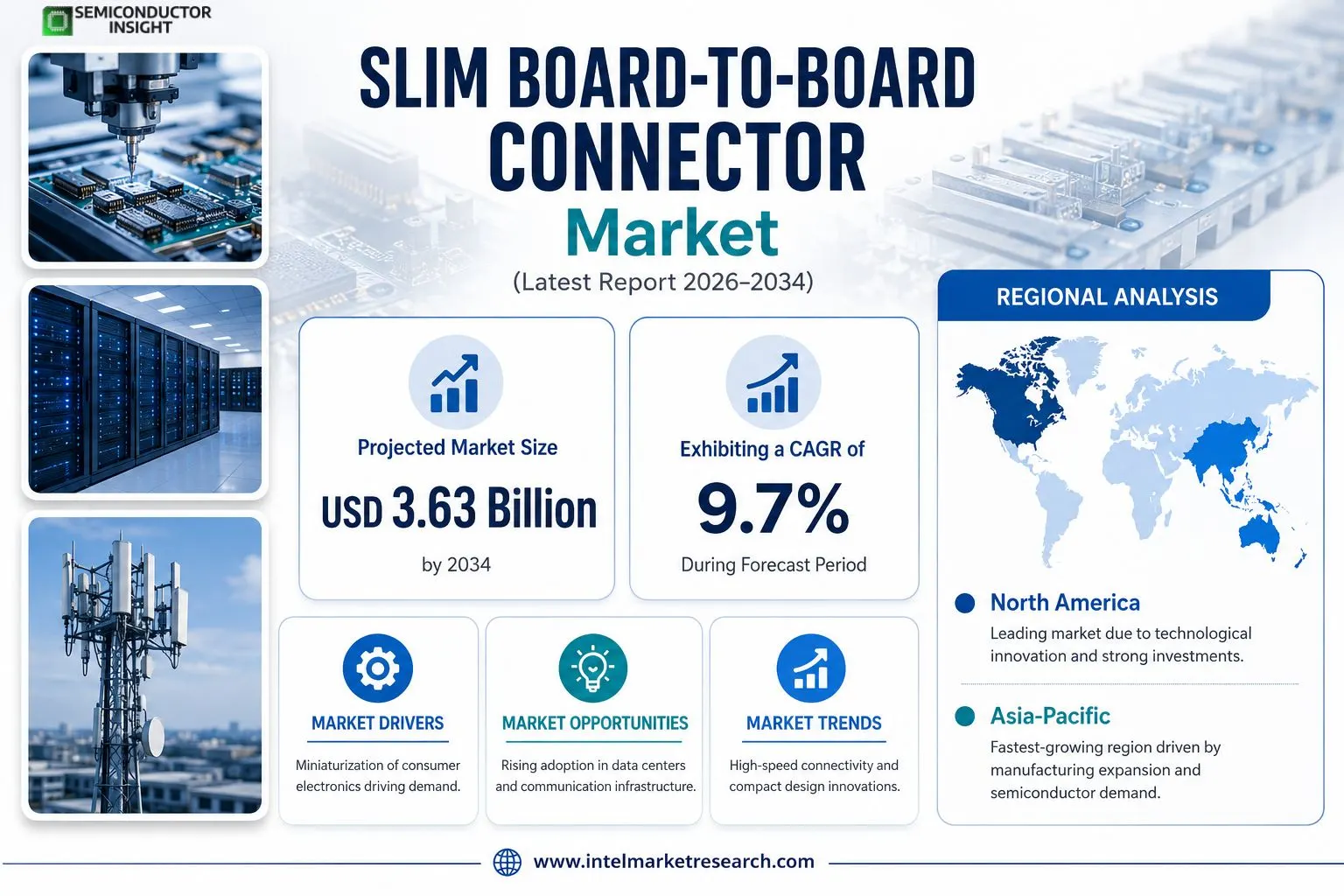
Slim Board-to-Board Connector market size was valued at USD 1909 million in 2025. The market is projected to reach USD 3631 million by 2034, exhibiting a CAGR of 9.7% during the forecast period.
Slim Board-to-Board Connector is a compact interconnection device designed for ultra‑thin electronic assemblies, enabling reliable high‑speed signal and power transmission between stacked printed circuit boards in space‑constrained systems. It is widely used in data centers and communication base stations where miniaturization, high integration density, and signal integrity are critical.The product delivers reduced vertical height, stable electrical performance, high mechanical precision and strong electromagnetic compatibility, making it suitable for next‑generation high‑density electronic architectures.
MARKET DRIVERS
Miniaturization of Consumer Electronics
The relentless push toward thinner smartphones, wearables, and portable medical devices has forced designers to seek interconnect solutions that consume minimal board real‑estate. Slim Board-to-Board Connector Market offerings, with heights often below 0.5 mm, enable manufacturers to compress component layouts without sacrificing signal integrity. This engineering compromise directly translates into sleeker product form‑factors that meet consumer expectations for comfort and aesthetics.
Demand for High‑Speed Data Transfer
Emerging standards such as USB 4.0, PCIe 5.0, and automotive Ethernet demand connectors that can sustain multi‑gigabit bandwidth while maintaining a low profile. Suppliers that embed differential pair routing and robust shielding in slim architectures are seeing preference from OEMs that cannot afford the space penalties of traditional mezzanine connectors. The market therefore rewards designs that marry high‑frequency performance with a reduced vertical footprint.
➤ “Design teams are prioritizing connectors that shrink board thickness by up to 30 % while preserving 10 Gbps data rates.” – Industry analyst briefing, 2024
These dynamics compel system integrators to reevaluate bill‑of‑materials costs. By adopting slimmer board‑to‑board solutions, they often offset higher unit prices with savings in enclosure machining, cooling infrastructure, and assembly time, delivering an overall net‑positive impact on product margins.
MARKET CHALLENGES
Manufacturing Tolerances and Yield Rates
Achieving sub‑0.5 mm thickness while preserving consistent contact force across thousands of pins stretches current solder and plating processes. Small deviations in wire‑bond spacing can trigger intermittent failures, prompting manufacturers to impose stricter in‑line inspections that raise production overhead.
Other Challenges
Supply‑Chain Volatility
Fluctuating availability of high‑purity copper and specialty alloys creates lead times that extend beyond typical component orders, pressuring OEMs to hold safety stock or redesign for alternate materials.
MARKET RESTRAINTS
Cost Sensitivity in High‑Volume Segments
While slim connectors deliver board‑space savings, their unit cost remains above that of conventional through‑hole or larger surface‑mount alternatives. For commodity productssuch as entry‑level smartphonesprice elasticity forces buyers to prioritize cost over marginal size reductions.In addition, the engineering effort required to redesign existing footprints for ultra‑low‑profile parts can be non‑trivial. Companies must allocate design resources and validation cycles that may not be justifiable when projected volume growth is modest.
MARKET OPPORTUNITIES
Expansion into Automotive ADAS Platforms
Advanced driver‑assistance systems (ADAS) rely on dense sensor arrays and high‑speed communication buses. The interior architecture of electric vehicles increasingly mirrors that of consumer electronics, where every millimeter counts. Deploying Slim Board-to-Board Connector Market solutions within these platforms can free up chassis space for battery modules or cooling pathways, creating a compelling value proposition for OEMs.Regulatory trends encouraging lighter vehicle weight amplify the incentive to adopt low‑profile interconnects. As safety‑critical modules demand both reliability and compactness, suppliers that certify automotive‑grade slim connectors stand to capture a growing slice of the automotive electronics spend.
Slim Board-to-Board Connector Market Trends
Miniaturization Fuels Demand for Ultra‑Thin Connectors
The push for ever‑smaller electronic footprints is reshaping component specifications across data‑center racks and telecom base stations. Designers now target vertical clearances measured in fractions of a millimeter, and the Slim Board-to-Board Connector emerges as the preferred interconnect because it preserves high‑speed signal fidelity while shedding bulk. Production volumes have risen in line with the proliferation of AI‑intensive workloads, where every millimeter of board stack height translates into measurable thermal and power‑budget savings. For manufacturers, this translates into tighter tolerances on stamping accuracy and more rigorous impedance‑control protocols, because any deviation is amplified in densely packed stacks.
Other Trends
Supply Chain Shifts Toward Advanced Materials
Upstream, the reliance on copper and high‑performance engineering plastics has intensified competition among raw‑material providers such as Freeport‑McMoRan and BASF. Buyers are negotiating longer‑term contracts to secure consistent conductivity and dimensional stability, especially as operating frequencies climb above 25 GHz. The resulting economies of scale have nudged the average unit price down modestly, while margin compression hovers around the mid‑30 percent range. Meanwhile, midstream firms are investing in precision‑alignment equipment that can consistently achieve sub‑10 µm placement, a capability that differentiates market leaders from fringe players.
Performance Pressures Drive Engineering Innovation
As signal rates accelerate, the electromagnetic compatibility of the Slim Board-to-Board Connector becomes a decisive factor for system reliability. Engineers are integrating advanced simulation tools to validate high‑frequency behavior before tooling, thereby shortening time‑to‑market. The heightened focus on thermal stability has also spurred the adoption of low‑CTE substrates, ensuring that the connector maintains its mechanical integrity across the wide temperature swings typical of telecom outdoor sites. Downstream customersincluding major telecom OEMsare now specifying tighter bulk‑current‑capacity limits, prompting suppliers to refine contact geometry and surface‑finish treatments. These technical refinements not only address current performance gaps but also lay the groundwork for the next generation of densely stacked compute modules.
COMPETITIVE LANDSCAPE
Key Industry Players
Competitive Overview of Slim Board-to-Board Connector Market
Amphenol Corporation dominates the upper tier of the market, leveraging a broad portfolio that spans high‑density data‑center interconnects and telecom‑base‑station modules. Its extensive engineering plastics expertise and aggressive investment in ultra‑thin stamping capability have allowed it to lock in major OEMs such as Huawei and Cisco, securing a stable revenue stream that dwarfs most rivals. TE Connectivity follows closely, differentiating through a supply chain that integrates copper sourcing from Freeport‑McMoRan with in‑house impedance‑control platforms. Both firms command sizable design‑wins in the 10‑25 Gbps segment, where mechanical precision and thermal stability are decisive. The duopoly shapes market structure by setting price benchmarks and dictating compliance standards, forcing niche players to specialize either in ultra‑high‑frequency (>25 Gbps) solutions or in cost‑effective volume offerings for emerging Asian data‑center expansions.Beyond the two giants, a constellation of specialized manufacturers sustains competitive pressure. ITT Cannon and Glenair concentrate on ruggedized connectors for telecom infrastructure, emphasizing mechanical repeatability that meets stringent aerospace certifications. Omnetics and AirBorn carve out niches in aerospace and defense by pairing micro‑pitch contact technology with aggressive margin management. European firms such as Smiths Interconnect, Souriau, Nicomatic, and Axon’ Cable exploit advanced engineering plastics to target the automotive and industrial‑control segments, where EMI performance trumps raw bandwidth. Asian challengersJAE Electronics, Hosiden Corporation, Jonhon Optronic Technology, Guizhou Space Appliance, and Sichuan Huafeng Technologyare rapidly scaling production capacity, aiming to capture the low‑cost, high‑volume tier that serves next‑generation data‑center farms in China and Southeast Asia.
List of Key Slim Board-to-Board Connector Companies Profiled
- Amphenol Corporation
- TE Connectivity
- ITT Cannon
- Glenair
- Omnetics Connector
- AirBorn
- Smiths Interconnect
- Souriau
- Nicomatic
- Axon’ Cable
- JAE Electronics
- Hosiden Corporation
- Jonhon Optronic Technology
- Guizhou Space Appliance
- Sichuan Huafeng Technology
Segment Analysis:
| Segment Category | Sub-Segments | Key Insights |
| By Type |
|
Surface Mount Type is widely embraced because it fits the ultra‑thin design ethos, delivers reliable high‑speed signal paths, and simplifies automated assembly. • Enables tighter PCB stacking while preserving signal integrity. • Supports precise impedance control essential for high‑frequency operation. • Aligns with the trend toward fully automated surface‑mount production lines, reducing manual handling risks. |
| By Application |
|
Data Center architectures dominate because they demand maximal integration density and impeccable signal fidelity. • Slim connectors shrink vertical envelope, freeing valuable rack space. • High mechanical precision mitigates vibration‑induced failures in dense server farms. • Robust electromagnetic compatibility supports ever‑increasing data throughput demands. |
| By End User |
|
Enterprise IT departments value the connectors for their ability to sustain high‑speed interconnects in compact server blades. • Reduces overall system footprint, aiding data‑center densification strategies. • Enhances thermal management by limiting vertical stack height. • Provides dependable performance under continuous high‑load operation. |
| By Data Rate |
|
High data‑rate solutions are pivotal as emerging architectures push signal frequencies ever higher. • Require meticulous impedance matching to avoid signal distortion. • Benefit from the connector’s stable electrical performance under fast switching conditions. • Drive continuous refinement of stamping accuracy and material stability. |
| By Contact Pitch |
|
Very fine pitch configurations underpin the push toward denser interconnect arrays. • Allow more contacts within a limited area, increasing functionality per board. • Necessitate precise alignment mechanisms to maintain reliable connections. • Enhance overall system miniaturization while preserving electrical performance. |
Regional Analysis: Slim Board-to-Board Connector Market
Asia-Pacific
China remains the nucleus of volume output, leveraging mature PCB fabs and a deep bench of component assemblers. Japan and South Korea focus on high‑precision, low‑volume runs for premium applications, while Taiwan supplies a blend of both, balancing scale with stringent quality controls.
Regional R&D centers prioritize miniaturization, pushing connector pitch below 0.5 mm. Collaborative projects between universities and industry accelerators generate proprietary locking mechanisms that simplify assembly in tight enclosures.
Harmonized standards under IEC and RoHS are enforced rigorously, prompting suppliers to certify material compliance early. This reduces redesign cycles for downstream OEMs seeking market entry across multiple Asian economies.
The diversification of sourcing to Vietnam and the Philippines cushions the region against geopolitical disruptions, while strategic stockpiling of key alloys ensures continuity for high‑frequency signal paths.
North America
In North America, Slim Board-to-Board Connector Market is anchored by a mature design ecosystem that values reliability and certification depth. U.S. OEMs often require extensive testing records, which steers suppliers toward offering comprehensive validation services. The automotive sector, especially electric‑vehicle platforms, is nudging manufacturers to produce connectors that reconcile high‑speed data transmission with stringent crash‑safety standards. Canadian firms add a layer of cold‑climate performance, prompting material choices that resist thermal cycling. Companies that can align product portfolios with these nuanced specifications are positioned to lock in long‑term contracts with tier‑one suppliers.
Europe
European manufacturers exhibit a pronounced preference for modularity and lifecycle support. The automotive and industrial automation markets demand connectors that can be easily upgraded without redesigning the entire board stack‑up. Regulatory pressures, such as the EU’s Restriction of Hazardous Substances (RoHS) updates, force vendors to adopt lead‑free alloys and recyclable substrates. German and French design houses, in particular, are integrating digital twins into the validation phase, allowing virtual stress testing before physical prototypes are built. Firms that embed these simulation capabilities into their sales process gain a competitive edge.
South America
South America’s market trajectory is shaped by cost‑sensitivity and gradual adoption of advanced electronics. Brazil’s growing consumer‑electronics assembly sector is the primary catalyst, yet it still contends with import‑tariff structures that influence pricing strategies. Local distributors favor connectors that combine ease of soldering with robust mechanical retention, reducing field failures. While the overall volume remains modest, niche applications in agricultural machinery and renewable‑energy installations are prompting a modest shift toward higher‑density interconnects.
Middle East & Africa
The Middle East & Africa region is characterized by a mix of high‑value projects in aerospace and defense alongside emerging telecom infrastructure upgrades. Countries such as the United Arab Emirates invest heavily in smart‑city initiatives, where compact board‑to‑board solutions enable tighter packaging of edge‑computing modules. Meanwhile, African markets are still in the early adoption phase, with emphasis on ruggedized connectors that tolerate dust and temperature extremes. Partnership models that include on‑site technical support are increasingly important for gaining market trust.
Report Scope
This market research report provides a comprehensive analysis of the Slim Board-to-Board Connector Market , covering the forecast period 2026–2034. It offers detailed insights into market dynamics, technological advancements, competitive landscape, and key trends shaping the industry.
Key focus areas of the report include:
- Market Overview: The report begins with an overview outlining its current market scenario, key growth indicators, and industry transformation drivers. It discusses macroeconomic factors, demand–supply balance, regulatory landscape, and the strategic role of semiconductors in powering advancements across industries such as automotive, telecommunications, consumer electronics, and industrial automation.
- Market Size & Forecast: Historical data and future projections for revenue, unit shipments, and market value across major regions and segments.
- Segmentation Analysis: Detailed breakdown by product type, technology, application, and end-user industry to identify high-growth segments and investment opportunities.
- Regional Insights: Insights into market performance across North America, Europe, Asia-Pacific, Latin America, and the Middle East & Africa, including country-level analysis where relevant.
- Competitive Landscape: Profiles of leading market participants, including their product offerings, R&D focus, manufacturing capacity, pricing strategies, and recent developments such as mergers, acquisitions, and partnerships.
- Technology Trends & Innovation: Assessment of emerging technologies, integration of AI/IoT, semiconductor design trends, fabrication techniques, and evolving industry standards.
- Market Drivers & Restraints: Evaluation of factors driving market growth along with challenges, supply chain constraints, regulatory issues, and market-entry barriers.
- Stakeholder Insights: Insights for component suppliers, OEMs, system integrators, investors, and policymakers regarding the evolving ecosystem and strategic opportunities.
Primary and secondary research methods are employed, including interviews with industry experts, data from verified sources, and real-time market intelligence to ensure the accuracy and reliability of the insights presented.
FREQUENTLY ASKED QUESTIONS:
What is the current market size of Slim Board-to-Board Connector Market?
->Slim Board-to-Board Connector Market was valued at USD 1909 million in 2025 and is expected to reach USD 3631 million by 2034 at a CAGR of 9.7% during the forecast period.
Which key companies operate in Slim Board-to-Board Connector Market?
-> Key players include Amphenol Corporation, TE Connectivity, ITT Cannon, Glenair, Omnetics Connector, AirBorn, Smiths Interconnect, Souriau, Nicomatic, Axon’ Cable, JAE Electronics, Hosiden Corporation, Jonhon Optronic Technology, Guizhou Space Appliance, Sichuan Huafeng Technology, among others.
What are the key growth drivers?
-> Key growth drivers include the rapid expansion of data centers and communication base stations, rising AI workloads, demand for ultra‑thin high‑density interconnect solutions, and the ongoing trend toward system miniaturization.
Which region dominates the market?
-> Asia is the dominant region, driven by extensive data‑center deployments and telecom infrastructure growth.
What are the emerging trends?
-> Emerging trends include enhanced stamping accuracy, advanced impedance control, higher mechanical precision, and improved thermal stability to support higher‑frequency operation and tighter PCB stacking.

Get Sample Report PDF for Exclusive Insights
Report Sample Includes
- Table of Contents
- List of Tables & Figures
- Charts, Research Methodology, and more...
 Download Sample Report PDF