RF and Coaxial Connectors Market Insights
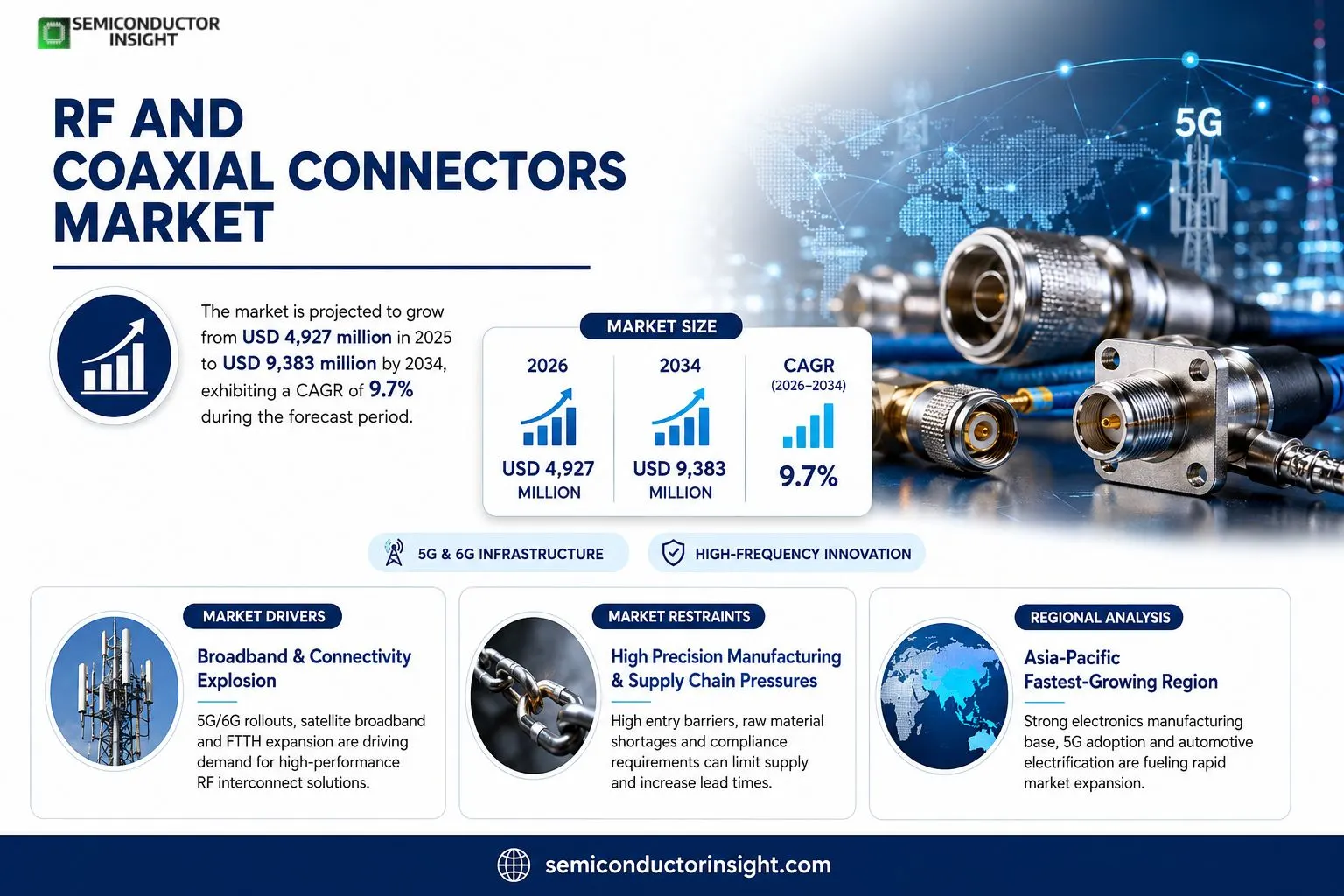
RF and Coaxial Connectors market size was valued at USD 4,927 million in 2025. The market is projected to grow from USD 4,927 million in 2025 to USD 9,383 million by 2034, exhibiting a CAGR of 9.7% during the forecast period.
RF and coaxial connectors are precision interconnect components used for signal transmission from the megahertz range to millimeter‑wave frequencies. Their core role is to maintain stable impedance, low insertion loss, low return loss, effective shielding, and long‑term mechanical reliability across board‑side, cable‑side, panel‑side, module‑side,and equipment‑side interfaces so that RF links in wireless communications, test & measurement, automotive electronics, consumer terminals, industrial equipment,and aerospace systems can be connected reliably,serviced efficiently,and manufactured at scale.The market is experiencing growth due to several factors,including expanding 5G‑Advanced deployments,increasing vehicle intelligence content,rising demand for high‑frequency test equipment,and broader adoption of miniaturizedand automotive‑specific connector families such as FAKRAandU.FL.Recent developments include Amphenol’s launch of a new 1.85 mm millimeter‑wave series in March 2024and TE Connectivity’s acquisition of a micro‑coax supplier in July 2024.Rosenberger,Huber+Suhner,Hirose,Radiall,and other key players continue to broaden portfolios with adapters,cable assemblies,and custom solutions.
MARKET DRIVERS
Broadband Infrastructure Expansion
The rollout of 5G networks and fiber‑to‑the‑home projects has heightened demand for high‑frequency interconnects. **RF and Coaxial Connectors Market** participants are witnessing a surge in orders as telecom operators replace legacy copper links with robust connector assemblies capable of supporting gigahertz‑level signals.
Automation and Industrial IoT Adoption
Manufacturers of robotics, sensors, and edge‑computing devices increasingly rely on miniature RF connectors to maintain signal integrity in compact enclosures. The push toward smarter factories translates into higher unit volumes and a willingness to pay premium for connectors with tighter tolerances.
➤ Connector manufacturers that diversify material portfoliosintroducing low‑loss ceramic and PTFE variantsare capturing a larger share of the growth tied to high‑frequency applications.
Finally, the acceleration of satellite constellations for broadband delivery creates niche demand for space‑qualified coaxial assemblies. Suppliers that can certify their products against stringent thermal‑vacuum cycles are positioned to benefit from contracts worth tens of millions of dollars.
MARKET CHALLENGES
Supply‑Chain Vulnerabilities
shortages of high‑purity copper and specialty alloys have forced many OEMs to extend lead times. When material costs climb, manufacturers often face a dilemma between absorbing margins and passing price hikes to end users, which can dampen order growth.
Other Challenges
Regulatory Compliance
Stringent electromagnetic‑compatibility (EMC) standards in Europe and North America compel designers to select connectors with documented shielding performance, adding engineering overhead and limiting the pool of qualifying suppliers.
MARKET RESTRAINTS
High Entry Cost for Precision Manufacturing
Establishing a line capable of producing connectors with micron‑level dimensional control requires substantial capital investment in CNC equipment and clean‑room facilities. Small and mid‑size firms often lack the financial bandwidth, resulting in market concentration among a few large players and limiting competitive pricing.
MARKET OPPORTUNITIES
Emerging Automotive Radar Systems
Advanced driver‑assistance systems (ADAS) and autonomous‑vehicle platforms depend on millimeter‑wave radar modules that operate at 77 GHz and above. This frequency band demands connectors with ultra‑low insertion loss, opening a niche where specialized manufacturers can secure long‑term supply agreements with automotive Tier‑1 suppliers.
RF and Coaxial Connectors Market Trends
Shift Toward Higher Frequency and Miniaturization
The industry is moving away from legacy BNC, TNC and N families toward connectors that can sustain performance above 40 GHz and, increasingly, beyond 110 GHz. This shift is fueled by the rollout of advanced wireless generations, satellite broadband constellations and high‑frequency test equipment that require tighter VSWR control and lower insertion loss. At the same time, manufacturers are introducing ultra‑compact interfaces such as U.FL, MHF and AMC to satisfy space‑constrained modules in smartphones and IoT devices. The growing presence of electric‑drive vehicles adds a layer of automotive‑specific requirements, prompting the adoption of coded FAKRA and Mini‑FAKRA solutions that combine keying, locking and vibration resistance. Collectively, these forces shape a development path where frequency ceiling, dielectric engineering and mechanical miniaturization dominate product road‑maps, positioning RF and Coaxial Connectors Market as a critical enabler for next‑generation connectivity. European firms continue to dominate high‑end test applications, while East Asian players excel in rapid scaling of miniaturized automotive parts, creating a balanced competitive landscape.
Other Trends
Automotive Interface Evolution
Automotive connectivity is transitioning from generic RF interfaces to purpose‑built modules that survive harsh under‑hood conditions. The adoption of FAKRA and Mini‑FAKRA families reflects a shift toward keyed connectors that prevent mis‑mating while delivering repeatable impedance across a broad temperature range. Recent vehicle designs integrate these parts directly onto antenna modules, reducing cable harness length and improving overall system reliability. Suppliers are also bundling adapters and pre‑terminated cable assemblies to meet OEM demands for rapid integration and lower assembly cost. This combined approach not only elevates the perceived value of each part but also creates a recurring revenue stream linked to vehicle model refresh cycles.
Diversified Business Models and Solution Integration
On the supply side, manufacturers are augmenting pure catalog sales with engineered solutions that include cable assemblies, adapters, tooling and custom development services. This hybrid model responds to diversified end‑user expectations across telecom, test equipment and automotive sectors, where buyers seek a single source that can guarantee performance, simplify logistics and reduce total cost of ownership. Companies that can align design‑for‑manufacturability with high‑frequency material expertise are gaining pricing leverage, especially in regions where high‑reliability test markets dominate. Consequently, RF and Coaxial Connectors Market is evolving from a commoditized component segment into a platform that underpins broader signal‑chain strategies, prompting both incumbents and new entrants to invest in expanded product matrices and value‑added services. In addition, the migration toward automated assembly lines is encouraging suppliers to offer fully tested connector modules, further blurring the line between component and system.
COMPETITIVE LANDSCAPEKey Industry Players
RF and Coaxial Connectors: Competitive Overview
The market is anchored by a handful of multinational firms that command the majority of high‑frequency, high‑reliability segments. Rosenberger, TE Connectivity and Huber+Suhner each operate extensive design‑to‑manufacturing networks, allowing them to offer end‑to‑end solutions that span catalog parts, custom cable assemblies, and tooling kits. Their breadth of product familiesfrom legacy N and SMA connectors to millimeter‑wave 1.85 mm interfacesgives them leverage in telecom infrastructure, aerospace and defense procurement where performance specifications are non‑negotiable. Amphenol and Molekule (Molex) complement this tier with a strong presence in automotive and consumer‑electronics supply chains, emphasizing volume‑driven production and rapid iteration cycles. The combined effect of deep engineering expertise, vertically integrated supply bases and long‑standing OEM relationships creates a structural barrier for newcomers seeking to penetrate the premium test‑grade and automotive‑coded connector niches.Beyond the dominant tier, a vibrant cohort of specialized manufacturers fuels differentiation. Hirose, Radiall and I‑PEX (Dai‑Ichi Seiko) focus on miniature and high‑density interfaces such as U.FL and MHF, capitalizing on the relentless push toward smaller modules in 5G‑Advanced smartphones and IoT devices. Companies like Samtec, SMK and Foxconn have carved out niches in blind‑mate and compression‑mount solutions tailored for data‑center and server‑backplane applications. Regional playersincluding Wutong Holding (China), Kingsignal Technology (Taiwan) and Souriau (France)leverage localized engineering hubs to deliver automotive‑grade FAKRA and Mini‑FAKRA connectors that meet stringent durability standards while keeping component costs competitive. This layered ecosystem of giants and agile specialists ensures that buyers can source both commoditized catalog items and highly customized, application‑specific platforms within a single marketplace.
List of Key RF and Coaxial Connectors Companies Profiled
- Rosenberger
- TE Connectivity
- Huber+Suhner
- Amphenol
- Hirose
- Radiall
- I‑PEX (Dai‑Ichi Seiko)
- Molex
- JAE
- Samtec
- SMK
- Foxconn
- Wutong Holding Group Co., Ltd.
- Kingsignal Technology Co., Ltd.
- Souriau
Segment Analysis:
| Segment Category | Sub-Segments | Key Insights |
| By Type |
|
N Connectors remain the leading type because of their balanced performance across a broad frequency range and robust mechanical design.
The combination of high‑frequency capability and proven reliability keeps N connectors at the core of many system architectures. |
| By Application |
|
Wireless Infrastructure drives the most diverse connector requirements due to the rapid rollout of 5G‑Advanced and upcoming 6G networks.
This application’s breadth forces suppliers to innovate across frequency, form‑factor, and protection specifications. |
| By End User |
|
Telecom Equipment Makers prioritize connectors that deliver consistent VSWR control and easy integration into high‑density board layouts.
Their focus on network performance and serviceability shapes many of the market’s product development roadmaps. |
| By Mounting Position |
|
Panel‑Mount Connector has become pivotal as system designers move toward modular, plug‑in architectures.
Its versatility and installation efficiency make it a preferred choice across multiple industries. |
| By Interface Series |
|
Millimeter‑Wave Precision Interface is emerging as the most critical series for next‑generation high‑frequency applications.
Its development reflects the market’s shift toward ever‑higher frequency ceilings and tighter dimensional tolerances. |
Regional Analysis: RF and Coaxial Connectors Market
North America
Military contracts prioritize connectors that can survive extreme temperature cycles and electromagnetic interference. Suppliers that invest in ruggedization testing gain preferential access to classified projects, reinforcing the region’s lead in high‑reliability segments.
The push to densify small‑cell deployments raises the number of high‑frequency interconnects per square kilometer. Manufacturers capable of delivering low‑insertion‑loss connectors at millimeter‑wave bands are positioning themselves as essential infrastructure partners.
Electric vehicles now embed multiple antenna modules for radar, V2X and infotainment. This architectural shift drives a steady climb in demand for compact, high‑performance coaxial solutions that meet automotive grade reliability.
Recent disruptions have prompted OEMs to qualify secondary sources and shorten lead times. Firms that can demonstrate flexible manufacturing footprints are capturing share from risk‑averse customers.
Europe
European demand is shaped by stringent regulatory frameworks and a strong emphasis on sustainable communications infrastructure. The region’s rollout of private LTE networks for industrial campuses fuels interest in connectors that balance bandwidth with environmental durability. Moreover, the automotive sector’s transition toward fully electric platforms encourages designers to adopt miniaturized coaxial assemblies that support multiple sensor arrays. While the market is competitive, suppliers that align with the EU’s circular‑economy directivesoffering recyclable materials and extended product lifecyclesare earning preference among OEMs seeking compliance and cost efficiency.
Asia‑Pacific
Asia‑Pacific’s growth trajectory is propelled by massive urbanization projects and an accelerating rollout of next‑generation mobile networks. Countries such as China, India, and South Korea are investing heavily in smart‑city infrastructure, which in turn expands the need for high‑frequency interconnects in public‑safety and transportation systems. The region also hosts a large manufacturing base for consumer electronics, where demand for compact, cost‑effective connectors remains robust. Strategic partnerships between local assemblers and connector designers are emerging as a way to bridge technology gaps and meet the region’s scale‑driven price expectations.
South America
South America presents a nuanced landscape where telecom expansion coexists with infrastructure modernization in the energy sector. Nations like Brazil and Chile are upgrading satellite‑ground stations and reinforcing broadband penetration in remote areas, creating niche opportunities for ruggedized RF connectors. Simultaneously, the burgeoning renewable‑energy projectsparticularly wind farmsrequire reliable high‑frequency links for monitoring and control, prompting a modest but steady demand for specialty coaxial components.
Middle East & Africa
In the Middle East, sovereign wealth funds are channeling capital into large‑scale data‑center developments and fiber‑to‑the‑home initiatives, both of which rely on high‑performance interconnects. The harsh desert climate drives a preference for connectors with superior corrosion resistance and temperature tolerance. Africa’s telecom sector is caught in a rapid expansion phase, with mobile network operators scaling up to meet rising data consumption. This creates a market for affordable yet reliable connectors, encouraging vendors to establish localized support hubs to overcome logistical challenges.
Report Scope
This market research report provides a comprehensive analysis of the RF and Coaxial Connectors Market , covering the forecast period 2026–2034. It offers detailed insights into market dynamics, technological advancements, competitive landscape, and key trends shaping the industry.
Key focus areas of the report include:
- Market Overview: The report begins with an overview outlining its current market scenario, key growth indicators, and industry transformation drivers. It discusses macroeconomic factors, demand–supply balance, regulatory landscape, and the strategic role of semiconductors in powering advancements across industries such as automotive, telecommunications, consumer electronics, and industrial automation.
- Market Size & Forecast: Historical data and future projections for revenue, unit shipments, and market value across major regions and segments.
- Segmentation Analysis: Detailed breakdown by product type, technology, application, and end-user industry to identify high-growth segments and investment opportunities.
- Regional Insights: Insights into market performance across North America, Europe, Asia-Pacific, Latin America, and the Middle East & Africa, including country-level analysis where relevant.
- Competitive Landscape: Profiles of leading market participants, including their product offerings, R&D focus, manufacturing capacity, pricing strategies, and recent developments such as mergers, acquisitions, and partnerships.
- Technology Trends & Innovation: Assessment of emerging technologies, integration of AI/IoT, semiconductor design trends, fabrication techniques, and evolving industry standards.
- Market Drivers & Restraints: Evaluation of factors driving market growth along with challenges, supply chain constraints, regulatory issues, and market-entry barriers.
- Stakeholder Insights: Insights for component suppliers, OEMs, system integrators, investors, and policymakers regarding the evolving ecosystem and strategic opportunities.
Primary and secondary research methods are employed, including interviews with industry experts, data from verified sources, and real-time market intelligence to ensure the accuracy and reliability of the insights presented.
FREQUENTLY ASKED QUESTIONS:
What is the current market size of RF and Coaxial Connectors Market?
-> RF and Coaxial Connectors Market was valued at USD 4,927 million in 2025 and is expected to reach USD 9,383 million by 2034.
Which key companies operate in RF and Coaxial Connectors Market?
-> Key players include Rosenberger, TE Connectivity, Huber+Suhner, Amphenol, Hirose, Radiall, Telegartner, I‑PEX, Molex, JAE, Samtec, DDK Ltd, SMK, Foxconn, Wutong Holding Group, Souriau, Kingsignal Technology, Jonhon Optronic Technology, Jiangsu Huacan Telecommunication Group, AVIC FORSTAR S&T, Electric Connector Technology, Renhotec, Shenzhen Xinqiyuan Technology, Dongguan Nengsu Electronics, KINSUN Industries, TAIWANCAST INC., WS Conn Inc., CHIN NAN Precision Electronics, Connekt Precision Electronics, Golden Loch Industrial, Emico, Huang Liang, Invax Technologies, GigaLane, WithWave, UBCS, Smiths Interconnect, SV Microwave, Cinch Connectivity Solutions, Adam Tech, among others.
What are the key growth drivers?
-> Key growth drivers include deployment of 5G‑Advanced and upcoming 6G networks, satellite internet expansion, vehicle intelligence, industrial wireless deployments, and rising demand for high‑frequency test and measurement solutions.
Which region dominates the market?
-> Asia-Pacific is the fastest‑growing region, while Europe remains a dominant market.
What are the emerging trends?
-> Emerging trends include miniaturized micro‑coax interfaces, automotive‑specific coded connectors (FAKRA, Mini‑FAKRA), and millimeter‑wave precision connectors (2.92 mm, 2.4 mm, 1.85 mm) catering to high‑frequency applications.
Get Sample Report PDF for Exclusive Insights
Report Sample Includes
- Table of Contents
- List of Tables & Figures
- Charts, Research Methodology, and more...
 Download Sample Report PDF