Micro Wire Connector Market Insights
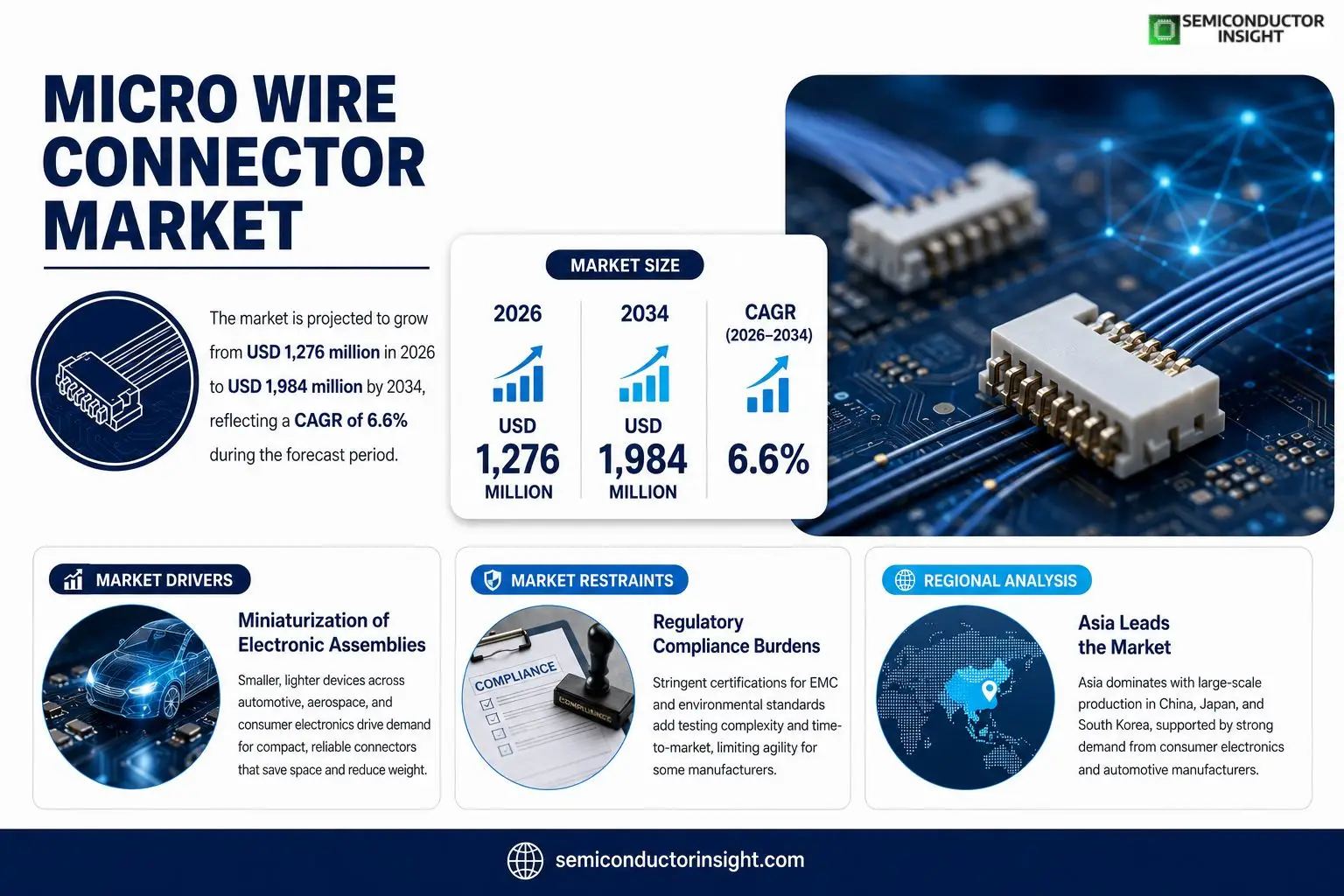
Micro Wire Connector Market size was valued at USD 1,276 million in 2025. The market will increase from USD 1,276 million in 2025 to USD 1,984 million by 2034, reflecting a CAGR of 6.6 % over the forecast period.
Micro Wire Connectors are compact interconnection components that join fine wires within high‑density electronic assemblies, delivering stable signal and power transmission in confined spaces. Their miniaturized structure, lightweight design, high contact reliability and resistance to vibration and thermal variation make them well‑suited for consumer electronics and automotive systems.In 2025 production reached roughly 254 million units at an average price of USD 5.5 per unit; capacity utilization stood at 60 % while gross margins averaged 38 %. Upstream inputs such as copper and engineering plastics are supplied by firms including Freeport‑McMoRan, Southwire and BASF, whereas downstream customers span Apple, Samsung, Tesla and Toyota.
MARKET DRIVERS
Miniaturization of Electronic Assemblies
The push for smaller, lighter devices in automotive, aerospace and consumer electronics forces designers to adopt tighter interconnect solutions. Micro Wire Connector Market participants benefit as OEMs replace bulkier housings with compact connection modules that free up board real estate and lower overall weight, directly influencing product performance and compliance with stringent safety standards.
Stringent Reliability Requirements
Industries such as medical equipment and industrial automation cannot tolerate intermittent connections. The demand for connectors that withstand vibration, thermal cycling and corrosive environments encourages suppliers to invest in high‑precision manufacturing and advanced material coatings, thereby strengthening Micro Wire Connector Market’s value proposition.
➤ “Customers are willing to pay a premium for connectors that certify to higher MTBF ratings, reshaping supplier pricing strategies.”
Supply chain resilience, especially after recent disruptions, has prompted manufacturers to diversify sourcing and increase inventory buffers. This strategic shift creates a stable demand stream for reliable micro‑connectors, reinforcing the market’s foundation amid uncertain geopolitical conditions.
MARKET CHALLENGES
Cost Sensitivity in High‑Volume Segments
While performance drives adoption, price remains a decisive factor for mass‑market applications such as consumer electronics. Producers must balance the expense of precision tooling with the need to keep unit costs low, a tension that can deter some buyers from upgrading to newer micro‑connector architectures.
Other Challenges
Standardization Gaps
The coexistence of multiple proprietary formats hampers cross‑compatibility, forcing end users to maintain parallel inventories. This fragmentation slows procurement cycles and can erode the perceived benefits of transitioning to newer connector families.
MARKET RESTRAINTS
Regulatory Compliance Burdens
Stringent certifications for electromagnetic compatibility and environmental directives impose additional testing phases and documentation requirements. Companies that lack the infrastructure to meet these obligations may experience delayed product launches, limiting their ability to capture emerging demand within Micro Wire Connector Market.
MARKET OPPORTUNITIES
Integration with Advanced Manufacturing
Adoption of additive manufacturing and automated assembly lines enables the production of bespoke connector geometries at lower volumes without sacrificing precision. Firms that align their design pipelines with these technologies stand to unlock new niche applications, expanding the addressable market for micro‑wire solutions.
Micro Wire Connector Market Trends
Miniaturization and Integration Density Fueling Demand
The relentless push for thinner, more capable devices has placed the Micro Wire Connector at the center of design trade‑offs. In smartphones, wearables and emerging vehicle infotainment platforms the need to route dozens of high‑frequency signals through millimetre‑scale spaces is no longer optional; it is a prerequisite for product differentiation. This pressure translates into higher unit shipments even as manufacturers squeeze the bill of materials. The connector’s lightweight, vibration‑tolerant construction aligns with automotive electrification trends, where electric power‑train controls and driver‑assist modules must survive harsh thermal cycles while occupying limited chassis volume. Consequently, buyers such as Apple, Samsung, Tesla and Toyota are specifying ever‑smaller pitch solutions, prompting suppliers to refine terminal geometry and adopt tighter tolerances.
Other Trends
Manufacturing Efficiency and Margin Pressure
In 2025 overall capacity utilization hovered around 60 %, indicating that a substantial portion of production capability remains idle. With an average selling price of US $5.5 per unit and a gross margin near 38 %, firms are acutely aware that any lift in yield or reduction in cycle time can directly boost profitability. Automation of micro‑assembly stepsparticularly die‑bond placement and laser trimminghas become a competitive lever, as it reduces operator‑related variability and accelerates throughput. Companies are also experimenting with inline optical inspection to catch contact defects before final testing, a practice that shortens rework loops and preserves margin in high‑volume contracts.
Supply Chain Resilience and Material Innovation
Upstream inputs of copper and engineering plastics dominate the cost structure of these connectors. Supplier concentration, exemplified by players such as Freeport‑McMoRan, Southwire and BASF, creates a material‑risk profile that manufacturers are actively managing through dual‑sourcing agreements and strategic stockpiles. At the same time, the industry is exploring copper‑alloy formulations that improve conductivity while tolerating thermal expansion, as well as bio‑based polymer blends that lower environmental footprint without sacrificing dielectric performance. These material advances not only address regulatory pressure but also open avenues for differentiating products in premium automotive segments where long‑term reliability under temperature excursions is a decisive factor. By reinforcing supply continuity and embedding greener chemistry, firms can safeguard delivery schedules and appeal to OEMs pursuing sustainability targets.
COMPETITIVE LANDSCAPE
Key Industry Players
Micro Wire Connector Market – Competitive Overview
The upper tier of the market is dominated by a handful of multinational firms whose scale enables tight control over copper alloy sourcing, precision molding, and automated micro‑assembly lines. Amphenol Corporation, TE Connectivity, ITT Cannon, Glenair, and Omnetics Connector together account for roughly a third of shipments, leveraging vertically integrated operations to sustain margins of 35‑40 % despite price pressure from high‑volume OEMs. Their breadth of product familiesranging from sub‑0.5 mm pitch wire‑to‑board modules to rugged automotive board‑to‑board stacksallows them to serve both consumer‑electronics giants and Tier‑1 automotive suppliers, reinforcing a barrier to entry for smaller entrants. Strategic investments in vibration‑testing labs and high‑speed signal integrity programs have turned reliability metrics into a differentiator that many customers now demand as a prerequisite for qualifying components.Beyond the leaders, a diverse set of niche manufacturers captures specialized segments by targeting ultra‑high‑frequency data rates, aerospace standards, or cost‑sensitive mass markets. AirBorn, Smiths Interconnect, Souriau, Nicomatic, Axon’ Cable, JAE Electronics, Hosiden Corporation, Jonhon Optronic Technology, Guizhou Space Appliance, and Sichuan Huafeng Technology each carve out competitive space through proprietary spring‑contact designs, custom housing materials, or localized production hubs in China and Europe. These firms often excel in rapid prototyping cycles and bespoke engineering services, making them preferred partners for emerging electric‑vehicle platforms, medical‑device makers, and next‑generation wearables where design turnover outpaces the large players’ product‑roadmap cadence. Their agility, combined with lower overhead, pressures incumbents to broaden portfolio breadth and accelerate innovation pipelines.
List of Key Micro Wire Connector Companies Profiled
- Amphenol Corporation
- TE Connectivity
- ITT Cannon
- Glenair
- Omnetics Connector
- AirBorn
- Smiths Interconnect
- Souriau
- Nicomatic
- Axon’ Cable
- JAE Electronics
- Hosiden Corporation
- Jonhon Optronic Technology
- Guizhou Space Appliance
- Sichuan Huafeng Technology
Segment Analysis:
| Segment Category | Sub-Segments | Key Insights |
| By Type |
|
Wire-to-Board
|
| By Application |
|
Consumer Electronics
|
| By End User |
|
OEMs
|
| By Data Rate |
|
10‑25 Gbps
|
| By Contact Pitch |
|
0.5‑1 mm
|
Regional Analysis: Micro Wire Connector Market
Europe
The EU’s updated electromagnetic compatibility directives have tightened acceptable interference levels, forcing connector makers to adopt advanced shielding techniques. Vendors that embed compliance testing into early design stages gain a competitive edge by reducing redesign cycles and ensuring smoother certification pathways.
Recent geopolitical tensions have highlighted the fragility of single‑source copper supplies. European firms are diversifying their raw‑material sources and investing in recycling initiatives, thereby bolstering supply continuity for critical connector components.
Cities such as Stuttgart and Turin host collaborative labs where automotive OEMs, tier‑1 suppliers, and research institutes co‑develop ultra‑compact connectors. These ecosystems accelerate prototype validation and shorten the transition from lab to production floor.
European vehicle manufacturers prioritize connectors that balance weight reduction with robust thermal performance. This preference fuels demand for high‑performance alloys and novel polymer blends that sustain reliability under demanding driving conditions.
North America
The North American segment of Micro Wire Connector Market is shaped by the rapid rollout of electric trucks and the growth of autonomous vehicle testing corridors. OEMs are demanding connectors that can endure higher voltage thresholds while fitting within cramped battery enclosures. Supplier strategies therefore emphasize rapid prototyping capabilities and close engineering partnerships with automotive firms located in Detroit and Silicon Valley. In parallel, the region’s defense sector continues to require ruggedized connectors for aerospace applications, adding a layer of diversification to the market’s demand profile. Companies that can navigate both commercial automotive and defense procurement cycles stand to capture incremental revenue streams.
Asia-Pacific
Asia‑Pacific’s surge in vehicle production volumes creates a fertile ground for cost‑sensitive micro‑connector manufacturers. While price pressure is intense, the market also rewards firms that introduce incremental performance gains, such as improved vibration resistance for vehicles operating on varied road surfaces. Emerging economies within the region are upgrading their automotive standards, prompting local suppliers to mimic European compliance levels to access export markets. Moreover, the proliferation of smart‑city initiatives and IoT‑enabled transportation networks is expanding the application horizon beyond traditional power transmission, encouraging diversification into data‑centric connector designs.
South America
In South America, market dynamics are moderated by a slower pace of vehicle electrification but accelerated by the region’s focus on heavy‑duty logistics. Truck manufacturers are incorporating micro‑wire connectors into power‑train control modules to improve fuel efficiency and reduce maintenance intervals. The competitive landscape features a mix of local producers and multinational entrants, each vying for contracts through localized support services. Strategic alliances with regional distributors enable suppliers to navigate complex import regulations and tailor product offerings to the specific climate challenges of the Amazon basin and high‑altitude Andean routes.
Middle East & Africa
The Middle East & Africa region reflects a dual narrative of high‑end automotive projects in the Gulf states and burgeoning infrastructure development across Africa. Wealthy consumers in the UAE and Saudi Arabia are adopting premium electric vehicles, demanding connectors that meet the exacting standards of luxury interiors and high‑temperature environments. Concurrently, African nations are upgrading public transportation fleets, introducing micro‑wire solutions that can tolerate dust and temperature extremes. Suppliers that embed after‑sales training and remote diagnostic support into their service model are better positioned to earn trust in markets where technical expertise is still maturing.
Report Scope
This market research report provides a comprehensive analysis of the Micro Wire Connector Market , covering the forecast period 2026–2034. It offers detailed insights into market dynamics, technological advancements, competitive landscape, and key trends shaping the industry.
Key focus areas of the report include:
- Market Overview: The report begins with an overview outlining its current market scenario, key growth indicators, and industry transformation drivers. It discusses macroeconomic factors, demand–supply balance, regulatory landscape, and the strategic role of semiconductors in powering advancements across industries such as automotive, telecommunications, consumer electronics, and industrial automation.
- Market Size & Forecast: Historical data and future projections for revenue, unit shipments, and market value across major regions and segments.
- Segmentation Analysis: Detailed breakdown by product type, technology, application, and end-user industry to identify high-growth segments and investment opportunities.
- Regional Insights: Insights into market performance across North America, Europe, Asia-Pacific, Latin America, and the Middle East & Africa, including country-level analysis where relevant.
- Competitive Landscape: Profiles of leading market participants, including their product offerings, R&D focus, manufacturing capacity, pricing strategies, and recent developments such as mergers, acquisitions, and partnerships.
- Technology Trends & Innovation: Assessment of emerging technologies, integration of AI/IoT, semiconductor design trends, fabrication techniques, and evolving industry standards.
- Market Drivers & Restraints: Evaluation of factors driving market growth along with challenges, supply chain constraints, regulatory issues, and market-entry barriers.
- Stakeholder Insights: Insights for component suppliers, OEMs, system integrators, investors, and policymakers regarding the evolving ecosystem and strategic opportunities.
Primary and secondary research methods are employed, including interviews with industry experts, data from verified sources, and real-time market intelligence to ensure the accuracy and reliability of the insights presented.
FREQUENTLY ASKED QUESTIONS:
What is the current market size of Micro Wire Connector Market?
-> Micro Wire Connector Market was valued at USD 1276 million in 2025 and is expected to reach USD 1984 million by 2034, at a CAGR of 6.6% during the forecast period.
Which key companies operate in Micro Wire Connector Market?
-> Key players include Amphenol Corporation, TE Connectivity, ITT Cannon, Glenair, Omnetics Connector, AirBorn, Smiths Interconnect, Souriau, Nicomatic, Axon’ Cable, JAE Electronics, Hosiden Corporation, Jonhon Optronic Technology, Guizhou Space Appliance, and Sichuan Huafeng Technology, among others.
What are the key growth drivers?
-> Key growth drivers include the industry trend toward miniaturization and higher integration density in consumer electronics, increasing demand for reliable interconnect solutions in automotive electrification and intelligent systems, and the pressure to improve manufacturing efficiency through process optimization and automation.
Which region dominates the market?
-> Asia dominates Micro Wire Connector Market, driven by large-scale production in China, Japan, and South Korea, as well as strong demand from regional consumer electronics and automotive manufacturers.
What are the emerging trends?
-> Emerging trends include advanced miniaturized connector designs, higher data‑rate capabilities, integration of vibration‑resistant materials, and increased focus on cost‑effective, automated micro‑assembly processes.

Get Sample Report PDF for Exclusive Insights
Report Sample Includes
- Table of Contents
- List of Tables & Figures
- Charts, Research Methodology, and more...
 Download Sample Report PDF