Circular Industrial Connector Market Insights
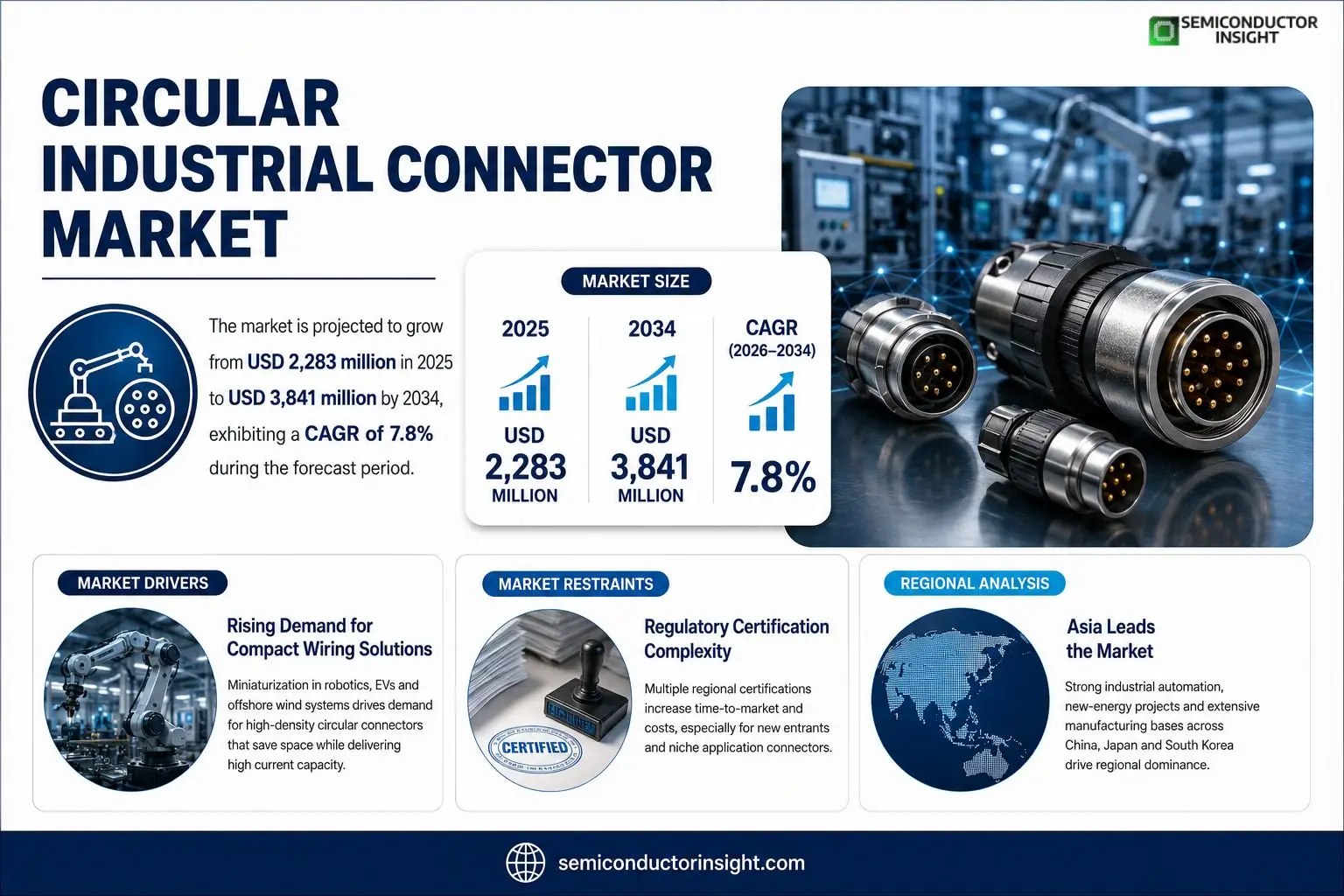
Circular Industrial Connector market size was valued at USD 2283 million in 2025. The market is projected to grow from USD 2283 million in 2025 to USD 3841 million by 2034, exhibiting a CAGR of 7.8 % during the forecast period.
Circular industrial connectors are electrically conductive components featuring a circular housing that integrates a plug, socket, contacts and sealing elements. Designed for power, signal or data transmission, they deliver robust mechanical strength and environmental resiliencetypically meeting IP67/IP68 standards for water‑dust protection and tolerating wide temperature ranges. Their applications span industrial automation, rail transportation, new‑energy systems, machinery and communications equipment where reliable connectivity under vibration and harsh conditions is essential.The market expansion is fueled by rising automation adoption, growth of renewable‑energy installations and increasing demand for high‑density modular designs. However, manufacturers contend with volatile raw‑material costs and lengthy certification cycles that can delay product launches. Leading suppliers such as Amphenol, TE Connectivity, ITT Cannon and Molex continue investing in high‑performance series that combine corrosion‑resistant plating with fast‑lock mechanisms, positioning themselves to capture the mid‑to‑high‑end segment where gross margins range from 30 % to 55 %.
MARKET DRIVERS
Rising Demand for Compact Wiring Solutions
Circular Industrial Connector Market is being propelled by the need to minimize panel footprints in high‑density equipment. Manufacturers of robotics, electric vehicles and offshore wind turbines favor circular connectors because they deliver equivalent current capacity within a smaller envelope, freeing up valuable space for additional components or cooling systems. This shift toward miniaturization is less about cosmetic design and more about operational efficiency and cost‑per‑square‑meter savings.
Stringent Reliability Requirements in Hazardous Environments
Industries such as oil & gas, chemical processing and aerospace impose rigorous IEC and MIL standards on interconnectivity. Circular geometry inherently distributes mechanical stress and provides superior sealing against dust, moisture and vibration. As a result, end‑users are migrating from legacy rectangular or modular connectors toward circular variants that can demonstrably meet uptime targets of 99.9% in extreme conditions.
➤ “When a connector can survive a 30‑minute sub‑mersion test without performance loss, procurement teams award contracts based on risk mitigation rather than price alone.”
Beyond durability, the ability of circular connectors to support higher pin counts within a single housing reduces the number of mating cycles and splices required on a system. This translates into lower maintenance expenses and a longer overall equipment life, reinforcing the business case for broader adoption across Circular Industrial Connector Market.
MARKET CHALLENGES
Cost Sensitivity Among Tier‑2 Manufacturers
Smaller OEMs operating in emerging economies often prioritize upfront component cost over long‑term reliability. Circular industrial connectors, while offering superior performance, carry higher material and engineering expenses than basic pin‑and‑socket solutions. This price differential creates a hurdle for widespread penetration in cost‑driven procurement environments.
Other Challenges
Supply Chain Volatility
shortages of high‑grade copper alloys and specialty polymers have led to longer lead times for key connector components. Manufacturers that lack diversified sourcing strategies may face production bottlenecks, which in turn can delay projects that rely on resilient circular connections.
MARKET RESTRAINTS
Regulatory Certification Complexity
Obtaining compliance across multiple jurisdictionssuch as CE, UL, and CSArequires distinct testing protocols and documentation. The cumulative cost of certification can deter new entrants and slow product launches, especially for niche applications where the volume justification is marginal.Furthermore, the rapid evolution of safety standards means that designs successful today may require redesign to meet next‑generation requirements. Companies that cannot allocate dedicated engineering resources to monitor and adapt to these changes risk market exclusion.
MARKET OPPORTUNITIES
Integration with IoT‑Enabled Monitoring
Embedding diagnostics within circular connectors allows real‑time health monitoring of power and signal pathways. As factories adopt predictive maintenance platforms, connectors that can transmit temperature, resistance and lubrication status become attractive upgrade items, opening a service‑oriented revenue stream within Circular Industrial Connector Market.In parallel, the expanding renewable‑energy sectorparticularly offshore wind farmsrequires connectors that withstand harsh marine conditions while supporting remote condition‑based monitoring. Companies that can certify IoT‑ready circular connectors for marine use stand to capture a growing share of this high‑margin niche.
Circular Industrial Connector Market Trends
Shift Toward High‑Density Modular Designs
Circular Industrial Connector Market is seeing a decisive move toward compact, high‑density modules that combine power, signal and data pathways within a single housing. Customers in automation and rail sectors demand equipment that fits tighter spaces while maintaining the ruggedness required for harsh environments. Manufacturers respond by integrating multi‑contact arrays and leveraging precise injection‑molding techniques that keep tolerances tight. This evolution reduces the total number of parts in a system, shortens assembly time, and lowers labour costs for end‑users. The trend also aligns with the broader push for smarter factory layouts, where space efficiency translates directly into higher throughput and lower capital expenditure.
Other Trends
Supply‑Chain Pricing Pressures
Raw‑material volatilityparticularly for copper and specialty alloyshas introduced measurable cost uncertainty for midstream producers. While upstream margins remain modest (10‑25 %), midstream firms, which command 30‑55 % gross margins, are compelled to adjust pricing strategies more frequently. The fluctuating price environment motivates operators to lock‑in long‑term contracts with material suppliers and to invest in recycling initiatives that mitigate exposure to market swings. Companies that can smooth price inputs without passing excess cost to customers gain a competitive edge, especially in regions where downstream integrators operate on tight budgets.
Emergence of Integrated Smart Connectors
Advances in sensor embedding and firmware miniaturization are spawning a new class of “smart” circular connectors that not only transmit power and data but also report health metrics such as temperature, vibration and connection integrity. These intelligent units appeal to manufacturers of renewable‑energy turbines and autonomous rail systems, where predictive maintenance drives availability targets above 99 %. By offering built‑in diagnostics, vendors differentiate their product portfolios and justify premium pricing, often capturing margins at the higher end of the midstream range. The adoption curve, however, is moderated by lengthy certification cycles and the need for alignment with industry‑specific safety standards. Firms that have already established certification pipelines and can deliver customized firmware are positioned to capture the emerging demand and shape the next wave of value creation in Circular Industrial Connector Market.
COMPETITIVE LANDSCAPE
Key Industry Players
Competitive Dynamics in the Circular Industrial Connector Market
Amphenol dominates the upper tier of the sector, leveraging a broad portfolio that spans ruggedized power modules to high‑frequency data links. Its vertical integrationfrom metal alloy sourcing to precision moldingcreates a cost advantage that is difficult for newcomers to replicate. The firm’s extensive certification network accelerates time‑to‑market for OEMs, reinforcing its role as a primary supplier for rail, automation and new‑energy platforms. Midstream manufacturers such as TE Connectivity and ITT Cannon sit just below Amphenol in market share; they differentiate through modular architectures and proprietary locking systems that cater to aerospace and defense contracts requiring stringent reliability standards.Beyond the top tier, a cadre of niche specialists sustains diversity in the ecosystem. Companies like Molex and HARTING Technology Group focus on high‑density signal solutions for robotics, while Phoenix Contact and Hirose excel in modular designs that simplify field upgrades. European firmsBinder, Bulgin Limited, Lemo, and Switchcraftretain strong footholds in sectors where conformity to regional standards (e.g., IEC, DIN) is paramount. Emerging players such as Norcomp, Lumberg, Metz Connect, and Neutrik are expanding their footprint by targeting cost‑sensitive segments in automotive electronics and home‑appliance integrations, often through strategic partnerships with local system integrators.
List of Key Circular Industrial Connector Companies Profiled
- Amphenol
- TE Connectivity
- ITT Cannon
- Molex
- HARTING Technology Group
- Phoenix Contact
- Hirose Electric
- Binder
- Bulgin Limited
- Lemo
- Switchcraft
- Norcomp
- Lumberg
- Metz Connect
- Neutrik
Segment Analysis:
| Segment Category | Sub-Segments | Key Insights |
| By Type |
|
Above 100 Contacts – preferred for high‑current and heavy‑duty equipment; – delivers superior mechanical strength and stable electrical performance under vibration; – aligns with the industry shift toward modular, high‑density designs. |
| By Application |
|
Industrial Automation – drives demand for high‑reliability, IP‑rated connectors; – supports trend toward intelligent, compact equipment with fast data transmission; – encourages manufacturers to offer modular, easily serviceable solutions. |
| By End User |
|
Equipment Manufacturers – require certified, long‑life connectors for OEM integration; – prioritize customization to meet specific performance and environmental standards; – value suppliers with strong engineering support and rapid prototyping capabilities. |
| By Material |
|
Stainless Steel Housing – offers outstanding corrosion resistance for harsh industrial environments; – supports high temperature and vibration endurance; – favored by manufacturers targeting premium, long‑service‑life applications. |
| By Function |
|
Power Connectors – essential for safe high‑current transfer in rail and new‑energy systems; – emphasize robust contact retention and thermal management; – influence mid‑stream manufacturers’ focus on precision machining and reliability testing. |
Regional Analysis: Circular Industrial Connector Market
Europe
EU directives on resource efficiency compel manufacturers to embed recyclability into connector design, prompting firms to adopt closed‑loop material sourcing. Compliance audits have become a negotiating lever, rewarding suppliers that can certify end‑of‑life recovery pathways.
Distributed production networks across Germany, France, and the Benelux reduce dependency on single sourcing points, allowing rapid reallocation of connector inventories during disruptions while preserving circular handling protocols.
Smart‑enabled connectors equipped with condition‑monitoring chips are gaining traction, feeding usage data into asset‑management platforms that schedule remanufacture cycles based on actual wear patterns.
OEMs in the automotive and renewable‑energy sectors preferentially source connectors that demonstrate verified reuse potential, aligning procurement policies with sustainability mandates from corporate leadership.
North America
North America’s approach to Circular Industrial Connector Market reflects a blend of regulatory incentives and market‑driven sustainability goals. The United States, through its growing emphasis on circular economy legislation, encourages manufacturers to document material recovery rates, while Canadian provinces offer tax credits for closed‑loop manufacturing facilities. End users, particularly in the aerospace and data‑center domains, prioritize connectors that can be serviced on‑site, limiting total waste and extending product uptime. Industry consortia are experimenting with standard‑based take‑back schemes that simplify reverse logistics, creating a nascent but increasingly influential secondary market for refurbished components. As procurement teams align buying criteria with ESG objectives, the demand for connectors engineered for disassembly intensifies, reshaping supplier roadmaps across the continent.
Asia‑Pacific
The Asia‑Pacific region presents a heterogeneous landscape for circular connector adoption. Nations such as Japan and South Korea leverage advanced manufacturing techniques to embed recyclability at the design stage, while emerging economies prioritize cost efficiency over comprehensive reuse frameworks. Large‑scale infrastructure projects in China have begun to mandate modular connector solutions that facilitate on‑site refurbishment, signaling a gradual shift toward circular thinking. Meanwhile, regional trade associations promote knowledge exchange on material recovery, helping smaller suppliers adopt best practices without extensive capital outlays. Customer expectations in high‑growth sectors like robotics and renewable energy are driving a modest but steady rise in demand for connectors that can be easily inspected and remanufactured.
South America
In South America, Circular Industrial Connector Market is shaped by a combination of resource constraints and incremental policy development. Brazil’s emerging waste‑management regulations encourage manufacturers to consider end‑of‑life pathways, yet implementation varies widely across the supply chain. Industries such as mining and heavy equipment favor rugged connector designs that can withstand harsh environments, creating opportunities for refurbishment programs that reduce replacement cycles. Local OEMs are beginning to partner with European firms to gain access to circular design expertise, fostering a collaborative ecosystem that gradually introduces circular practices into traditionally linear production models.
Middle East & Africa
The Middle East & Africa region exhibits a cautious yet forward‑looking attitude toward circular connector initiatives. Gulf Cooperation Council (GCC) countries are investing in sustainability frameworks that reward the reuse of industrial components, aligning with broader diversification strategies beyond oil. In Africa, limited access to high‑grade manufacturing infrastructure makes remanufacture an attractive cost‑saving alternative, especially for the telecommunications and petrochemical sectors. Cross‑regional training programs are helping local technicians acquire the skills needed to inspect and refurbish connectors safely, laying the groundwork for a modest but growing secondary market that supports broader circular economy objectives.
Report Scope
This market research report provides a comprehensive analysis of the Circular Industrial Connector Market , covering the forecast period 2026–2034. It offers detailed insights into market dynamics, technological advancements, competitive landscape, and key trends shaping the industry.
Key focus areas of the report include:
- Market Overview: The report begins with an overview outlining its current market scenario, key growth indicators, and industry transformation drivers. It discusses macroeconomic factors, demand–supply balance, regulatory landscape, and the strategic role of semiconductors in powering advancements across industries such as automotive, telecommunications, consumer electronics, and industrial automation.
- Market Size & Forecast: Historical data and future projections for revenue, unit shipments, and market value across major regions and segments.
- Segmentation Analysis: Detailed breakdown by product type, technology, application, and end-user industry to identify high-growth segments and investment opportunities.
- Regional Insights: Insights into market performance across North America, Europe, Asia-Pacific, Latin America, and the Middle East & Africa, including country-level analysis where relevant.
- Competitive Landscape: Profiles of leading market participants, including their product offerings, R&D focus, manufacturing capacity, pricing strategies, and recent developments such as mergers, acquisitions, and partnerships.
- Technology Trends & Innovation: Assessment of emerging technologies, integration of AI/IoT, semiconductor design trends, fabrication techniques, and evolving industry standards.
- Market Drivers & Restraints: Evaluation of factors driving market growth along with challenges, supply chain constraints, regulatory issues, and market-entry barriers.
- Stakeholder Insights: Insights for component suppliers, OEMs, system integrators, investors, and policymakers regarding the evolving ecosystem and strategic opportunities.
Primary and secondary research methods are employed, including interviews with industry experts, data from verified sources, and real-time market intelligence to ensure the accuracy and reliability of the insights presented.
FREQUENTLY ASKED QUESTIONS:
What is the current market size of Circular Industrial Connector Market?
-> Circular Industrial Connector Market was valued at USD 2,283 million in 2025 and is expected to reach USD 3,841 million by 2034, growing at a CAGR of 7.8% during the forecast period.
Which key companies operate in Circular Industrial Connector Market?
-> Key players include Amphenol, ITT Cannon, EATON, TE Connectivity, Binder, Bulgin Limited, Camdenboss, Molex, HARTING Technology Group, Hirose, Phoenix Contact, Switchcraft, Norcomp, Lemo, Lumberg, Metz Connect, and Neutrik.
What are the key growth drivers?
-> Key growth drivers include the rapid expansion of downstream applications such as industrial automation, robotics, rail transportation, new energy and communications; increasing demand for high‑reliability, vibration‑resistant and IP‑rated connectors; and the trend toward miniaturization, high‑density integration and modular design.
Which region dominates the market?
-> Asia dominates Circular Industrial Connector Market, driven by strong industrial automation adoption, new‑energy projects and extensive manufacturing bases across China, Japan and South Korea.
What are the emerging trends?
-> Emerging trends include high‑density integration and modular connector systems, support for high‑speed data transmission, enhanced IP ratings (IP67/IP68), and increased customization capabilities to serve high‑end industrial and military applications.

Get Sample Report PDF for Exclusive Insights
Report Sample Includes
- Table of Contents
- List of Tables & Figures
- Charts, Research Methodology, and more...
 Download Sample Report PDF