Military Grade High Speed Connector Market Insights
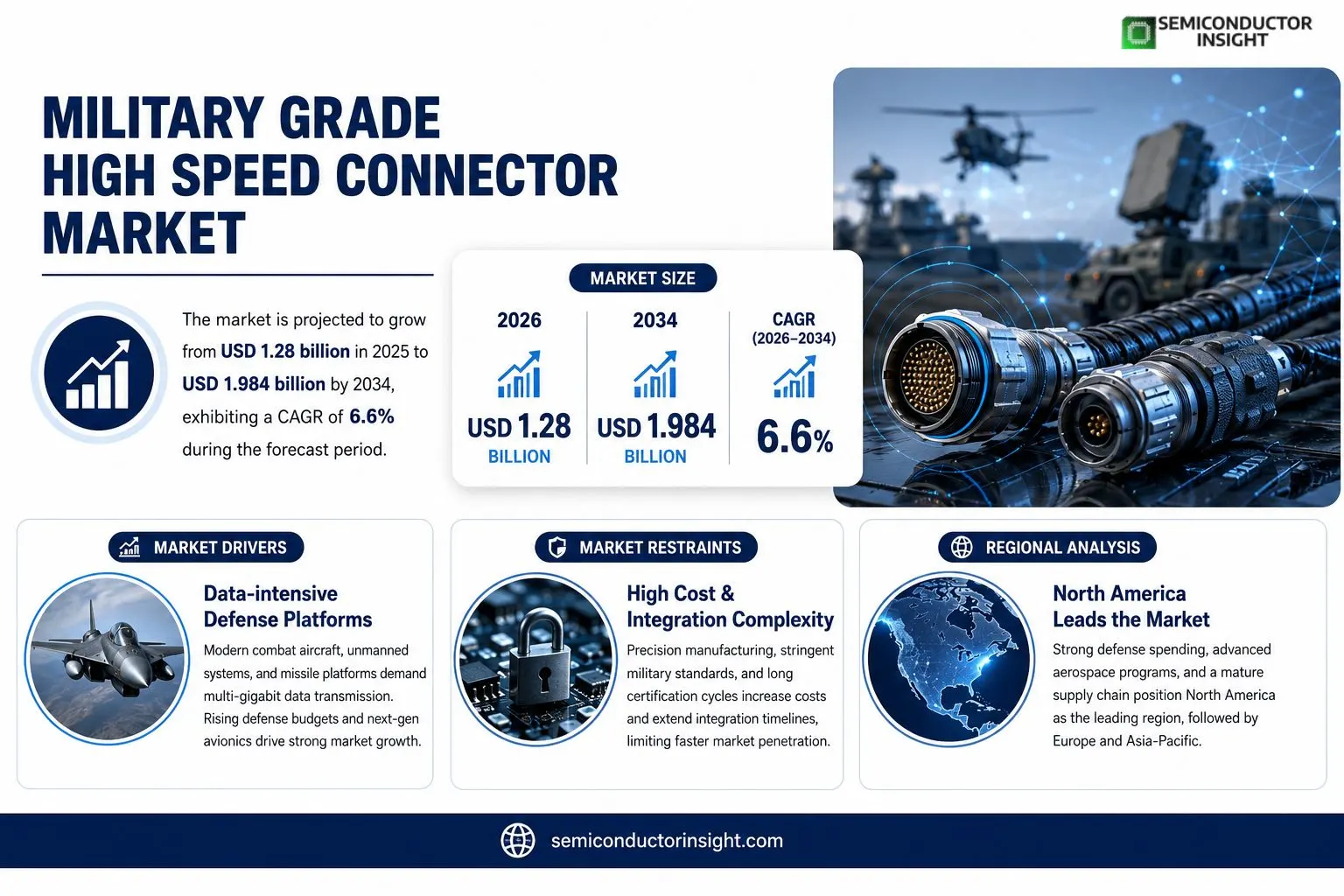
Military Grade High Speed Connector market size was valued at USD 1.28 billion in 2025. The market is projected to grow from USD 1.28 billion in 2025 to USD 1.984 billion by 2034, exhibiting a CAGR of 6.6% during the forecast period.
Military Grade High Speed Connectors are high‑reliability interconnect devices engineered for defense applications, enabling high‑speed signal transmission and stable power delivery under harsh conditions such as strong vibration, mechanical shock, and extreme temperatures. Designed to meet stringent military standards, they deliver high data integrity, low signal attenuation, robust mechanical performance and superior electromagnetic compatibilityattributes essential for mission‑critical communication and electronic systems.The market is gaining momentum because modern warfare increasingly relies on network‑centric operations that demand higher data rates and real‑time processing across avionics, radar and secure communication platforms. At the same time, long qualification cycles and strict procurement rules temper rapid expansion, while emerging needs from unmanned systems and advanced surveillance platforms create incremental demand. Leading suppliersincluding Amphenol Corporation, TE Connectivity, ITT Cannon and Glenairare expanding their product portfolios and investing in precision contact engineering and shielding optimization to address these challenges.
MARKET DRIVERS
Data‑intensive Defense Platforms
Modern combat aircraft, unmanned systems, and missile subsystems now exchange terabytes of data per mission. This surge in bandwidth requirement forces Military Grade High Speed Connector Market to deliver connectors that sustain multi‑gigabit rates while meeting stringent shock and vibration specifications. Vendors that can certify such performance gain direct access to procurement budgets earmarked for next‑generation platforms.
Government Funding for Next‑Gen Avionics
Defense ministries across North America, Europe, and the Asia‑Pacific have allocated upwards of $12 billion to modernise avionics and electronic warfare suites. Those programmes explicitly call for connectors capable of handling high‑speed serial protocols, thereby expanding the addressable market slice for specialised connector manufacturers. Companies that align product road‑maps with these funding cycles can secure multi‑year contracts that stabilise revenue streams.
➤ “Modular mission‑critical architectures are driving a rapid refresh of interconnect standards, compelling suppliers to innovate at an unprecedented pace.”
Collectively, the push for higher data throughput, coupled with sizable public‑sector investment, creates a fertile environment where product differentiation and rapid certification become decisive competitive advantages for participants in Military Grade High Speed Connector Market.
MARKET CHALLENGES
Technical Integration Complexity
Integrating high‑speed connectors into legacy platforms often requires redesign of housings, cable assemblies, and signal conditioning circuits. Engineers must reconcile disparate grounding schemes and electromagnetic compatibility (EMC) requirements, which extends development timelines and inflates engineering costs. Failure to manage these intricacies can erode the value proposition of a new connector solution.
Other Challenges
Supply‑Chain Vulnerabilities
The reliance on a narrow pool of specialty alloys and precision‑machined components exposes the sector to material shortages and price volatility. Any disruption in the upstream supply chain ripples through to end‑user schedules, prompting procurement officers to favour established vendors with proven logistics networks.Regulatory clearance cycles further complicate market entry; certification bodies demand exhaustive testing under extreme temperature and pressure envelopes, a process that can add six to twelve months before a product reaches operational status.
MARKET RESTRAINTS
Elevated Cost Structures
Manufacturing tolerances required for high‑speed signal integrity drive unit costs well above those of conventional connectors. For budget‑constrained programs, the price premium can trigger a trade‑off analysis that favours lower‑performance options, limiting overall market penetration.
Stringent Regulatory Landscape
Defense acquisition standards impose rigorous documentation, traceability, and lifecycle support mandates. Compliance efforts consume significant engineering resources, often discouraging smaller innovators from entering the space.
Concentrated Supplier Base
Only a handful of firms possess the machining precision and quality‑assurance infrastructure to meet military specifications. This concentration limits competitive pricing and creates entry barriers for new entrants seeking to capture market share.
MARKET OPPORTUNITIES
Expansion into Emerging Defense Markets
Countries investing in indigenous defence manufacturing are adopting international connector standards to ensure interoperability with allied forces. This trend opens a channel for manufacturers to supply kits and training programs alongside hardware, expanding the revenue ecosystem beyond pure product sales.
Hybrid Fibre‑Optic/Electrical Solutions
Emerging architectures that blend fibre‑optic bandwidth with rugged electrical contacts present a niche where existing connector platforms can be upgraded. Firms that develop hybrid families stand to capture incremental demand from retro‑fit projects across existing fleets.
Aftermarket Service Networks
Lifecycle supportspare parts, field repair kits, and predictive maintenance analyticsoffers a high‑margin avenue. Operators value guaranteed availability of mission‑critical connectors, and contracts that bundle service guarantees are increasingly favored in procurement negotiations.
Military Grade High Speed Connector Market Trends
Accelerating Demand for Ultra‑Reliable, High‑Bandwidth Interconnects
The defense sector’s push toward network‑centric warfare has intensified the need for connectors that can carry multi‑gigabit signals without degradation. In 2025, manufacturers delivered roughly 29.2 million units at an average price of $48, supporting platforms that require both high data integrity and ruggedness against vibration, shock, and extreme temperature swings. As avionics, radar, and secure communications migrate to data rates above 10 Gbps, the market’s valuation rose to $1.28 billion, a level expected to climb to $1.98 billion by 2034. This trajectory reflects not only the technical imperative for low‑attenuation pathways but also the strategic imperative for armed forces to sustain real‑time situational awareness across increasingly electronic‑dense platforms.
Other Trends
Supply‑Chain Tightness and Margin Resilience
Upstream reliance on copper and engineering plastics ties connector output to commodity price volatility. Nevertheless, the industry sustained a 40 % gross margin in 2025 despite a capacity utilization rate of only 65 %. Suppliers such as Freeport‑McMoRan, Southwire, and BASF have invested in long‑term contracts that smooth raw‑material costs, while midstream firms focus on precision contact engineering and shielding optimization to preserve performance margins. The combination of disciplined sourcing and high‑value downstream contracts with OEMs like Lockheed Martin and Raytheon mitigates the erosion of profitability that often accompanies raw‑material swings.
Emergence of Unmanned and Autonomous Platforms
Unmanned aerial and ground systems are reshaping the demand profile for high‑speed connectors. These platforms prioritize lightweight, compact interconnect solutions capable of withstanding sustained high‑frequency operation in hostile environments. The shift elevates the relevance of board‑to‑board and backplane formats, particularly those supporting 25‑56 Gbps data rates. As procurement cycles for autonomous systems shorten relative to traditional aircraft programs, manufacturers that can certify connectors to stringent military standards faster are poised to capture incremental revenue streams, while also prompting a modest reallocation of production capacity toward lower‑profile, high‑density product families.
COMPETITIVE LANDSCAPE
Key Industry Players
Competitive Overview of Military Grade High Speed Connector Market
Amphenol Corporation, headquartered in the United States, commands the largest share of the high‑speed connector segment thanks to its breadth of product families, deep defense‑grade certification portfolio, and long‑standing relationships with prime contractors such as Lockheed Martin and Raytheon. The company’s ability to integrate copper‑alloy contacts with advanced engineering‑plastic housings enables it to meet austere reliability specifications while maintaining a gross margin above the industry average. Amphenol’s vertical integrationfrom raw material sourcing through to final testingreduces lead‑time variability, a critical advantage given the protracted acquisition cycles typical of defense programs. TE Connectivity follows closely, leveraging its manufacturing footprint to supply both aerospace platforms and land‑based command systems. Both firms invest heavily in signal‑integrity simulation and electromagnetic‑compatibility validation labs, reinforcing their positions as preferred suppliers for platform‑level integration projects that demand low attenuation at multi‑gigahertz data rates.Beyond the two market leaders, a constellation of specialized firms sustains competitive pressure. Glenair and Omnetics (now part of Molex) differentiate themselves through niche designs for miniature board‑to‑board interfaces used in unmanned aerial vehicles and portable radar modules. Smiths Interconnect and Souriau focus on high‑precision shielding techniques that address the strict EMI requirements of next‑generation communication suites. European players such as Nicomatic and Axon’ Cable capitalize on their ability to customize connector geometry for compact avionics racks, while Asian manufacturersincluding JAE Electronics, Hosiden Corporation, Jonhon Optronic Technology, Guizhou Space Appliance, and Sichuan Huafeng Technologyexploit cost‑effective production capacities to serve emerging defense programs across the Indo‑Pacific region. These companies often pursue joint‑development agreements with system integrators, allowing them to embed proprietary contact metallurgy or novel polymer blends that enhance thermal endurance. The resulting ecosystem ensures a steady flow of innovation, giving end‑users a spectrum of options that balance performance, cost, and qualification timelines.
List of Key Military Grade High Speed Connector Companies Profiled
- Amphenol Corporation
- TE Connectivity
- ITT Cannon
- Glenair
- Omnetics Connector (Molex)
- AirBorn
- Smiths Interconnect
- Souriau
- Nicomatic
- Axon’ Cable
- JAE Electronics
- Hosiden Corporation
- Jonhon Optronic Technology
- Guizhou Space Appliance
- Sichuan Huafeng Technology
Segment Analysis:
| Segment Category | Sub-Segments | Key Insights |
| By Type |
|
Board-to-Board Connector
|
| By Application |
|
Military Communication Systems
|
| By End User |
|
Defense Contractors
|
| By Data Rate |
|
10-25 Gbps
|
| By Connector Interface |
|
SFP Connector
|
Regional Analysis: Military Grade High Speed Connector Market
North America
Concentrations of expertise in Silicon Valley, Austin, and Toronto accelerate connector miniaturization by blending semiconductor know‑how with ruggedized packaging. These hubs attract venture capital, which fuels start‑ups developing next‑generation dielectric materials that can endure extreme shock and vibration.
Redundant sourcing strategies, including domestic production of critical alloys, mitigate risks associated with geopolitical tensions. Firms increasingly diversify supplier bases across the U.S. and Canada to assure uninterrupted component flow for mission‑critical programs.
Close coordination with MIL‑STD committees ensures that new connector architectures comply with evolving electromagnetic interference thresholds, reducing costly redesign cycles and expediting certification timelines.
Defense primes demand bespoke configurations for platforms ranging from unmanned aerial systems to hardened ground vehicles, prompting manufacturers to adopt flexible production lines that can switch between low‑volume, high‑spec orders without compromising quality.
Europe
European defense ministries, particularly in Germany, the United Kingdom, and France, are investing heavily in digital battlefield initiatives, prompting a surge in demand for connectors that can sustain gigabit data rates under harsh conditions. The continent’s emphasis on standardization through NATO and EU frameworks simplifies cross‑border procurement, yet also imposes rigorous testing protocols that drive manufacturers toward higher reliability engineering. Collaborative research programs, such as those under the European Defence Fund, encourage joint development of advanced sealing compounds, positioning Europe as a competitive alternative to North American suppliers.
Asia‑Pacific
Rapid modernization of armed forces across China, India, Japan, and South Korea fuels a growing appetite for high‑speed interconnect solutions compatible with indigenous radar and communications systems. Domestic production capacity is expanding, yet many firms still rely on imported precision machining equipment, creating a hybrid market where local design expertise meets foreign manufacturing capabilities. Strategic government incentives aimed at reducing import dependence are accelerating joint ventures that blend Asian cost advantages with Western technical know‑how.
South America
In Brazil and Argentina, defense procurement is increasingly referencing performance‑based contracts, compelling suppliers to demonstrate durability through extensive field trials. Limited domestic component fabrication capacity drives a reliance on imports, but emerging aerospace clusters in São Paulo and Buenos Aires are nurturing talent pools focused on high‑frequency connector design. The region’s focus on cost‑effectiveness, combined with a gradual shift toward indigenous production, creates a nuanced market where price sensitivity meets strict performance criteria.
Middle East & Africa
The Middle East’s strategic focus on air‑defense and naval modernization, especially in the United Arab Emirates and Saudi Arabia, has elevated the profile of Military Grade High Speed Connectors as enablers of next‑generation command‑and‑control networks. Africa, while still nascent, is witnessing incremental growth as several nations upgrade legacy platforms with modern data links. Partnerships with established manufacturers provide technology transfer, while local governments prioritize training programs to develop a skilled workforce capable of maintaining sophisticated connector assemblies.
Report Scope
This market research report provides a comprehensive analysis of the Military Grade High Speed Connector Market , covering the forecast period 2026–2034. It offers detailed insights into market dynamics, technological advancements, competitive landscape, and key trends shaping the industry.
Key focus areas of the report include:
- Market Overview: The report begins with an overview outlining its current market scenario, key growth indicators, and industry transformation drivers. It discusses macroeconomic factors, demand–supply balance, regulatory landscape, and the strategic role of semiconductors in powering advancements across industries such as automotive, telecommunications, consumer electronics, and industrial automation.
- Market Size & Forecast: Historical data and future projections for revenue, unit shipments, and market value across major regions and segments.
- Segmentation Analysis: Detailed breakdown by product type, technology, application, and end-user industry to identify high-growth segments and investment opportunities.
- Regional Insights: Insights into market performance across North America, Europe, Asia-Pacific, Latin America, and the Middle East & Africa, including country-level analysis where relevant.
- Competitive Landscape: Profiles of leading market participants, including their product offerings, R&D focus, manufacturing capacity, pricing strategies, and recent developments such as mergers, acquisitions, and partnerships.
- Technology Trends & Innovation: Assessment of emerging technologies, integration of AI/IoT, semiconductor design trends, fabrication techniques, and evolving industry standards.
- Market Drivers & Restraints: Evaluation of factors driving market growth along with challenges, supply chain constraints, regulatory issues, and market-entry barriers.
- Stakeholder Insights: Insights for component suppliers, OEMs, system integrators, investors, and policymakers regarding the evolving ecosystem and strategic opportunities.
Primary and secondary research methods are employed, including interviews with industry experts, data from verified sources, and real-time market intelligence to ensure the accuracy and reliability of the insights presented.
FREQUENTLY ASKED QUESTIONS:
What is the current market size of Military Grade High Speed Connector Market?
-> Military Grade High Speed Connector Market was valued at USD 1,280 million in 2025 and is expected to reach USD 1,984 million by 2034, growing at a CAGR of 6.6% during the forecast period.
Which key companies operate in Military Grade High Speed Connector Market?
-> Key players include Amphenol Corporation (USA), TE Connectivity (Switzerland), ITT Cannon (USA), Glenair (USA), Omnetics Connector (USA), AirBorn (USA), Smiths Interconnect (UK), Souriau (France), Nicomatic (France), Axon’ Cable (France), JAE Electronics (Japan), Hosiden Corporation (Japan), Jonhon Optronic Technology (China), Guizhou Space Appliance (China), and Sichuan Huafeng Technology (China).
What are the key growth drivers?
-> Key growth drivers include the shift toward higher data rates and system integration in defense electronics, increased demand for reliable high‑speed interconnects in avionics, radar and secure communication systems, and the expansion of unmanned and advanced surveillance platforms.
Which region dominates the market?
-> North America leads the market, driven by substantial defense spending and advanced aerospace programs in the United States, while Europe and Asia‑Pacific also exhibit strong growth potential.
What are the emerging trends?
-> Emerging trends include integration of high‑speed connectors in compact, electronically dense platforms, adoption of modular architectures for rapid system upgrades, and the development of connectors tailored for unmanned aerial vehicles and next‑generation surveillance systems.

Get Sample Report PDF for Exclusive Insights
Report Sample Includes
- Table of Contents
- List of Tables & Figures
- Charts, Research Methodology, and more...
 Download Sample Report PDF