Key Statistics
Key Takeaways
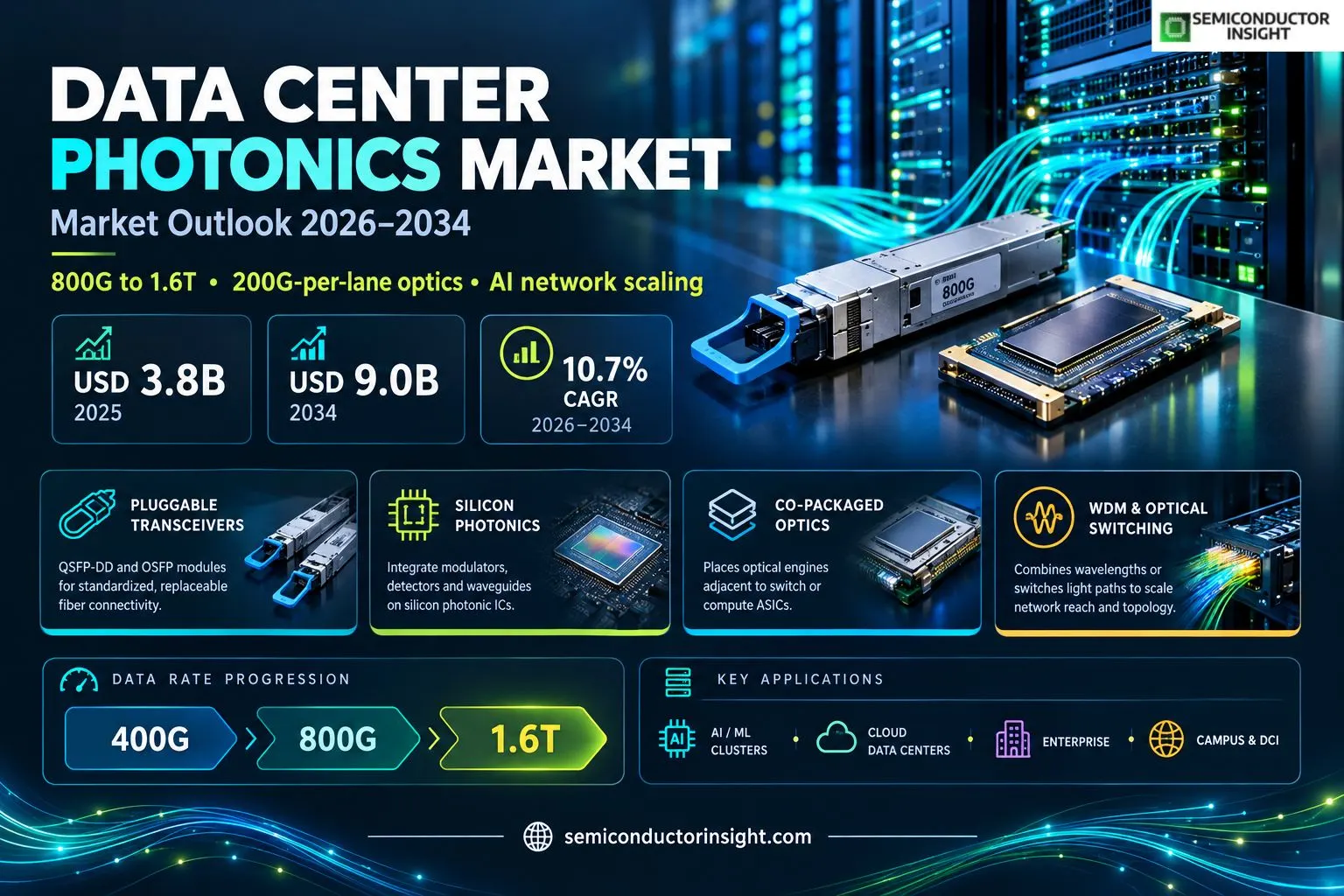
- Market size and growth: the market is valued at USD 3.800 billion in 2025 and is projected to reach USD 9.000 billion by 2034, with a 10.7% CAGR over 2026–2034.
- Pluggable Optical Transceivers leads by type because pluggable modules remain the dominant deployment model across 400G and 800G data-center links and are now scaling to 1.6T.
- AI/ML Clusters is the leading application because accelerator fabrics generate extreme east-west traffic and require higher bandwidth at lower energy per bit.
- North America leads regionally, while Asia Pacific offers the strongest incremental growth.
- Primary driver: AI clusters are pushing data-center links from 400G to 800G and 1.6T while increasing pressure to reduce network power per bit
- Principal restraint: high-speed optical packaging, laser reliability, DSP power and interoperability make next-generation photonics expensive and complex
Market Overview
The data center photonics market was valued at USD 3.800 billion in 2025 and is projected to reach USD 9.000 billion by 2034, expanding at a 10.7% CAGR over 2026–2034. North America leads in 2025, while the market is being reshaped by 800G-to-1.6T migration, 200G-per-lane optics, co-packaged optics, optical circuit switching and coherent-lite campus links..
Data center photonics includes optical transceivers, silicon photonic engines, wavelength-division multiplexing, optical switching and related components that move data inside and between server facilities. Fiber becomes progressively more attractive as bandwidth rises because copper reach falls quickly at high SerDes rates. The market is therefore closely tied to switch bandwidth, accelerator cluster size and the power budget allocated to networking.
Marvell’s current optical DSP portfolio targets the shift from 400G to 800G and 1.6T, including coherent-lite links spanning 2 km to 20 km across large AI campuses. Coherent and Lumentum both offer 1.6T data-center transceivers, while Broadcom’s co-packaged-optics platform places optical engines next to switch or compute ASICs to reduce electrical path loss and power. These technologies address different reach and integration points within the same optical fabric.
Co-packaged optics is moving from demonstration toward production use. Broadcom states that its CPO platform can provide more than 3.5 times power savings relative to conventional approaches and reported one million cumulative 400G-equivalent port device hours of flap-free operation at Meta in 2025. Its 102.4 Tbps Tomahawk 6 Davisson switch uses 200G SerDes and silicon photonics, indicating the bandwidth density required for next-generation AI networks.
Segment Analysis: By Type
By type, the market is segmented into Pluggable Optical Transceivers, Silicon Photonics Engines, Co-Packaged Optics, WDM & Optical Switching. Pluggable Optical Transceivers holds the leading position based on current performance requirements and deployment economics.
| Type | Function / role | Market position |
|---|---|---|
| Pluggable Optical Transceivers | QSFP-DD and OSFP modules provide standardized replaceable fiber connectivity. | Leading installed model across 400G, 800G and emerging 1.6T links. |
| Silicon Photonics Engines | Integrate modulators, detectors and waveguides on silicon photonic ICs. | Fast-growing platform that improves density and manufacturing integration. |
| Co-Packaged Optics | Places optical engines adjacent to switch or compute ASICs. | Strategic growth architecture for very high switch bandwidth and lower electrical loss. |
| WDM & Optical Switching | Combines wavelengths or switches light paths to scale network reach and topology. | Growing in campus, DCI and optical-circuit-switch fabrics. |
Commercial implications by type
Pluggables remain dominant because they are standardized, replaceable and operationally familiar. Co-packaged optics offers better electrical efficiency at very high bandwidth but changes service models and laser placement. Silicon photonics is used across both approaches, while WDM and optical switching become more valuable as AI campuses expand beyond a single building or rack cluster.
Segment Analysis: By Application
By application, demand is segmented into AI/ML Clusters, Cloud Data Centers, Enterprise Data Centers, Data Center Interconnect. AI/ML Clusters is the leading application because it directly links the technology to measurable bandwidth, positioning, power, disinfection or system-efficiency benefits.
| Application | Demand characteristics |
|---|---|
| AI/ML Clusters | Leading growth application because GPU/XPU fabrics require extremely high east-west bandwidth. |
| Cloud Data Centers | Hyperscale compute, storage and network services sustain broad 400G/800G deployment. |
| Enterprise Data Centers | High-performance enterprise and private cloud use optics for spine-leaf and storage fabrics. |
| Data Center Interconnect | Coherent and coherent-lite optics connect buildings, campuses and geographically separate sites. |
By Data Rate
| Data Rate | Commercial relevance |
|---|---|
| 400G | Large installed base across cloud and enterprise networks. |
| 800G | Current hyperscale growth platform for AI scale-out. |
| 1.6T | Fastest emerging tier using 200G electrical and optical lanes. |
| Beyond 1.6T | Early roadmap for next-generation CPO and optical engines. |
By Reach
| Reach | Commercial relevance |
|---|---|
| Short Reach (<500 m) | Intra-data-center PAM4 optics connect leaf, spine and accelerator fabrics. |
| Campus Reach (500 m–20 km) | FR/LR and coherent-lite technologies link large AI campuses. |
| DCI (>20 km) | Coherent optics connect metro and regional data centers. |
By Integration
| Integration | Commercial relevance |
|---|---|
| DSP-Retimed Pluggable | Highest interoperability and signal margin. |
| Linear / Transmit-Retimed Optics | Reduces module DSP power where link budgets allow. |
| Co-Packaged Optics | Minimizes electrical path loss by moving optics beside ASICs. |
Regional Analysis
North America leads the market because North America leads because U.S. hyperscalers, AI-platform companies and optical-semiconductor vendors are driving the fastest adoption of 800G, 1.6T and co-packaged optics. Asia Pacific has the strongest growth profile as demand expands through China, Japan, South Korea and Southeast Asia are expanding cloud capacity, optical-module manufacturing and AI infrastructure.
How does regional demand differ across this market?
North America leads high-value deployment and technology development, Asia Pacific is the largest optical manufacturing ecosystem and fastest-growing end market, and Europe is expanding cloud and sovereign data-center capacity. South America and the Middle East & Africa are smaller but rising through regional cloud zones and AI infrastructure projects. Regional demand increasingly tracks accelerator-cluster scale rather than traditional server counts alone.
| Region | Position | Growth outlook | Demand profile | Supplier selection |
|---|---|---|---|---|
| North America | Largest | Strong | AI hyperscale and CPO | Power per bit, bandwidth density |
| Asia Pacific | Second | Fastest | Manufacturing and cloud growth | Cost, scale, supply chain |
| Europe | Third | Strong | Cloud and sovereign infrastructure | Efficiency, standards, reliability |
| South America | Smaller | Moderate | Cloud region expansion | Cost and availability |
| Middle East & Africa | Emerging | Strong | New AI campuses | Power efficiency, service |
Competitive Landscape
Competition spans optical-module vendors, silicon-photonics specialists, DSP suppliers and Ethernet-switch companies, with power efficiency becoming as important as raw bandwidth.
Broadcom, Marvell, Coherent and Lumentum are central to the current transition. Broadcom integrates silicon photonics with switch silicon through CPO, Marvell supplies PAM4 and coherent DSPs, and Coherent and Lumentum ship high-speed transceivers and optical components.
Broadcom’s current CPO platform claims more than 3.5 times power savings and 40% lower optics cost per bit, while its 102.4 Tbps Davisson switch uses 512 lanes of 200G PAM4 optical I/O. These metrics show why optics is moving closer to compute and switching silicon.
Pluggables are not disappearing. Coherent’s 1.6T DR8 OSFP supports 8x200G PAM4 over 500 m, and Lumentum offers 800G and 1.6T modules for AI fabrics. The market will likely support multiple architectures depending on reach, serviceability and rack design.
| Competitive tier | Representative participants | Competitive focus |
|---|---|---|
| Integrated silicon-photonics leaders | Broadcom, Intel, Cisco | CPO, switch integration and silicon photonics |
| Optical DSP / connectivity leaders | Marvell | PAM4, coherent and coherent-lite DSP platforms |
| Transceiver and component leaders | Coherent, Lumentum, Infinera/Ciena ecosystem | 800G/1.6T modules, lasers and photonic components |
Companies Profiled
Broadcom, Marvell, Coherent, Lumentum, Cisco, Intel, Ciena, Infinera
Production Capacity Analysis
Capacity depends on silicon-photonics wafers, lasers, DSPs, photonic packaging, fiber attach, optical test and high-volume transceiver assembly.
The bottleneck is increasingly photonic packaging rather than only wafer fabrication. High-density fiber attach, laser integration, thermal control and automated optical test must scale to millions of ports while maintaining low insertion loss and field reliability.
CPO raises the manufacturing bar further because optical engines share a package with expensive switch or compute ASICs. Yield loss becomes more costly, so wafer-scale test, known-good optical engines and automated assembly are essential. Broadcom highlights CMOS foundry processes and automated high-density fiber attach as enablers for production CPO.
Market Dynamics
The market is moving toward an optical continuum from short-reach pluggables to campus coherent-lite and co-packaged optics.
AI changes network economics because thousands of accelerators must exchange data at very low latency. As SerDes speeds rise, electrical reach shrinks and retiming power increases, so photonics moves progressively closer to the ASIC. The winning architecture depends on rack topology and serviceability, but optical content per accelerator cluster is clearly rising.
Market Drivers
Drivers Impact Analysis
| Driver | Impact | Commercial mechanism |
|---|---|---|
| AI accelerator fabrics | High | Large GPU/XPU clusters require massive east-west bandwidth. |
| 800G and 1.6T migration | High | Higher switch radix and lane speed increase optical content. |
| Power efficiency | High | Network energy per bit is becoming a data-center design constraint. |
| Campus-scale AI | Medium | 2–20 km links create demand for coherent-lite optics. |
AI accelerator fabrics
Large GPU/XPU clusters require massive east-west bandwidth.
800G and 1.6T migration
Higher switch radix and lane speed increase optical content.
Power efficiency
Network energy per bit is becoming a data-center design constraint.
Campus-scale AI
2–20 km links create demand for coherent-lite optics.
Market Restraints
Restraints Impact Analysis
| Restraint | Impact | Commercial mechanism |
|---|---|---|
| Packaging complexity | High | Fiber attach and optical alignment are difficult at high density. |
| DSP power | High | Retimed pluggables consume meaningful power inside dense racks. |
| CPO serviceability | Medium | Integrated optics changes failure and replacement models. |
| Standards transitions | Medium | Rapid lane-rate changes increase product-development cost. |
Packaging complexity
Fiber attach and optical alignment are difficult at high density.
DSP power
Retimed pluggables consume meaningful power inside dense racks.
CPO serviceability
Integrated optics changes failure and replacement models.
Standards transitions
Rapid lane-rate changes increase product-development cost.
Market Opportunities
1.6T pluggables
200G-per-lane OSFP modules are the next major transceiver tier.
Co-packaged optics
CPO can reduce electrical path loss and network power.
Coherent-lite campus links
AI campuses need cost-efficient 2–20 km connectivity.
Optical circuit switching
Dynamic optical fabrics can reduce latency and improve topology flexibility.
Supply Chain Analysis
Silicon photonics, InP lasers, modulators, photodiodes
PAM4/coherent DSPs, TIAs, laser drivers
Fiber attach, optical engines, thermal management
Pluggable modules, switches, CPO and DCI
Photonics wafers and lasers
Silicon photonics integrates passive and active functions, while external or integrated lasers provide optical power.
DSP and drivers
Electrical equalization and modulation determine link reach and energy.
Packaging
High-density fiber coupling and optical alignment increasingly define manufacturing cost.
Systems
Network architecture determines whether customers choose pluggable, linear or co-packaged optics.
Recent Developments
2026 — Marvell showcases 1.6T and photonic-fabric technology
Marvell highlighted 1.6T PAM4 DSPs, optical scale-up and coherent connectivity for AI infrastructure. Source
2025 — Broadcom reports one million flap-free CPO port-hours at Meta
The field data supports production maturity and lower optics power for CPO. Source
Current — Coherent offers 1.6T DR8 OSFP modules
The current module provides 1.6 Tbps over 500 m using eight 200G PAM4 lanes. Source
Report Scope & Segmentation
| Attribute | Coverage |
|---|---|
| Market | Data Center Photonics |
| Base Year | 2025 |
| Estimated Year | 2026 |
| Forecast Period | 2026–2034 |
| 2025 Market Size | USD 3.800 billion |
| 2026 Estimated Size | USD 4.000 billion |
| 2034 Forecast Size | USD 9.000 billion |
| CAGR | 10.7% (2026–2034) |
| By Type | Pluggable Optical Transceivers, Silicon Photonics Engines, Co-Packaged Optics, WDM & Optical Switching |
| By Application | AI/ML Clusters, Cloud Data Centers, Enterprise Data Centers, Data Center Interconnect |
| By Data Rate | 400G, 800G, 1.6T, Beyond 1.6T |
| By Reach | Short Reach (<500 m), Campus Reach (500 m–20 km), DCI (>20 km) |
| By Integration | DSP-Retimed Pluggable, Linear / Transmit-Retimed Optics, Co-Packaged Optics |
| Regions | North America, Asia Pacific, Europe, South America, Middle East & Africa |
| Companies Profiled | Broadcom, Marvell, Coherent, Lumentum, Cisco, Intel, Ciena, Infinera |
Frequently Asked Questions
What is the data center photonics market size in 2025?
The market is valued at USD 3.800 billion in 2025.
What is the projected market size by 2034?
The market is projected to reach USD 9.000 billion by 2034.
What is the CAGR from 2026 to 2034?
The market is expected to expand at a 10.7% CAGR.
Which region leads the market?
North America is the largest regional market in 2025.
Which type leads the market?
Pluggable Optical Transceivers is the leading type.
Which application leads demand?
AI/ML Clusters is the leading application.
What is the main growth driver?
AI clusters are pushing data-center links from 400G to 800G and 1.6T while increasing pressure to reduce network power per bit.
What is the principal restraint?
high-speed optical packaging, laser reliability, DSP power and interoperability make next-generation photonics expensive and complex.
Where are the strongest opportunities?
1.6T pluggables, co-packaged optics, coherent-lite campus links and optical circuit switching.
Which companies are active in the market?
Broadcom, Marvell, Coherent, Lumentum, Cisco, Intel, Ciena, Infinera.
Research Sources & Evidence Base
View primary and official evidence used in this overview
- Broadcom: Co-Packaged Optics Platform — CPO power, cost and bandwidth-density metrics.
- Broadcom: 102.4 Tbps Davisson CPO Switch — 200G SerDes and 102.4 Tbps switch architecture.
- Broadcom: CPO Reliability at Meta — Field reliability and power-reduction evidence.
- Marvell: Optical DSPs for AI Infrastructure — 400G/800G/1.6T PAM4, coherent and coherent-lite connectivity.
- Marvell: OFC 2026 AI Data Center Connectivity — 1.6T and photonic-fabric roadmap.
- Coherent: 1.6T DR8 OSFP Transceiver — Current 1.6T pluggable transceiver specifications.
- Lumentum: Datacom Transceivers — 800G and 1.6T AI/cloud transceiver portfolio.

Get Sample Report PDF for Exclusive Insights
Report Sample Includes
- Table of Contents
- List of Tables & Figures
- Charts, Research Methodology, and more...
 Download Sample Report PDF