Key Statistics
Key Takeaways
- Single-core DSPs hold more than 70% share in the current market structure because many audio, control and communications workloads still value deterministic, efficient signal processing over maximum parallel throughput.
- Communication devices are the largest application with 43% share in the current market structure, supported by base stations, modems, routers, smartphones and radio systems that rely on filtering, modulation, coding and real-time signal analysis.
- China is the largest consumption market with about 45% share, reflecting its large electronics manufacturing and telecommunications base, while the wider Asia Pacific region remains the dominant production and demand ecosystem.
- DSP functionality is increasingly integrated into SoCs. TI combines C7x DSP cores with Arm and AI accelerators, Qualcomm integrates Hexagon vector/tensor processing into mobile SoCs, and NXP combines dedicated radar-processing engines with general-purpose compute.
- High-performance standalone DSP remains relevant. Analog Devices’ current SHARC+ and SHARC-FX portfolio includes devices operating up to 1 GHz for professional audio, industrial and real-time processing applications.
DSP Chips Market Overview
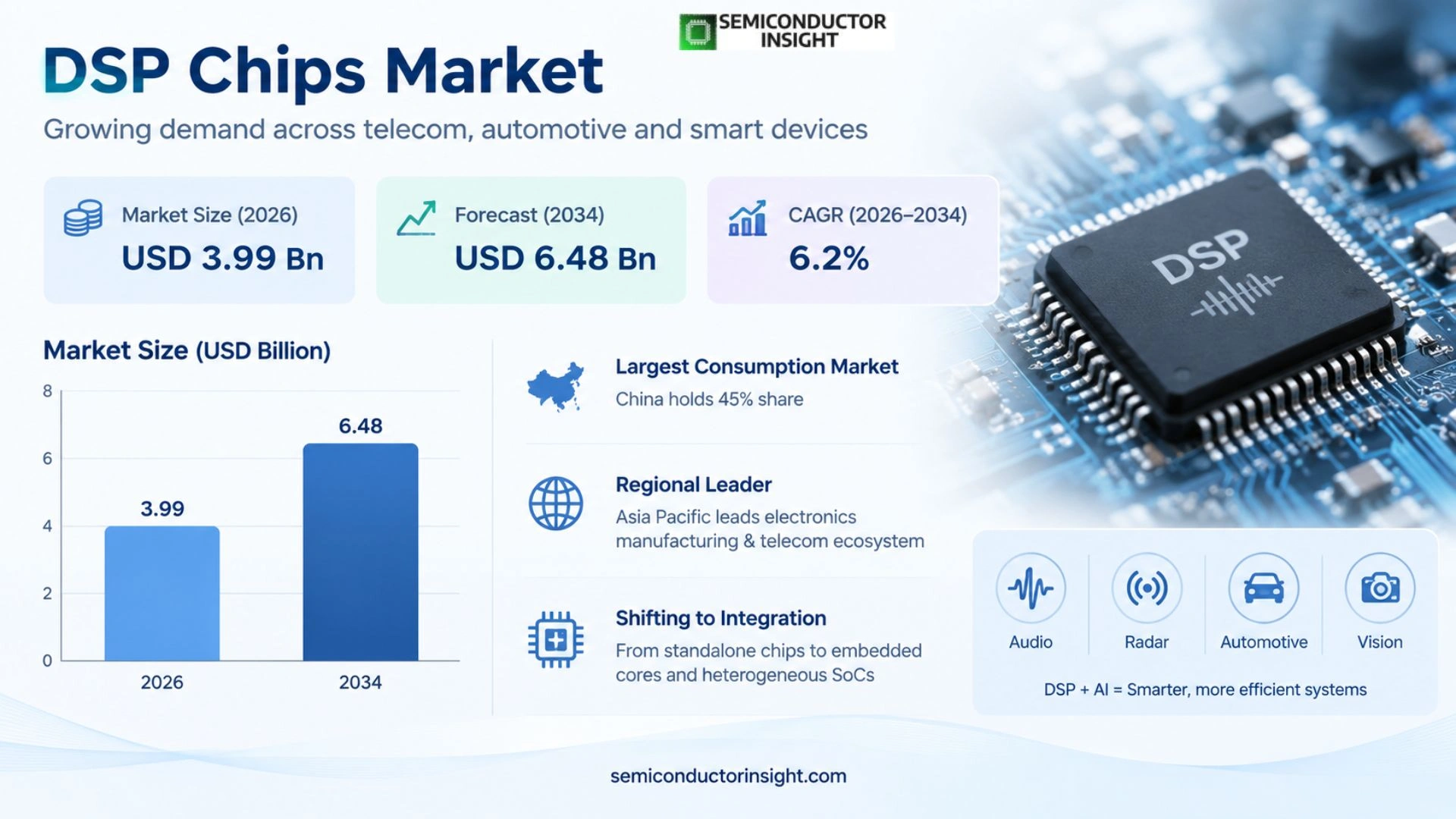
DSP Chips market is estimated at USD 3.76 billion in 2025 and is projected to reach USD 6.48 billion by 2034, representing a 6.2% CAGR during 2026–2034. The 2026 estimated market size is USD 3.99 billion. China is the largest consumption market with a 45% share, while Asia Pacific leads the broader electronics manufacturing and telecommunications ecosystem.
Digital signal processors are optimized for repetitive arithmetic on streaming data such as multiply-accumulate, filtering, Fourier transforms, beamforming, audio effects, radar processing and communications algorithms. Their value comes from deterministic real-time execution, specialized addressing, parallel arithmetic and memory architectures that can move data efficiently without the control overhead of a general-purpose CPU.
The market is changing from a simple standalone-chip model toward a continuum of standalone DSPs, embedded DSP cores and heterogeneous SoCs. Dedicated devices remain important in professional audio, industrial control and high-reliability systems, while high-volume mobile, automotive and vision platforms increasingly integrate DSP capability beside CPUs, GPUs and AI accelerators. This integration reduces component count and power while allowing signal-processing workloads to remain optimized for vector and fixed-function execution.
AI does not eliminate DSP demand; it changes where DSP sits in the compute hierarchy. Radar, audio, communications and sensor pipelines still require deterministic pre-processing, filtering and feature extraction before neural inference. Modern SoCs therefore combine DSP and AI acceleration so that classical signal processing, sensor fusion and machine learning can share data efficiently.
Segment Analysis: By Type
By type, the market covers Single-core DSP and Multi-core DSP. Single-core devices remain the dominant category with more than 70% share because many established applications need predictable processing at moderate compute levels, while multi-core DSPs gain importance in radar, wireless infrastructure and high-performance audio where parallel workloads and greater throughput justify higher complexity.
| Type | Architecture and use case | Market position |
|---|---|---|
| Single-core DSP | Single-core devices concentrate deterministic signal-processing capability in one optimized compute core, often with hardware multipliers, MAC units, DMA and specialized memory. They are efficient for audio, control, modulation, filtering and many industrial workloads that do not need broad thread-level parallelism. | Largest type, above 70% share. Mature software ecosystems, lower power and predictable timing support continued use across communications, consumer electronics and industrial systems. |
| Multi-core DSP | Multi-core DSPs run multiple signal-processing tasks in parallel or split large workloads across cores. They are suited to beamforming, radar, baseband processing and advanced audio where latency and throughput targets exceed the capability of one DSP core. | A higher-performance growth segment. Adoption rises as 5G, imaging radar and complex sensor processing demand more parallelism, but development and memory orchestration are more complex. |
Processing capability and integration-level segmentation
The market also segments by processing capability and integration level. General-purpose DSPs remain the leading processing category because programmability allows one architecture to serve many applications. Application-specific and high-performance DSPs trade flexibility for power or throughput advantages. At the integration level, SoCs with DSP functionality are the strongest architectural trend because they combine control, connectivity, AI and real-time signal processing in one package.
| Axis | Segments | Commercial implication |
|---|---|---|
| By Processing Capability | General-Purpose DSP · Application-Specific DSP · High-Performance DSP | General-purpose DSPs maximize software reuse, application-specific devices optimize power and cost for fixed workloads, and high-performance DSPs target radar, wireless infrastructure and demanding audio or scientific processing. |
| By Integration Level | Standalone DSP Chips · Embedded DSP Cores · System-on-Chip (SoC) with DSP | Standalone devices preserve maximum flexibility and long lifecycle, embedded cores add dedicated signal processing inside another IC, and SoCs integrate DSP with CPU, AI, memory and connectivity for compact high-volume systems. |
Segment Analysis: By Application
By application, Communication Devices lead the market with 43% share, followed by consumer electronics, computers and other applications. Communications infrastructure and devices use DSPs for modulation, demodulation, filtering, channel estimation, echo cancellation, beamforming and coding, while automotive and industrial systems are becoming important growth areas.
| Application | Demand characteristics |
|---|---|
| Communication Devices | The largest application includes smartphones, base stations, routers, radios and modem systems. DSPs execute modulation, coding, filtering, channel estimation and beamforming with tight latency budgets. 5G and evolving wireless standards increase algorithm complexity and support higher-performance vector DSP architectures. |
| Consumer Electronics | Televisions, smart speakers, headphones, cameras and home electronics use DSP for audio enhancement, noise reduction, image pipelines and voice interfaces. Cost and power are critical, so DSP functionality is often integrated into codecs, application processors or connectivity SoCs rather than sold as a separate chip. |
| Computer | PCs, workstations and embedded compute systems use DSPs in audio subsystems, accelerators, communications and specialized peripheral functions. The segment is smaller than communications but benefits from richer audio, conferencing and AI-assisted media processing. |
| Automotive & Industrial | Radar, active noise cancellation, motor control, machine vision and sensor fusion create high-value DSP demand. Automotive systems require functional safety and deterministic latency, while industrial users value long product availability and real-time performance. |
Regional Analysis
Asia Pacific leads the DSP Chips market, with China representing the largest consumption market at about 45% share. The region combines smartphone, telecom, consumer-electronics and automotive manufacturing with a broad semiconductor assembly ecosystem. North America remains a major DSP design and innovation center, while Europe is strong in automotive, industrial and communications applications.
How do regional DSP demand mechanisms differ?
DSP consumption follows electronics manufacturing and communications infrastructure, while design leadership is more geographically distributed. China has the largest consumption base, North America hosts major DSP and SoC vendors, Europe has strong automotive and industrial semiconductor demand, and Japan, South Korea and Taiwan contribute manufacturing and system integration. Emerging regions create demand mainly through telecom deployment and imported electronic systems.
| Region | Market position | Growth outlook | Demand profile | What decides supplier selection |
|---|---|---|---|---|
| Asia Pacific | Largest consumption region | High | Telecom, electronics & automotive | Cost, volume and integration |
| North America | Design and innovation hub | High | Industrial, aerospace, AI & communications | Performance, tools and software ecosystem |
| Europe | Specialized high-value market | Moderate to high | Automotive & industrial | Safety, lifecycle and deterministic performance |
| South America | Emerging | Moderate | Telecom & consumer electronics | Cost and platform availability |
| Middle East & Africa | Developing | Moderate | 5G, smart infrastructure & IoT | Connectivity and ruggedness |
Competitive Landscape
Key participants include Texas Instruments, Analog Devices, NXP Semiconductors, STMicroelectronics, Cirrus Logic, Qualcomm, onsemi, DSP Group, AMD, CETC No.38 Research Institute, NJR Semiconductor, Renesas, Microchip, Infineon and Intel. The market is consolidated at the top but fragmented by application because audio, radar, telecom and industrial systems value different DSP architectures.
Texas Instruments remains a core DSP supplier and is extending DSP capability into heterogeneous automotive SoCs. Its current C7000-based products combine vector DSPs with Arm cores and AI acceleration for audio, radar and vision. This approach preserves optimized signal processing while sharing memory and safety functions with the rest of the system.
Analog Devices maintains a strong standalone-DSP position through SHARC+ and the newer SHARC-FX family. Current SHARC+ devices operate up to 1 GHz and include large on-chip SRAM and audio interfaces. The product model is attractive in professional audio and industrial systems where deterministic latency, mature development tools and long product availability are more important than smartphone-style integration.
NXP and Qualcomm illustrate the trend toward embedded DSP inside larger SoCs. NXP’s radar processors use dedicated signal-processing engines beside Arm CPUs, while Qualcomm’s Hexagon architecture combines scalar, vector and tensor processing inside mobile platforms. These designs expand the functional reach of DSP technology even when the market no longer counts every DSP core as a standalone chip.
Competitive tier structure
| Tier | Companies | Basis of competition |
|---|---|---|
| Standalone / industrial DSP leaders | Texas Instruments; Analog Devices; Microchip; Renesas | Real-time DSP cores, development tools, long lifecycle, industrial and professional audio support |
| Automotive & mixed-signal leaders | NXP Semiconductors; STMicroelectronics; Infineon; onsemi | Radar, automotive audio, sensor processing, safety and integrated control |
| Integrated mobile / compute DSP | Qualcomm; AMD; Intel; Cirrus Logic | DSP cores inside SoCs, audio/image pipelines, AI-assisted signal processing and high-volume integration |
Key companies profiled in the report scope
- Texas Instruments
- Analog Devices, Inc.
- NXP Semiconductors N.V.
- STMicroelectronics
- Cirrus Logic, Inc.
- Qualcomm Incorporated
- ON Semiconductor
- DSP Group, Inc.
- Advanced Micro Devices, Inc. (AMD)
- CETC No.38 Research Institute
- NJR Semiconductor (New Japan Radio Co., Ltd.)
- Renesas Electronics Corporation
- Microchip Technology Inc.
- Infineon Technologies AG
- Intel Corporation
DSP Chip Design, Foundry & Software Capacity Analysis
DSP supply capacity depends on semiconductor foundry allocation, package/test capacity and software-development capability. Many DSP vendors are fabless or use mixed manufacturing models, so physical chip output can scale through external foundries. The harder constraint is often engineering capacity: compilers, optimized libraries, reference software and customer support determine whether new silicon can be adopted efficiently.
Standalone DSPs often use mature process nodes because deterministic performance, analog integration and long lifecycle matter more than maximum transistor density. Heterogeneous SoCs can use more advanced nodes to integrate DSP, CPU, GPU and AI engines within a tight power envelope. Vendors therefore manage different foundry strategies across industrial, automotive and mobile product families.
Software is a major form of capacity because customers need optimized signal-processing libraries, debuggers, compilers and real-time frameworks. A theoretically faster DSP can lose a design if engineers cannot port algorithms or meet timing quickly. Large vendors invest heavily in IDEs, auto-vectorizing compilers and model-based tools to reduce customer development effort.
Market Dynamics
Growth is driven by 5G and communications, automotive radar and audio, industrial automation, smart consumer devices and heterogeneous AI processing. Restraints include competition from general-purpose CPUs/GPUs, rapid obsolescence, semiconductor supply constraints and power budgets. Opportunities center on integrated DSP+AI architectures, imaging radar, software-defined audio and edge signal processing.
MARKET DRIVERS
Drivers Impact Analysis*
| Factor | Forecast impact* | Geographic relevance | Impact timeline |
|---|---|---|---|
| 5G and communications infrastructure | High | Asia Pacific, North America, Europe | Persistent |
| Automotive radar and in-cabin audio | High | Europe, Asia Pacific, North America | Medium to long term |
| Industrial automation and edge sensing | Medium to high | Global | Persistent |
| Integrated DSP + AI SoCs | High | Mobile, automotive, vision | Medium term |
*Directional analytical rating; it is not a measured contribution to the headline CAGR.
Communications requires deterministic vector processing
Wireless systems perform modulation, demodulation, channel estimation, coding and beamforming continuously. These workloads map well to vector DSPs because they involve repeated arithmetic on streaming data with strict latency. Each new radio standard increases bandwidth and algorithm complexity, supporting higher-performance DSP and SoC architectures.
Automotive radar expands high-value DSP workloads
Imaging radar processes many antenna channels and must identify objects in real time under rain, fog and darkness. NXP’s S32R47 shows how radar processors combine dedicated signal-processing engines with safety CPUs. As Level 2+ and higher ADAS adoption grows, radar processing becomes an important specialized DSP market.
Audio remains a durable DSP application
Professional audio, automotive sound systems, conferencing and consumer devices use DSP for equalization, echo cancellation, spatial audio and active noise control. These workloads require low latency and predictable timing, which keeps dedicated DSP architectures relevant even as general-purpose processors become faster.
AI increases heterogeneous signal-processing demand
Sensor and communications pipelines often need classical DSP before neural inference. Filtering, beamforming and feature extraction can reduce the data sent to an NPU and improve overall power efficiency. Modern SoCs therefore combine DSP and AI accelerators rather than replacing one with the other.
MARKET RESTRAINTS
Restraints Impact Analysis*
| Factor | Forecast impact* | Geographic relevance | Impact timeline |
|---|---|---|---|
| CPU/GPU/NPU substitution | High | Integrated consumer systems | Persistent |
| Rapid architecture obsolescence | Medium to high | Mobile & communications | Persistent |
| Power constraints | Medium | Battery and edge devices | Persistent |
| Foundry and supply concentration | Medium | Global | Short to medium term |
*Directional analytical rating; it is not a measured contribution to the headline CAGR.
General-purpose and AI processors absorb some DSP workloads
CPUs, GPUs and NPUs have become more capable and can execute signal-processing algorithms that previously required a separate DSP. In highly integrated consumer devices, eliminating a standalone component can lower cost. DSP vendors must therefore offer better power, deterministic latency or software efficiency to justify dedicated silicon.
Fast standards cycles increase development risk
Wireless, automotive and consumer interfaces change quickly. A DSP designed for one generation may lose competitiveness before development costs are recovered. Vendors mitigate this with programmable architectures and reusable cores, but they still need frequent compiler, library and silicon updates.
Performance must fit tight power budgets
Mobile, wearable and edge devices cannot run high-performance DSP continuously at desktop power levels. Designers need clock gating, specialized accelerators and efficient memory access. Poor data movement can consume more energy than arithmetic, making architecture and software optimization essential.
External foundry dependence can constrain supply
Fabless DSP and SoC vendors compete for wafer capacity with many other semiconductor products. Automotive and industrial customers also demand long product lifecycles. Suppliers must balance advanced-node performance with the supply stability of mature process technologies.
MARKET OPPORTUNITIES
Combine DSP and AI in heterogeneous SoCs
A DSP can handle filtering, spectral analysis and sensor pre-processing while an NPU runs neural inference. Sharing memory and interconnect reduces data movement and can improve power efficiency. This architecture is attractive in automotive radar, cameras, audio and industrial edge systems.
Expand imaging radar processors
Higher-resolution automotive radar requires more FFT, beamforming and object-processing throughput. Dedicated DSP and radar accelerators can provide deterministic performance at lower power than general-purpose compute. Safety certification and scalable software create strong barriers to entry and long vehicle-platform lifecycles.
Modernize professional audio DSP
Immersive audio, active noise control and software-defined vehicle sound systems require more channels and more complex processing. New SHARC-FX and C7x-based products can target higher sample rates, more filters and AI-assisted audio features while preserving deterministic low latency.
License DSP cores into broader SoCs
Vendors can monetize DSP architecture without selling every device as a standalone chip. Embedded cores inside MCUs, connectivity chips, application processors and custom ASICs expand the installed base and create software ecosystem value across many end markets.
DSP Chip Value Chain Analysis
Architecture and tools determine usable performance
Peak operations per second matter only if compilers and libraries map real algorithms efficiently to the hardware. DSP vendors invest in instruction sets, DMA, memory hierarchy and vector libraries so customers can meet latency without hand-optimizing every kernel.
Foundry choice balances density and lifecycle
Industrial DSPs can remain on mature nodes for years because software investment and supply stability matter more than shrinking geometry. High-volume heterogeneous SoCs move to newer nodes to improve performance per watt. The market therefore spans a wide range of process technologies.
System integration defines the winning form factor
A standalone DSP is ideal when developers need flexible high-performance signal processing, while embedded cores and SoCs reduce board area and component count. Analog front ends, RF transceivers and sensors increasingly determine how much data the DSP must process and how tightly functions should be integrated.
Software support creates long customer relationships
DSP algorithms are often deeply embedded in product firmware and validated over years. Changing architecture can require porting filters, codecs, control loops and safety software. Vendors with stable tools and backward compatibility gain strong switching barriers once a platform reaches production.
Recent Developments in the DSP Chips Market
Analog Devices updates SHARC-FX processor enablement
Analog Devices updated optimization and hardware documentation for its new SHARC-FX generation, extending high-performance real-time DSP development for audio and industrial applications.
Analog Devices SHARC+ data sheet reaches Rev. A
ADI updated the ADSP-21560/61/64/68 family documentation, supporting up to 1 GHz SHARC+ processing with large on-chip SRAM and hardware signal-processing accelerators.
Qualcomm launches Snapdragon 8 Elite Gen 5 for Galaxy
The mobile SoC integrates the Hexagon processing architecture with CPU and GPU resources for on-device AI, imaging and signal-processing workloads, demonstrating the continuing shift toward embedded DSP inside heterogeneous application processors.
NXP unveils S32R47 imaging-radar processors
NXP introduced its third-generation radar processor family in 16 nm FinFET technology, targeting Level 2+ to Level 4 automated-driving functions with dedicated radar-processing acceleration and safety features.
TI expands C7000-based automotive DSP SoCs
Texas Instruments’ current audio and radar DSP SoC portfolio combines C7000 DSP technology with Arm cores and, in selected devices, AI acceleration for automotive audio, radar and vision-processing workloads.
REPORT SCOPE & SEGMENTATION
| Attribute | Details |
|---|---|
| Study Period | 2020–2034 |
| Base Year | 2025 |
| Estimated Year | 2026 |
| Forecast Period | 2026–2034 |
| Historical Period | 2020–2025 |
| Market Size 2025 | USD 3.76 billion |
| Market Size 2034 | USD 6.48 billion |
| Growth Rate | CAGR of 6.2% from 2026–2034 |
| Unit | Value (USD Million/Billion) and chip shipments |
| Segmentation | By Type, By Application, By End User, By Processing Capability, By Integration Level, By Region |
| By Type | Single core DSP · Multi-core DSP |
| By Application | Communication Device · Consumer Electronics · Computer · Others |
| By End User | Original Equipment Manufacturers (OEMs) · Telecommunication Service Providers · Industrial & Automotive Enterprises |
| By Processing Capability | General-Purpose DSP · Application-Specific DSP · High-Performance DSP |
| By Integration Level | Standalone DSP Chips · Embedded DSP Cores · System-on-Chip (SoC) with DSP |
| By Region | Each region analysed by DSP type, application, end user, processing capability, integration level and country marketNorth AmericaUnited States, Canada, MexicoEuropeGermany, Netherlands, France, Italy and other European marketsAsia PacificChina, Japan, South Korea, Taiwan, India, Southeast Asia and other Asian marketsSouth AmericaBrazil, Argentina and other South American marketsMiddle East & AfricaUAE, Saudi Arabia, South Africa and other MEA markets |
| Key Companies Profiled | Texas Instruments · Analog Devices, Inc. · NXP Semiconductors N.V. · STMicroelectronics · Cirrus Logic, Inc. · Qualcomm Incorporated · ON Semiconductor · DSP Group, Inc. · Advanced Micro Devices, Inc. (AMD) · CETC No.38 Research Institute · NJR Semiconductor (New Japan Radio Co., Ltd.) · Renesas Electronics Corporation · Microchip Technology Inc. · Infineon Technologies AG · Intel Corporation |
| Customization Scope | Free report customization equivalent to up to four analyst working days with purchase. Addition or alteration to country, regional and segment scope. |
Frequently Asked Questions
What is the 2025 size of the DSP Chips market?
The market size is USD 3.76 billion in 2025 and is projected to reach USD 6.48 billion by 2034. The 2026 estimate is USD 3.99 billion and the 2026–2034 CAGR is 6.2%, based on the long-term market growth path.
Which DSP type leads the market?
Single-core DSP chips lead with more than 70% share in the current market structure. They remain widely used because many communications, audio and industrial workloads need deterministic signal processing at moderate compute levels and can achieve lower power and simpler software than a multi-core architecture.
Which application is the largest?
Communication devices are the largest application with 43% share. DSPs are fundamental to base stations, modems, radios, routers and smartphones because these systems continuously execute filtering, modulation, coding, channel estimation and beamforming under strict real-time constraints.
Which geography leads DSP consumption?
China is the largest consumption market with about 45% share, supported by its large electronics manufacturing and telecommunications base. The broader Asia Pacific region also leads through smartphone, automotive, networking and consumer-electronics production in China, South Korea, Japan and Taiwan.
What is the estimated market size in 2026?
The 2026 estimated market size is USD 3.99 billion. Growth is supported by 5G infrastructure, automotive radar, industrial automation, professional audio and increasing use of embedded DSP cores inside heterogeneous SoCs.
Why are DSPs still relevant when CPUs and GPUs are faster?
DSPs are optimized for repetitive real-time arithmetic and predictable data movement. They can execute filters, FFTs, beamforming and control loops with lower latency and power than a general-purpose processor. In modern systems they often work beside CPUs, GPUs and NPUs rather than competing with them directly.
What is the role of DSP in automotive radar?
Radar processors use DSP and dedicated accelerators for FFT, beamforming, detection and tracking across many antenna channels. NXP’s S32R47 family demonstrates the trend toward combining specialized signal engines with safety CPUs for higher-resolution Level 2+ to Level 4 sensing.
What are the main market restraints?
The main restraints are substitution by integrated CPUs, GPUs and NPUs, rapid standards-driven obsolescence, strict power budgets and dependence on semiconductor foundries. Standalone DSP suppliers must therefore differentiate through deterministic performance, software tools, long lifecycle and application-specific acceleration.
What is the most important architectural trend?
The strongest trend is DSP integration into heterogeneous SoCs. TI, Qualcomm and NXP combine DSP or dedicated signal-processing engines with Arm CPUs, AI accelerators and connectivity. This reduces board components and data movement while preserving optimized real-time processing for audio, communications, radar and vision.
What does the report cover?
The report covers single-core and multi-core DSPs; communications, consumer, computer and other applications; OEM, telecom and industrial/automotive end users; general-purpose, application-specific and high-performance DSPs; standalone, embedded and SoC integration; five global regions; capacity analysis; and all profiled companies.
Research Sources & Evidence Base
View primary and authoritative evidence used in this overview
- Texas Instruments. Audio & Radar DSP SoCs – Official current portfolio covering C7000-based DSP SoCs for automotive audio, radar, vision and embedded real-time processing.
- Analog Devices. Digital Signal Processors Portfolio – Official product portfolio covering SHARC+, SHARC-FX and other current DSP families.
- Analog Devices. ADSP-21561 SHARC+ DSP – Official device data covering up to 1 GHz processing, on-chip SRAM and hardware FIR/IIR acceleration.
- NXP Semiconductors. S32R47 Imaging Radar Processor – Official product evidence on radar-processing engines, Arm cores, safety and automotive imaging-radar use.
- Qualcomm. Snapdragon 8 Elite Gen 5 – Official SoC specification showing Hexagon scalar, vector and tensor processing integrated with CPU and GPU resources.
Get Sample Report PDF for Exclusive Insights
Report Sample Includes
- Table of Contents
- List of Tables & Figures
- Charts, Research Methodology, and more...
 Download Sample Report PDF