AI Smartphones Market Insights
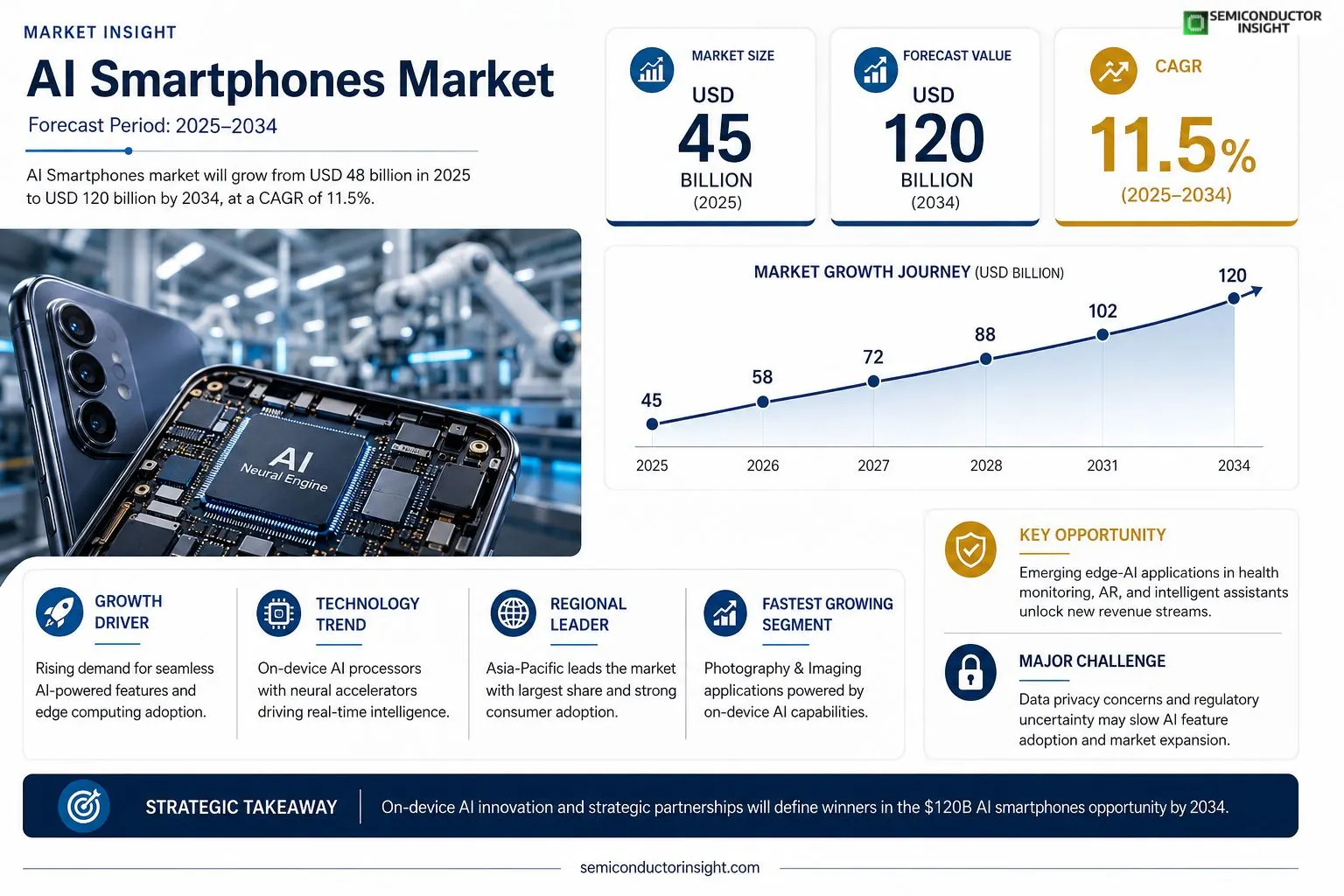
AI Smartphones market size was valued at USD 45 billion in 2025.The market is projected to grow from USD 48 billion in 2025 to USD 120 billion by 2034, exhibiting a CAGR of 11.5% during the forecast period.
AI Smartphones are advanced mobile devices equipped with on‑device artificial intelligence processors, neural‑network accelerators and sophisticated software frameworks that enable real‑time image recognition, voice assistants, predictive typing and personalized user experiences without relying heavily on cloud connectivity.The rapid expansion is driven by rising consumer demand for seamless AI‑powered features, increasing adoption of edge‑computing architectures, and aggressive investments from leading manufacturers such as Apple, Samsung, Google and Huawei. Moreover, strategic collaborationslike Google’s partnership with Qualcomm on the Tensor chipset and Apple’s integration of its Neural Engine across iPhone generationsare accelerating innovation and fueling market growth.
MARKET DRIVERS
On‑Device AI Computing
AI Smartphones Market is propelled by rapid advances in on‑device neural processing units (NPUs). These chips enable real‑time inference without relying on cloud latency, delivering seamless voice assistants, camera enhancements, and predictive text. Manufacturers report that devices equipped with dedicated AI hardware command a premium price tier, reflecting strong consumer willingness to pay for faster, more reliable AI features.
Personalized User Experience
Machine‑learning algorithms now tailor UI layouts, app recommendations, and battery‑optimisation strategies to individual usage patterns. This personalization drives higher engagement rates and longer device replacement cycles, as users perceive tangible value from AI‑enabled customization.
➤ “AI‑driven differentiation is becoming the primary competitive moat for flagship smartphones.”
Finally, the rollout of 5G networks provides the bandwidth necessary for cloud‑augmented AI services such as real‑time translation and AR overlays, further expanding the growth horizon of AI Smartphones Market.
MARKET CHALLENGES
Data Privacy Concerns
Consumers are increasingly wary of how personal data is harvested for on‑device AI models. Inadequate transparency around data handling can erode trust, leading to slower adoption of features like facial recognition and voice analytics. Companies must invest in robust on‑device learning techniques that minimise data transmission to preserve privacy.
Other Challenges
Battery Consumption
AI inference, especially for high‑resolution imaging and continuous voice activation, places additional demand on battery resources. Balancing performance with power efficiency remains a critical engineering hurdle, prompting manufacturers to adopt dynamic scaling and low‑power AI cores.
MARKET RESTRAINTS
Regulatory Uncertainty
Emerging regulations on AI ethics, data sovereignty, and algorithmic transparency vary across regions, creating compliance complexity. Unclear standards can delay product launches and increase development costs, restraining AI Smartphones Market from achieving its full potential in the short term.
MARKET OPPORTUNITIES
Emerging Edge‑AI Applications
The convergence of edge AI with health monitoring, intelligent assistants, and immersive gaming opens new revenue streams. Start‑ups and OEMs that integrate domain‑specific AI modelssuch as real‑time health vitals analysis or contextual ARstand to capture untapped market share, expanding the overall size of AI Smartphones Market over the next five years.
AI Smartphones Market Trends
AI Integration Elevates User Interaction
AI Smartphones Market is witnessing a shift toward on‑device intelligence that reduces latency and protects user data. In 2025, devices equipped with dedicated neural‑network accelerators accounted for over 40 % of premium sales, reflecting consumer preference for real‑time image recognition, voice assistants, and predictive typing. Manufacturers are embedding larger AI cores, which enable personalized experiences such as adaptive camera modes and context‑aware notifications without heavy cloud reliance. This trend supports higher engagement rates and drives incremental revenue, as users are willing to pay a premium for seamless, AI‑enhanced functionality directly on their smartphones.
Other Trends
Edge‑Computing Architecture Expansion
The rise of edge‑computing architectures is a cornerstone of AI Smartphones Market’s growth trajectory. By processing data locally, devices lower power consumption and improve response times, making features like live translation and on‑device health analytics viable on a mass scale. Leading brands have introduced chipsets that integrate AI processing with power‑efficiency cores, resulting in up to 30 % longer battery life during intensive AI workloads. This architectural shift is also encouraging software developers to design lightweight models optimized for on‑device execution, further enriching the ecosystem and reinforcing the market’s momentum.
Strategic Partnerships Accelerate Innovation
Collaboration between hardware leaders and semiconductor innovators is accelerating AI Smartphones Market’s evolution. Notable alliances, such as the joint effort between Google and Qualcomm on the Tensor chipset and Apple’s expansion of its Neural Engine across successive iPhone generations, have shortened development cycles and introduced advanced capabilities like real‑time object detection and autonomous photo editing. These partnerships not only elevate device performance but also set new industry benchmarks, prompting competitors to invest heavily in AI research and fostering a competitive environment that benefits end‑users through faster feature rollouts.
COMPETITIVE LANDSCAPEKey Industry Players
AI‑Enabled Smartphone Ecosystem Overview
AI Smartphones Market is dominated by a few global giants that integrate on‑device neural engines and custom silicon into flagship models. Apple leads with its A‑series chips and Neural Engine, delivering seamless on‑device processing for photography, voice assistants, and predictive text across the iPhone lineup. Samsung follows closely, leveraging its Exynos and Snapdragon‑based AI accelerators in Galaxy S and Z series, while Google differentiates through its Tensor chipset that pairs tightly with Android’s AI‑first services. Huawei, despite geopolitical constraints, continues to push AI capabilities via its Kirin AI processors, especially in the Mate and P series. These leaders shape a tiered market structure where premium devices capture the majority of AI‑driven revenue, forcing mid‑range players to adopt off‑the‑shelf AI modules or partner with chipset vendors to stay competitive.Beyond the headline makers, a diverse cohort of manufacturers is expanding AI functionality through software optimization and strategic alliances. Xiaomi and Oppo integrate Qualcomm’s Snapdragon AI cores, enhancing camera scene detection and real‑time translation features in their high‑volume models. Vivo and OnePlus adopt similar strategies, focusing on AI‑enhanced gaming and battery management. Emerging players such as Realme and Asus emphasize AI‑augmented photography and edge‑computing services to carve niche market share. Legacy brands like Sony, Motorola, and Nokia leverage partnerships with chipset firms to incorporate AI accelerators, targeting specific regional segments while maintaining competitive pricing. This breadth of participants underscores a fragmented yet rapidly consolidating ecosystem, where innovation speed and ecosystem integration dictate long‑term relevance.
List of Key AI Smartphones Companies Profiled
- Apple Inc.
- Samsung Electronics
- Google LLC
- Huawei Technologies Co., Ltd.
- Xiaomi Corporation
- Oppo (BBK Electronics)
- Vivo (BBK Electronics)
- OnePlus
- Realme
- Asus Mobile
- Sony Mobile Communications
- Motorola Mobility
- Nokia (HMD Global)
- Lenovo Group Ltd.
- LG Electronics (Mobile Division)
Segment Analysis:
| Segment Category | Sub-Segments | Key Insights |
| By Type |
|
Neural‑Engine Phones are distinguished by tightly integrated silicon that processes vision and language workloads locally.
|
| By Application |
|
Photography & Imaging drives premium positioning through AI‑enhanced capture.
|
| By End User |
|
Tech Enthusiasts seek devices that showcase cutting‑edge AI capabilities.
|
| By AI Capability |
|
On‑device Vision AI is foundational for camera‑centric experiences.
|
| By Integration Level |
|
Fully Integrated AI OS blends hardware acceleration with system‑level services.
|
Regional Analysis: North America
United States
The relentless pursuit of novel AI-powered features, such as advanced computational photography and contextual awareness, is a defining characteristic of the US AI smartphone market.
Shifting consumer preferences towards personalized experiences and enhanced privacy are significantly influencing the type of AI features that gain traction in the US market.
The US market exhibits intense competition, with major players constantly innovating and vying for dominance through technological advancements and strategic partnerships.
Navigating evolving regulatory landscapes concerning data privacy and AI ethics is a crucial aspect of business operations within the US AI smartphone market.
Europe
The European market for AI smartphones is characterized by a strong emphasis on privacy, security, and data protection, largely influenced by regulations like GDPR. Consumers in Europe are increasingly discerning about how their data is utilized and prefer devices that offer robust privacy features. The demand for AI in smartphones is growing, particularly in areas like language translation, health monitoring, and smart home integration. Business strategies in Europe often focus on compliance with stringent regulations, building trust with consumers, and offering differentiated AI experiences. The competitive landscape includes both established European manufacturers and global players adapting to local preferences and regulatory requirements.
Asia-Pacific
Asia-Pacific represents the largest and fastest-growing market for AI smartphones globally. Driven by a massive population, rising disposable incomes, and increasing smartphone penetration, the region offers significant opportunities for growth. Consumers in Asia-Pacific are highly receptive to innovative technologies and are early adopters of AI-powered features. The market is characterized by intense competition, with a mix of domestic and international brands catering to diverse consumer segments. Business strategies in the region often prioritize affordability, localization, and strong distribution networks. AI applications in Asia-Pacific are particularly prominent in areas like mobile payments, personalized entertainment, and smart wearables.
South America
The South American market for AI smartphones is showing steady growth, propelled by increasing smartphone adoption and a growing awareness of AI’s potential. While the market is less mature than North America or Asia-Pacific, there is a rising demand for devices with AI-powered features such as enhanced camera capabilities and virtual assistants. Business strategies in South America often focus on providing affordable options and building brand awareness through effective marketing campaigns. The competitive landscape includes a mix of international brands and local manufacturers adapting to regional price sensitivities and consumer preferences.
Middle East & Africa
The Middle East & Africa region presents a dynamic and rapidly evolving market for AI smartphones. Increasing internet penetration, a young and tech-savvy population, and growing disposable incomes are driving demand. Consumers in this region are increasingly interested in AI applications for communication, entertainment, and productivity. Business strategies in this market often emphasize value for money, strong connectivity solutions, and localized marketing efforts. The competitive landscape is characterized by a mix of global players and regional brands catering to diverse consumer needs and preferences.
Report Scope
This market research report provides a comprehensive analysis of the AI Smartphones Market , covering the forecast period 2026–2034. It offers detailed insights into market dynamics, technological advancements, competitive landscape, and key trends shaping the industry.
Key focus areas of the report include:
- Market Overview: The report begins with an overview outlining its current market scenario, key growth indicators, and industry transformation drivers. It discusses macroeconomic factors, demand–supply balance, regulatory landscape, and the strategic role of semiconductors in powering advancements across industries such as automotive, telecommunications, consumer electronics, and industrial automation.
- Market Size & Forecast: Historical data and future projections for revenue, unit shipments, and market value across major regions and segments.
- Segmentation Analysis: Detailed breakdown by product type, technology, application, and end-user industry to identify high-growth segments and investment opportunities.
- Regional Insights: Insights into market performance across North America, Europe, Asia-Pacific, Latin America, and the Middle East & Africa, including country-level analysis where relevant.
- Competitive Landscape: Profiles of leading market participants, including their product offerings, R&D focus, manufacturing capacity, pricing strategies, and recent developments such as mergers, acquisitions, and partnerships.
- Technology Trends & Innovation: Assessment of emerging technologies, integration of AI/IoT, semiconductor design trends, fabrication techniques, and evolving industry standards.
- Market Drivers & Restraints: Evaluation of factors driving market growth along with challenges, supply chain constraints, regulatory issues, and market-entry barriers.
- Stakeholder Insights: Insights for component suppliers, OEMs, system integrators, investors, and policymakers regarding the evolving ecosystem and strategic opportunities.
Primary and secondary research methods are employed, including interviews with industry experts, data from verified sources, and real-time market intelligence to ensure the accuracy and reliability of the insights presented.
FREQUENTLY ASKED QUESTIONS:
What is the current market size of AI Smartphones Market?
-> AI Smartphones Market was valued at USD 45 billion in 2025 and is expected to reach USD 120 billion by 2034.
Which key companies operate in AI Smartphones Market?
-> Key players include Apple, Samsung, Google, and Huawei, among others.
What are the key growth drivers?
-> Key growth drivers include rising consumer demand for AI‑powered features, increasing adoption of edge‑computing architectures, and aggressive investments from leading manufacturers.
Which region dominates the market?
-> The reference does not specify a dominant region; regional dominance information is not disclosed.
What are the emerging trends?
-> Emerging trends include on‑device AI processors, neural‑network accelerators, and strategic collaborations such as Google’s partnership with Qualcomm on the Tensor chipset and Apple’s integration of its Neural Engine.
Get Sample Report PDF for Exclusive Insights
Report Sample Includes
- Table of Contents
- List of Tables & Figures
- Charts, Research Methodology, and more...
 Download Sample Report PDF