Bistable Cholesteric LCD (ChLCD) Market Insights
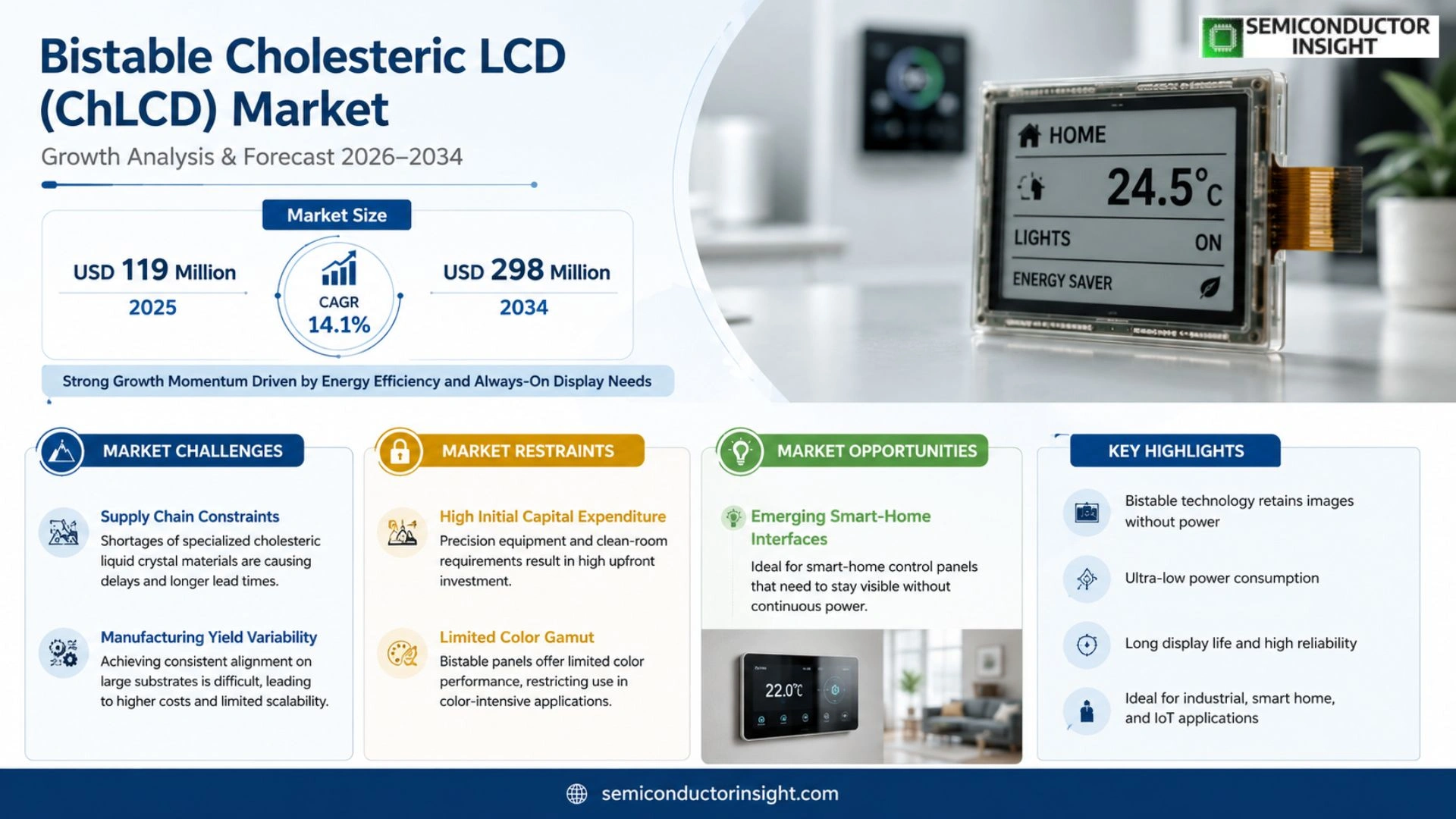
Global Bistable Cholesteric LCD (ChLCD) market size was valued at USD 119 million in 2025 and expands to USD 298 million by 2034, reflecting a compound annual growth rate of 14.1 % over the forecast horizon.
Bistable Cholesteric LCD (ChLCD) is a reflective liquid‑crystal display that retains an image without continuous power input; energy is consumed only during refresh cycles. This characteristic makes ChLCD ideal for ultra‑low‑power applications such as e‑readers and electronic shelf labels, where near‑zero static power draw, high ambient‑light readability, stable image retention, and reduced battery maintenance are critical.
The market gains momentum because ultra‑low‑power display infrastructure is expanding faster than traditional consumer replacement cycles. Demand concentrates on electronic shelf labels and dedicated reading devices where bistability directly cuts energy usage and service costs across large deployments; consequently, manufacturers focus on yield stability, long‑term supply reliability, and multi‑year program support rather than rapid feature turnover.
MARKET DRIVERS
Energy‑Efficient Display Adoption
Bistable Cholesteric LCD (ChLCD) Market benefits from manufacturers seeking screens that retain images without power. Recent product roll‑outs in e‑readers demonstrate that a display that can stay static for weeks dramatically cuts battery demand, prompting OEMs to prioritize this technology over conventional backlit panels.
Growth of Low‑Power IoT Devices
IoT gateways, smart signage, and wearables increasingly require visual feedback without draining limited energy stores. The bistable nature of cholesteric LCDs aligns perfectly with these constraints, leading design teams to integrate them into next‑generation sensors and control panels.
➤ “A display that can hold its image for up to 30 days without refresh reshapes power budgeting for portable devices.” – Industry analyst
Beyond energy savings, the intrinsic sunlight readability of cholesteric panels opens new avenues for outdoor information kiosks, where glare‑free visibility has historically been a barrier for traditional LCDs.
MARKET CHALLENGES
Supply Chain Constraints
Raw‑material shortages, especially for the specialized cholesteric liquid crystal mixtures, have introduced bottlenecks that delay product launches. End‑users report longer lead times, nudging some buyers toward more readily available technologies.
Other Challenges
Manufacturing Yield Variability
Achieving consistent cell alignment across large substrates remains technically demanding. Yield gaps inflate per‑unit costs, making price‑sensitive segments hesitant to commit large volumes.
Furthermore, the niche nature of bistable displays limits the pool of qualified contract manufacturers, which in turn constricts scaling possibilities for emerging applications.
MARKET RESTRAINTS
High Initial Capital Expenditure
Setting up production lines for cholesteric LCDs requires precision equipment and rigorous clean‑room protocols. The upfront investment often exceeds the budget thresholds of mid‑size firms, curbing broader market participation.
Limited Color Gamut
Although bistable panels excel at grayscale and limited‑palette displays, they struggle to match the vivid color range demanded by premium consumer electronics. This technical limitation narrows the addressable market to specific segments where color depth is secondary.
MARKET OPPORTUNITIES
Emerging Smart‑Home Interfaces
Smart‑home control panels that must remain legible during power outages are a natural fit for Bistable Cholesteric LCD (ChLCD) Market. Manufacturers are prototyping wall‑mounted thermostats and lighting controllers that leverage the display’s ability to hold information without continuous power, creating a differentiated user experience.
Automotive Instrumentation Niche
Automakers seeking to reduce cabin power draw are exploring bistable displays for secondary gauges and infotainment prompts. Early pilot programs indicate that integrating cholesteric panels can shave several watts from the vehicle’s electrical load, a measurable advantage for electric vehicle range optimization.
Bistable Cholesteric LCD (ChLCD) Market Trends
Ultra‑Low‑Power Display Infrastructure Fuels Demand
The most visible shift in Bistable Cholesteric LCD (ChLCD) Market stems from the migration of retail and reading platforms toward displays that can stay visible without continuous power. Electronic shelf labels and dedicated e‑readers exploit the technology’s ability to keep an image static for months, trimming energy bills and reducing battery swap cycles. Because the display consumes power only when the content is refreshed, operators can deploy thousands of units in a single venue without fearing excessive electricity draw. This characteristic aligns tightly with sustainability goals pushed by large retailers, which in turn makes the technology a preferred choice over conventional back‑lit panels for static‑information use cases.
Other Trends
Supply Chain Consolidation and Yield Management
Upstream, the market hinges on a narrow set of bistable liquid‑crystal manufacturers and specialty glass suppliers such as Merck, JNC, Corning, AGC and IRICO Group. Their limited number creates a natural barrier to entry, concentrating risk around material consistency. Midstream firms focus on cell‑assembly techniques that guarantee long‑term image retention while minimizing seal failures; a 60 % capacity utilization rate in 2025 demonstrates that many players are still balancing line throughput against the need for stringent quality control. Gross margins hovered near 36 % last year, suggesting that firms that can improve yield without sacrificing reliability are positioned to capture disproportionate earnings.
Profitability Pressures and Customer Ownership‑Cost Focus
Future profit dynamics will revolve around total cost of ownership rather than feature‑driven pricing wars. Large‑scale buyers increasingly evaluate suppliers on their ability to deliver stable field performance over multi‑year programs, because unexpected downtime translates directly into operational expense. Companies that can lock in material supply, honor delivery schedules and keep customization costs in check will likely secure repeat contracts from e‑reader manufacturers and shelf‑label operators. Conversely, firms that chase niche customizations without a clear margin cushion risk eroding profitability as customers shift toward vendors offering predictable, low‑maintenance solutions.
COMPETITIVE LANDSCAPE
Key Industry Players
Bistable Cholesteric LCD (ChLCD) Competitive Landscape 2025‑2032
The market is anchored by a handful of vertically integrated manufacturers that control both cell engineering and module assembly. AU Optronics (AUO) and Iris Optronics together capture roughly one‑third of global shipments, leveraging deep expertise in glass‑substrate processing and proprietary bistable liquid‑crystal formulations. Their ability to sustain yield rates above 95 % underpins long‑term contracts with e‑reader giants and large‑scale electronic‑shelf‑label operators. Mid‑tier firms such as Kent Displays, Varitronix and Fujitsu Frontech focus on niche form‑factors—particularly sub‑4 inch passive‑matrix panels—where they can differentiate on price per unit while maintaining the margin discipline demanded by low‑volume OEMs. The tiered structure creates a competitive dynamic where scale players defend market share through capacity reliability, whereas specialized suppliers compete on customization speed and application‑specific integration.
Beyond the core display manufacturers, a secondary cohort of material and component specialists exerts outsized influence on profitability. Companies like Merck, JNC and Corning dominate the supply of bistable liquid‑crystal mixtures and high‑purity glass, dictating cost baselines for downstream assemblers. Meanwhile, emerging module integrators such as New Vision Display, Sharp and TCL have begun to offer turnkey solutions that bundle sealing technology, driver ICs and firmware, thereby reducing the total cost of ownership for end users. This layered ecosystem forces traditional display makers to cooperate closely with material vendors and to invest in process automation, lest they face margin erosion from bespoke development projects.
List of Key Bistable Cholesteric LCD Companies Profiled
- AU Optronics
- Iris Optronics
- Kent Displays
- Varitronix
- Fujitsu Frontech
- New Vision Display
- Sharp
- Samsung Display
- LG Display
- TCL
- BOE Technology
- Tianma Microelectronics
- Japan Display Inc. (JDI)
Segment Analysis:
| Segment Category | Sub-Segments | Key Insights |
| By Type |
|
Active Matrix ChLCDs
|
| By Application |
|
Electronic Shelf Labels
|
| By End User |
|
Retail (ESL)
|
| By Screen Size |
|
4‑7 Inch
|
| By Resolution |
|
160×128
|
Regional Analysis: Bistable Cholesteric LCD (ChLCD) Market
Europe
European manufacturers draw on a dense network of specialty chemical firms that supply the cholesteric mixtures essential for bistable operation. This vertical integration shortens procurement cycles and enables rapid prototyping, granting European OEMs a competitive edge in time‑to‑market for custom display solutions.
Smart signage, public‑transport information boards, and low‑energy medical monitoring devices dominate European demand. Regulators’ focus on standby‑power limits pushes system integrators toward ChLCDs, which retain content without power.
The EU’s Ecodesign framework explicitly rewards technologies that eliminate continuous power draw. Companies that embed bistable cholesteric LCD modules can claim compliance credits, accelerating adoption across regulated markets.
Local firms wield first‑mover status in niche verticals, while global players eye partnerships with European material suppliers to secure a foothold in the region’s high‑value contracts.
North America
North America’s ChLCD market is shaped by a blend of consumer‑device innovators and defense contractors seeking displays that retain imagery without power. The United States leverages its deep talent pool in advanced optics to experiment with flexible bistable panels for wearable robotics. However, the broader region still grapples with fragmented standards, which slows uniform rollout across retail and transportation sectors.
Asia‑Pacific
In Asia‑Pacific, the technology is embraced primarily by fast‑moving electronics manufacturers in China, South Korea, and Taiwan, who value the cost savings of a display that eliminates standby power. Rapid scaling of smart‑city infrastructure fuels pilot projects, yet the market’s growth pace is tempered by lingering concerns over material sourcing and long‑term reliability in humid climates.
South America
South American adopters focus on low‑cost public‑information displays for metro stations and bus terminals, where the ability to retain data without electricity aligns with intermittent power‑grid reliability. Local manufacturers are still building expertise in cholesteric formulation, leading them to partner with European suppliers for material inputs.
Middle East & Africa
The Middle East & Africa region views ChLCDs as a strategic tool for energy‑constrained environments, especially in remote tourism sites and desert‑based logistics hubs. Investment in pilot installations is growing, but the scarcity of regional chemical producers means most projects rely on imports, adding cost pressures that limit large‑scale deployment.
Report Scope
This market research report provides a comprehensive analysis of the Bistable Cholesteric LCD (ChLCD) Market , covering the forecast period 2026–2034. It offers detailed insights into market dynamics, technological advancements, competitive landscape, and key trends shaping the industry.
Key focus areas of the report include:
- Market Overview: The report begins with an overview outlining its current market scenario, key growth indicators, and industry transformation drivers. It discusses macroeconomic factors, demand–supply balance, regulatory landscape, and the strategic role of semiconductors in powering advancements across industries such as automotive, telecommunications, consumer electronics, and industrial automation.
- Market Size & Forecast: Historical data and future projections for revenue, unit shipments, and market value across major regions and segments.
- Segmentation Analysis: Detailed breakdown by product type, technology, application, and end-user industry to identify high-growth segments and investment opportunities.
- Regional Insights: Insights into market performance across North America, Europe, Asia-Pacific, Latin America, and the Middle East & Africa, including country-level analysis where relevant.
- Competitive Landscape: Profiles of leading market participants, including their product offerings, R&D focus, manufacturing capacity, pricing strategies, and recent developments such as mergers, acquisitions, and partnerships.
- Technology Trends & Innovation: Assessment of emerging technologies, integration of AI/IoT, semiconductor design trends, fabrication techniques, and evolving industry standards.
- Market Drivers & Restraints: Evaluation of factors driving market growth along with challenges, supply chain constraints, regulatory issues, and market-entry barriers.
- Stakeholder Insights: Insights for component suppliers, OEMs, system integrators, investors, and policymakers regarding the evolving ecosystem and strategic opportunities.
Primary and secondary research methods are employed, including interviews with industry experts, data from verified sources, and real-time market intelligence to ensure the accuracy and reliability of the insights presented.
FREQUENTLY ASKED QUESTIONS:
What is the current market size of Bistable Cholesteric LCD (ChLCD) Market?
-> Bistable Cholesteric LCD (ChLCD) market size was valued at USD 119 million in 2025 and expands to USD 298 million by 2034
Which key companies operate in Bistable Cholesteric LCD (ChLCD) Market?
-> Key players include AUO, Iris Optronics, Kent Displays, Varitronix, Fujitsu Frontech, and New Vision Display, among others.
What are the key growth drivers?
-> Key growth drivers include the expansion of ultra‑low‑power display infrastructure, increasing adoption of electronic shelf labels and e‑readers, and the need for energy‑efficient, long‑duration information displays that reduce battery and maintenance costs.
Which region dominates the market?
-> The report indicates that demand is spread across major regions with no single region explicitly identified as dominant; growth is driven globally by applications in e‑readers and electronic shelf tags.
What are the emerging trends?
-> Emerging trends include focus on yield stability, long‑term supply reliability, support for multi‑year program contracts, and efforts to maintain material consistency while avoiding margin erosion from excessive customization.
Get Sample Report PDF for Exclusive Insights
Report Sample Includes
- Table of Contents
- List of Tables & Figures
- Charts, Research Methodology, and more...
 Download Sample Report PDF