BGA Heat Sinks Market Insights
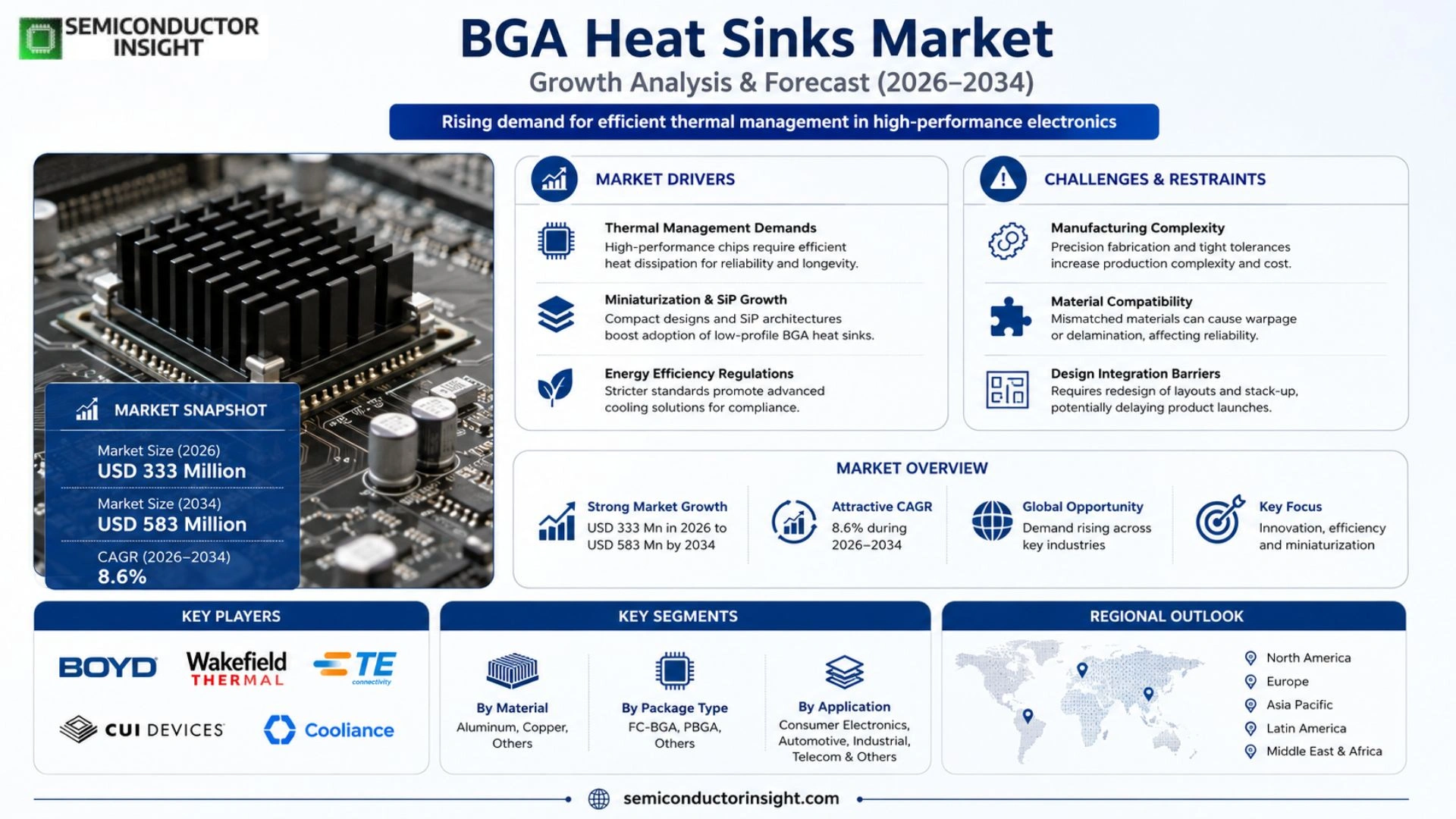
BGA Heat Sinks market is forecasted to increase from USD 333 million in 2026 to USD 583 million by 2034, reflecting a CAGR of 8.6% over the forecast period.
BGA heat sinks are simple extruded metal parts mounted on ball‑grid‑array devices; they are frequently cross‑cut into pins, enabling use across motherboards, video cards and other high‑performance platforms.
The expansion occurs because rising power densities in modern electronics raise the need for effective thermal solutions, while improvements in extrusion processes lower production costs. Recent product launches from firms such as Boyd and TE Connectivity illustrate competitive activity, and strong adoption in the United States and China underscores regional momentum.
MARKET DRIVERS
Thermal Management Demands in High‑Performance Electronics
Modern processors, graphics units, and power‑dense modules generate heat levels that exceed the capacity of legacy cooling solutions. Manufacturers are turning to BGA Heat Sinks Market offerings because they provide a low‑profile, efficient pathway to dissipate heat directly from ball‑grid‑array (BGA) packages. Enhanced thermal conductivity translates into longer device lifespans and fewer warranty claims, which directly influences profit margins.
Shift Toward Miniaturization and System‑in‑Package (SiP) Architectures
The industry’s push for thinner, lighter devices forces designers to integrate multiple functions within a single footprint. BGA heat sinks complement SiP strategies by fitting within tight board spaces while still delivering the required cooling performance. Space‑saving geometry enables OEMs to meet aggressive form‑factor targets without compromising reliability.
➤ “Effective heat removal is no longer optional; it is a core criterion for product qualification.”
Regulatory scrutiny on energy efficiency also nudges the market. Standards that penalize excessive power draw indirectly promote thermal solutions that maintain component efficiency under load. Companies that adopt advanced BGA heat sink designs can demonstrate compliance while differentiating their product portfolios.
MARKET CHALLENGES
Manufacturing Complexity and Cost Sensitivity
Fabricating precision‑engineered heat sinks that align with fine‑pitch BGA arrays requires specialized tooling and tight process control. Small‑to‑mid‑size producers often face higher unit costs compared with standard thermal pads, limiting their ability to compete on price alone.
Other Challenges
Material Compatibility
Selecting alloys that balance thermal conductivity, coefficient of thermal expansion, and solder‑ability remains a nuanced task. Mismatches can lead to warpage or delamination, undermining product reliability.
MARKET RESTRAINTS
Design Integration Barriers
Integrating a BGA heat sink into an existing board layout often requires redesign of mechanical clearances and PCB stack‑up. This additional engineering effort can delay time‑to‑market, especially for firms with constrained R&D resources.
Supply Chain Volatility
Fluctuations in raw material availability, particularly for high‑purity copper and aluminum alloys, can create lead‑time uncertainties. Companies that lack diversified sourcing strategies may experience production bottlenecks.
MARKET OPPORTUNITIES
Emerging Applications in Edge Computing
Edge devices power AI inference at the network periphery, demanding compact yet powerful cooling. BGA heat sink solutions that deliver high thermal performance within a minimal footprint are positioned to capture a growing slice of this market segment.
Customization Through Additive Manufacturing
3‑D printing of metal heat sinks enables on‑demand production of geometry‑optimized designs tailored to specific BGA layouts. Early adopters can leverage this flexibility to shorten design cycles and offer differentiated products to niche customers.
BGA Heat Sinks Market Trends
Shift Toward Aluminum Extrusions
Manufacturers are increasingly favoring aluminum as the base material for heat‑sink designs. The metal’s low density and high thermal conductivity allow extruded fins to be thin yet efficient, meeting the thermal budgets of modern high‑density packages. Because the geometry can be cross‑cut into pin arrays, designers gain flexibility to address space‑constrained board layouts without sacrificing cooling performance. This material shift also aligns with broader sustainability initiatives, as aluminum recycling rates exceed those of copper, reducing overall production footprints while preserving functional reliability.
Other Trends
Application Diversification
Historically anchored to motherboards and video‑card GPUs, the product is now penetrating emerging segments such as edge‑AI accelerators and automotive infotainment modules. The rise of heterogeneous integration drives engineers to stack multiple BGA devices on a single substrate, intensifying localized heat. Pin‑type heat sinks, derived from cross‑cut extrusions, are being adopted to manage these hotspots without adding significant board height. As a result, vendors are customizing fin pitch and pin density to match the thermal profiles of specific workloads, creating a niche market for application‑specific solutions.
Consolidation Among Key Players
Competitive pressure is prompting a wave of strategic alliances and acquisitions. Companies such as Boyd and TE Connectivity have broadened their product portfolios through targeted purchases of smaller specialty manufacturers, enabling them to offer end‑to‑end thermal‑management solutions. This consolidation reduces the number of independent suppliers, but it also introduces more integrated design support, shortening time‑to‑market for OEMs. The resulting ecosystem favors customers who demand both component reliability and engineering services, encouraging larger players to invest in application‑specific engineering teams and faster prototype cycles.
COMPETITIVE LANDSCAPE
Key Industry Players
Competitive Dynamics in BGA heat sinks Market
BGA heat sink sector is anchored by a handful of vertically integrated manufacturers that command the majority of revenue. Boyd and Wakefield Thermal leverage long‑standing relationships with OEMs in the motherboard and video‑card segments, converting their extrusion expertise into high‑volume aluminum solutions that dominate the price‑sensitive tier. TE Connectivity, with its extensive global distribution network, differentiates through custom‑engineered copper‑based designs that address thermal constraints in high‑performance computing platforms. Meanwhile, CUI Devices and Cooliance have invested in automated cross‑cutting processes, enabling rapid pin conversion and thereby meeting the short lead‑times demanded by fast‑growth regions such as Southeast Asia. These leaders benefit from scale economies, broad product portfolios, and the ability to lock in supply contracts that preserve margin even as raw‑material costs fluctuate.
Beyond the top tier, a constellation of specialist firms adds depth to the competitive picture. Advanced Thermal Solutions and Ohmite focus on niche applications,industrial control units and power electronics,where reliability outweighs unit cost. Trenz Electronic and Magntek Electronic exploit regional manufacturing hubs in Germany and Taiwan to offer region‑specific material grades, enhancing responsiveness to local design trends. Emerging players such as COFAN USA, Broadlake, Suzhou Xunchuan Electronics, Shenzhen Lori Technology, and CTS Corporation are expanding their footprints through strategic acquisitions and targeted R&D, aiming to capture market share in the fast‑growing copper segment. Their agility allows them to pilot innovative fin geometries and surface‑treatment processes that senior OEMs are beginning to trial, suggesting a gradual shift toward differentiated thermal performance over pure cost competition.
List of Key BGA Heat Sinks Companies Profiled
- Boyd
- Wakefield Thermal
- Advanced Thermal Solutions
- Ohmite
- Trenz Electronic
- CTS Corporation
- CUI Devices
- TE Connectivity
- Cooliance
- Magntek Electronic
- COFAN USA
- Broadlake
- Suzhou Xunchuan Electronics
- Shenzhen Lori Technology
Segment Analysis:
| Segment Category | Sub-Segments | Key Insights |
| By Type |
|
Aluminum dominates the market due to its favorable balance of thermal conductivity, weight, and cost.
|
| By Application |
|
Motherboards represent the core adoption driver, as BGA devices on boards require reliable thermal paths.
|
| By End User |
|
Consumer Electronics lead due to the proliferation of compact, high‑performance devices.
|
| By Thermal Design Feature |
|
Pin‑Through designs are preferred for applications requiring high convection efficiency.
|
| By Integration Level |
|
Integrated Package is gaining traction as system‑in‑package (SiP) strategies mature.
|
Regional Analysis: BGA Heat Sinks Market
Smartphone and wearable makers are tightening thermal budgets, prompting designers to specify low‑profile BGA heat sinks that fit within slimmer chassis. The push for higher processing speeds intensifies heat flux, making efficient dissipation a decisive factor in product differentiation.
Electric‑vehicle power modules generate concentrated hotspots; integrating BGA heat sinks with ruggedized substrates helps maintain reliability under vibration and temperature cycling. OEMs are increasingly specifying these components to meet longevity targets.
Joint ventures between foundries and thermal‑solution firms are accelerating the rollout of fan‑out wafer‑level packaging that embeds BGA heat sinks directly into the substrate, shortening lead times and lowering assembly complexity.
Regional distributors are consolidating inventories to offer tier‑1 sourcing, reducing component shortages that previously hampered rapid product cycles in high‑growth markets.
North America
North America remains a pivotal market for BGA heat sinks, driven chiefly by the semiconductor design houses concentrated in Silicon Valley and the broader Midwest. Companies here prioritize performance validation and regulatory compliance, encouraging the adoption of heat‑sink solutions that meet stringent reliability standards. The presence of leading automotive OEMs experimenting with autonomous driving platforms adds a layer of complexity, as thermal management must accommodate both high‑speed processors and harsh operating environments. Consequently, U.S. suppliers are focusing on customizable designs and advanced simulation services to differentiate themselves, while Canadian firms leverage low‑cost manufacturing to capture niche segments in medical imaging and aerospace.
Europe
In Europe, BGA heat sinks Market is shaped by a strong emphasis on sustainability and energy efficiency across the industrial and consumer sectors. German and French manufacturers are investing in recyclable materials and heat‑sink geometries that reduce overall system power consumption. The region’s mature automotive supply chain, especially in Germany, demands heat‑sink solutions that can integrate with electric‑drive modules while adhering to stringent emissions legislation. Additionally, the growing health‑technology corridor in the Nordics stimulates demand for compact, reliable thermal components in portable diagnostic devices, prompting European producers to fine‑tune their product portfolios toward low‑mass, high‑efficiency offerings.
South America
South America’s participation in BGA heat sinks Market is emerging, anchored by Brazil’s expanding electronics assembly sector and Argentina’s growing automotive parts industry. Local manufacturers are increasingly sourcing heat‑sink components to reduce dependence on imports, motivated by currency volatility and trade‑policy shifts. While overall volumes remain modest, the region is experimenting with hybrid metal‑ceramic designs that balance cost with the thermal performance needed for ruggedized equipment used in mining and agricultural applications. This strategic pivot is expected to solidify a more resilient local supply chain over the next decade.
Middle East & Africa
The Middle East & Africa region is witnessing nascent demand for BGA heat sinks, largely propelled by data‑center expansions in the United Arab Emirates and the rise of mobile‑network infrastructure across sub‑Saharan nations. Operators in these markets favor heat‑sink solutions that can endure high ambient temperatures and dust‑laden environments, prompting vendors to adapt protective coatings and robust mounting mechanisms. Moreover, the region’s investment in renewable‑energy projects, such as solar in Morocco, creates ancillary demand for thermal management in power‑electronics converters, indirectly reinforcing market footholds for specialized heat‑sink providers.
Report Scope
This market research report provides a comprehensive analysis of the BGA Heat Sinks Market , covering the forecast period 2026–2034. It offers detailed insights into market dynamics, technological advancements, competitive landscape, and key trends shaping the industry.
Key focus areas of the report include:
- Market Overview: The report begins with an overview outlining its current market scenario, key growth indicators, and industry transformation drivers. It discusses macroeconomic factors, demand–supply balance, regulatory landscape, and the strategic role of semiconductors in powering advancements across industries such as automotive, telecommunications, consumer electronics, and industrial automation.
- Market Size & Forecast: Historical data and future projections for revenue, unit shipments, and market value across major regions and segments.
- Segmentation Analysis: Detailed breakdown by product type, technology, application, and end-user industry to identify high-growth segments and investment opportunities.
- Regional Insights: Insights into market performance across North America, Europe, Asia-Pacific, Latin America, and the Middle East & Africa, including country-level analysis where relevant.
- Competitive Landscape: Profiles of leading market participants, including their product offerings, R&D focus, manufacturing capacity, pricing strategies, and recent developments such as mergers, acquisitions, and partnerships.
- Technology Trends & Innovation: Assessment of emerging technologies, integration of AI/IoT, semiconductor design trends, fabrication techniques, and evolving industry standards.
- Market Drivers & Restraints: Evaluation of factors driving market growth along with challenges, supply chain constraints, regulatory issues, and market-entry barriers.
- Stakeholder Insights: Insights for component suppliers, OEMs, system integrators, investors, and policymakers regarding the evolving ecosystem and strategic opportunities.
Primary and secondary research methods are employed, including interviews with industry experts, data from verified sources, and real-time market intelligence to ensure the accuracy and reliability of the insights presented.
FREQUENTLY ASKED QUESTIONS:
What is the current market size of BGA Heat Sinks Market?
-> BGA Heat Sinks Market is projected to reach USD 583 million by 2034, at a CAGR of 8.6% during the forecast period.
Which key companies operate in BGA Heat Sinks Market?
-> Key players include Boyd, Wakefield Thermal, Advanced Thermal Solutions, Ohmite, Trenz Electronic, CTS Corporation, CUI Devices, TE Connectivity, Cooliance, Magntek Electronic, etc.
What are the key growth drivers?
-> Key growth drivers include rising demand for high‑performance electronics, increasing use of BGA devices in motherboards and video cards, and the need for efficient thermal management solutions.
Which region dominates the market?
-> North America (United States) and Asia (China) are the most significant regions, with the United States and China representing the largest market volumes.
What are the emerging trends?
-> Emerging trends include cross‑cut extrusion designs that convert fins into pins for versatile applications, greater adoption of aluminum and copper materials for improved thermal performance, and expanding use in motherboards and video‑card segments.

Get Sample Report PDF for Exclusive Insights
Report Sample Includes
- Table of Contents
- List of Tables & Figures
- Charts, Research Methodology, and more...
 Download Sample Report PDF