Automotive Vision Processor (ISP + CNN) Market Insights
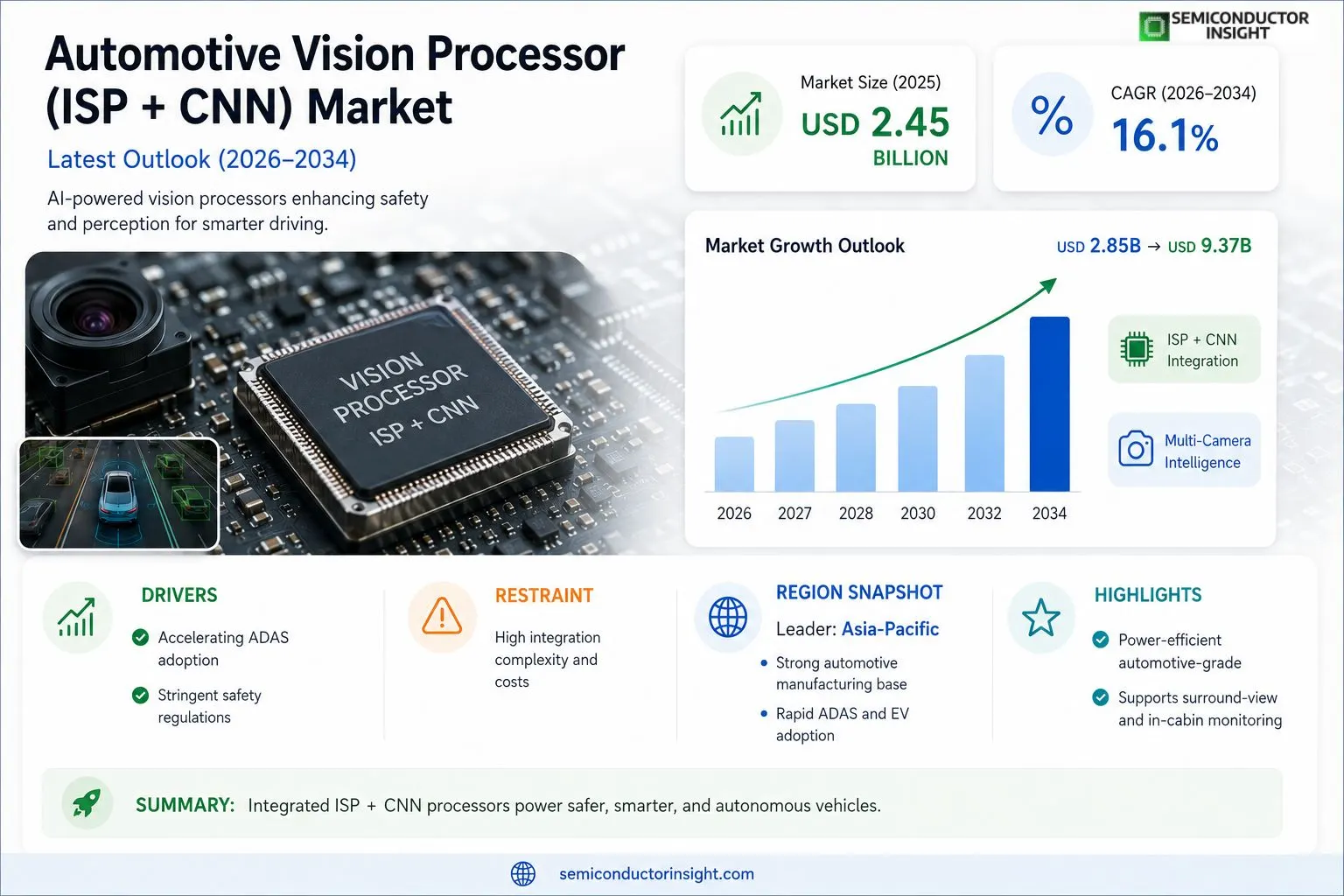
Global Automotive Vision Processor (ISP + CNN) market size was valued at USD 2.45 billion in 2025. The market is projected to grow from USD 2.85 billion in 2026 to USD 9.37 billion by 2034, exhibiting a CAGR of 16.1% during the forecast period.
Automotive Vision Processors integrating Image Signal Processors (ISP) and Convolutional Neural Networks (CNN) are specialized semiconductor solutions designed to handle real-time image and video data from vehicle cameras. These processors enhance raw sensor data through noise reduction, dynamic range optimization, and color correction via the ISP component, while the embedded CNN accelerators enable advanced perception tasks such as object detection, lane recognition, pedestrian identification, and semantic segmentation critical for Advanced Driver Assistance Systems (ADAS) and autonomous driving applications.
The market is experiencing rapid growth due to several factors, including the accelerating adoption of ADAS features across vehicle segments, stringent government safety regulations mandating camera-based systems, and the ongoing shift toward higher levels of vehicle autonomy. Furthermore, the rising demand for multi-camera surround-view systems and in-cabin monitoring solutions contributes significantly to market expansion. Innovations by key players continue to drive progress, with a strong emphasis on power-efficient designs suitable for automotive-grade reliability and functional safety requirements. Major companies operating in this space offer comprehensive portfolios that support the integration of vision processing with AI capabilities to meet evolving industry needs.
MARKET DRIVERS
Rising ADAS and Autonomous Driving Adoption
Automotive Vision Processor (ISP + CNN) Market is propelled by the rapid integration of advanced driver assistance systems (ADAS) and progress toward higher levels of vehicle autonomy. These processors combine image signal processing for high-quality visual data with CNN capabilities for real-time object detection, lane tracking, and environmental perception, essential for safety features like automatic emergency braking and adaptive cruise control.
Expansion of High-Resolution Camera Systems
Modern vehicles increasingly deploy multiple high-resolution cameras, driving demand for efficient vision processors capable of handling large data volumes with low latency. The surge in camera-based sensing, supported by growing EV adoption and smart cockpit features, further accelerates market expansion as manufacturers seek optimized ISP + CNN solutions for superior image quality and AI-driven analytics. [[1]](https://www.gminsights.com/industry-analysis/automotive-image-signal-processor-market)
➤ Government safety regulations and NCAP requirements continue to mandate enhanced vision capabilities, boosting the need for integrated ISP and CNN processors in new vehicle platforms.
Technological advancements in edge AI and sensor fusion are enabling more sophisticated vision processing directly in vehicles, reducing reliance on centralized computing while improving response times and power efficiency for real-time automotive applications.
MARKET CHALLENGES
High Integration Complexity and Costs
Developing and integrating Automotive Vision Processor (ISP + CNN) solutions involves significant engineering challenges, including sensor calibration, software optimization, and ensuring compliance with stringent automotive safety standards such as ISO 26262. These factors contribute to elevated system costs that can limit adoption, particularly among smaller OEMs and in price-sensitive markets.
Other Challenges
Power Consumption and Thermal Management
Vision processors must deliver high-performance CNN inference and ISP functions while operating within tight power budgets, especially in electric vehicles where energy efficiency directly impacts range. Balancing computational demands with thermal constraints remains a key technical hurdle.
Real-Time Processing Demands
Handling multiple high-resolution camera streams with minimal latency for safety-critical decisions requires advanced architectures, creating ongoing challenges in algorithm optimization and hardware efficiency.
MARKET RESTRAINTS
Supply Chain and Functional Safety Requirements
Stringent automotive qualification processes and the need for functional safety compliance significantly restrain faster market penetration for Automotive Vision Processor (ISP + CNN) technologies. High development costs combined with complex supply chain requirements for ASIL-rated components limit scalability across diverse vehicle segments. The integration of vision processors with existing vehicle architectures demands substantial validation and testing, extending time-to-market and increasing overall project expenses for automakers transitioning to software-defined vehicles.
MARKET OPPORTUNITIES
Edge AI and Multi-Sensor Fusion Advancements
Emerging opportunities in Automotive Vision Processor (ISP + CNN) Market arise from the shift toward edge-based AI processing and sophisticated multi-sensor fusion systems. Innovations integrating ISP pipelines directly with neural network accelerators enable more efficient, low-power solutions optimized for L2+ and higher autonomy levels. Growing demand for in-cabin monitoring, surround-view systems, and enhanced ADAS features in mass-market vehicles presents substantial growth potential, particularly as costs decrease and performance improves through specialized semiconductor designs.
Automotive Vision Processor (ISP + CNN) Market Trends
Integration of ISP and CNN Accelerators Driving Real-Time Perception
Automotive Vision Processors integrating Image Signal Processors (ISP) and Convolutional Neural Networks (CNN) are specialized semiconductor solutions designed to handle real-time image and video data from vehicle cameras. These processors enhance raw sensor data through noise reduction, dynamic range optimization, and color correction via the ISP component, while the embedded CNN accelerators enable advanced perception tasks such as object detection, lane recognition, pedestrian identification, and semantic segmentation critical for Advanced Driver Assistance Systems (ADAS) and autonomous driving applications.
Other Trends
Rising Demand for Multi-Camera Systems and In-Cabin Monitoring
The market is experiencing rapid growth due to several factors, including the accelerating adoption of ADAS features across vehicle segments, stringent government safety regulations mandating camera-based systems, and the ongoing shift toward higher levels of vehicle autonomy. Furthermore, the rising demand for multi-camera surround-view systems and in-cabin monitoring solutions contributes significantly to market expansion.
Focus on Power Efficiency and Automotive-Grade Reliability
Innovations by key players continue to drive progress, with a strong emphasis on power-efficient designs suitable for automotive-grade reliability and functional safety requirements. Major companies operating in this space offer comprehensive portfolios that support the integration of vision processing with AI capabilities to meet evolving industry needs. These advancements ensure that vision processors can operate effectively in demanding automotive environments while maintaining the high performance levels required for safety-critical applications. The combination of ISP preprocessing and CNN-based inference within a single chip reduces latency and power consumption compared to traditional multi-chip solutions, enabling broader deployment in both premium and mass-market vehicles.
COMPETITIVE LANDSCAPE
Key Industry Players
Competitive Dynamics in Automotive Vision Processor (ISP + CNN) Market
Automotive Vision Processor Market integrating ISP and CNN capabilities is dominated by a select group of semiconductor leaders with strong expertise in automotive-grade AI acceleration and image processing. Mobileye (Intel) maintains a commanding position through its EyeQ series, widely adopted for camera-based ADAS perception, while NVIDIA leverages its DRIVE platform and Orin/Thor SoCs to target higher autonomy levels with powerful CNN processing. These frontrunners benefit from deep OEM relationships and vertically integrated software-hardware solutions that meet stringent ASIL functional safety standards.
Other significant players include specialized vision SoC providers such as Ambarella, which excels in power-efficient AI vision processors for multi-camera systems, alongside established automotive chipmakers like NXP Semiconductors, Renesas Electronics, Texas Instruments, and ON Semiconductor. These companies focus on scalable, reliable solutions that combine traditional ISP pipelines with embedded neural network accelerators, supporting the industry’s shift toward centralized compute architectures for surround-view and in-cabin monitoring applications.
List of Key Automotive Vision Processor Companies Profiled
- Mobileye (Intel)
- NVIDIA Corporation
- Ambarella, Inc.
- NXP Semiconductors
- Renesas Electronics Corporation
- Texas Instruments Incorporated
- ON Semiconductor (onsemi)
- STMicroelectronics
- Qualcomm Technologies, Inc.
- Horizon Robotics
- Socionext Inc.
- OmniVision Technologies
- VeriSilicon Microelectronics
Segment Analysis:
| Segment Category | Sub-Segments | Key Insights |
| By Type |
|
Integrated ISP + CNN SoCs represent the dominant approach as they deliver seamless real-time processing by combining image signal optimization with AI inference on a single chip. This architecture reduces latency significantly while optimizing power consumption essential for automotive environments. Key advantages include simplified system integration for camera modules, enhanced functional safety compliance through unified hardware, and superior handling of complex visual scenes under varying lighting and weather conditions. Manufacturers prioritize these solutions to support multiple camera streams simultaneously without compromising performance. |
| By Application |
|
Advanced Driver Assistance Systems (ADAS) lead adoption due to the critical need for reliable real-time vision processing in safety-critical features. These processors excel at enhancing raw camera feeds for accurate object detection, lane marking recognition, and traffic sign interpretation. Integration of ISP and CNN enables robust performance across diverse driving scenarios, supporting features like automatic emergency braking and adaptive cruise control. The segment benefits from continuous innovation in edge AI capabilities that allow faster decision-making while maintaining automotive-grade reliability and thermal efficiency. |
| By End User |
|
Automotive OEMs are the primary drivers as they integrate vision processors directly into next-generation vehicle platforms. They demand highly reliable solutions that align with stringent safety standards and support scalable architectures across vehicle lineups. OEMs focus on processors that facilitate smooth fusion of vision data with other sensor inputs for comprehensive environmental understanding. This end-user group emphasizes long-term partnerships with semiconductor providers to ensure supply chain stability and customized feature development tailored to specific brand requirements and regional preferences. |
| By Vehicle Type |
|
Premium and Luxury Vehicles lead in sophisticated vision processor deployment by incorporating multiple high-resolution cameras and advanced AI features. These vehicles utilize the full potential of ISP+CNN integration for superior image quality and intelligent scene analysis that enhances both safety and comfort systems. The segment drives innovation toward higher computational capabilities while maintaining low power profiles suitable for premium automotive electrical architectures. Luxury manufacturers leverage these processors to differentiate their offerings through enhanced autonomous capabilities and intelligent driver monitoring that improve overall user experience. |
| By Functionality |
|
Object Detection & Classification stands out as the core functionality powering reliable environmental perception. Integrated ISP+CNN processors deliver exceptional accuracy in identifying vehicles, pedestrians, cyclists, and obstacles under challenging conditions through optimized image preprocessing and neural network acceleration. This functionality enables proactive safety responses and forms the foundation for higher autonomy levels. Continuous enhancements focus on reducing false positives while improving detection range and speed, making it indispensable for both current ADAS features and future self-driving applications across diverse operating environments. |
Regional Analysis: Automotive Vision Processor (ISP + CNN) Market
Asia-Pacific
Asia-Pacific benefits from dense clusters of semiconductor and automotive talent, fostering rapid prototyping of vision processors. Collaborative R&D between suppliers and vehicle manufacturers ensures that ISP and CNN architectures evolve to meet stringent performance requirements for safety-critical applications.
The region’s advanced production facilities enable cost-effective scaling of complex vision processor chips. This manufacturing prowess supports timely integration into both premium and mass-market vehicles, strengthening supply chain resilience for Automotive Vision Processor (ISP + CNN) solutions.
Growing middle-class consumers in Asia-Pacific increasingly expect sophisticated safety and convenience features, driving OEMs to embed powerful vision processors. This demand encourages continuous enhancement of CNN algorithms for better object recognition and scene understanding.
Supportive regulatory frameworks and incentives for autonomous and electric mobility create fertile ground for vision processor deployment. Policymakers emphasize road safety technologies, directly boosting integration of ISP+CNN processors across vehicle fleets.
North America
North America maintains a strong position in Automotive Vision Processor (ISP + CNN) Market through leadership in software algorithms and system integration. The region’s focus on premium vehicles and advanced autonomy projects drives demand for high-accuracy vision processors capable of processing complex visual data in real time. Tech giants and automotive incumbents invest heavily in refining CNN models that enhance perception reliability, particularly for highway pilot and urban navigation scenarios. Collaborative ecosystems between Silicon Valley innovators and traditional Detroit manufacturers accelerate the development of robust solutions tailored to stringent safety standards.
Europe
Europe excels in Automotive Vision Processor (ISP + CNN) Market with its emphasis on safety regulations and sustainable mobility. German, French, and Swedish automakers integrate sophisticated vision processors to comply with rigorous functional safety requirements while delivering refined driving experiences. The region’s engineering expertise shines in developing power-efficient designs that balance performance with thermal management in compact vehicle architectures. Strong intellectual property frameworks encourage continuous innovation in image signal processing techniques optimized for European road conditions and multi-sensor environments.
South America
South America is emerging in Automotive Vision Processor (ISP + CNN) Market as local manufacturers gradually adopt advanced safety technologies. While infrastructure challenges persist, growing interest in ADAS features for both passenger and commercial vehicles stimulates demand for cost-effective vision processors. Partnerships with global technology providers help introduce ISP+CNN solutions adapted to regional driving patterns, including varied terrain and lighting conditions. This market shows potential for steady growth as economic development supports greater vehicle sophistication.
Middle East & Africa
The Middle East and Africa region presents unique opportunities in Automotive Vision Processor (ISP + CNN) Market, particularly in luxury vehicle segments and fleet modernization efforts. Harsh environmental conditions drive the need for durable vision processors with superior image enhancement capabilities. Governments investing in smart cities and transportation infrastructure increasingly recognize the value of these technologies for improving road safety. Though adoption remains selective, strategic initiatives in key markets are laying foundations for broader integration of Automotive Vision Processor solutions across diverse vehicle categories.
Report Scope
This market research report provides a comprehensive analysis of the Automotive Vision Processor (ISP + CNN) Market , covering the forecast period 2026–2034. It offers detailed insights into market dynamics, technological advancements, competitive landscape, and key trends shaping the industry.
Key focus areas of the report include:
- Market Overview: The report begins with an overview outlining its current market scenario, key growth indicators, and industry transformation drivers. It discusses macroeconomic factors, demand–supply balance, regulatory landscape, and the strategic role of semiconductors in powering advancements across industries such as automotive, telecommunications, consumer electronics, and industrial automation.
- Market Size & Forecast: Historical data and future projections for revenue, unit shipments, and market value across major regions and segments.
- Segmentation Analysis: Detailed breakdown by product type, technology, application, and end-user industry to identify high-growth segments and investment opportunities.
- Regional Insights: Insights into market performance across North America, Europe, Asia-Pacific, Latin America, and the Middle East & Africa, including country-level analysis where relevant.
- Competitive Landscape: Profiles of leading market participants, including their product offerings, R&D focus, manufacturing capacity, pricing strategies, and recent developments such as mergers, acquisitions, and partnerships.
- Technology Trends & Innovation: Assessment of emerging technologies, integration of AI/IoT, semiconductor design trends, fabrication techniques, and evolving industry standards.
- Market Drivers & Restraints: Evaluation of factors driving market growth along with challenges, supply chain constraints, regulatory issues, and market-entry barriers.
- Stakeholder Insights: Insights for component suppliers, OEMs, system integrators, investors, and policymakers regarding the evolving ecosystem and strategic opportunities.
Primary and secondary research methods are employed, including interviews with industry experts, data from verified sources, and real-time market intelligence to ensure the accuracy and reliability of the insights presented.
FREQUENTLY ASKED QUESTIONS:
What is the current market size of Automotive Vision Processor (ISP + CNN) Market?
-> Automotive Vision Processor (ISP + CNN) Market was valued at USD 2.45 billion in 2025 and is expected to reach USD 9.37 billion by 2034.
Which key companies operate in Automotive Vision Processor (ISP + CNN) Market?
-> Key players include leading semiconductor firms specializing in automotive vision solutions, among others.
What are the key growth drivers?
-> Key growth drivers include accelerating adoption of ADAS features across vehicle segments, stringent government safety regulations mandating camera-based systems, and the ongoing shift toward higher levels of vehicle autonomy.
Which region dominates the market?
-> Asia-Pacific is the fastest-growing region, while North America and Europe remain dominant markets.
What are the emerging trends?
-> Emerging trends include power-efficient designs for automotive-grade reliability, integration of ISP and CNN accelerators, and support for multi-camera surround-view and in-cabin monitoring systems.

Get Sample Report PDF for Exclusive Insights
Report Sample Includes
- Table of Contents
- List of Tables & Figures
- Charts, Research Methodology, and more...
 Download Sample Report PDF