Automotive Photoelectric Sensors and Inductive Sensors Market Insights
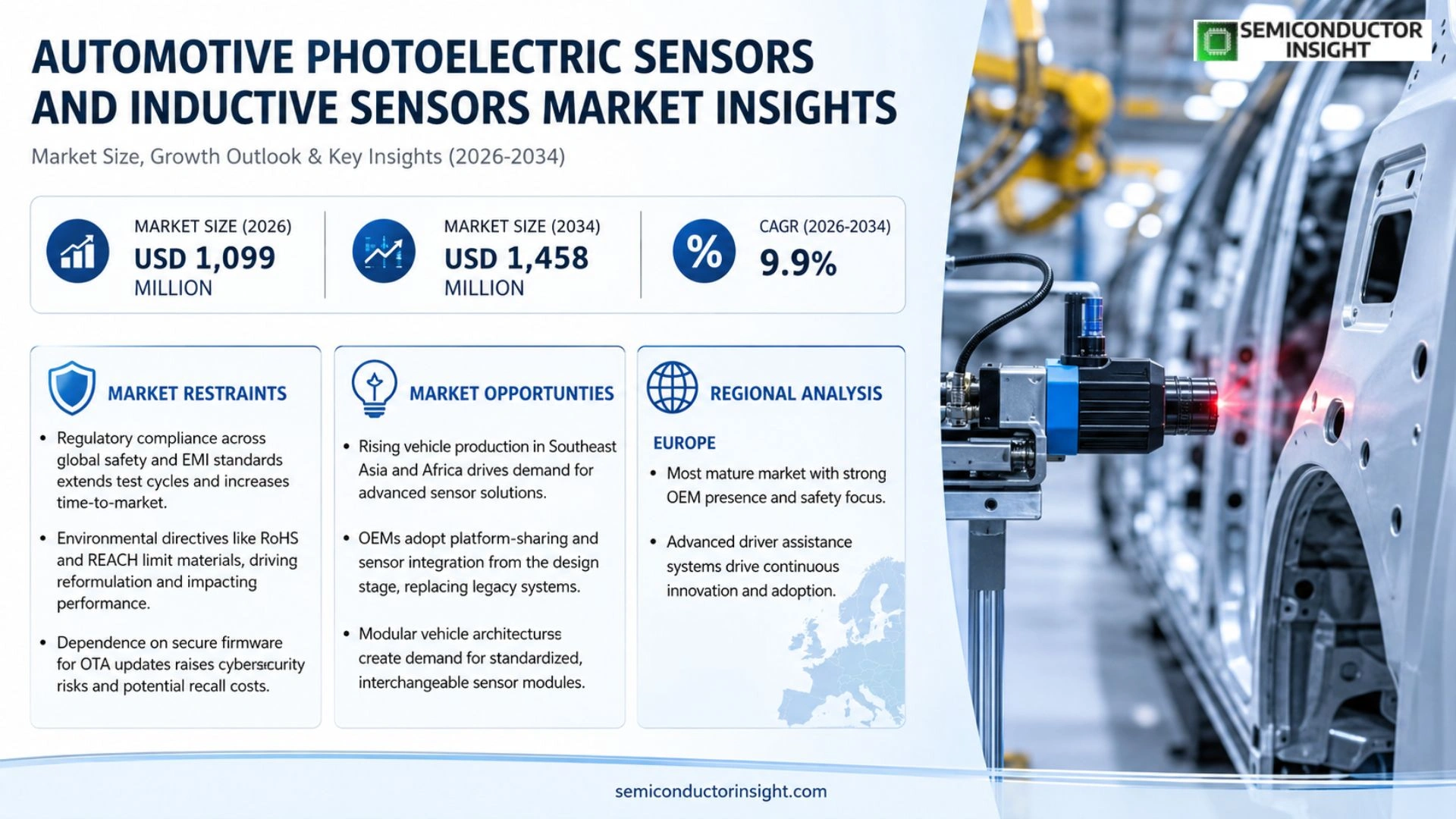
Automotive Photoelectric Sensors and Inductive Sensors market size was valued at USD 578 million in 2024. The market is projected to grow from USD 1,099 million in 2026 to USD 1,458 million by 2034, exhibiting a CAGR of 9.9% during the forecast period.
A photoelectric sensor,or “photo eye”,detects distance, absence or presence of an object by emitting light (typically infrared) toward a target and receiving the reflected signal; its main variants are opposed (through‑beam), retro‑reflective and diffused proximity sensing. An inductive sensor generates an electromagnetic field that senses ferrous metal targets without physical contact.
The upward trend stems from concentrated automotive production in Asia (56%), Europe (20%) and North America (16%), coupled with increasing vehicle electrification and advanced driver‑assistance systems that rely on precise sensing solutions. Nevertheless, semiconductor supply bottlenecks introduce short‑term pressure on component availability. Leading suppliers such as Keyence, Omron, Sick and Pepperl + Fuchs are reinforcing their positions through new product introductions and strategic collaborations.
MARKET DRIVERS
Electrification of Vehicle Systems
The shift toward electric and hybrid powertrains introduces a higher density of electronic control units, each requiring precise position feedback. Automotive Photoelectric Sensors and Inductive Sensors Market benefits because manufacturers replace mechanical linkages with solid‑state sensors that improve reliability while trimming vehicle weight. This engineering trend compels suppliers to broaden portfolio breadth and accelerate component miniaturization.
Demand for Advanced Driver Assistance
Advanced driver‑assistance systems (ADAS) rely on rapid detection of obstacles, lane markings, and proximity cues. Photoelectric sensors provide high‑resolution optical data for lane‑keep functions, whereas inductive sensors deliver robust metal‑target detection under harsh conditions. The convergence of these technologies fuels OEM investment in sensor‑fusion algorithms, creating a clear revenue stream for vendors able to certify automotive‑grade parts.
➤ Integrated sensor arrays shorten validation cycles, allowing manufacturers to bring safety‑critical features to market faster.
OEMs are also responding to consumer expectations for seamless cabin automation. Gesture‑based controls, automated seat adjustments, and ambient lighting all depend on reliable photoelectric or inductive inputs, reinforcing the market’s forward momentum.
MARKET CHALLENGES
Cost Sensitivity in Mass‑Produced Models
Volume carmakers operate under razor‑thin margins, and any sensor that adds appreciable cost must demonstrate a proportional value gain. Even modest price increases can jeopardize adoption in entry‑level segments, prompting manufacturers to negotiate aggressively on unit pricing and to favor multi‑function components over single‑purpose devices.
Other Challenges
Supply‑Chain Volatility
Raw‑material shortages for semiconductor wafers and specialty alloys have created lead‑time fluctuations. Suppliers that cannot guarantee consistent delivery risk being sidelined in OEM procurement, especially when production schedules are tied to just‑in‑time inventory models.
Moreover, the rapid turnover of automotive electronic architectures forces sensor makers to redesign parts frequently, increasing R&D expenditures and eroding profitability in the short term.
MARKET RESTRAINTS
Regulatory Compliance Complexity
Global safety and electromagnetic‑interference standards impose strict testing regimes on every sensor variant. Achieving certification across the United States, Europe, China, and emerging regions entails duplicated test cycles, inflating time‑to‑market.
In addition, environmental directives such as RoHS and REACH limit the use of certain hazardous substances, compelling manufacturers to reformulate alloys and encapsulants, which can affect performance characteristics.
Finally, the push toward over‑the‑air (OTA) updates creates a dependency on secure firmware architectures; any breach could halt sensor operation and trigger costly recalls.
MARKET OPPORTUNITIES
Emerging Markets and New Vehicle Architectures
Growth in Southeast Asian and African automotive production presents fertile ground for sensor expansion. Local OEMs are adopting platform‑sharing strategies that embed photoelectric and inductive modules from the design stage, bypassing legacy mechanical solutions.
Simultaneously, the adoption of modular vehicle platforms,where sensor clusters are swapped between models,creates demand for standardized, plug‑and‑play components. Suppliers that deliver calibrated, interchangeable units can capture a larger share of the design‑to‑assembly pipeline.
Finally, the rise of autonomous‑driving pilots in premium fleets calls for ultra‑low‑latency sensor networks. Investing in high‑frequency inductive units combined with next‑generation optical arrays positions vendors to secure long‑term contracts tied to self‑driving deployments.
Automotive Photoelectric Sensors and Inductive Sensors Market Trends
Integration of Photoelectric Sensors into Advanced Driver‑Assistance Systems
The automotive sector is reshaping its electronic architecture to accommodate increasingly sophisticated driver‑assistance features. Photoelectric sensors, with their ability to detect object presence via infrared beams, have become preferred for functions such as blind‑spot monitoring and automated parking. Their non‑contact operation reduces mechanical wear, supporting longer service intervals and lower warranty costs. As OEMs embed these sensors deeper into chassis control loops, suppliers that can guarantee high reliability under temperature extremes gain a competitive edge. The trend pushes manufacturers toward tighter quality assurance processes and encourages joint development programs that align sensor performance with software‑defined vehicle functions.
Other Trends
Miniaturization and Cost Optimization
Vehicle platforms are trending toward lighter, more compact designs, compelling sensor producers to shrink footprint without sacrificing signal integrity. Advances in semiconductor packaging and lens technology have enabled photoelectric and inductive units that occupy less than half the area of earlier generations. This size reduction translates directly into material cost savings and eases integration into constrained mounting locations. Vendors that master batch‑level testing and automated assembly can pass price advantages to automakers, who are under pressure to keep per‑vehicle electronic spend within tight budgets. The ripple effect includes faster refresh cycles for product lines and heightened importance of after‑sales support to maintain long‑term profitability.
Regional Shifts and Supply‑Chain Realignment
Production of passenger cars remains heavily concentrated in Asia, yet demand for high‑precision sensors is rising faster in European and North‑American markets where regulatory scrutiny on safety systems intensifies. This divergence encourages sensor makers to establish regional design centers that can tailor solutions to local certification requirements while retaining a centralized manufacturing hub in cost‑competitive zones. The resulting supply‑chain configuration reduces lead times for premium models and mitigates exposure to tariff fluctuations. For participants in the Automotive Photoelectric Sensors and Inductive Sensors Market, the strategic implication is a need to balance economies of scale with localized engineering capabilities, ensuring both price competitiveness and compliance with evolving safety standards.
COMPETITIVE LANDSCAPE
Key Industry Players
Automotive Photoelectric and Inductive Sensors: Competitive Overview
The market is anchored by a handful of large OEM‑focused suppliers that dominate system‑level contracts with global automotive manufacturers. Keyence, with its broad portfolio of high‑resolution photoelectric units, leverages deep R&D resources to secure design‑win agreements across premium and mass‑market vehicle programs. Omron and Sick complement this structure by offering modular inductive families that integrate seamlessly into chassis and power‑train assemblies, allowing tier‑1 integrators to reduce part counts. The concentration of revenue among these three firms creates a de‑facto tiered supply chain in which midsize players must differentiate through application‑specific engineering, faster lead‑times, or cost‑effective variants for emerging electric‑vehicle platforms.
Beyond the dominant tier, a diverse set of niche manufacturers keeps the ecosystem vibrant. Pepperl+Fuchs, IFM Electronic and Turck specialize in rugged sensors for commercial‑vehicle cabins and heavy‑duty applications, often targeting aftermarket retrofits. Baumer and Autonics excel in compact, low‑power photoelectric modules suited for interior lighting and occupancy detection. Panasonic and Rockwell Automation bring strong electronics integration capabilities, while Balluff, Optex and Wenglor focus on high‑frequency inductive designs for safety‑critical functions. Schneider Electric and Leuze Electronic round out the field with extensive automation portfolios that enable cross‑selling in smart‑factory initiatives, reinforcing the market’s resilience despite cyclical automotive demand.
List of Key Automotive Photoelectric and Inductive Sensors Companies Profiled
- Keyence
- Omron
- Sick
- Pepperl+Fuchs
- IFM Electronic
- Turck
- Baumer
- Autonics
- Panasonic
- Rockwell Automation
- Balluff
- Optex
- Schneider Electric
- Wenglor
- Leuze Electronic
Segment Analysis:
| Segment Category | Sub-Segments | Key Insights |
| By Type |
|
Photoelectric Sensors
|
| By Application |
|
Advanced Driver‑Assistance Systems
|
| By End User |
|
OEMs
|
| By Technology Trend |
|
Safety‑Critical Sensing
|
| By Vehicle Platform |
|
Electric Vehicles
|
Regional Analysis: Automotive Photoelectric Sensors and Inductive Sensors Market
Europe
Euro‑NCAP’s recent safety revisions require finer object detection, prompting OEMs to substitute legacy capacitive devices with photoelectric units that deliver sharper edge detection. This regulatory pressure nudges suppliers toward higher‑performance designs, reshaping procurement priorities across the continent.
Recent mergers among European sensor manufacturers have reduced fragmentation, allowing the few remaining players to negotiate more favorable terms with raw‑material providers. The tighter value chain improves cost predictability for automakers, but also raises entry barriers for newcomers.
The blending of photoelectric and inductive principles into hybrid modules addresses space constraints in compact vehicle platforms. Engineers favor these multi‑function components for their ability to service both proximity and speed‑measurement tasks, reducing wiring complexity.
Collaborative R&D programs between sensor firms and German automotive clusters have yielded bespoke calibration algorithms. Such alliances accelerate the translation of lab innovations into production‑ready hardware, reinforcing Europe’s competitive edge.
North America
In North America, the sensor market is shaped by a blend of legacy automakers and an accelerating electric‑vehicle (EV) rollout. U.S. manufacturers are integrating inductive sensors into power‑train control modules to enhance torque management, while Canadian firms focus on rugged photoelectric solutions for off‑road applications. The region’s decentralized supplier ecosystem favors niche players that can offer quick customization, a valuable trait when OEMs experiment with novel vehicle architectures. However, the emphasis on cost efficiency forces suppliers to balance performance upgrades against price pressures, prompting a shift toward modular designs that can be scaled across multiple vehicle lines.
Asia‑Pacific
Asia‑Pacific’s sensor landscape is driven by volume and rapid model turnover, particularly in China, Japan, and South Korea. Manufacturers there prioritize high‑throughput production, which pushes sensor makers to adopt automated test rigs that ensure consistency across millions of units. The rise of connected car initiatives fuels demand for photoelectric sensors capable of precise lane‑keeping assistance, while inductive sensors remain integral to low‑cost interior detection systems. Competitive dynamics are intense, with local firms leveraging lower labor costs to undercut imported alternatives, compelling global players to establish joint ventures to retain market relevance.
South America
South American automakers, especially in Brazil and Argentina, are modernizing assembly lines to meet rising domestic demand for safety‑enhanced vehicles. Photoelectric sensors are increasingly specified for blind‑spot monitoring, a feature that differentiates mid‑range models in a price‑sensitive market. Inductive sensors find application in fuel‑injection timing for flex‑fuel engines, reflecting regional fuel preferences. Supplier relationships are often built on long‑term contracts, granting firms the stability needed to invest in localized calibration facilities that align with regional vehicle specifications.
Middle East & Africa
The Middle East & Africa region displays a contrasting blend of luxury‑focused demand and emerging market growth. Gulf states import premium vehicles equipped with sophisticated sensor suites, creating a niche for high‑precision photoelectric units that support advanced driver assistance functions. In sub‑Saharan markets, cost‑effective inductive sensors dominate due to their simplicity and durability on rugged road networks. Infrastructure projects, such as smart‑city initiatives, are beginning to influence automotive sensor adoption, encouraging suppliers to tailor solutions that can operate reliably under extreme temperature fluctuations.
Report Scope
This market research report provides a comprehensive analysis of the Automotive Photoelectric Sensors and Inductive Sensors Market , covering the forecast period 2026–2034. It offers detailed insights into market dynamics, technological advancements, competitive landscape, and key trends shaping the industry.
Key focus areas of the report include:
- Market Overview: The report begins with an overview outlining its current market scenario, key growth indicators, and industry transformation drivers. It discusses macroeconomic factors, demand–supply balance, regulatory landscape, and the strategic role of semiconductors in powering advancements across industries such as automotive, telecommunications, consumer electronics, and industrial automation.
- Market Size & Forecast: Historical data and future projections for revenue, unit shipments, and market value across major regions and segments.
- Segmentation Analysis: Detailed breakdown by product type, technology, application, and end-user industry to identify high-growth segments and investment opportunities.
- Regional Insights: Insights into market performance across North America, Europe, Asia-Pacific, Latin America, and the Middle East & Africa, including country-level analysis where relevant.
- Competitive Landscape: Profiles of leading market participants, including their product offerings, R&D focus, manufacturing capacity, pricing strategies, and recent developments such as mergers, acquisitions, and partnerships.
- Technology Trends & Innovation: Assessment of emerging technologies, integration of AI/IoT, semiconductor design trends, fabrication techniques, and evolving industry standards.
- Market Drivers & Restraints: Evaluation of factors driving market growth along with challenges, supply chain constraints, regulatory issues, and market-entry barriers.
- Stakeholder Insights: Insights for component suppliers, OEMs, system integrators, investors, and policymakers regarding the evolving ecosystem and strategic opportunities.
Primary and secondary research methods are employed, including interviews with industry experts, data from verified sources, and real-time market intelligence to ensure the accuracy and reliability of the insights presented.
FREQUENTLY ASKED QUESTIONS:
What is the current market size of Automotive Photoelectric Sensors and Inductive Sensors Market?
-> Automotive Photoelectric Sensors and Inductive Sensors market is projected to grow from USD 1,099 million in 2026 to USD 1,458 million by 2034
Which key companies operate in Automotive Photoelectric Sensors and Inductive Sensors Market?
-> Key players include Keyence, Omron, Sick, Pepperl + Fuchs, IFM Electronic GmbH, Turck Banner, Baumer, Autonics, Panasonic, Rockwell Automation, Balluff, Optex, TAKEX, Wenglor, Schneider Electric, Leuze Electronic, Tri‑Tronics, Di‑soric, RiKO, and F&C Sensing Technology.
What are the key growth drivers?
-> Key growth drivers include rising automotive production, increasing adoption of advanced driver‑assistance systems (ADAS), growing demand for higher safety and automation in passenger and commercial vehicles, and the shift toward electrification which requires more precise sensor integration.
Which region dominates the market?
-> Asia dominates the market, accounting for over 50% of global automotive production and sensor demand, with China alone representing approximately 32% of worldwide vehicle output.
What are the emerging trends?
-> Emerging trends include integration of photoelectric and inductive sensors with IoT and AI for predictive maintenance, development of miniaturized multi‑function sensors, and increased use of resilient sensor technologies in electric and autonomous vehicles.

Get Sample Report PDF for Exclusive Insights
Report Sample Includes
- Table of Contents
- List of Tables & Figures
- Charts, Research Methodology, and more...
 Download Sample Report PDF