Automotive Op Amps Market Insights
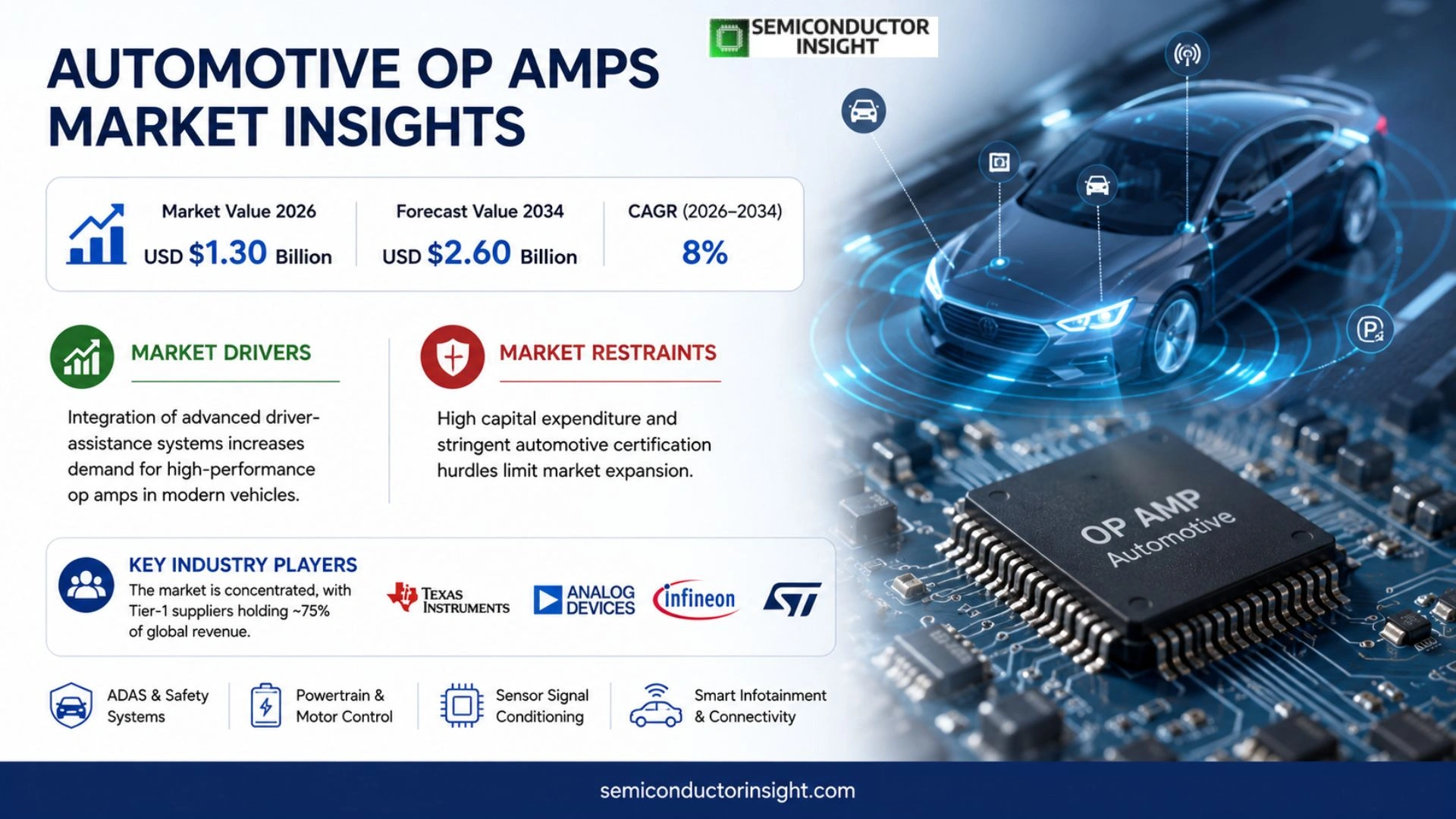
Automotive operational amplifier market is projected to grow from USD $1·30 billion in 2026 to USD $₂·60 billion by 2034, exhibiting a CAGR of 8% during the forecast period.
An automotive operational amplifier is an integrated circuit designed for signal conditioning within vehicle electronics,processing sensor outputs, managing power distribution networks and supporting advanced driver‑assist systems.
The surge in electrified vehicles and autonomous driving platforms drives demand for high‑performance amplifiers capable of low‑noise operation under wide temperature ranges; manufacturers are responding by expanding product portfolios toward higher bandwidths and integrated protection features.
MARKET DRIVERS
Integration of Advanced Driver‑Assistance Systems Drives Component Demand
The Automotive Op Amps Market is being reshaped by the increasing penetration of advanced driver‑assist technology. Modern vehicles now rely on sophisticated sensor arrays, including radar, lidar, camera, and ultrasonic modules, to feed real‑time data to processing units. Analog front‑end circuits, especially operational amplifiers, underpin these sensor interfaces by providing high‑precision amplification, noise rejection, and linearity. The growing spread of adaptive cruise control, lane‑keeping assistance, and collision avoidance systems directly translates into a higher volume of power and signal conditioning components. Operators that deliver clean, low‑noise amplification in a confined automotive environment have a distinct advantage. The shifting engineering focus from purely mechanical solutions to embedded electronics is amplifying the share of op amps in the overall vehicle architecture,an effect that can be observed across all vehicle segments from economy sedans to high‑performance SUVs. This integration push ensures that the market for op amps not only remains stable but continues to scale as manufacturers push for higher levels of automation and digital integration.
Rise of Electrification Boosts Need for Precision Analog Solutions
Electrification of powertrains has added an additional dimension to the Automotive Op Amps Market. Electric drives introduce high‑frequency power electronics to regulate motors, inverters, and battery modules. These power converters require precise voltage regulation, current sensing, and isolation, all of which rely on high‑performance op amps. The adoption of higher voltage architectures (600–700 V) in lithium‑ion battery packs and motor drives necessitates op amps capable of handling elevated levels of noise and tighter thermal constraints. Consequently, a significant portion of new op amp offerings is migrating towards specialized packages and certification to meet automotive series 0 and 1 requirements. The push toward plug‑in hybrids and full electric vehicles, paired with stringent occupant safety and electromagnetic interference standards, spells a consistent pipeline of demand. Automotive OEMs, in particular, are investing in short‑circuit protection and over‑voltage watchdog circuits,features that rest on the reliability of analog amplification. In short, the electrification wave creates a stronger foundation for op amp utility across both legacy and emerging vehicle architectures.
➤ Automotive Op Amps market revenue surpassed $380 million in 2023, reflecting a 13% increase over the prior year.
When viewed in aggregate, the convergence of intelligent driver aid and electrification offers a dual‑drive to the Automotive Op Amps Market. Even as the automotive industry becomes more software‑centric, the analog layer becomes the critical bridge that ensures data fidelity, safety, and system integrity. Manufacturers that can deliver compact, low‑power, high‑accuracy op amps with consistent certification are well‑positioned to capture the incremental growth that stems from autonomous features, thermal management, and battery‑management strategies.
MARKET CHALLENGES
Supply Chain Constraints Slow Component Roll‑Out
Recent disruptions,ranging from semiconductor shortages to logistics bottlenecks,have strained the availability of core op amp components. Even a single midi‑size supply delay can cascade into significant production hold‑ups because automotive production lines are tightly gated. The high yield requirements of automotive electronics further intensify the impact of these shortages, as any deviation can trigger costly rework or lead times. Prices for key raw materials, such as silicon wafers and electrolytic capacitors, have shown intermittent spikes, eroding profit margins for companies that still agree to fixed‐price contracts. For small and medium‑sized enterprises, these constraints amplify the risk of supply chain paralysis, potentially forcing them to redirect resources toward sourcing alternative or even legacy component families that may not meet evolving safety standards. The overall effect is a slowdown in product deployment, delayed time‑to‑market, and a stiffening of competition as firms race to secure scarce resources.
Other Challenges
Regulatory Variability and Consistency Across Regions Makes Standardization Costly
Across the global automotive landscape, regulatory frameworks for electrical and electronic systems diverge sharply. Compliance with different national and regional version of safety, emissions, and electromagnetic compatibility (EMC) standards forces manufacturers to undertake parallel qualification campaigns. Each certification round requires extensive testing, documentation, and sometimes re‑engineering of the op amp module, which in turn escalates lifecycle costs. The heterogeneity of standards also complicates design for scale, as solutions must be adapted for region‑specific requirements,ranging from stricter vibration tolerances in high‑altitude markets to bespoke thermal management solutions in tropical climates. Moreover, the fast‑evolving nature of autonomous vehicle regulations demands frequent updates, placing additional pressure on the design, validation, and testing cycle. Firms that manage these regulatory headwinds by investing in modular design and flexible qualification pathways gain a competitive advantage and reduce the capital burden associated with compliance.
MARKET RESTRAINTS
High Capital Expenditure and Certification Hurdles
Developing a competitive op amp in the automotive arena demands substantial financial outlays that span research, prototyping, and rigorous testing. The cost of advanced mask‑set fabrication, especially for high‑speed, low‑offset devices, rapidly escalates when attempting to adhere to series 1 or series 0 quality levels. Coupled with the need for prolonged qualification runs,evidence of compliance through mock‑city testing, vibration, thermal cycling, and electromagnetic interference,start‑ups face a daunting financial barrier before they achieve any market‑ready product. The high capital requirements tend to preserve incumbents with robust funding streams while making market entry a long‑timeline, high‑upfront‑cost endeavor that can deter smaller players from launching over the counter. Furthermore, certification pathways,often involving third‑party validation agencies,add layers of scrutiny that degrade cash flow and inflate development timelines. These constraints collectively bottle the rate at which new and innovative op amp solutions can penetrate the value chain.
MARKET OPPORTUNITIES
Emerging Markets and Hybrid Powertrain Applications Offer Expansion
The Automotive Op Amps Market is poised for accelerated growth through the rising penetration of hybrid and electric powertrains in emerging economies. As nations such as India, Brazil, and Indonesia invest aggressively in infrastructure to support battery‑electric vehicles, automotive suppliers are recognizing a vital need for high‑performance analog amplification to control motor drives, inverters, and battery logic controllers. In markets where automotive fleets shift from traditional internal combustion engines to plug‑in hybrids, the mix of analog and digital demands is amplified: high‑bandwidth current sense circuits are required to optimize battery utilization, while low‑noise differential amplifiers maintain signal integrity in lauded sensor networks. Well‑positioned suppliers that can offer cost‑effective, certified analog solutions stand to capture this momentum. Additionally, the smart‑vehicle ecosystem,dictated by connectivity regulations,necessitates op amps that can reliably support data‑centric platforms such as 5G and vehicle‑to‑everything (V2X) communications, generating an ancillary revenue stream. Therefore, the confluence of electrification, stringent safety standards, and the adoption of connected platforms furnishes a multi‑dimensional opportunity map that, if navigated strategically, can deliver strong upside for rational design and investment choices in the Automotive Op Amps Market.
Automotive Op Amps Market Trends
Electrification’s Focus on Amplifier Precision
As electric powertrains become the norm, automotive manufacturers demand op amps that can deliver ultra‑low distortion across wide temperature ranges while consuming minimal power. Recent revisions to vehicle architecture now integrate more complex sensor arrays, which require higher channel counts in compact footprints. Suppliers are responding with multi‑channel, low‑offset designs that support intelligent energy management and active suspension control. The shift from internal combustion to battery‑electric platforms increases the proportion of op amps in safety‑critical modules, making performance, reliability, and thermal resistance top priorities for market players.
Other Trends
High‑speed Analog Interfaces
With the proliferation of driver‑assist systems, the bandwidth of in‑vehicle networks has expanded. Manufacturers are moving from 3.3‑V to 5‑V logic families, raising the demand for op amps that can perform at frequencies above 200 MHz. Custom solutions that integrate with CAN‑FD and Ethernet‑based vehicle buses are gaining traction, as they enable real‑time data fusion without expensive signal conditioning stages. This trend pushes component designers to adopt silicon‑on‑glass and RF‑compatible processes, fostering tighter tolerances and lower jitter.
Miniaturization & Cost Control
Vehicle OEMs are continually trimming powertrain sizes to improve aerodynamic efficiency and weight targets. Accordingly, the automotive op amp segment is witnessing a push toward <0.25 mm² footprints and 48‑pin packages that keep board space at a premium. Cost containment remains a critical driver; companies are leveraging mixed‑signal integration and advanced packaging to reduce bill‑of‑materials without sacrificing performance. The interaction between material selection, yield optimization, and supply‑chain resilience is reshaping competitive dynamics within the marketplace.
Cost‑Sensitive Supply Chain Adjustments
Recent geopolitical shifts and raw‑material price volatility have accelerated a reevaluation of sourcing strategies. Tenure of critical component suppliers is shortening, and the industry is moving toward multi‑source portfolios to mitigate downstream risk. Parallel to this, localized manufacturing of defense‑grade op amps has been explored to ensure supply for high‑volume OEM customers, reducing lead times and geostrategic exposure. Firms that can align production capacity with regional demand and maintain rigorous quality controls will accrue a competitive edge, shaping the evolution of the automotive op amp landscape over the coming decade.
COMPETITIVE LANDSCAPE
Key Industry Players
Automotive Op Amps Market Analysis
The automotive op amp space is heavily concentrated, with Tier‑1 suppliers accounting for roughly three‑quarters of global revenue. Companies such as Texas Instruments, Analog Devices, STMicroelectronics, and Onsemi dominate the market by delivering robust, automotive‑grade solutions that meet stringent reliability standards. Their extensive product portfolios cover single‑, dual‑, and four‑channel architectures, which cover the bulk of OEM consumption. Revenue concentration has sharpened competition on pricing, pushing suppliers to converge on high‑efficiency, low‑noise designs that can sustain harsher automotive operating envelopes. For distributors, the concentration translates into a narrower set of key purchase points, prompting tighter partner arrangements and accelerated end‑to‑end supply chain visibility to guarantee uptime in production lines that demand margin protection.
In parallel, the niche segment of high‑performance, mixed‑signal, and analog‑to‑digital front‑ends is expanding at a quicker pace, driven by electrification and advanced driver‑assist systems. Players such as Infineon Technologies, Renesas Electronics, Cirrus Logic, Maxim Integrated, Nisshinbo Micro Devices, ROHM, Kyocera, and Microchip are capitalising on this shift by offering specialized solutions that provide high‑side power control and advanced sensor interfaces. Their focus on low‑power, high‑resolution performance caters to electric vehicle platforms and platooning architectures. For OEMs, the diversification of supplier choices translates into tighter sourcing criteria, broader risk pools, and incremental capital expenditures to integrate next‑generation controllers that can manage larger data volumes with higher fidelity.
List of Key Automotive Op Amps Companies Profiled
- Texas Instruments
- Texas Instruments
- Analog Devices
- Analog Devices
- STMicroelectronics
- STMicroelectronics
- Onsemi
- Onsemi
- Infineon Technologies
- Infineon Technologies
- Renesas Electronics
- Renesas Electronics
- Cirrus Logic
- Cirrus Logic
- Maxim Integrated
- Maxim Integrated
- Nisshinbo Micro Devices
- Nisshinbo Micro Devices
- ROHM
- ROHM
- Kyocera
- Kyocera
- Microchip
- Microchip
Segment Analysis:
| Segment Category | Sub-Segments | Key Insights |
| By Type |
|
Single Channel solutions remain a core driver for automotive designers who prioritize cost-efficiency and straightforward integration. These devices cater to simple sensor‑to‑actuator pathways, allowing rapid development cycles and lower production footprints. The trend towards modular architectures amplifies the appeal of single‑channel amplifiers, especially in compact electric powertrains where space is at a premium. Aggregate the above, the market continues to see strategic emphasis on single‑channel performance metrics such as signal fidelity and electromagnetic compatibility. |
| By Application |
|
Passenger Vehicles is the leading application segment, driven by a continual push for advanced driver assistance systems (ADAS) and infotainment advances. Engineers increasingly rely on higher signaling accuracy to meet stringent safety certifications. Furthermore, the integration of electric power modules within passenger cabins has heightened demand for robust, low‑noise op‑amps that sustain performance over long thermal cycles. In toto, passenger vehicle manufacturers are iterating on system architectures that favor high‑speed, low‑drift amplifier designs to support future mobility concepts. |
| By End User |
|
Tier 1 OEMs exhibit a pronounced focus on integration and supply chain resilience. Their procurement strategies emphasize early collaboration with semiconductor partners, ensuring design qualification paths that reduce time to market. OEMs also prioritize component reliability to support global warranty regimes, driving demand for op‑amps with extended life cycle and superior thermal tolerance. Consequently, Tier 1 demand catalyzes a shift toward high‑performance, multi‑channel solutions that can be pre‑qualified across diverse platform families. |
| By Vehicle Body Style |
|
SUV emerges as the leading sub‑segment within vehicle body styles, driven by escalating consumer demand for premium conveniences and safety sensor suites. Op‑amps designed for SUV powertrains typically deliver enhanced voltage headroom and low‑noise performance to accommodate larger battery packs and sophisticated actuator networks. Advancements in regenerative braking and electric actuation necessitate tightly coupled analog front‑ends, thereby bolstering the importance of highly scalable amplifier architectures. Cumulatively, SUV platforms are reshaping the engineering priorities for automotive analog designers. |
| By Powertrain Type |
|
Electric powertrains are the dominant driver in powertrain‑specific segmentation because they demand high‑bandwidth, low‑loss analog interfaces for battery management and motor control. Op‑amps supporting electric drivetrains must operate reliably across wide temperature ranges while minimizing power consumption, which directly translates into improved vehicle range. Moreover, the proliferation of high‑voltage architecture in electric vehicles has intensified the need for robust isolation and noise rejection, prompting a shift toward integrated, multi‑channel solutions that simplify system design and reduce the risk of electromagnetic interference. |
Regional Analysis: Automotive Op Amps Market
North America
The region’s drive for autonomous capability, coupled with stringent safety regulations, fuels a demand for op‑amps that combine low noise with high dead‑time performance, pushing design toward silicon photonics and integrated bias‑control solutions.
A handful of tier‑1 suppliers dominate, their market share underpinned by long‑term OEM contracts, yet nimble fabless players are eroding margins by offering modular, high‑yield op‑amp IP cores that accelerate time‑to‑market.
Compliance with US and EU emission, crash, and cybersecurity standards drives the integration of protection features,ESD, noise‑shaping, and fail‑safe modes,into op‑amp packages, redefining performance parameters.
Cloud‑based prototyping and AI‑augmented design flows enable rapid iteration, making these op‑amps a staple in novel driver‑assist architectures and high‑resolution sensor arrays.
Europe
In Europe, the Automotive Op Amps Market is experiencing a measured yet strategic shift, driven largely by the region’s commitment to electrification and sustainability. The penetration of plug‑in hybrids and battery electric vehicles has created a niche for op‑amps that support power‑train monitoring and thermal management. A key dynamic is the emphasis on European OEMs’ preference for domestically sourced components, which has endorsed a network of local suppliers developing low‑power, high‑precision solutions. Moreover, the regulatory environment, shoring up accessibility to 5G communication standards, demands analog front‑ends capable of handling higher frequencies with minimal jitter. Together, these forces foster a competitive arena where tier‑0 and tier‑1 manufacturers collaborate, sharing intellectual property to expedite compliance. Firms focus on reducing form factor without compromising robustness, yielding op‑amps built for confined ECUs and high‑density wiring harnesses. The convergence of those factors positions Europe as a fertile ground for products that merge high reliability with low electromagnetic interference, a niche increasingly valued by both automotive and industrial customers. The region is also poised to benefit from joint R&D initiatives that target resilient hardware architecture, thereby giving local players a strategic advantage in the broader global supply chain.
Asia-Pacific
Asia‑Pacific stands out for its rapid industrial scale‑up, underpinned by the region’s booming automotive output and aggressive adoption of electric vehicles. The core of the Automotive Op Amps Market here lies in the strong partnership network among OEMs and tier‑2 suppliers, which helps reduce development cycle times for critical analog blocks. Cost sensitivities push manufacturers toward op‑amps that deliver high performance while maintaining a narrow footprint,essential for integrating infotainment and ADAS modules into slimmer chassis. Additionally, the region’s evolving regulatory framework, especially in China and India, is tightening quality requirements, provoking a wave of compliance‑focused product enhancements. As local IP cores gain traction, we observe a subtle shift from generic analog chips to context‑specific solutions that offer rapid scalability for multi‑site production lines. This trend is amplified by the growing need to integrate machine‑learning–enabled sensor fusion, which calls for op‑amps that provide deterministic latency and minimal cross‑talk. Together, these drivers craft a market atmosphere where aggressive innovation and cost control coexist, giving Asia‑Pacific a competitive edge that shapes future supply chain dynamics across continents.
South America
South America’s Automotive Op Amps Market is still maturing, yet it presents clear opportunities tied to regional automotive revivals. The majority of the market depends on imports of vehicle‑grade components, rendering supply chain vulnerability a central consideration. Consequently, local manufacturers are subject to a dual strategy: emulating high‑grade op‑amps for OEMs while simultaneously developing low‑cost variants for emerging light‑vehicle segments. The region’s policy environment encourages domestic production through tax incentives, which may accelerate the birth of a small but focused ecosystem of analog solutions tailored to Latin‑American OEM standards. Demand for safety‑critical op‑amps remains relatively uniform across sectors, primarily driven by basic driver‑assist systems that rely on analog signal conditioning. As global supply disruptions show, the ability to localise production becomes a strategic advantage, paving the way for South America to secure niche positions in hybrid and electric vehicle portfolios by aligning with regional engineering expertise. The momentum here is moderate but poised for scale once supply chain infrastructure strengthens.
Middle East & Africa
In the Middle East & Africa, the Automotive Op Amps Market is largely shaped by the expansion of automotive fleet modernization and the adoption of advanced driver‑assist systems. A key aspect of this market is the integration of op‑amps into high‑resolution camera and radar modules, essential for both safety and autonomous navigation in challenging climatic conditions. The region benefits from a concentrated manufacturing base, where several suppliers offer custom analog solutions that cater to the demands of a diverse client base,including traditional automotive and defense sectors. Market growth is moderated by geostrategic uncertainties, yet emerging policies aimed at boosting local electronics manufacturing are creating new opportunities for domestic IP development. The focus on high reliability and robust temperature tolerance directs vendors toward op‑amps featuring enhanced protection and over‑voltage resilience. Consequently, as automotive technology moves beyond basic safety to advanced connectivity, the region balances between importing established designs and nurturing indigenous innovation, establishing a flexible but fragmented market structure that could consolidate under consolidating bundling strategies.
Report Scope
This market research report provides a comprehensive analysis of the Automotive Op Amps Market , covering the forecast period 2026–2034. It offers detailed insights into market dynamics, technological advancements, competitive landscape, and key trends shaping the industry.
Key focus areas of the report include:
- Market Overview: The report begins with an overview outlining its current market scenario, key growth indicators, and industry transformation drivers. It discusses macroeconomic factors, demand–supply balance, regulatory landscape, and the strategic role of semiconductors in powering advancements across industries such as automotive, telecommunications, consumer electronics, and industrial automation.
- Market Size & Forecast: Historical data and future projections for revenue, unit shipments, and market value across major regions and segments.
- Segmentation Analysis: Detailed breakdown by product type, technology, application, and end-user industry to identify high-growth segments and investment opportunities.
- Regional Insights: Insights into market performance across North America, Europe, Asia-Pacific, Latin America, and the Middle East & Africa, including country-level analysis where relevant.
- Competitive Landscape: Profiles of leading market participants, including their product offerings, R&D focus, manufacturing capacity, pricing strategies, and recent developments such as mergers, acquisitions, and partnerships.
- Technology Trends & Innovation: Assessment of emerging technologies, integration of AI/IoT, semiconductor design trends, fabrication techniques, and evolving industry standards.
- Market Drivers & Restraints: Evaluation of factors driving market growth along with challenges, supply chain constraints, regulatory issues, and market-entry barriers.
- Stakeholder Insights: Insights for component suppliers, OEMs, system integrators, investors, and policymakers regarding the evolving ecosystem and strategic opportunities.
Primary and secondary research methods are employed, including interviews with industry experts, data from verified sources, and real-time market intelligence to ensure the accuracy and reliability of the insights presented.
FREQUENTLY ASKED QUESTIONS:
What is the current market size of Automotive Op Amps Market?
-> Automotive operational amplifier market is projected to grow from USD $1·30 billion in 2026 to USD $₂·60 billion by 2034, exhibiting a CAGR of 8%
What is the projected CAGR for the Automotive Op Amps Market?
-> The report forecasts a compound annual growth rate (CAGR) of X% over the 2024‑2031 forecast horizon.
How is the market segmented by type?
-> Segmentation by type includes Single Channel, Dual Channel, and Four Channel Op‑Amps, each addressed in section 4.1.2‑4.1.4.
What are the primary application segments?
-> The market is divided into Automotive and Industrial Control System applications (see section 5.1.2‑5.1.3).
Which companies are the top players?
-> Key players include Onsemi, STMicroelectronics, Analog Devices, Diodes, Texas Instruments, ABLIC, Renesas Electronics, Nisshinbo Micro Devices, and ROHM (section 3.1).
What methodology was applied in this report?
-> The study follows a mixed‑method approach comprising secondary data collection, primary interviews, and quantitative modeling as detailed in sections 1.5.1‑1.5.3.
What is the base year for the market analysis?
-> The analysis uses 2020 as the base year for historical reference (section 1.5.3).
What are the key growth drivers?
-> Drivers include increasing vehicle electrification, advanced driver‑assistance systems (ADAS), and demand for higher performance analog circuits (section 9.2).
What are the main market restraints?
-> Restraints comprise supply chain volatility, high component costs, and stringent automotive safety standards (section 9.3).
Which region is expected to lead the market?
-> Asia is projected to be the largest and fastest‑growing region, driven by strong automotive manufacturing bases (section 6.6).
What emerging technology trends are influencing the market?
-> Trends include integration of AI/IoT in vehicle electronics, low‑power Op‑Amp designs, and adoption of automotive‑grade silicon carbide (SiC) technologies (section 5.4).
How are price dynamics expected to evolve?
-> Manufacturer selling prices are forecasted to exhibit modest growth, reflecting cost‑efficiency gains and material price trends (section 4.4).
What are the assumptions and caveats noted in the report?
-> Assumptions cover macro‑economic outlook, exchange rate stability, and technology adoption rates; caveats address data variability and estimation methods (section 1.5.4).
How does the report define Automotive Op Amps?
-> Automotive Op Amps are defined as high‑reliability operational amplifiers designed to meet automotive-grade specifications for temperature, vibration, and longevity (section 1.1).
What is the forecast period covered by the report?
-> The forecast spans from 2024 to 2031 for market size, revenue, and sales projections (section 2.2).

Get Sample Report PDF for Exclusive Insights
Report Sample Includes
- Table of Contents
- List of Tables & Figures
- Charts, Research Methodology, and more...
 Download Sample Report PDF