Automotive Low-side Gate Drivers Market Insights
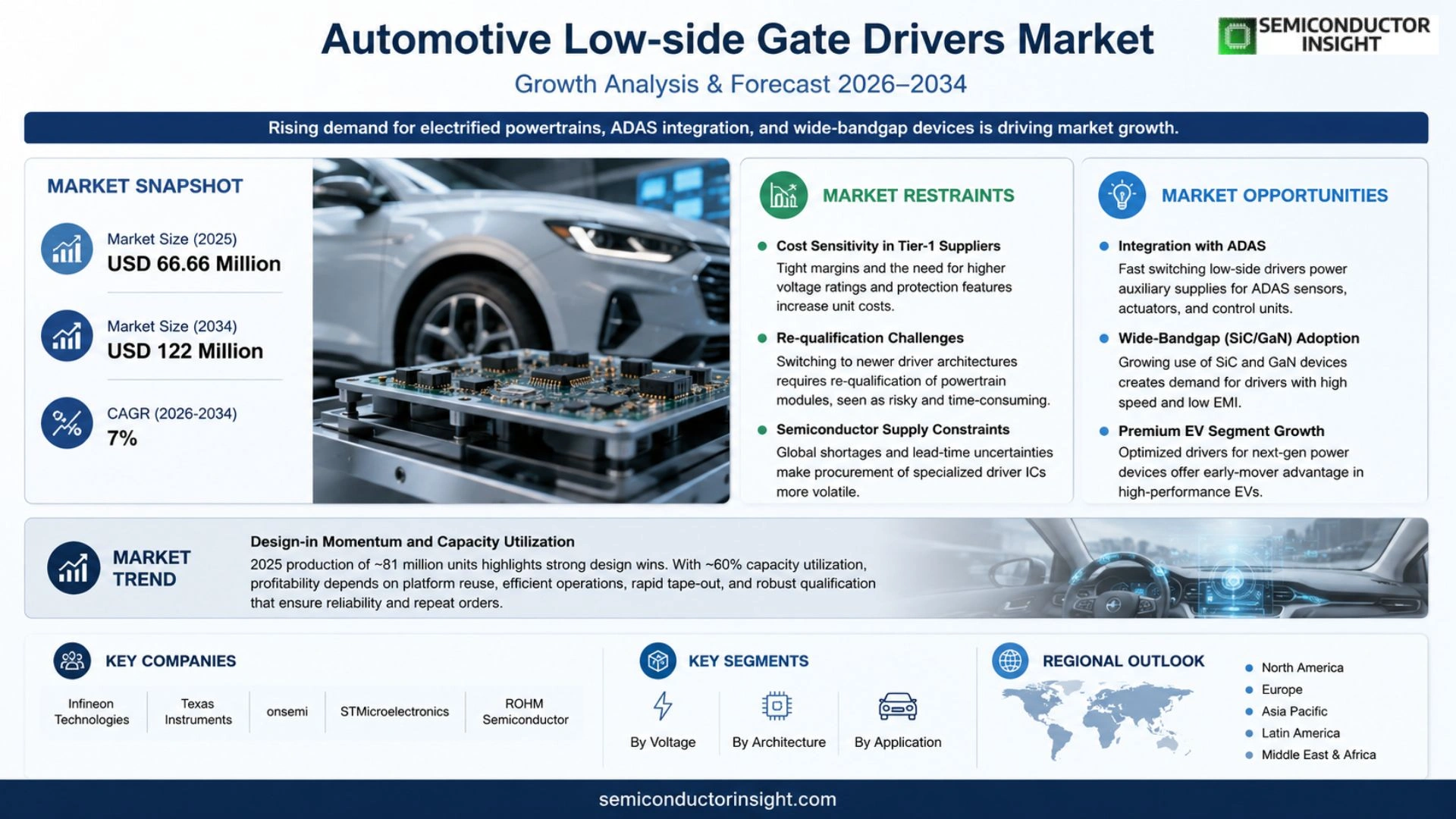
Global Automotive Low-side Gate Drivers market size was USD 66.66 million in 2025 and is forecasted to reach USD 122 million by 2034, implying a CAGR of about 7 % over the nine‑year horizon.
Automotive Low-side Gate Drivers are automotive‑grade integrated circuits that control low‑side power transistors, delivering rapid gate switching together with built‑in protection functions such as over‑current limit, undervoltage lockout and thermal shutdown; these capabilities ensure reliable load actuation across vehicle power‑train and actuator subsystems while meeting stringent automotive reliability requirements.
MARKET DRIVERS
Electrification of Powertrains
The shift toward electric drivetrains compels OEMs to adopt highly efficient switching solutions. Low‑side gate drivers deliver the precise control needed for inverters and motor‑control modules, enabling higher energy conversion rates while keeping thermal footprints modest. This technical advantage translates directly into longer driving ranges and lower inverter losses, factors that vehicle manufacturers foreground in product roadmaps.
Regulatory Safety Standards
Stricter functional‑safety mandates, such as ISO 26262, require deterministic fault‑handling mechanisms. Low‑side drivers, with their inherent fail‑safe topology, satisfy these criteria without excessive component count, reducing system‑level risk. Consequently, suppliers that embed compliant drivers gain a competitive edge in contracts that prioritize safety certification.
➤ “The convergence of efficiency targets and safety mandates is forcing a redesign of power‑stage architectures, where low‑side gate drivers become a foundational element.”
In parallel, the proliferation of vehicle‑to‑grid (V2G) concepts demands robust, low‑cost gate‑driver families that can operate reliably across wide voltage swings. Manufacturers that anticipate this requirement early can lock‑in volume commitments from emerging mobility service providers.
MARKET CHALLENGES
Thermal Management Constraints
High‑current applications generate localized heating that challenges the modest thermal budget of low‑side drivers. Designers must balance silicon‑on‑insulator (SOI) processes with advanced heat‑spreader techniques, a trade‑off that increases BOM complexity and can delay time‑to‑market.
Other Challenges
Component Integration Complexity
Integrating low‑side drivers alongside high‑side counterparts in compact power modules raises signal‑integrity concerns. Crosstalk and ground‑bounce become critical at the switching speeds required for traction inverters, prompting the need for meticulous PCB layout strategies and, occasionally, custom ASIC solutions.
MARKET RESTRAINTS
Cost Sensitivity in Tier‑1 Suppliers
Tier‑1 firms operate under razor‑thin margins, and any incremental cost in driver ICs is scrutinized against total vehicle price targets. While low‑side drivers are generally inexpensive, the push for higher voltage ratings and integrated protection features inflates unit costs, prompting buyers to weigh performance gains against budget constraints.
Moreover, legacy supplier relationships often anchor design cycles to established part families. Transitioning to newer driver architectures may require re‑qualification of entire power‑train modules, a process that can be perceived as risky and time‑consuming.
Finally, the global semiconductor shortage has amplified lead‑time uncertainties, making procurement planning for specialized low‑side driver families more volatile and discouraging speculative adoption in low‑volume models.
MARKET OPPORTUNITIES
Integration with Advanced Driver‑Assistance Systems
ADAS platforms increasingly rely on high‑frequency actuation for steering, braking, and power‑assist functions. Low‑side gate drivers, with their fast turn‑on/off capabilities, can be leveraged to control auxiliary power supplies that feed sensor processing units and actuator drivers, opening a niche where performance and reliability are paramount.
In addition, the rise of silicon‑carbide (SiC) and gallium‑nitride (GaN) power devices creates a demand for driver ICs that can handle higher switching speeds while preserving low electromagnetic interference (EMI). Companies that develop low‑side drivers optimized for these wide‑bandgap technologies stand to capture early‑adopter contracts in premium EV segments.
Automotive Low-side Gate Drivers Market Trends
Design‑in Momentum and Capacity Utilization
The 2025 production run of roughly 81 million units revealed a clear shift toward high‑volume design wins that anchor profitability. With capacity utilization hovering near 60 percent, manufacturers are compelled to extract every ounce of efficiency from silicon fabs and assembly lines. Margins of about 45 percent are no longer sustained by modest price‑point tweaks; they depend on platform reuse across multiple vehicle families and on delivering a robust qualification package that minimizes field failures. In practice, suppliers that can compress the tape‑out timeline, guarantee consistent packaging quality, and provide rapid design‑in support earn the trust of OEM engineering groups, translating into repeat orders that keep the production line humming at optimal load.
Other Trends
Supply‑Chain Stability
Upstream material providers such as Shin‑Etsu Chemical, SUMCO and GlobalWafers play a pivotal role in preserving the thin margin between wafer cost and end‑product price. Recent fluctuations in silicon wafer pricing have prompted driver manufacturers to lock in longer‑term contracts and to diversify substrate sources, thereby shielding downstream assembly from cost spikes. On the packaging side, firms like AT&S and Ibiden have ramped up capacity for automotive‑grade substrates, ensuring that the stringent reliability specifications of the Automotive Low-side Gate Drivers Market are met without inducing bottlenecks. The combined effect of these actions is a more predictable bill of materials, which in turn supports the high‑volume, low‑failure‑rate production models prized by automakers.
Reliability as a Competitive Lever
Passenger and commercial vehicle platforms increasingly embed low‑side drivers in power‑train and chassis‑control subsystems, where failure translates directly into costly warranty claims. Consequently, OEMs are rewarding suppliers that demonstrate proven field reliability through extensive lifetime testing and integrated fault‑handling mechanisms. Companies that can bundle protection features, such as over‑temperature shutdown and short‑circuit immunity, with a track record of minimal in‑field rework, are securing long‑term supply contracts that outweigh pure cost considerations. This reliability focus reshapes the competitive landscape, nudging firms toward deeper collaboration with vehicle engineers and encouraging investment in advanced verification tools that shorten the qualification loop while preserving the high gross margins that define the Automotive Low-side Gate Drivers Market today.
COMPETITIVE LANDSCAPE
Key Industry Players
Automotive Low-side Gate Drivers: Competitive Structure and Strategic Positioning
The segment is anchored by a handful of global semiconductor firms that have secured long‑term design‑in agreements with the major OEMs. Infineon Technologies leverages its broad automotive portfolio and deep legacy in power‑device protection to dominate high‑volume platforms such as Volkswagen’s modular electric architecture. STMicroelectronics follows closely, differentiating its offering through integrated diagnostics that simplify validation cycles for Ford and GM. Both companies benefit from economies of scale that keep unit costs near the $0.9 benchmark while preserving the roughly 45 % gross‑margin envelope reported in 2025. Their market share is reinforced by aggressive silicon‑verification programs and a supply chain that blends wafer sources like Shin‑Etsu and packaging partners such as AT&S, enabling them to meet the 60 % capacity utilization target without compromising reliability.
Beyond the tier‑one leaders, a diverse set of niche players adds depth to the ecosystem. Rohm Semiconductor and Microchip Technology focus on cost‑efficient single‑channel solutions that attract Tier‑2 vehicle programs in emerging markets. Analog Devices and Skyworks bring a strong analog‑front‑end pedigree, appealing to chassis‑control applications where low‑noise performance is paramount. IXYS Corporation, Diodes Incorporated, and Power Integrations supply specialized dual‑channel families that address high‑current actuation in commercial‑vehicle power‑train modules. These firms compensate for smaller volumes with rapid design‑support cycles and regional manufacturing footprints, allowing them to capture segment share in markets such as China, India, and Southeast Asia.
List of Key Automotive Low-side Gate Drivers Companies Profiled
- Infineon Technologies
- STMicroelectronics
- NXP Semiconductors
- Renesas Electronics
- ON Semiconductor
- Rohm Semiconductor
- Microchip Technology
- Analog Devices
- Skyworks Solutions
- IXYS Corporation
- Diodes Incorporated
- Power Integrations
Segment Analysis:
| Segment Category | Sub-Segments | Key Insights |
| By Type |
|
Single-Channel dominates early‑stage designs because it offers straightforward integration and lower design risk. – Engineers favor its simplicity for rapid prototyping and platform reuse. – Its compact footprint supports dense power‑train modules. – Robust protection features align with automotive reliability standards. Dual-Channel gains traction in more advanced architectures where space and cost efficiencies are critical. – Enables shared control logic reducing overall component count. – Provides redundancy that enhances fault tolerance in safety‑critical functions. – Aligns with trends toward integrated driver solutions for electric and hybrid platforms. |
| By Application |
|
Passenger Cars drive the most intense innovation cycle, demanding drivers that balance performance, cost, and long‑term reliability. – Integration with body‑electronics and chassis control systems pushes for tighter EMC compliance. – OEMs value suppliers that can expedite design‑in and provide continuous support across model refreshes. – The shift toward electrified powertrains raises expectations for thermal robustness. Commercial Vehicles prioritize durability and high‑current capability to handle heavier loads and longer duty cycles. – Drivers must endure harsher thermal environments and more frequent load‑switching events. – Fleet operators seek solutions that minimize downtime through robust fault‑handling. – Long vehicle lifespans foster preference for proven, qualification‑ready components. |
| By End User |
|
OEMs are focused on early design‑in, long‑term supply security, and integrated validation support. – Preference for drivers that come with extensive automotive qualification documentation. – Collaborative development models that reduce validation cycles are highly valued. – Consistency in performance across model variants supports platform‑level cost efficiencies. Tier‑1 Suppliers seek drivers that can be seamlessly embedded into larger system modules and provide diagnostic visibility. – Emphasis on modular architectures that simplify system integration. – Drivers with built‑in fault reporting aid in overall vehicle health monitoring. – Reliability across varied operating conditions aligns with Tier‑1 quality frameworks. Aftermarket participants look for flexible, cost‑effective solutions that can be retrofitted or upgraded. – Simpler driver topologies lower integration effort. – Robust protection features mitigate risk of field failures. – Compatibility with a wide range of vehicle platforms enhances market appeal. |
| By Voltage |
|
12 V remains the workhorse voltage for conventional vehicle subsystems, where cost sensitivity and mature design standards dominate. – Drivers are tuned for low‑voltage operation with emphasis on minimizing quiescent current. – Compatibility with legacy architectures simplifies retrofits. – Proven reliability under varied temperature ranges reinforces supplier confidence. 24 V is increasingly adopted in high‑power domains such as electric power‑train auxiliaries, demanding higher robustness. – Enhanced insulation and protection schemes are essential. – Design practices focus on handling higher transient currents while preserving electromagnetic compatibility. – Supplier support for co‑design with power‑stage components accelerates integration. |
| By Package |
|
SOIC offers a balance between ease of assembly and footprint efficiency, making it a go‑to choice for many OEM platforms. – Well‑established supply chain ensures consistent quality. – Sufficient thermal performance for typical automotive load cycles. – Familiarity among design houses speeds up schematic capture. TSSOP provides reduced pad pitch and lower profile, supporting compact module designs. – Favored where board real‑estate is at a premium. – Improved leads enhance solderability in high‑volume production. – Compatibility with automated optical inspection bolsters yield confidence. |
Regional Analysis: Automotive Low-side Gate Drivers Market
Europe
European manufacturers are pursuing joint ventures and strategic acquisitions to secure silicon‑on‑insulator (SOI) wafers essential for low‑side gate drivers. This consolidation reduces lead times and creates a more predictable component pipeline, which is vital for meeting the cadence of vehicle launches.
OEMs are mandating reliability qualification early in the development phase, prompting suppliers to adopt advanced simulation tools that predict thermal cycling and electro‑static discharge resilience of gate driver circuits.
Industry bodies across the EU are harmonising interface specifications for low‑side drivers, which eases integration across different vehicle platforms and accelerates component reuse across model families.
Green procurement policies are influencing buyers to select gate drivers fabricated with low‑impact processes, encouraging manufacturers to showcase carbon‑footprint reductions in their product catalogues.
North America
In the United States and Canada, low‑side gate driver adoption is fueled by the expansive electric‑vehicle rollout supported by federal incentives. OEMs are integrating these drivers into high‑performance power‑train modules to meet the aggressive power‑density requirements of next‑generation EVs. Supplier partnerships focus on modular designs that can be scaled across multiple vehicle segments, from compact cars to heavy‑duty trucks. The competitive landscape is shaped by a blend of legacy semiconductor firms and emerging startups that bring silicon‑carbide solutions, offering lower conduction losses. The strategic implication for market entrants is to align product roadmaps with the fast‑evolving vehicle architectures that are increasingly software‑centric.
Asia‑Pacific
Rapid expansion of automotive manufacturing hubs in China, India, and Southeast Asia is reshaping demand for low‑side gate drivers. Local OEMs prioritize cost‑effective solutions that do not compromise on performance, prompting a surge in design‑for‑manufacturability initiatives. At the same time, regional policy pushes for higher fuel efficiency are nudging manufacturers toward driver topologies that improve inverter efficiency. The region’s fragmented supplier base creates opportunities for firms that can offer standardized platforms coupled with localized support. Companies that invest in regional R&D centers tend to capture early market share by tailoring devices to region‑specific vehicle platforms.
South America
Brazil and Argentina lead automotive production in South America, and both governments are introducing modest subsidies for hybrid and electric models. Low‑side gate driver suppliers are responding by providing solutions that balance performance with the price sensitivity of the market. Integration efforts focus on simplifying PCB layouts to reduce assembly time, a key factor for manufacturers operating with lean inventories. The market’s evolution will be influenced by how quickly OEMs can transition from conventional ICE architectures to electrified power‑trains, making flexibility in driver design a critical success factor.
Middle East & Africa
The Middle East and Africa region remains nascent in terms of electric‑vehicle penetration, yet a handful of luxury automakers are introducing EVs in affluent markets such as the UAE and Saudi Arabia. Low‑side gate driver vendors are leveraging this nascent demand by offering high‑temperature tolerant devices suitable for the region’s extreme climate. Simultaneously, African automotive assemblers are exploring low‑cost power‑train components to serve emerging economies. Strategic positioning involves establishing local distribution networks and demonstrating the reliability of gate driver solutions under harsh environmental conditions, which can accelerate adoption as regional infrastructure improves.
Report Scope
This market research report provides a comprehensive analysis of the Automotive Low-side Gate Drivers Market , covering the forecast period 2026–2034. It offers detailed insights into market dynamics, technological advancements, competitive landscape, and key trends shaping the industry.
Key focus areas of the report include:
- Market Overview: The report begins with an overview outlining its current market scenario, key growth indicators, and industry transformation drivers. It discusses macroeconomic factors, demand–supply balance, regulatory landscape, and the strategic role of semiconductors in powering advancements across industries such as automotive, telecommunications, consumer electronics, and industrial automation.
- Market Size & Forecast: Historical data and future projections for revenue, unit shipments, and market value across major regions and segments.
- Segmentation Analysis: Detailed breakdown by product type, technology, application, and end-user industry to identify high-growth segments and investment opportunities.
- Regional Insights: Insights into market performance across North America, Europe, Asia-Pacific, Latin America, and the Middle East & Africa, including country-level analysis where relevant.
- Competitive Landscape: Profiles of leading market participants, including their product offerings, R&D focus, manufacturing capacity, pricing strategies, and recent developments such as mergers, acquisitions, and partnerships.
- Technology Trends & Innovation: Assessment of emerging technologies, integration of AI/IoT, semiconductor design trends, fabrication techniques, and evolving industry standards.
- Market Drivers & Restraints: Evaluation of factors driving market growth along with challenges, supply chain constraints, regulatory issues, and market-entry barriers.
- Stakeholder Insights: Insights for component suppliers, OEMs, system integrators, investors, and policymakers regarding the evolving ecosystem and strategic opportunities.
Primary and secondary research methods are employed, including interviews with industry experts, data from verified sources, and real-time market intelligence to ensure the accuracy and reliability of the insights presented.
FREQUENTLY ASKED QUESTIONS:
What is the current market size of Automotive Low-side Gate Drivers Market?
-> Automotive Low-side Gate Drivers market is forecasted to reach USD 122 million by 2034, growing at a CAGR of 7.0% during the forecast period.
Which key companies operate in Automotive Low-side Gate Drivers Market?
-> Key players include STMicroelectronics, Infineon, Rohm Semiconductor, ON Semiconductor, Microchip Technology, Renesas Electronics, NXP Semiconductors, Power Integrations, Skyworks, Analog Devices, IXYS, Diodes.
What are the key growth drivers?
-> Key growth drivers include increasing vehicle electrification, high‑volume design wins, platform reuse, strong capacity utilization, and the need for robust, low‑loss switching solutions in passenger and commercial vehicles.
Which region dominates the market?
-> Asia‑Pacific dominates the Automotive Low-side Gate Drivers market, driven by major OEMs and high production volumes in China, Japan, and South Korea.
What are the emerging trends?
-> Emerging trends include integration of advanced protection and fault‑handling features, migration to finer‑pitch packaging (e.g., TSSOP, BGA), and deeper design‑in collaboration with OEMs for long‑life vehicle platforms.

Get Sample Report PDF for Exclusive Insights
Report Sample Includes
- Table of Contents
- List of Tables & Figures
- Charts, Research Methodology, and more...
 Download Sample Report PDF