Automotive Image Sensor (CIS) Market Insights
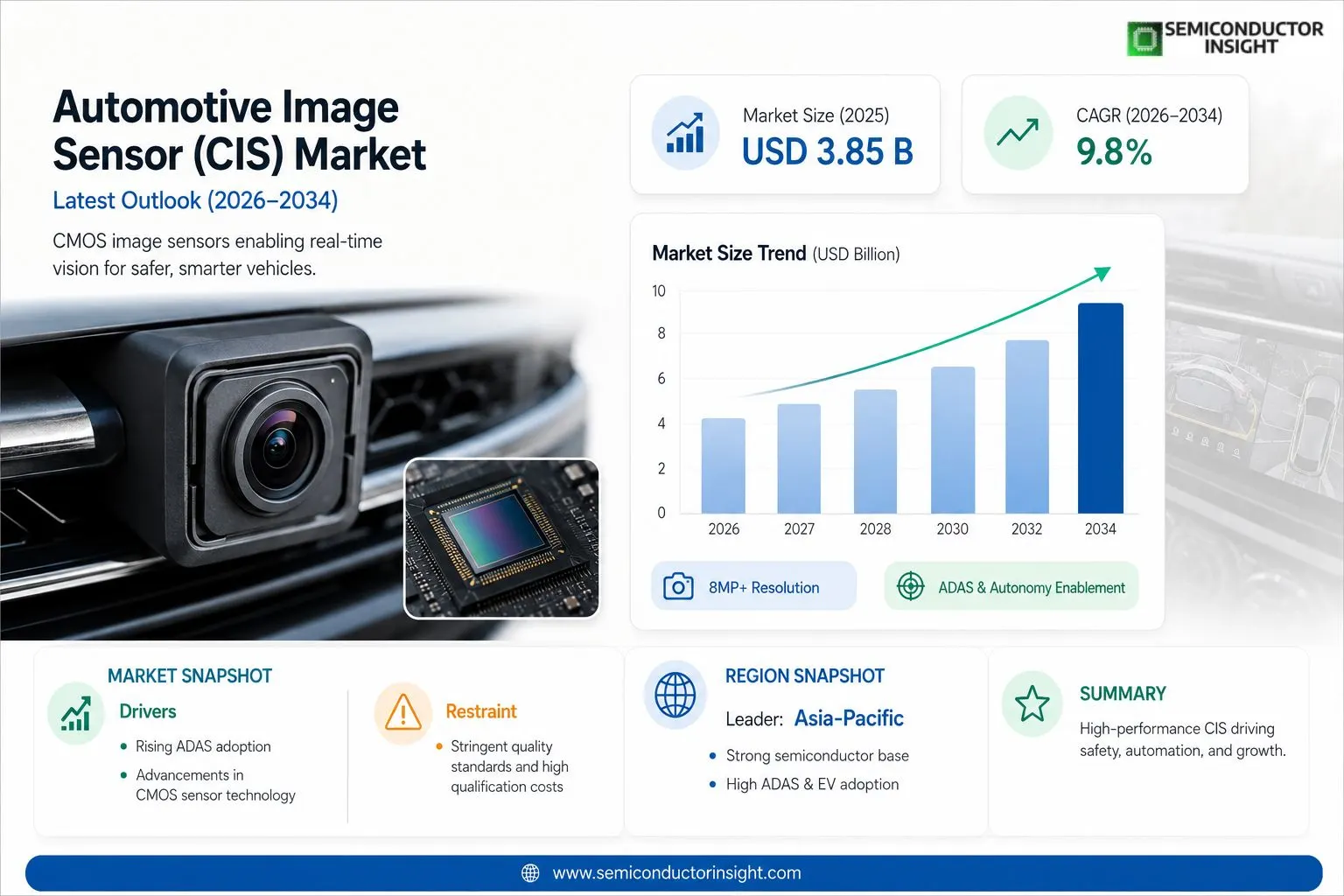
Global Automotive Image Sensor (CIS) market size was valued at USD 3.85 billion in 2025. The market is projected to grow from USD 4.25 billion in 2026 to USD 8.95 billion by 2034, exhibiting a CAGR of 9.8% during the forecast period.
Automotive Image Sensors (CIS), primarily based on CMOS technology, are specialized semiconductor devices that convert light into electrical signals to capture high-quality images and video in real-time. These sensors are essential components in modern vehicles, enabling critical functions such as Advanced Driver Assistance Systems (ADAS), surround-view monitoring, driver monitoring systems, and autonomous driving capabilities. Key attributes include high dynamic range, low-light performance, LED flicker mitigation, and robust operation in harsh automotive environments.
The market is experiencing robust growth due to several factors, including the rising adoption of ADAS features driven by stringent safety regulations, increasing consumer demand for enhanced vehicle safety and comfort, and the accelerating development of autonomous vehicles. Furthermore, the proliferation of cameras per vehicle,from basic rear-view systems to multi-camera setups with 8MP+ resolutions,continues to boost sensor demand. Advancements in sensor technologies, such as stacked CMOS designs and improved near-infrared sensitivity, are contributing to market expansion. Key players like Sony Semiconductor Solutions, OmniVision Technologies, ON Semiconductor, and Samsung Electronics operate in the market with extensive portfolios focused on high-performance automotive-grade solutions.
MARKET DRIVERS
Rising Adoption of ADAS and Autonomous Driving Technologies
Automotive Image Sensor (CIS) Market is experiencing robust growth driven by the rapid integration of Advanced Driver-Assistance Systems (ADAS) across passenger and commercial vehicles. High-dynamic-range CMOS sensors are essential for critical functions including lane departure warning, automatic emergency braking, surround-view cameras, and pedestrian detection. Regulatory mandates in the US and Europe, such as requirements for automatic emergency braking, are accelerating the deployment of multiple cameras per vehicle.
Technological Advancements in CMOS Sensors
Continuous innovation in back-illuminated (BSI) and stacked CMOS architectures has improved low-light performance, LED flicker mitigation, and thermal stability, making sensors more suitable for harsh automotive environments. These enhancements support higher resolution imaging while maintaining low power consumption, enabling broader adoption in mid-range vehicles and expanding applications to in-cabin monitoring systems.\
➤ The proliferation of cameras in modern vehicles, often exceeding five units in new models, continues to fuel demand for high-performance Automotive Image Sensor (CIS) solutions.
Growing consumer demand for enhanced safety features and the shift toward electric and autonomous vehicles further amplify the need for reliable vision systems, positioning Automotive Image Sensor (CIS) Market for sustained expansion through the coming decade.
MARKET CHALLENGES
Harsh Operating Environments and Performance Reliability
Automotive image sensors must deliver consistent performance under extreme temperature fluctuations, varying light conditions, glare, rain, fog, and contamination on lenses. These environmental challenges demand advanced engineering for thermal stability and robust image processing, increasing development complexity for Automotive Image Sensor (CIS) Market.
Other Challenges
High Integration Costs and Complexity
The expense of integrating high-resolution sensors with supporting electronics, calibration, and sensor fusion systems poses barriers, particularly for mass-market vehicles where cost sensitivity is high.
Supply Chain Vulnerabilities
Global semiconductor supply disruptions, geopolitical factors, and reliance on specialized materials continue to affect production timelines and pricing stability in the Automotive Image Sensor (CIS) segment.
MARKET RESTRAINTS
Stringent Regulatory and Qualification Standards
Compliance with rigorous automotive-grade standards such as AEC-Q100, ISO 26262, and functional safety requirements significantly extends development cycles and raises costs for manufacturers in Automotive Image Sensor (CIS) Market. These mandates, while driving quality, act as barriers to rapid innovation and market entry for smaller players.
Additionally, high manufacturing and R&D expenses for advanced features like enhanced HDR and cybersecurity capabilities limit adoption rates in lower vehicle segments, constraining overall market penetration despite strong underlying demand.
MARKET OPPORTUNITIES
Expansion in Emerging Markets and EV Integration
Rising vehicle production in Asia-Pacific and other developing regions, combined with increasing penetration of electric vehicles that incorporate sophisticated camera systems, presents substantial growth potential for Automotive Image Sensor (CIS) Market. In-cabin monitoring for driver and occupant safety offers a particularly promising new application area.
Opportunities also exist in the development of AI-integrated sensors with on-chip processing and higher-resolution solutions for Level 3+ autonomy, enabling differentiation and premium pricing as the industry transitions toward more advanced mobility solutions.
Automotive Image Sensor (CIS) Market Trends
Rising Integration of ADAS Driving Demand for Advanced CIS Solutions
Automotive Image Sensor (CIS) Market is witnessing significant momentum from the rapid integration of Advanced Driver Assistance Systems (ADAS) across vehicle segments. Stringent safety regulations worldwide are compelling automakers to incorporate multiple camera-based systems for functions including lane departure warning, automatic emergency braking, and pedestrian detection. Automotive Image Sensor (CIS) solutions, primarily leveraging CMOS technology, deliver the high dynamic range and real-time image processing essential for these safety-critical applications in varying lighting conditions.
Other Trends
Proliferation of Multi-Camera Setups in Vehicles
Modern vehicles are transitioning from basic rear-view cameras to comprehensive surround-view monitoring systems featuring 8MP+ resolution sensors. This increase in camera count per vehicle, supporting features like 360-degree parking assistance and enhanced visibility, continues to expand the role of Automotive Image Sensor (CIS) Market technologies. Manufacturers are focusing on compact, high-performance sensors that maintain reliability in harsh automotive environments while delivering superior low-light performance and LED flicker mitigation.
Technological Advancements in Sensor Design
Stacked CMOS designs and improved near-infrared sensitivity represent key innovations shaping Automotive Image Sensor (CIS) Market. These developments enable better image quality for driver monitoring systems and support the complex visual requirements of semi-autonomous and autonomous driving platforms. Enhanced robustness against temperature fluctuations and vibrations ensures consistent operation, making these sensors indispensable for next-generation mobility solutions.
Evolving Consumer Expectations and Autonomous Vehicle Development
Consumer demand for enhanced vehicle safety, comfort, and convenience features is accelerating the adoption of sophisticated imaging solutions. As the industry progresses toward higher levels of vehicle autonomy, Automotive Image Sensor (CIS) Market participants are investing in technologies that facilitate seamless data capture for machine vision algorithms. Leading semiconductor companies are expanding their automotive-grade portfolios to address these evolving requirements, with emphasis on power efficiency and integration capabilities that align with the overall electronic architecture of modern vehicles. This trend underscores the strategic importance of image sensors in enabling safer and more intelligent transportation systems.
COMPETITIVE LANDSCAPE
Key Industry Players
Automotive Image Sensor (CIS) Market Competitive Analysis
Automotive Image Sensor (CIS) Market is moderately consolidated, dominated by a select group of semiconductor leaders with specialized expertise in high-performance CMOS technology tailored for automotive environments. OMNIVISION Technologies holds a leading position with significant market share, driven by its strong supply relationships with Chinese automakers, competitive high-resolution offerings for ADAS and surround-view systems, and robust portfolio featuring excellent low-light performance and LED flicker mitigation. The competitive dynamics are shaped by rapid technological advancements in stacked CMOS designs, increasing pixel resolutions, and the need for automotive-grade reliability under stringent safety standards.
Other significant players include established giants like Sony Semiconductor Solutions and onsemi, alongside emerging challengers such as SmartSens Technology that are gaining traction through cost-effective solutions and localization strategies. Samsung Electronics maintains a strong presence with vertically integrated capabilities, while niche contributors like STMicroelectronics focus on specialized applications in driver monitoring and high-dynamic-range imaging, fostering a vibrant ecosystem of innovation to support the transition toward higher levels of vehicle autonomy.
List of Key Automotive Image Sensor Companies Profiled
- OMNIVISION Technologies
- Sony Semiconductor Solutions
- onsemi (ON Semiconductor)
- Samsung Electronics
- SmartSens Technology
- STMicroelectronics
- GalaxyCore
- Panasonic Corporation
- China Wafer Level CSP
- Brillnics
- PixelPlus
- Tower Semiconductor
- BYD Semiconductor
Segment Analysis:
| Segment Category | Sub-Segments | Key Insights |
| By Type |
|
High Dynamic Range Sensors excel in managing extreme lighting variations encountered in real-world driving conditions. They deliver superior image clarity during transitions between bright sunlight and shadowed areas. These sensors enhance object detection reliability for safety systems. Their robust performance in challenging environments supports consistent operation across diverse weather and time-of-day scenarios. Advanced pixel architectures enable simultaneous capture of multiple exposure levels without motion artifacts. |
| By Application |
|
Advanced Driver Assistance Systems represent the primary growth driver as vehicles integrate increasingly sophisticated safety features. These applications demand real-time high-quality imaging for lane departure warnings, automatic emergency braking, and pedestrian detection. Integration with multiple camera feeds creates comprehensive environmental awareness. The sensors enable rapid processing of visual data critical for collision avoidance. Continuous innovation focuses on higher frame rates and better low-light capabilities to support evolving ADAS functionalities. |
| By End User |
|
Passenger Vehicles lead adoption due to widespread consumer emphasis on safety and convenience features. Manufacturers incorporate multiple image sensors to differentiate their offerings in competitive markets. These vehicles benefit from cost-effective integration of vision-based systems. End users prioritize comfort-enhancing applications like parking assistance and 360-degree views. Growing regulatory requirements for basic safety systems accelerate sensor deployment across mainstream models. |
| By Resolution |
|
8 Megapixel and Higher Sensors enable finer detail capture essential for accurate object recognition in complex traffic scenarios. Higher resolutions support advanced algorithms that distinguish between various road users and obstacles. These sensors facilitate improved performance in machine vision applications. Enhanced pixel density provides clearer images for both human review and AI processing. They accommodate future software updates that leverage additional visual information for smarter decision-making. |
| By Technology |
|
Stacked CMOS Designs offer superior integration of processing capabilities directly with the sensor array. This architecture improves signal quality while reducing latency in data transmission. Enhanced thermal management supports reliable operation in high-temperature automotive environments. The technology enables compact form factors suitable for multiple camera placements. Advanced stacking techniques facilitate better power efficiency and faster readout speeds critical for real-time applications. |
Regional Analysis: Automotive Image Sensor (CIS) Market
Asia-Pacific
Asia-Pacific leads in pioneering high-performance Automotive Image Sensor (CIS) solutions optimized for challenging lighting and motion conditions. Manufacturers emphasize miniaturization and enhanced dynamic range, enabling superior object detection crucial for autonomous navigation. Collaborative R&D ecosystems accelerate the transition toward sensors supporting higher frame rates and multi-camera architectures.
The region’s vertically integrated semiconductor and automotive industries facilitate rapid prototyping and scaling of CIS technologies. Proximity between suppliers and assemblers reduces development timelines and supports continuous improvements in sensor durability and thermal management for demanding in-vehicle environments.
Proactive regulatory frameworks promoting vehicle safety and electrification create sustained demand for advanced image sensors. Initiatives focused on smart mobility encourage adoption of CIS-enabled features across passenger and commercial vehicle segments, strengthening regional market momentum.
Vibrant startup scenes and established tech giants foster breakthroughs in pixel technology and on-sensor processing. This dynamic environment positions Asia-Pacific at the forefront of developing next-generation Automotive Image Sensor (CIS) solutions for emerging applications like 3D sensing and environmental perception.
North America
North America maintains a significant position in Automotive Image Sensor (CIS) Market through its emphasis on innovation in vehicle safety and autonomous technologies. The region excels in software-hardware integration, where image sensors combine with sophisticated AI algorithms to deliver enhanced perception capabilities. Major automakers and technology firms drive demand for high-reliability CIS components suitable for premium vehicles and commercial fleets. Research institutions contribute to advancements in sensor fusion techniques, improving overall system robustness. The market dynamics reflect a strong consumer preference for advanced safety features, encouraging continuous evolution in image sensor performance parameters such as resolution and low-light sensitivity. Strategic investments focus on developing sensors that meet stringent quality standards while addressing challenges related to data processing and cybersecurity in connected vehicles.
Europe
Europe demonstrates strong momentum in Automotive Image Sensor (CIS) Market, shaped by rigorous safety regulations and a commitment to sustainable mobility. The region’s automotive manufacturers prioritize CIS technologies that support comprehensive environmental monitoring essential for both ADAS and full autonomy. Collaborative projects between OEMs, suppliers, and research bodies accelerate the refinement of sensors capable of operating effectively across diverse climatic conditions. Emphasis on functional safety and compliance with international standards distinguishes European approaches to image sensor deployment. The market benefits from a focus on premium vehicle segments where sophisticated vision systems enhance driver experience and passenger safety. Ongoing developments target improved power efficiency and integration with emerging vehicle architectures, positioning Europe as a key influencer in global quality benchmarks for automotive image sensors.
South America
South America is gradually expanding its footprint in Automotive Image Sensor (CIS) Market as local automotive production incorporates more safety and driver assistance features. Growing awareness of vehicle safety benefits drives adoption of basic to mid-level CIS applications in passenger and commercial vehicles. The region leverages opportunities to integrate established sensor technologies from global suppliers while building local technical capabilities. Market dynamics reflect increasing demand influenced by urbanization and infrastructure development initiatives. Manufacturers focus on cost-effective solutions that deliver reliable performance in regional operating conditions, including varied road qualities and environmental factors. Strategic partnerships support technology transfer, helping elevate the sophistication of automotive vision systems across key markets in the region.
Middle East & Africa
The Middle East and Africa region shows emerging potential in Automotive Image Sensor (CIS) Market, primarily through luxury vehicle imports and infrastructure modernization projects. Rising interest in intelligent transportation systems creates pathways for greater CIS integration in fleet management and smart city applications. Market growth is supported by investments in automotive assembly and technology adoption aimed at enhancing road safety. Regional dynamics emphasize sensors that can withstand extreme temperatures and dust conditions prevalent in many areas. While adoption rates vary across countries, key markets are witnessing increased incorporation of image sensor technologies in both private and commercial vehicles. Collaborative efforts with international technology providers facilitate knowledge sharing and localized adaptations, fostering steady progress in automotive vision capabilities throughout the region.
Report Scope
This market research report provides a comprehensive analysis of the Automotive Image Sensor (CIS) Market , covering the forecast period 2026–2034. It offers detailed insights into market dynamics, technological advancements, competitive landscape, and key trends shaping the industry.
Key focus areas of the report include:
- Market Overview: The report begins with an overview outlining its current market scenario, key growth indicators, and industry transformation drivers. It discusses macroeconomic factors, demand–supply balance, regulatory landscape, and the strategic role of semiconductors in powering advancements across industries such as automotive, telecommunications, consumer electronics, and industrial automation.
- Market Size & Forecast: Historical data and future projections for revenue, unit shipments, and market value across major regions and segments.
- Segmentation Analysis: Detailed breakdown by product type, technology, application, and end-user industry to identify high-growth segments and investment opportunities.
- Regional Insights: Insights into market performance across North America, Europe, Asia-Pacific, Latin America, and the Middle East & Africa, including country-level analysis where relevant.
- Competitive Landscape: Profiles of leading market participants, including their product offerings, R&D focus, manufacturing capacity, pricing strategies, and recent developments such as mergers, acquisitions, and partnerships.
- Technology Trends & Innovation: Assessment of emerging technologies, integration of AI/IoT, semiconductor design trends, fabrication techniques, and evolving industry standards.
- Market Drivers & Restraints: Evaluation of factors driving market growth along with challenges, supply chain constraints, regulatory issues, and market-entry barriers.
- Stakeholder Insights: Insights for component suppliers, OEMs, system integrators, investors, and policymakers regarding the evolving ecosystem and strategic opportunities.
Primary and secondary research methods are employed, including interviews with industry experts, data from verified sources, and real-time market intelligence to ensure the accuracy and reliability of the insights presented.
FREQUENTLY ASKED QUESTIONS:
What is the current market size of Automotive Image Sensor (CIS) Market?
-> Automotive Image Sensor (CIS) Market was valued at USD 3.85 billion in 2025 and is expected to reach USD 8.95 billion by 2034.
Which key companies operate in Automotive Image Sensor (CIS) Market?
-> Key players include Sony Semiconductor Solutions, OmniVision Technologies, ON Semiconductor, and Samsung Electronics, among others.
What are the key growth drivers?
-> Key growth drivers include rising adoption of ADAS features driven by stringent safety regulations, increasing consumer demand for enhanced vehicle safety and comfort, and the accelerating development of autonomous vehicles.
Which region dominates the market?
-> Asia-Pacific is the fastest-growing region with strong semiconductor manufacturing base, while North America and Europe remain dominant markets due to high ADAS adoption.
What are the emerging trends?
-> Emerging trends include stacked CMOS designs, improved near-infrared sensitivity, higher resolution sensors (8MP+), and LED flicker mitigation for advanced automotive applications.

Get Sample Report PDF for Exclusive Insights
Report Sample Includes
- Table of Contents
- List of Tables & Figures
- Charts, Research Methodology, and more...
 Download Sample Report PDF