Image Sensor Chips Market Insights
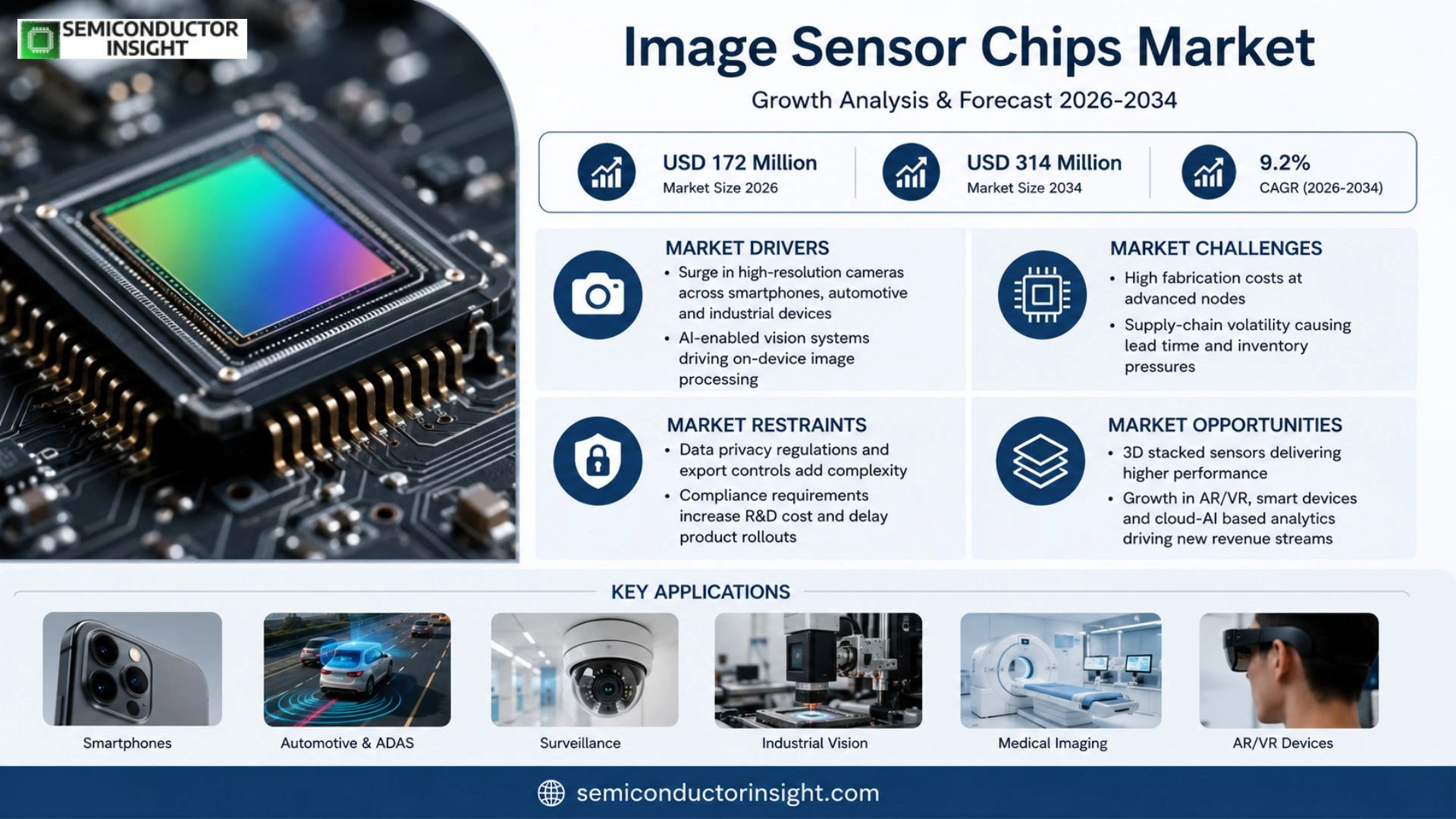
Global Image Sensor Chips market size was valued at USD 172 million in 2026. The market is projected to reach USD 314 million by 2034, exhibiting a CAGR of 9.2% during the forecast period.
Image sensor chips consist of an array of pixels built from light‑sensitive photodiodes, micro‑lenses that focus incoming photons, and integrated micro‑electronic circuitry that converts optical signals into electrical outputs.
The sector benefits from the broader semiconductor rebound; after a robust 26.2% expansion in 2021, overall semiconductor sales settled at USD 580 billion in 2022, with sensors growing 16.3% year‑over‑year. While analog components posted double‑digit gains, Asia‑Pacific showed modest contraction, underscoring divergent regional demand patterns that shape sensor adoption across automotive, security and industrial applications.
MARKET DRIVERS
Proliferation of Advanced Imaging Devices
Image Sensor Chips market is being pulled forward by a surge in high‑resolution cameras inside smartphones, automotive ADAS modules, and industrial inspection tools. As manufacturers embed more pixels per square millimeter, the demand for sensors that deliver low‑light performance and rapid frame rates climbs sharply. This technical push translates into larger design wins for chip suppliers.
Shift Toward AI‑Enabled Vision Systems
Artificial‑intelligence workloads now rely on on‑device image processing to reduce latency and bandwidth costs. Companies that integrate AI accelerators with image sensor chips can offer differentiated solutions for security surveillance, retail analytics, and autonomous navigation. The convergence of AI and imaging creates a compelling revenue stream for vendors that can co‑optimize hardware and software.
➤ Manufacturers that fuse computational photography algorithms directly onto sensor silicon are capturing premium pricing and faster adoption cycles.
Within the next twelve months, the cumulative effect of device upgrades and AI‑centric designs is expected to lift overall shipments, prompting OEMs to renegotiate supply agreements and invest in next‑generation fab capacity.
MARKET CHALLENGES
Escalating Fabrication Costs
Producing CMOS image sensor chips at sub‑micron nodes demands expensive equipment and stringent yield controls. The capital outlay required for new production lines can deter smaller players, concentrating market power among a few incumbents. This cost pressure may restrict price flexibility for downstream integrators.
Other Challenges
Supply‑Chain Volatility
Recent disruptions in semiconductor raw materials and logistics have introduced lead‑time uncertainties. OEMs facing unpredictable deliveries may increase safety stock, which in turn raises inventory carrying costs and compresses margins for sensor manufacturers.
MARKET RESTRAINTS
Regulatory and Privacy Concerns
Data‑privacy regulations in major jurisdictions now impose strict controls on image capture and processing, especially for facial‑recognition applications. Vendors must embed encryption and on‑device anonymization, which adds design complexity and development timelines.
Additionally, export controls on advanced sensor technologies limit market access for some manufacturers, curbing growth opportunities in regions with high adoption rates for smart‑city solutions.
These compliance burdens elevate R&D spend and may slow the rollout of next‑generation chips, tempering optimism for rapid market expansion.
MARKET OPPORTUNITIES
Emergence of 3D Stacked Sensor Architectures
Stacked CMOS designs that separate photodiode and logic layers are unlocking unprecedented performance metrics,higher dynamic range, faster readout, and reduced power consumption. Early adopters in automotive LIDAR and medical imaging are signaling willingness to pay a premium for these capabilities, opening a lucrative niche for innovators.
Beyond automotive, the rise of augmented‑reality headsets and smart glasses is generating a demand for ultra‑compact, low‑latency sensors. Companies that can deliver sub‑millimeter form factors while maintaining image fidelity stand to capture a sizable share of this nascent ecosystem.
Finally, collaborations between sensor makers and cloud‑AI service providers are fostering new business models where raw image data is processed remotely for analytics, creating recurring‑revenue streams tied to sensor deployment.
Image Sensor Chips Market Trends
Growing Preference for CMOS Sensors in Automotive Systems
The automotive sector is reshaping its imaging architecture by integrating CMOS‑based Image Sensor Chips Market solutions into advanced driver‑assistance systems. CMOS technology delivers higher frame rates and lower power consumption than legacy CCD designs, which aligns with the push for real‑time object detection and energy‑efficient vehicle platforms. Manufacturers are prioritizing sensor modules that combine on‑chip image processing with miniaturized lenses, thereby reducing bill‑of‑materials and simplifying vehicle electronics architecture. This shift is creating a demand cascade for high‑resolution, low‑noise chips that can operate across a wide temperature range, prompting suppliers to accelerate product roadmaps and invest in automotive‑grade qualification programs.
Other Trends
Miniaturization of Pixel Architectures
Pixel shrinkage is unlocking new form factors in consumer electronics and industrial IoT devices. By leveraging back‑illuminated pixel designs, vendors can double the light‑collection efficiency while keeping the sensor footprint under 5 mm². The resulting chips enable ultra‑compact cameras for smartphones, wearables, and smart home appliances without sacrificing image quality. Industry players are also experimenting with stacked‑die configurations that separate photodiode and circuitry layers, which improves signal‑to‑noise ratios and accelerates data throughput. This technical evolution is prompting OEMs to redesign enclosure layouts, opening avenues for thinner devices and novel mounting options in constrained environments.
Consolidation of Supply Chains Among Tier‑1 Suppliers
Recent merger activity has concentrated the upstream production of wafer‑scale equipment, giving a handful of tier‑1 firms greater leverage over pricing and capacity allocation. This consolidation is compelling smaller fabless designers to secure long‑term contracts and to diversify their supplier base to mitigate risk. As the market tightens, pricing negotiations are moving from volume‑based discounts to value‑added services such as rapid prototyping and joint development programs. The resulting ecosystem favors companies that can offer integrated design‑for‑manufacturing support, thereby accelerating time‑to‑market for next‑generation Image Sensor Chips Market products across automotive, security, and industrial applications.
COMPETITIVE LANDSCAPE
Key Industry Players
Image Sensor Chips: Competitive Dynamics and Market Positioning
Among the manufacturers, Sony remains the benchmark, leveraging its deep expertise in CMOS technology to capture premium segments such as high‑end smartphones and professional imaging equipment. Sony’s expansive wafer capacity, combined with a portfolio that spans full‑frame, stacked, and pixel‑binning sensors, enables it to set price points that competitors often have to match. Samsung follows closely, using its foundry scale to integrate advanced process nodes, which gives it a foothold in both consumer electronics and automotive vision systems. The market structure reflects a tiered hierarchy: a handful of global giants dominate volume sales, while a second tier of specialized firms competes on niche performance attributes or cost‑effective solutions for IoT devices.
Beyond the leaders, a constellation of focused players is reshaping specific sub‑segments. OmniVision, now part of a larger semiconductor group, concentrates on compact sensors for wearables and automotive driver‑assist functions, differentiating through aggressive pixel‑size reductions. STMicroelectronics and ON Semiconductor target industrial and automotive markets, emphasizing ruggedness and long‑term reliability. Himax and GalaxyCore have built reputations in the emerging market for low‑power sensors used in smart home and surveillance applications. Smaller innovators such as SmartSens, Canon, AMS, and Panasonic are carving out roles in medical imaging and aerospace, where precision and regulatory compliance outweigh sheer volume. These firms collectively ensure that the ecosystem remains vibrant, with technology cross‑pollination driving incremental improvements across the value chain.
List of Key Image Sensor Chips Companies Profiled
- Sony Corporation
- Samsung Electronics
- OmniVision Technologies
- STMicroelectronics
- ON Semiconductor
- Himax Technologies
- GalaxyCore Inc.
- SmartSens Technology
- AMS AG
- Canon Inc.
- Panasonic Corporation
- Toradex (sensor solutions unit)
Segment Analysis:
| Segment Category | Sub-Segments | Key Insights |
| By Type |
|
CMOS dominates the market due to its scalability and lower power consumption.
|
| By Application |
|
Automobile is emerging as a critical driver, especially for driver‑assistance and autonomous systems.
|
| By End User |
|
Consumer Electronics continues to fuel adoption across smartphones, tablets, and wearables.
|
| By Technology |
|
Back‑Illuminated sensors are gaining traction for superior light‑capture efficiency.
|
| By Emerging Use Cases |
|
AI Vision is reshaping sensor requirements with intelligent preprocessing.
|
Regional Analysis: Image Sensor Chips Market
Asia‑Pacific
Flagship device roll‑outs from South Korea, China, and Taiwan keep the region at the forefront of sensor integration. Manufacturers benefit from tight design‑fab loops, enabling rapid adoption of higher‑resolution and multi‑spectral chips without jeopardizing production cadence.
Growing regulatory pressure for advanced driver‑assistance systems has pushed carmakers to embed more capable image sensors. Local Tier‑1 suppliers are aligning their road‑map with global OEM requirements, creating a nascent but resilient automotive segment.
Recent capital infusions into 200‑mm and 300‑mm fabs are narrowing the technology gap with older nodes, offering cost‑effective volumes for mid‑range devices while preserving performance buffers for high‑end chips.
Diversified substrate sources and a growing emphasis on localized packaging mitigate disruptions, allowing manufacturers to keep inventories lean yet responsive to sudden market spikes.
North America
The United States and Canada remain critical for high‑value applications such as augmented reality, industrial robotics, and defense‑grade imaging. While domestic wafer capacity is modest, a dense network of design firms leverages offshore fabs, focusing on custom IP and algorithmic integration. Venture capital directed at sensor‑centric start‑ups has cultivated a fertile ground for niche solutions that address data‑intensive workloads. This ecosystem encourages rapid prototyping, thereby influencing product differentiation strategies for global OEMs seeking to penetrate premium segments.
Europe
European markets exhibit a measured pace, with emphasis on safety‑critical automotive imaging and medical diagnostics. Regulatory frameworks, especially those governing functional safety, compel manufacturers to adopt rigorous verification processes, which in turn elevates the bar for sensor reliability. Collaborative research initiatives across Germany, France, and the Nordic region foster cross‑border innovation, linking semiconductor design with AI analytics. The resulting portfolio of specialized chips, though limited in volume, commands premium pricing due to stringent certification pathways.
South America
Growth in Brazil and Mexico stems largely from expanding consumer electronics penetration and modest automotive assembly lines. Local manufacturers prioritize cost‑efficiency, often selecting mature process nodes that balance performance with affordability. While the region lacks native wafer fabs, import strategies are increasingly supported by regional trade agreements, reducing lead times. This dynamic encourages OEMs to tailor sensor specifications for mid‑tier devices, sustaining a steady demand curve.
Middle East & Africa
Investment in smart‑city infrastructure and surveillance projects drives modest demand for robust image sensors. Nations such as the United Arab Emirates and South Africa are establishing technology parks that attract multinational design teams. Although the market remains niche, the focus on security and environmental monitoring creates opportunities for low‑power, high‑sensitivity chips tailored to harsh operating conditions. Partnerships with global fabs enable regional players to access cutting‑edge processes without building local manufacturing capacity.
Report Scope
This market research report provides a comprehensive analysis of the Image Sensor Chips Market , covering the forecast period 2026–2034. It offers detailed insights into market dynamics, technological advancements, competitive landscape, and key trends shaping the industry.
Key focus areas of the report include:
- Market Overview: The report begins with an overview outlining its current market scenario, key growth indicators, and industry transformation drivers. It discusses macroeconomic factors, demand–supply balance, regulatory landscape, and the strategic role of semiconductors in powering advancements across industries such as automotive, telecommunications, consumer electronics, and industrial automation.
- Market Size & Forecast: Historical data and future projections for revenue, unit shipments, and market value across major regions and segments.
- Segmentation Analysis: Detailed breakdown by product type, technology, application, and end-user industry to identify high-growth segments and investment opportunities.
- Regional Insights: Insights into market performance across North America, Europe, Asia-Pacific, Latin America, and the Middle East & Africa, including country-level analysis where relevant.
- Competitive Landscape: Profiles of leading market participants, including their product offerings, R&D focus, manufacturing capacity, pricing strategies, and recent developments such as mergers, acquisitions, and partnerships.
- Technology Trends & Innovation: Assessment of emerging technologies, integration of AI/IoT, semiconductor design trends, fabrication techniques, and evolving industry standards.
- Market Drivers & Restraints: Evaluation of factors driving market growth along with challenges, supply chain constraints, regulatory issues, and market-entry barriers.
- Stakeholder Insights: Insights for component suppliers, OEMs, system integrators, investors, and policymakers regarding the evolving ecosystem and strategic opportunities.
Primary and secondary research methods are employed, including interviews with industry experts, data from verified sources, and real-time market intelligence to ensure the accuracy and reliability of the insights presented.
FREQUENTLY ASKED QUESTIONS:
What is the current market size of Image Sensor Chips Market?
-> Image Sensor Chips market is projected to reach USD 314 million by 2034, exhibiting a CAGR of 9.2% during the forecast period.
Which key companies operate in Image Sensor Chips Market?
-> Key players include AMS, ASE, GalaxyCore, SmartSens, among others.
What are the key growth drivers?
-> Key growth drivers include increasing demand for high‑resolution imaging in automotive, security, and industrial applications, and rapid advancements in CMOS sensor technology.
Which region dominates the market?
-> Asia‑Pacific remains the largest region by revenue, despite a slight decline, while other regions show strong growth.
What are the emerging trends?
-> Emerging trends include shift from CCD to CMOS sensors, integration of AI/IoT for smart imaging, and miniaturization for wearable and mobile devices.
Get Sample Report PDF for Exclusive Insights
Report Sample Includes
- Table of Contents
- List of Tables & Figures
- Charts, Research Methodology, and more...
 Download Sample Report PDF