Key Statistics
Key Takeaways
- Contact Cleaning Robots are the leading type on the source page with a stated 62% share because brushes, wipers and surface-contact mechanisms deliver predictable dirt removal on glass and structural facade materials.
- Commercial buildings are the dominant application because office towers, hotels and retail properties combine large facade areas, high recurring cleaning cost and strong image requirements. High-rise residential remains an opportunity but faces greater cost sensitivity and fragmented ownership structures.
- North America is retained as the largest 2025 market because the source page quantifies it at 34.2%, while Asia Pacific is identified as the fastest-growing region. A later source-page regional paragraph says Asia Pacific dominates, creating an internal leadership conflict that is explicitly logged rather than silently reconciled.
- Safety regulation creates a direct automation case. OSHA limits rope-descent-system use above 300 feet in general industry except where other methods are infeasible or create greater hazard, while New York City requires approximately 16,000 buildings over six stories to file facade inspection reports every five years.
- Commercialization is moving beyond prototypes. Skyline Robotics deployed Ozmo full time in New York in 2024, Kite Robotics is marketing a 25 kg rope-guided system with digital-twin safety control, and Fraunhofer continues to demonstrate fully automated facade-cleaning architectures with vacuum adhesion and obstacle recognition.
Automated Facade Cleaning Robot Market Overview
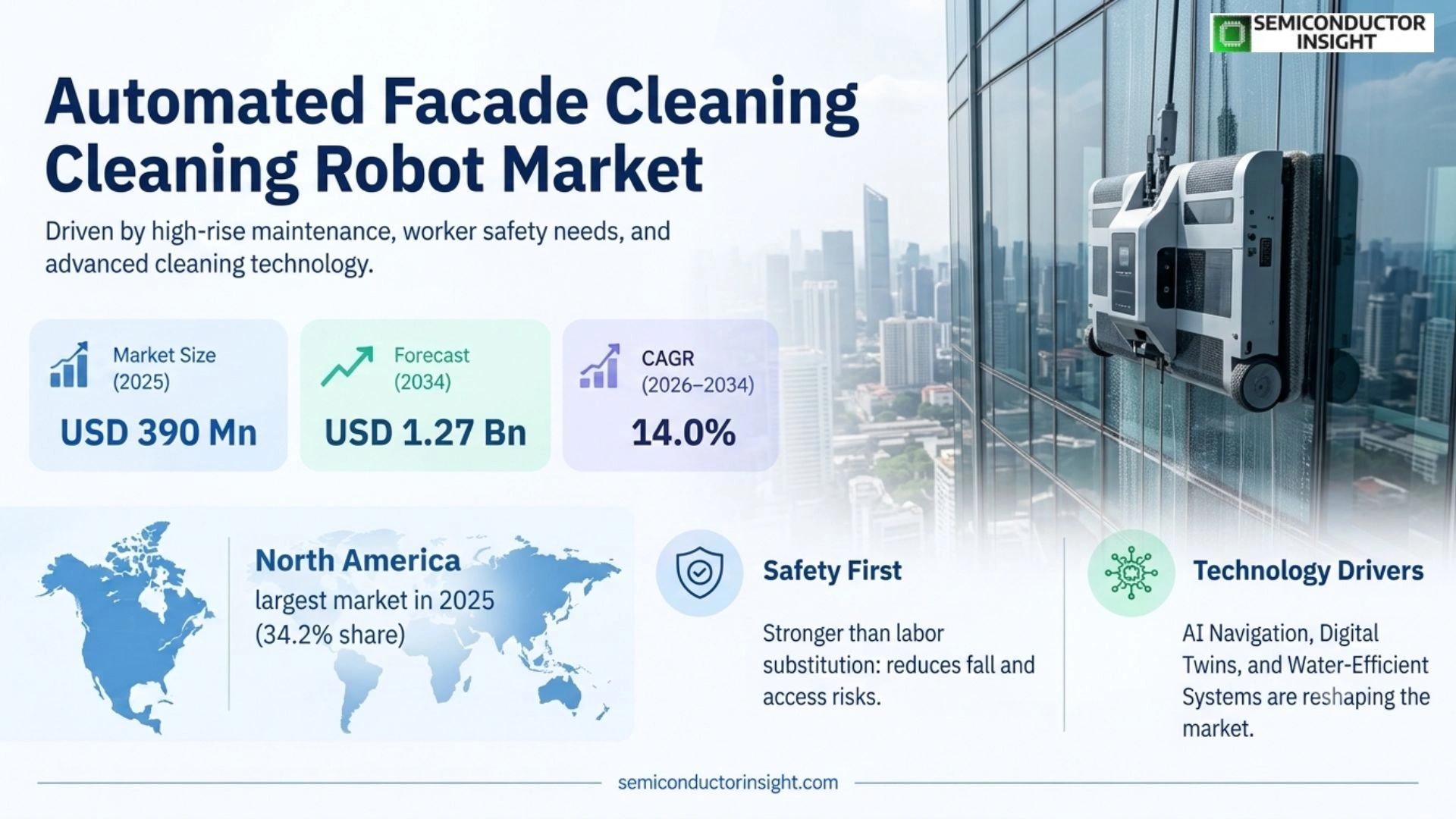
Automated Facade Cleaning Robot Market is rebased to USD 390 million in 2025, increases to an estimated USD 445 million in 2026, and is projected to reach USD 1.27 billion by 2034. The selected source-page size anchors imply a 14.0% CAGR during 2026–2034. North America is the largest market in 2025 based on the source page’s stated 34.2% share, while current demand is being reshaped by high-rise building maintenance, worker-safety requirements, labor-cost pressure, AI navigation, digital twins, water-efficient cleaning systems and the transition from pilot projects toward building-specific robotic maintenance programs.
Automated facade cleaning robots are robotic systems designed to clean glass, metal, stone and composite building exteriors while reducing or eliminating direct human exposure to high-altitude work. System architectures include roof-mounted cable robots, vacuum-adhering surface robots, guided brush platforms and non-contact water or air systems. Commercial performance depends on cleaning quality, building compatibility, wind tolerance, obstacle handling, water consumption, safe fall arrest and the ability to operate repeatedly without damaging facade coatings or seals.
The adoption case is strongest where manual access is expensive or heavily regulated. OSHA guidance notes that rope descent systems are generally limited to 300 feet above grade because longer rope lengths increase wind-related risk, while New York City’s Facade Inspection & Safety Program requires owners of buildings higher than six stories to inspect exterior walls every five years. These rules do not mandate robots, but they increase the economic value of maintenance technologies that reduce human exposure and make repeated facade work more predictable.
Technology is evolving from simple remote-controlled brush machines toward semi-autonomous and autonomous systems. Kite Robotics says its software digital twin predicts forces and positions every 10 milliseconds and compares them with sensor data, while Fraunhofer’s SIRIUS concept automatically recognizes facade structures and obstacles and generates robot actions. Skyline Robotics’ Ozmo adds computer vision and robotic manipulation to conventional building-maintenance units, illustrating how automation is being integrated into existing facade-access infrastructure rather than requiring entirely new buildings.
Segment Analysis: By Type
The source page segments the market into Contact Cleaning Robots and Non-contact Cleaning Robots. Contact systems hold the stated 62% share because direct brushes or wipers provide strong mechanical dirt removal and predictable cleaning quality across many glass and cladding surfaces. Non-contact systems can reduce surface contact and water use in selected designs, but performance depends heavily on nozzle geometry, pressure and contamination type.
| Type | Technical / commercial role | Market position |
|---|---|---|
| Contact Cleaning Robots | Contact robots use rotating brushes, rollers, pads or wipers that physically touch the facade while water is supplied to loosen and remove dirt. They may use roof cables, vacuum adhesion, magnetic systems or guided frames. Because cleaning force is applied mechanically, these systems can remove adherent dust and pollution more consistently than spray-only methods, especially on large glass curtain walls. | Leading segment with the source page stating 62% share. Commercial maturity is supported by deployed systems from Skyline, Kite, Serbot and Fraunhofer-derived designs. Key supplier differentiation lies in brush geometry, surface pressure, obstacle crossing, water recovery, cable control and the ability to adapt to mullions, frames and facade curvature. |
| Non-contact Cleaning Robots | Non-contact robots remove dirt through water jets, air, ultrasonic or other directed cleaning methods without relying on a brush or pad against the surface. They can be attractive for delicate coatings or facade geometries where mechanical contact is undesirable. However, they require careful pressure control and may struggle with strongly adhered contamination unless combined with chemical or repeated passes. | Smaller but strategically relevant segment. It benefits from sustainability and surface-protection requirements, especially where building owners want to reduce abrasion or manual intervention. Commercial success depends on water efficiency, overspray control, recovery systems and the ability to produce uniform results across changing wind and facade conditions. |
Secondary segmentation: By Operation Mode
The source page further segments systems into Autonomous Robots, Semi-autonomous Robots and Remote-controlled Robots. The practical distinction is how much the operator must control path planning, obstacle response and cleaning behavior. Autonomous systems have the strongest long-term value proposition, but building-specific programming and human supervision remain common because every facade presents unique geometry and safety constraints.
| Operation mode | Commercial characteristics |
|---|---|
| Autonomous Robots | Autonomous systems follow pre-programmed or sensor-generated cleaning paths and can adjust motion using computer vision, force sensing or digital models. Their value comes from repeatability and reduced operator workload. Adoption is strongest on standardized facades where geometry can be mapped accurately and the robot can be integrated with building-maintenance equipment. |
| Semi-autonomous Robots | Semi-autonomous systems automate repetitive movement and brush operation while allowing operators to intervene around obstacles, corners or weather changes. This model can be easier to deploy because it preserves human oversight while reducing dangerous manual work. It is likely to remain important during the transition from pilot automation to fully autonomous facade maintenance. |
| Remote-controlled Robots | Remote-controlled machines move under direct operator command through joysticks or tethered controls. They reduce worker exposure but do not eliminate labor. Serbot and other suppliers use radio-control approaches in related cleaning applications. The segment can be attractive for irregular surfaces where fully autonomous navigation would be expensive to configure. |
Secondary segmentation: By Cleaning Mechanism
The source page lists Water-based Cleaning, Chemical-based Cleaning and Dry Cleaning, with water-based systems described as dominant. Mechanism choice affects operating cost, residue, environmental compliance and facade compatibility. Purified water is especially attractive for glass because it can dry without mineral spotting, while chemical or dry methods serve more difficult contamination or water-constrained situations.
| Cleaning mechanism | Demand profile |
|---|---|
| Water-based Cleaning | Water-based robots use purified water, jets or wetted brushes to remove dirt and carry particles away. Kite Robotics emphasizes reverse-osmosis purified water for streak-free cleaning, while Fraunhofer’s Leipzig system uses warm clear water without detergent. The approach supports sustainability and reduces chemical residue, but requires water supply, runoff management and freeze-weather planning. |
| Chemical-based Cleaning | Chemical cleaning uses detergents or specialty agents where water alone cannot remove oily deposits, mineral staining or pollution. Robots can potentially meter chemistry more consistently than manual crews, but runoff, facade coatings and environmental rules must be considered carefully. Building-specific compatibility testing is therefore an important qualification step. |
| Dry Cleaning | Dry cleaning uses air, brushes or other low-liquid methods to reduce water consumption and runoff. It can suit dust-dominant environments or water-scarce regions, but cleaning effectiveness depends on soil type. Suppliers must also control airborne dust and static effects on delicate facade surfaces. |
Secondary segmentation: Contact-Robot Adhesion Subtypes
The source page identifies Magnetic Adhesion, Suction-based and Others as contact-cleaning subtypes. Adhesion architecture determines which facade materials can be addressed and how safely a machine can traverse vertical or inclined surfaces. Cable-guided systems are also common in commercial products because they transfer most load to the roof instead of relying on the facade surface alone.
| Adhesion / support method | Technical implication |
|---|---|
| Magnetic Adhesion | Magnetic systems can work effectively on steel surfaces but are unsuitable for ordinary glass or non-ferrous cladding without structural magnetic paths. Their niche value lies in industrial tanks, steel structures and selected facade elements where strong adhesion can be achieved without vacuum pumps. |
| Suction-based | Vacuum suction allows robots to move across glass and other smooth surfaces without permanent rails. Fraunhofer’s SIRIUS uses vacuum suckers and safety cables, showing how suction can provide locomotion while a separate fall-arrest system protects against loss of adhesion. Surface joints and contamination must be managed carefully. |
| Cable / Roof-supported Systems | Many commercial facade robots are suspended from roof-mounted building-maintenance equipment or dedicated cable points. This approach reduces the need for the robot to carry its own weight through the facade surface and is compatible with tall buildings, but installation geometry and building-specific engineering strongly influence deployment cost. |
Segment Analysis: By Application
By application, the source page segments demand into Commercial and Residential. Commercial properties dominate because office towers, hotels and retail buildings have large recurring facade-maintenance budgets and a direct financial incentive to reduce labor risk and improve cleaning consistency. Residential high-rises offer long-term potential but often have more fragmented ownership, smaller maintenance budgets and less standardized access infrastructure.
| Application | Demand characteristics |
|---|---|
| Commercial | Office towers, hotels, malls and mixed-use skyscrapers are the core application because facade appearance affects leasing, brand image and tenant satisfaction, while cleaning contracts represent recurring facility-management expenditure. High facade area and frequent cleaning create the strongest payback for automation. Large property owners can also deploy robots across portfolios, improving utilization of expensive systems. |
| Residential | High-rise apartments and luxury residential towers also require exterior glass and cladding maintenance, but adoption can be slower because budgets are distributed across owner associations or property managers. Robots become more attractive in premium buildings, very tall towers or locations where manual access is constrained, labor is expensive or building geometry was designed with automation in mind. |
Commercial sub-applications referenced on the source page
The source page identifies Office Buildings, Retail Spaces, Hotels and Others within commercial demand. These sub-applications share the same core safety requirements but differ in cleaning frequency, operating windows and sensitivity to visible facade condition. For facade-robot suppliers, the commercial consequence is that building compatibility, engineered safety, cleaning quality, operator productivity and local service capacity determine whether a prototype can become a repeatable maintenance solution.
| Commercial sub-application | Market implication |
|---|---|
| Office Buildings | Office towers provide the most direct automation economics because large curtain-wall surfaces require regular cleaning and access can interfere with occupants or public space. Systems that operate predictably during controlled hours can reduce scheduling complexity and limit worker exposure. |
| Retail Spaces | Shopping centers and flagship stores emphasize facade appearance but may have lower height than skyscrapers. Robots can still be useful on large atria, glazed roofs and complex external surfaces where manual lifts disrupt customer traffic. |
| Hotels | Hotels value exterior cleanliness as part of brand presentation and guest experience. Cleaning must be scheduled with minimal visual or noise disruption, creating an opportunity for quieter, repeatable systems that can operate during low-occupancy periods. |
| Others | Airports, hospitals, convention centers and institutional buildings can have large glazed surfaces that are difficult to access. The economic case depends on facade geometry, cleaning frequency and whether the robot can be shared with inspection or other maintenance functions. |
Regional Analysis
The source page contains a leadership conflict: its market-insight section states that North America holds the largest share at 34.2%, while a later regional paragraph says Asia Pacific dominates. The quantified North American share is used for the 2025 leadership card, and Asia Pacific is treated as the fastest-growing region as stated consistently across the page.
How do regulation, building height and labor economics shape regional adoption?
North America combines high labor costs, formal fall-protection rules and a large stock of commercial high-rises, making it the most mature quantified market on the source page. Asia Pacific offers the strongest growth through rapid high-rise construction and smart-city investment. Europe has long-standing robotic research and strict safety culture, the Middle East has many landmark towers, and South America remains earlier-stage because investment budgets and service networks are less developed.
| Region | Position | Growth outlook | Demand profile | What decides supplier selection |
|---|---|---|---|---|
| North America | Largest quantified market | High | High-rise commercial and safety-led | Building compatibility, ROI, liability reduction and service |
| Asia Pacific | Fastest-growing | Highest | Urbanization and new skyscraper-led | Cost, local support, automation and adaptable geometry |
| Europe | Technology-rich mature market | Moderate to high | Safety, research and sustainability-led | Standards, energy/water efficiency and retrofit feasibility |
| Middle East & Africa | High-potential emerging | High from small base | Skyscrapers and smart-city projects-led | Heat tolerance, service networks and water efficiency |
| South America | Emerging | Moderate | Commercial real estate and maintenance-led | Capital cost, imported systems and local support |
Competitive Landscape
The source page profiles a fragmented set of commercial suppliers, robotics specialists and research organizations. Serbot, Skyline Robotics, IPC Eagle, Fraunhofer, Sky Pro, Kite Robotics and regional companies compete with very different system architectures. The market is therefore technology- and project-driven rather than a standardized mass-production category, and building-specific engineering remains a major part of competitive advantage.
Skyline Robotics is commercially notable because Ozmo has been deployed full time in New York and is designed to work with existing building-maintenance units. Its model combines robotic manipulation, computer vision and a service-provider partnership rather than selling a standalone consumer robot. This lowers the need for owners to replace all roof infrastructure but still requires building-specific integration.
Serbot and Kite Robotics represent European specialist approaches. Serbot’s cleaning robots emphasize suction or surface-adhering systems and purified-water operation, while Kite uses a compact four-cable configuration and digital twin. Fraunhofer provides long-running research evidence for roof-guided and vacuum-suction architectures, although it is a research institute rather than a conventional product vendor.
The source page also lists IPC Eagle, Sky Pro, Autonopia, Yantai Haitelin, Beijing Litu, Sypron Solutions, WCB Robotics, Derson Arc Cleaners and Welbot Technology. Public information is uneven across these firms, so the HTML preserves the source-page company roster without inventing unsupported revenue rankings or market shares beyond the page’s general qualitative commentary.
| Competitive tier | Companies | Why they matter |
|---|---|---|
| Commercial high-rise automation leaders | Skyline Robotics; Serbot AG; Kite Robotics | These companies have visible commercial or productized robotic cleaning platforms and focus on building-specific engineering, surface adhesion, cable control and operator safety. Their ability to integrate into existing roof-access systems and provide local service can determine adoption more than robot hardware specifications alone. |
| Research & technology developers | Fraunhofer IFF; Autonopia; specialist robotics developers | Research organizations and engineering firms contribute navigation, sensing, vacuum adhesion and automated path-planning technology. Their work validates technical feasibility and can be licensed or transferred into commercial systems, especially for unusual facade geometries. |
| Regional / value-oriented participants | IPC Eagle; Sky Pro; Yantai Haitelin; Beijing Litu; Sypron Solutions; WCB Robotics; Derson Arc Cleaners; Welbot Technology | These firms address regional, cost-sensitive or specialized applications. Growth depends on demonstrating reliable cleaning and safety under local building conditions, while limited public product information means competitive strength should be evaluated case by case rather than inferred from the source-page list alone. |
Companies profiled in the report
The source page profiles Serbot AG, Skyline Robotics, IPC Eagle Corporation, Fraunhofer Institute for Manufacturing Engineering and Automation, Sky Pro, Kite Robotics, Autonopia, Yantai Haitelin Intelligent Technology, Beijing Litu Technology, Sypron Solutions, WCB Robotics, Derson Arc Cleaners and Welbot Technology. The company roster is preserved as provided; no unsupported revenue ranking is added.
Production Capacity Analysis: System Manufacturing & Deployment Capacity
Conventional factory capacity is only one part of the automated facade-cleaning market. Effective deployment capacity includes robot assembly, winches and cable systems, safety validation, building scanning, roof integration, software configuration, operator training and local maintenance. Because every facade can require custom engineering, annual project throughput and service capability are often more important than how many robot chassis a factory can assemble.
Core hardware includes frames, motors, winches, cables, brushes, pumps, suction systems, cameras, force sensors, controllers and fall-arrest equipment. Many components can be sourced from established industrial suppliers, so manufacturing is less capital intensive than semiconductor or automotive production. The difficult work is integrating those components into a system that behaves safely on a specific vertical surface under wind, water and obstacle conditions.
Building-specific engineering can be the true capacity bottleneck. Teams must survey the facade, model geometry, identify roof anchor points, program motion paths and validate loads. Kite’s digital-twin approach illustrates how software models become part of commissioning. A supplier with only a few engineering teams may therefore be unable to scale installations quickly even if hardware inventory is available.
After installation, local service capacity is essential because facade-cleaning equipment combines mechanical wear, water systems and safety-critical controls. Cables, brushes, seals, sensors and pumps need inspection and replacement. Commercial building owners will not adopt robots broadly unless suppliers or partners can provide rapid maintenance and safe fallback procedures in the target city.
Market Dynamics
The market is driven by worker safety, recurring maintenance cost, high-rise construction and smarter robotics, but adoption is restrained by high upfront cost, facade complexity, building-specific engineering and uncertain utilization. The strongest commercial models improve both safety and total lifecycle economics rather than relying on novelty alone. For facade-robot suppliers, the commercial consequence is that building compatibility, engineered safety, cleaning quality, operator productivity and local service capacity determine whether a prototype can become a repeatable maintenance solution.
Market Drivers
| Driver | Directional impact* | Commercial mechanism |
|---|---|---|
| Worker safety | High | Automation reduces direct human exposure to falls and wind at height. OSHA rules and building-maintenance safety programs create strong incentives to reduce rope-access work where practical. |
| High-rise building stock | High | More tall glass buildings create recurring facade-cleaning demand. New construction can be designed for robot access, lowering integration cost compared with legacy retrofits. |
| Labor cost and shortage | High in developed markets | Robots can reduce the number of workers exposed at height and allow skilled operators to supervise larger facade areas, improving productivity where wages and insurance costs are high. |
| AI navigation and sensing | Medium to High | Computer vision, force sensing and digital twins allow robots to handle more complex facades, increasing the addressable building stock and reducing manual intervention. |
Safety economics are stronger than simple labor substitution
Facade cleaning exposes workers to fall, wind and suspended-access risks. OSHA’s 300-foot rope-descent limitation and detailed window-cleaner fall-protection rules illustrate the seriousness of high-altitude access. A robot can reduce human time outside the building, lowering liability and making the business case broader than a direct comparison between worker wages and machine cost.
High-rise growth creates repeatable maintenance demand
Every new glass tower creates decades of recurring cleaning requirements. Automation becomes particularly attractive when robot compatibility is considered during building design because anchors, roof equipment and cleaning zones can be planned in advance. This converts a difficult retrofit into a predictable facility-management system with lower commissioning cost. This distinction matters because every building presents a different combination of roof access, facade geometry, materials and wind exposure, so deployment economics depend heavily on site engineering rather than robot hardware alone.
Labor constraints favor operator productivity
Traditional facade cleaning can require multiple workers, safety supervision and long setup time. Automated systems allow operators to remain on the roof or inside the building while a robot performs repetitive motion. The productivity benefit grows in cities where skilled rope-access labor is expensive or difficult to schedule. Buyers therefore evaluate not only the purchase price but also fall protection, cleaning coverage, water use, installation time, maintenance support and whether the system can operate within existing building-management procedures.
Software expands the range of cleanable geometry
Modern systems use cameras, sensors, path planning and building models to handle mullions, recesses and changing facade zones. Kite’s 10-millisecond digital-twin comparison and Fraunhofer’s obstacle recognition show how software can reduce one of the market’s biggest constraints: architectural complexity. Through 2034, suppliers that combine robust mechanics with digital building models, safety monitoring and service-based commercial models can address a wider building portfolio while improving equipment utilization.
Market Restraints
| Restraint | Directional impact* | Commercial mechanism |
|---|---|---|
| High initial investment | High | Robots, winches, installation and building-specific engineering create a meaningful upfront cost. Smaller owners may prefer existing manual contracts if payback is uncertain. |
| Complex facade geometry | High | Projections, balconies, fins, curved glass and material transitions can interrupt robot paths and require custom tooling or multiple access systems. |
| Building-specific integration | Medium to High | Roof anchors, BMUs, cable routes and control software must be engineered for each property, limiting standardized mass deployment. |
| Weather and environmental limits | Medium | Wind, rain, ice, heat and dust affect adhesion, water delivery and cleaning quality. Robots do not eliminate weather restrictions entirely. |
Upfront cost can exceed the budget of individual buildings
Automated facade-cleaning systems are not simple plug-and-play appliances. Equipment purchase, roof modifications, engineering, commissioning and training can require substantial capital before any cleaning occurs. The payback is strongest on large towers with frequent cleaning or across contractor portfolios that can keep the robot utilized on multiple buildings. The market implication is that a robot’s theoretical cleaning speed has limited value unless it can be installed safely, traverse real facade obstacles and be supported locally over repeated cleaning cycles.
Architecture remains difficult to standardize
Many modern facades intentionally use fins, setbacks, balconies, curves and mixed materials that interrupt a robot’s cleaning path. A machine optimized for flat curtain wall may require additional cable points, articulated tools or manual completion around obstacles. This raises project cost and can reduce the percentage of surface that is truly automated.
Integration requires engineering and approvals
A facade robot transfers loads into roof anchors, building-maintenance units or suction systems and therefore must be assessed as part of a safety-critical access system. Building owners, insurers and engineers need confidence in fall arrest and emergency procedures. Long approval processes can delay revenue even after a robot platform is technically ready.
Weather still affects robotic operation
Robots remove some human weather risk but do not eliminate physics. High winds can move suspended equipment, rain can reduce visibility or adhesion, and freezing temperatures can affect water-based cleaning. Hot climates create different challenges for electronics and seals. Suppliers need clear operating envelopes rather than claiming all-weather automation. For facade-robot suppliers, the commercial consequence is that building compatibility, engineered safety, cleaning quality, operator productivity and local service capacity determine whether a prototype can become a repeatable maintenance solution.
Market Opportunities
Robotics-as-a-service
A contractor-owned robot can be used across multiple buildings, spreading capital cost and increasing annual utilization. Building owners can buy a cleaning outcome rather than hardware, which lowers adoption risk and gives the service provider an incentive to maintain the system and optimize scheduling. This distinction matters because every building presents a different combination of roof access, facade geometry, materials and wind exposure, so deployment economics depend heavily on site engineering rather than robot hardware alone.
Cleaning plus facade inspection
Cameras, sensors and digital mapping can allow the same robot to document cracks, sealant condition, glazing damage or facade anomalies during cleaning. Combining two maintenance tasks increases system utilization and can connect robotic operation with regulatory inspection workflows. Buyers therefore evaluate not only the purchase price but also fall protection, cleaning coverage, water use, installation time, maintenance support and whether the system can operate within existing building-management procedures.
Robot-ready building design
Architects and facade consultants can specify anchor points, roof geometry, access zones and obstacle clearances that support automation from the beginning. Suppliers that work upstream with developers can reduce future deployment cost and make robotic cleaning part of the building-maintenance design rather than an afterthought. Through 2034, suppliers that combine robust mechanics with digital building models, safety monitoring and service-based commercial models can address a wider building portfolio while improving equipment utilization.
Water-saving and chemical-reduction systems
Purified-water and controlled-delivery mechanisms can reduce detergents, overspray and water use. This is especially attractive in arid regions, sustainability-certified buildings and properties where runoff management is difficult. Environmental performance can therefore become a purchasing criterion alongside labor savings. The market implication is that a robot’s theoretical cleaning speed has limited value unless it can be installed safely, traverse real facade obstacles and be supported locally over repeated cleaning cycles.
Supply Chain Analysis
Robotics hardware & industrial components
Robot integration & safety engineering
Building survey, modeling & installation
Cleaning service, maintenance & lifecycle support
Robotics hardware & industrial components
Motors, drives, cameras, force sensors, controllers, pumps, vacuum systems, brushes, winches and cables come from industrial supply chains. Reliability and corrosion resistance are critical because equipment operates outdoors while suspended over occupied public areas. For facade-robot suppliers, the commercial consequence is that building compatibility, engineered safety, cleaning quality, operator productivity and local service capacity determine whether a prototype can become a repeatable maintenance solution.
Robot integration & safety engineering
Manufacturers combine hardware with control software, fall-arrest systems and cleaning tools. The design must manage loads, emergency stops, communication loss and surface contact without damaging the building. Safety validation is therefore central to product credibility. This distinction matters because every building presents a different combination of roof access, facade geometry, materials and wind exposure, so deployment economics depend heavily on site engineering rather than robot hardware alone.
Building survey, modeling & installation
Integrators inspect roof equipment, facade geometry and anchorage, then configure cables, paths and software for the property. Digital twins and building models can reduce commissioning time but still require site-specific data and engineering sign-off. Buyers therefore evaluate not only the purchase price but also fall protection, cleaning coverage, water use, installation time, maintenance support and whether the system can operate within existing building-management procedures.
Cleaning service, maintenance & lifecycle support
Robots are operated by facility teams or specialist contractors and require recurring brush, cable, seal and sensor maintenance. Data from each cleaning cycle can improve path planning and create inspection records, enabling service revenue beyond the original equipment sale. Through 2034, suppliers that combine robust mechanics with digital building models, safety monitoring and service-based commercial models can address a wider building portfolio while improving equipment utilization.
Recent Developments
Recent developments show facade-cleaning robotics moving from research systems toward deployable building-specific platforms and more rigorous software control. Because the market is still young, credible commercialization events and safety frameworks are more informative than unsupported claims of mass adoption. The market implication is that a robot’s theoretical cleaning speed has limited value unless it can be installed safely, traverse real facade obstacles and be supported locally over repeated cleaning cycles.
2025–2030 — New York City entered Facade Inspection & Safety Program Cycle 10
New York City’s Cycle 10 runs from February 2025 to February 2030. Owners of buildings higher than six stories must continue filing five-year facade inspection reports. The program does not require robotic cleaning, but it sustains a large regulated ecosystem for facade access, maintenance and inspection where automated systems can reduce worker exposure and recurring service cost.
2025 — Kite Robotics highlighted a compact robot and digital-twin control
Kite Robotics presented its facade-cleaning system for office and residential buildings with a compact approximately 25 kg robot suspended from four anchor points. Current product information says a digital twin predicts forces and positions every 10 milliseconds and compares them with live sensor data, illustrating how software-based safety monitoring is entering commercial facade automation.
August 28, 2024 — Skyline Robotics deployed Ozmo full time in New York
Skyline Robotics announced the first full-time deployment of its Ozmo window-cleaning robot in New York City in partnership with The Durst Organization and Palladium Window Solutions. The project is significant because it placed a robot into a real commercial facade-maintenance workflow on an occupied high-rise rather than operating only as a demonstration.
Ongoing — Fraunhofer IFF demonstrates fully automated facade-cleaning architectures
Fraunhofer IFF continues to document its fully automatic Leipzig glass-roof system and the SIRIUS high-rise facade robot. SIRIUS combines vacuum locomotion, cleaning, fall protection, media supply and obstacle recognition without facade guide rails, providing a technically validated reference for the core engineering challenges commercial suppliers must solve. For facade-robot suppliers, the commercial consequence is that building compatibility, engineered safety, cleaning quality, operator productivity and local service capacity determine whether a prototype can become a repeatable maintenance solution.
Report Scope & Segmentation
| Attribute | Coverage |
|---|---|
| Market | Automated Facade Cleaning Robot |
| Base Year | 2025 |
| Estimated Year | 2026 |
| Forecast Period | 2026–2034 |
| 2025 Market Size | USD 390 million |
| 2034 Forecast Size | USD 1.27 billion |
| CAGR | 14.0% (2026–2034) |
| Largest Market in 2025 | North America |
| By Type | Contact Cleaning Robot; Non-contact Cleaning Robot |
| By Application | Commercial; Residential |
| By Operation Mode | Autonomous Robots; Semi-autonomous Robots; Remote-controlled Robots |
| By Cleaning Mechanism | Water-based Cleaning; Chemical-based Cleaning; Dry Cleaning |
| Regions | North America; Asia Pacific; Europe; Middle East & Africa; South America |
| Companies Profiled | Serbot AG; Skyline Robotics; IPC Eagle Corporation; Fraunhofer Institute for Manufacturing Engineering and Automation; Sky Pro; Kite Robotics; Autonopia; Yantai Haitelin Intelligent Technology; Beijing Litu Technology; Sypron Solutions; WCB Robotics; Derson Arc Cleaners; Welbot Technology |
Frequently Asked Questions
What is the automated facade cleaning robot market size in 2025?
The source page publishes USD 342 million in 2024 and USD 978 million in 2032. Those anchors imply a 2025 market size of approximately USD 390 million. Applying the same compound growth relationship gives an estimated USD 445 million in 2026 and approximately USD 1.27 billion in 2034. This distinction matters because every building presents a different combination of roof access, facade geometry, materials and wind exposure, so deployment economics depend heavily on site engineering rather than robot hardware alone.
What is the projected market size by 2034?
The rebased 2034 automated facade cleaning robot market is approximately USD 1.27 billion. This extends the source page’s 2024–2032 size anchors using the same compound annual growth factor and aligns the forecast with the requested 2025 base year, 2026 estimate and 2034 endpoint. Buyers therefore evaluate not only the purchase price but also fall protection, cleaning coverage, water use, installation time, maintenance support and whether the system can operate within existing building-management procedures.
Does the source page’s 14.1% CAGR reconcile with the market-size anchors?
Yes, closely. USD 342 million in 2024 and USD 978 million in 2032 imply approximately 14.04% annual compound growth, which rounds to 14.0% and is effectively consistent with the page’s printed 14.1% rate. Through 2034, suppliers that combine robust mechanics with digital building models, safety monitoring and service-based commercial models can address a wider building portfolio while improving equipment utilization.
Which robot type leads the market?
The source page identifies Contact Cleaning Robots as the leading type with a stated 62% share. Contact systems use brushes or wipers to remove dirt physically, providing predictable cleaning performance on many glass and structural facades. The market implication is that a robot’s theoretical cleaning speed has limited value unless it can be installed safely, traverse real facade obstacles and be supported locally over repeated cleaning cycles.
Which application dominates?
Commercial buildings dominate because office towers, hotels and retail properties have large facade areas and recurring maintenance budgets. Automation provides the strongest return where cleaning is frequent, labor is expensive and the building owner can standardize operating procedures across a large property. For facade-robot suppliers, the commercial consequence is that building compatibility, engineered safety, cleaning quality, operator productivity and local service capacity determine whether a prototype can become a repeatable maintenance solution.
Which region is the largest market?
The source page’s market-insight section states that North America holds the largest share at 34.2%, so that quantified figure is used for the 2025 leadership card. A later regional paragraph says Asia Pacific dominates, but the page also consistently calls Asia Pacific the fastest-growing region; the contradiction is disclosed rather than hidden.
How do safety regulations support robot adoption?
Safety rules increase the cost and complexity of human access at height. OSHA generally limits rope descent systems to 300 feet above grade, while New York City requires facade inspections every five years for buildings over six stories. Robots can reduce human exposure during cleaning even though regulations do not specifically mandate robotic systems.
What is the main market restraint?
The main restraint is building-specific integration. Facades differ in roof equipment, mullions, projections, curves, coatings and anchor points, so a robot cannot always move from one building to another without engineering work. This raises upfront cost and limits the speed at which suppliers can scale installations. This distinction matters because every building presents a different combination of roof access, facade geometry, materials and wind exposure, so deployment economics depend heavily on site engineering rather than robot hardware alone.
Who are the major companies profiled?
The source page profiles Serbot AG, Skyline Robotics, IPC Eagle, Fraunhofer IFF, Sky Pro, Kite Robotics, Autonopia, Yantai Haitelin Intelligent Technology, Beijing Litu Technology, Sypron Solutions, WCB Robotics, Derson Arc Cleaners and Welbot Technology. Buyers therefore evaluate not only the purchase price but also fall protection, cleaning coverage, water use, installation time, maintenance support and whether the system can operate within existing building-management procedures.
What is the most important strategic opportunity through 2034?
The strongest opportunity is to combine cleaning robots with service contracts, digital building models and facade inspection. A robot used across multiple properties or for multiple maintenance tasks can achieve much higher utilization, shortening payback and creating recurring software and service revenue beyond the original equipment sale. Through 2034, suppliers that combine robust mechanics with digital building models, safety monitoring and service-based commercial models can address a wider building portfolio while improving equipment utilization.

Get Sample Report PDF for Exclusive Insights
Report Sample Includes
- Table of Contents
- List of Tables & Figures
- Charts, Research Methodology, and more...
 Download Sample Report PDF