Semiconductor for Digital Twins Market Insights
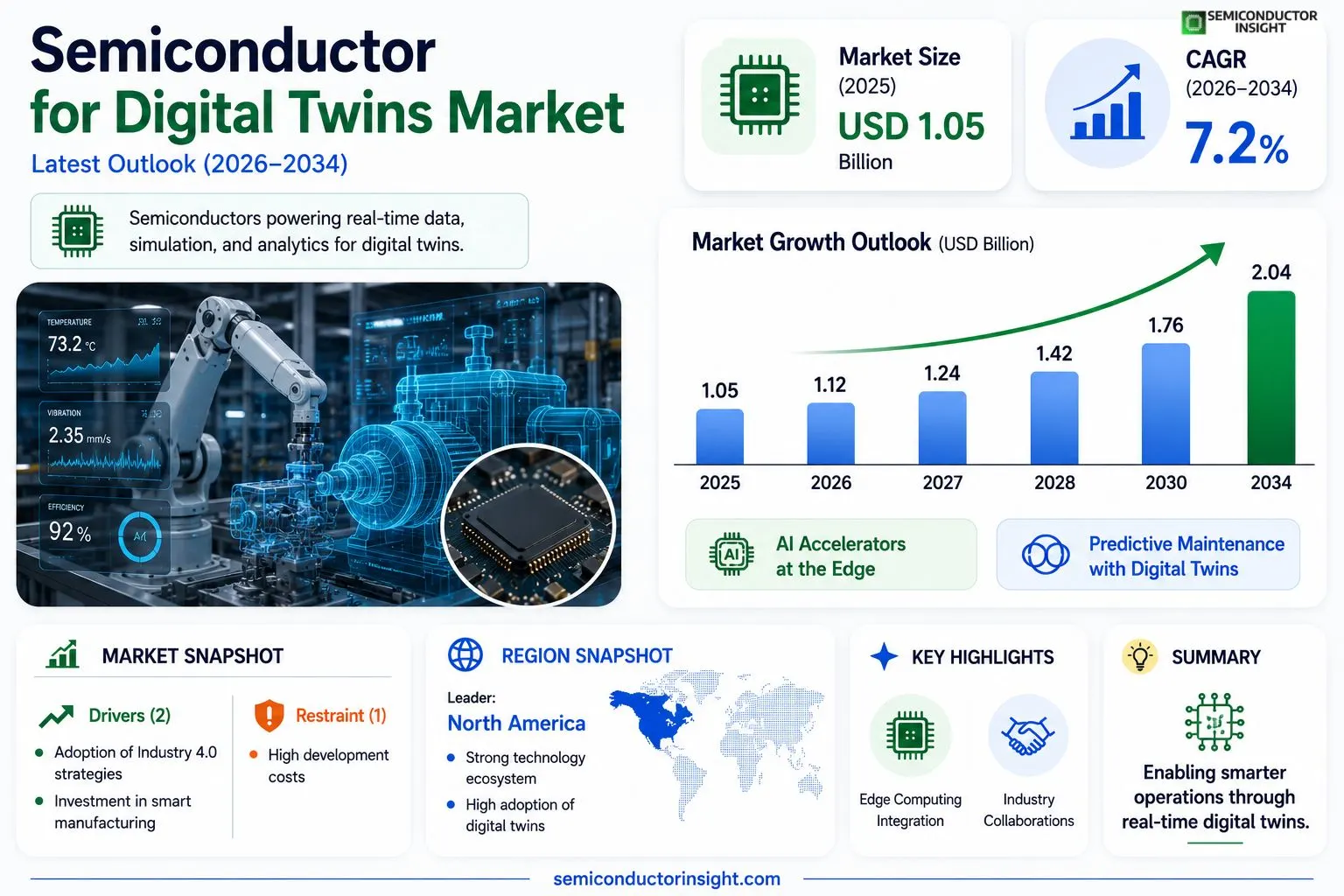
Global Semiconductor for Digital Twins market size was valued at USD 1.05 billion in 2025. The market is projected to grow from USD 1.12 billion in 2026 to USD 2.04 billion by 2034, exhibiting a CAGR of 7.2 % during the forecast period.
Semiconductors enable the high‑fidelity simulation of physical assets by providing processing power, sensor integration, and edge‑computing capabilities essential for digital twin ecosystems. These components include microcontrollers, system‑on‑chips (SoCs), AI accelerators, and power‑management ICs that translate real‑time data into actionable virtual models.The market is accelerating due to rising adoption of Industry 4.0 strategies, increased investment in smart manufacturing, and demand for predictive maintenance solutions. Furthermore, collaborations such as Intel’s partnership with Siemens on edge AI chips and NVIDIA’s integration of GPU‑based twin platforms are expanding deployment opportunities. Key players like Texas Instruments, STMicroelectronics, and Qualcomm continue to innovate with specialized twin‑focused semiconductor portfolios.
MARKET DRIVERS
Increasing Adoption of Digital Twin Technology
Semiconductor for Digital Twins Market is being propelled by rapid integration of digital twin platforms across manufacturing, aerospace, and energy sectors. Companies are leveraging real‑time sensor data to create high‑fidelity virtual replicas, which demand advanced, low‑latency semiconductor components capable of processing massive data streams.
Advancements in Semiconductor Miniaturization
Recent breakthroughs in nanometer‑scale process nodes have reduced power consumption while enhancing computational throughput. These innovations enable edge deployment of digital twins, allowing predictive maintenance and scenario analysis directly on factory floors.
➤ “The convergence of high‑performance semiconductors and digital twin analytics is set to transform product lifecycle management within the next five years.”
Furthermore, cross‑industry collaborations are fostering standardized interfaces for semiconductor modules, accelerating time‑to‑market and bolstering confidence among OEMs and solution integrators.
MARKET CHALLENGES
High Development Costs
Designing semiconductor solutions that meet the stringent latency and reliability requirements of digital twins involves substantial R&D investment. Small‑to‑mid‑size firms often face capital constraints, limiting their ability to compete with established fabs.
Other Challenges
Supply Chain Constraints
Global semiconductor shortages, combined with the need for specialized packaging, create bottlenecks that can delay product launches and increase unit costs for digital twin applications.
MARKET RESTRAINTS
Regulatory and Standardization Hurdles
Absence of unified standards for data exchange between digital twin platforms and semiconductor hardware hampers interoperability. Additionally, regulatory scrutiny over data security and privacy in critical infrastructure sectors adds compliance overhead.These factors can deter early adopters, especially in heavily regulated industries such as healthcare and autonomous transportation, where certification timelines are lengthy.
MARKET OPPORTUNITIES
Emerging Applications in Smart Manufacturing
Smart factories are embracing digital twins to optimize process flows, reduce downtime, and enable real‑time quality control. The need for high‑speed, low‑latency semiconductors creates a sizable growth avenue, with projected market expansion of 12% CAGR through 2032.Another lucrative segment is the development of AI‑accelerated semiconductor modules that can execute machine‑learning inference at the edge, further expanding the scope of predictive analytics within digital twin ecosystems.
Semiconductor for Digital Twins Market Trends
Edge AI Integration Drives Market Momentum
The integration of edge‑AI semiconductor solutions is reshaping the Digital Twins ecosystem. By embedding processing power directly at the sensor layer, manufacturers can achieve sub‑second latency for real‑time data analytics, which enhances the fidelity of virtual replicas. Intel’s partnership with Siemens on edge AI chips exemplifies how custom‑designed microcontrollers and AI accelerators are being deployed to translate raw sensor streams into actionable insights without reliance on centralized cloud resources. This shift not only improves reliability in harsh industrial environments but also aligns with Industry 4.0 initiatives that prioritize localized decision‑making. As a result, adoption rates among Tier‑1 automotive and heavy‑equipment producers have risen sharply, reflecting a broader strategic move toward decentralized intelligence.
Other Trends
Specialized System‑on‑Chip Portfolios for Predictive Maintenance
System‑on‑chips (SoCs) tailored for Digital Twins are gaining traction for predictive maintenance applications. These SoCs combine low‑power microcontrollers, high‑resolution ADCs, and dedicated AI inference engines, enabling continuous monitoring of equipment health. Texas Instruments and STMicroelectronics have introduced twin‑focused IC families that embed power‑management functions alongside edge analytics, reducing BOM complexity. By processing vibration, temperature, and pressure data on‑chip, manufacturers can detect degradation patterns early and schedule interventions before downtime occurs. This capability translates into measurable cost savings and aligns with the market’s emphasis on operational efficiency.
Strategic Partnerships Expand the Twin Ecosystem
Collaboration among semiconductor vendors, software platforms, and industrial system integrators is amplifying market reach. NVIDIA’s GPU‑based twin platforms, coupled with Qualcomm’s AI‑enabled connectivity solutions, are creating end‑to‑end pipelines that bridge high‑performance simulation with real‑world data ingestion. These alliances facilitate seamless integration of cloud‑scale modeling with edge‑level execution, fostering a more cohesive digital twin lifecycle. Moreover, joint development programs are accelerating the rollout of standardized interfaces, which reduces integration friction for OEMs and supports faster time‑to‑value across sectors such as smart manufacturing, energy, and aerospace.
COMPETITIVE LANDSCAPEKey Industry Players
Semiconductor for Digital Twins Market: Competitive Landscape Overview
Semiconductor for Digital Twins Market is dominated by a handful of global chipmakers that combine high‑performance processing, AI acceleration, and robust power‑management solutions. Intel leads the space through its edge‑AI silicon, notably the partnership with Siemens that supplies customized AI chips for real‑time twin simulations. NVIDIA follows with GPU‑centric platforms that enable photorealistic modeling and massive parallel inference, while Texas Instruments leverages its analog‑mixed‑signal portfolio to integrate sensor data directly at the edge. STMicroelectronics and Qualcomm further differentiate their offerings by embedding low‑latency communication modules and AI‑optimized SoCs, creating a tiered ecosystem where flagship processors target large‑scale industrial twins and mid‑range solutions serve modular manufacturing cells. The market structure reflects a blend of vertical integration,where chipmakers collaborate with OEMs and software vendors,and a competitive arms race in AI‑enabled silicon, driving a projected CAGR of 7.2 % through 2034.Beyond the headline players, a cadre of niche innovators enriches the semiconductor landscape for digital twins. Analog Devices focuses on precision analog front‑ends and high‑resolution ADCs essential for sensor fidelity. Infineon and NXP contribute specialized power‑management ICs and secure connectivity that safeguard data integrity across distributed twin nodes. Renesas and Microchip offer microcontroller families optimized for low‑power, real‑time control loops in edge deployments. AMD, through its acquisition of Xilinx, supplies reconfigurable FPGA solutions that adapt to evolving simulation workloads, while MediaTek’s system‑on‑chip platforms provide cost‑effective solutions for peripheral twin applications in smart factories. Collectively, these companies extend the technology stack, enabling a diversified supply chain that supports both enterprise‑grade and emerging‑market digital twin implementations.
List of Key Semiconductor Companies Profiled
- Intel
- NVIDIA
- Texas Instruments
- Qualcomm
- STMicroelectronics
- Analog Devices
- Infineon Technologies
- NXP Semiconductors
- Renesas Electronics
- Microchip Technology
- AMD
- MediaTek
Segment Analysis:
| Segment Category | Sub-Segments | Key Insights |
| By Type |
|
AI Accelerators are emerging as the cornerstone for high‑fidelity twin simulations, delivering:
|
| By Application |
|
Smart Manufacturing leverages semiconductor‑driven twins to:
|
| By End User |
|
OEMs benefit most from semiconductor‑enabled twins by:
|
| By Technology |
|
Edge AI Processing drives market momentum by:
|
| By Deployment Model |
|
Hybrid Deployment is gaining traction as it:
|
Regional Analysis: North America
North America
The integration of digital twins with industrial automation systems is creating unprecedented efficiencies. Semiconductors enable the real-time monitoring and control of complex manufacturing processes, leading to optimized production cycles and reduced downtime.
Digital twins are playing a crucial role in the design, testing, and maintenance of aerospace and defense systems. Advanced semiconductors power the complex simulations required for virtual prototyping and predictive analytics, enhancing safety and performance.
The automotive sector is leveraging digital twins for vehicle design, performance optimization, and autonomous driving development. Semiconductors provide the computational power for simulating vehicle behavior and testing new features in virtual environments.
Digital twins are being deployed in energy infrastructure to optimize power generation, distribution, and consumption. Semiconductors enable real-time monitoring of energy grids and predictive maintenance of critical equipment.
North America
North America continues to lead in the adoption of Semiconductor for Digital Twins Market solutions. The region’s mature technological ecosystem, combined with a proactive approach to digital transformation, positions it for sustained growth in this space. The rise of edge computing and 5G networks further enhances the capabilities of digital twins, enabling real-time data processing and faster decision-making.
Europe
Europe presents a significant and expanding market for Semiconductor for Digital Twins Market applications. Driven by strong industrial foundations and a focus on sustainable manufacturing, European companies are increasingly investing in digital twins to improve efficiency and reduce environmental impact. The automotive and manufacturing sectors are key drivers of demand in Europe, seeking to optimize production processes and enhance product quality. Government initiatives supporting Industry 4.0 and smart manufacturing are also fostering market growth.
Asia-Pacific
Asia-Pacific is emerging as a high-growth region for Semiconductor for Digital Twins Market. Countries like China, Japan, and South Korea are making substantial investments in digital infrastructure and advanced manufacturing technologies. The region’s large manufacturing base and increasing adoption of IoT devices are creating significant demand for digital twin solutions. The automotive and electronics industries are particularly active in adopting semiconductor-powered digital twins for product development and operational optimization.
South America
South America is starting to witness a growing interest in Semiconductor for Digital Twins Market. Early adopters in industries like mining and agriculture are exploring the potential of digital twins for optimizing resource management and improving operational efficiency. While the market is still in its nascent stages, the increasing availability of affordable technology and growing digital literacy are expected to drive future growth.
Middle East & Africa
The Middle East & Africa region represents a relatively untapped market for Semiconductor for Digital Twins Market. With increasing investments in infrastructure development and a growing focus on industrial diversification, the region is poised for significant growth. The energy sector, particularly in countries like Saudi Arabia and the UAE, is expected to be a key driver of demand. Moreover, smart city initiatives and the expansion of manufacturing capabilities will contribute to market expansion.
Report Scope
This market research report provides a comprehensive analysis of the Semiconductor for Digital Twins Market , covering the forecast period 2026–2034. It offers detailed insights into market dynamics, technological advancements, competitive landscape, and key trends shaping the industry.
Key focus areas of the report include:
- ✅ Market Overview: The report begins with an overview outlining its current market scenario, key growth indicators, and industry transformation drivers. It discusses macroeconomic factors, demand–supply balance, regulatory landscape, and the strategic role of semiconductors in powering advancements across industries such as automotive, telecommunications, consumer electronics, and industrial automation.
- ✅Market Size & Forecast: Historical data and future projections for revenue, unit shipments, and market value across major regions and segments.
- ✅Segmentation Analysis: Detailed breakdown by product type, technology, application, and end-user industry to identify high-growth segments and investment opportunities.
- ✅Regional Insights: Insights into market performance across North America, Europe, Asia-Pacific, Latin America, and the Middle East & Africa, including country-level analysis where relevant.
- ✅Competitive Landscape: Profiles of leading market participants, including their product offerings, R&D focus, manufacturing capacity, pricing strategies, and recent developments such as mergers, acquisitions, and partnerships.
- ✅Technology Trends & Innovation: Assessment of emerging technologies, integration of AI/IoT, semiconductor design trends, fabrication techniques, and evolving industry standards.
- ✅Market Drivers & Restraints: Evaluation of factors driving market growth along with challenges, supply chain constraints, regulatory issues, and market-entry barriers.
- ✅Stakeholder Insights: Insights for component suppliers, OEMs, system integrators, investors, and policymakers regarding the evolving ecosystem and strategic opportunities.
Primary and secondary research methods are employed, including interviews with industry experts, data from verified sources, and real-time market intelligence to ensure the accuracy and reliability of the insights presented.
FREQUENTLY ASKED QUESTIONS:
What is the current market size of Semiconductor for Digital Twins Market?
-> Semiconductor for Digital Twins Market was valued at USD 1.05 billion in 2025 and is expected to reach USD 2.04 billion by 2034, reflecting a CAGR of 7.2 %.
Which key companies operate in Semiconductor for Digital Twins Market?
-> Key players include Texas Instruments, STMicroelectronics, Qualcomm, and other leading semiconductor manufacturers.
What are the key growth drivers?
-> Key growth drivers include adoption of Industry 4.0 strategies, increased investment in smart manufacturing, and demand for predictive maintenance solutions.
Which region dominates the market?
-> The source does not specify a dominant region for Semiconductor for Digital Twins Market.
What are the emerging trends?
-> Emerging trends include integration of AI accelerators, edge‑computing chips, and strategic collaborations such as Intel‑Siemens and NVIDIA platforms.

Get Sample Report PDF for Exclusive Insights
Report Sample Includes
- Table of Contents
- List of Tables & Figures
- Charts, Research Methodology, and more...
 Download Sample Report PDF