Analog Phase Shifter Market Insights
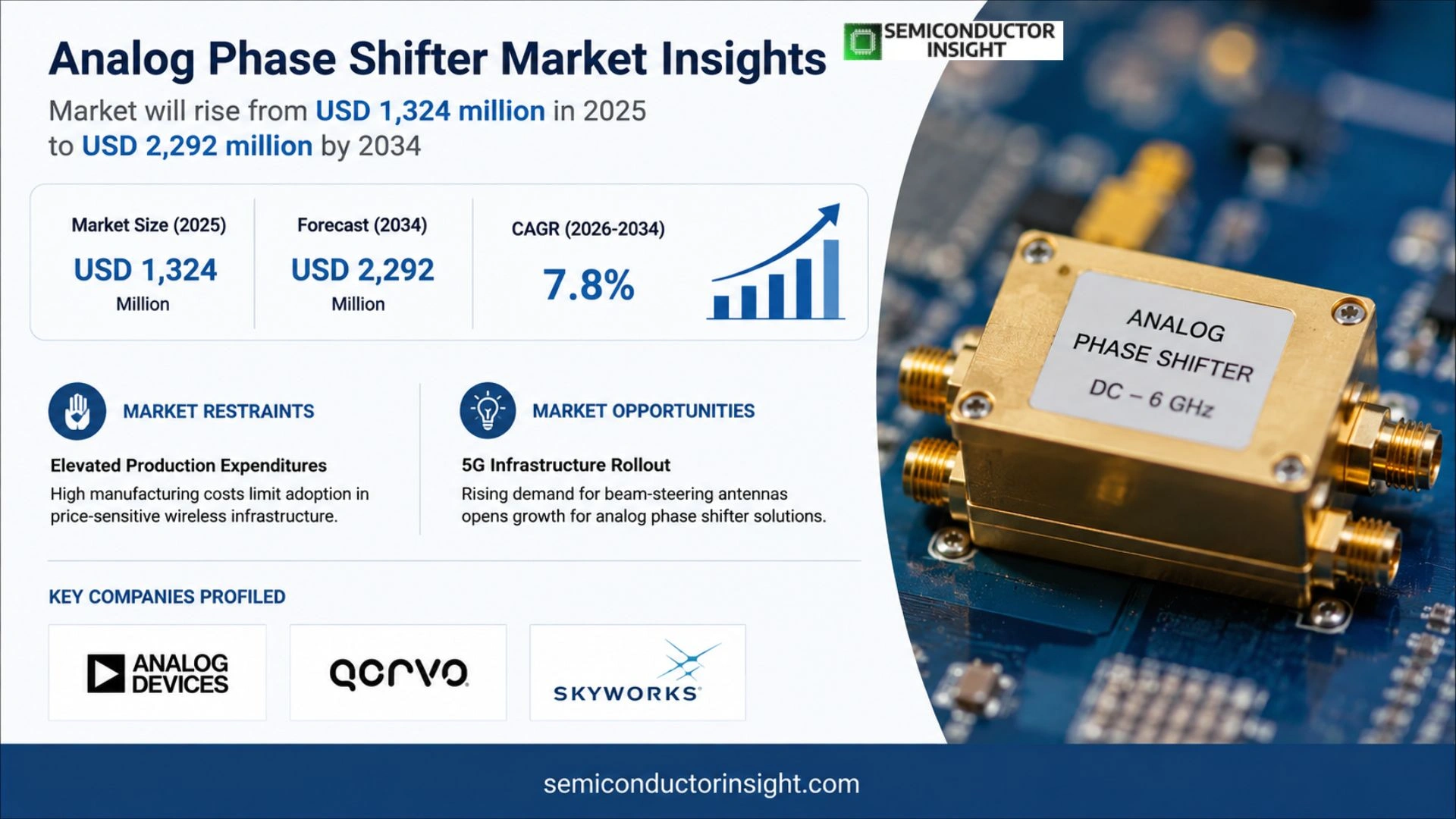
Analog Phase Shifter market will rise from USD 1,324 million in 2025 to USD 2,292 million by 2034, exhibiting a CAGR of 7.8% during the forecast period.
An Analog Phase Shifter is a core control device used in radio‑frequency and microwave systems. Its essential function is to continuously and smoothly adjust the phase angle of an input signal without changing the signal amplitude. Unlike a digital phase shifter that provides discrete step changes, an Analog Phase Shifter typically achieves stepless phase tuning through variable voltage or current, delivering continuous adjustment free of quantization error.
The expansion of the market stems from large‑scale deployment of 5G/6G networks, intensive launches of low‑earth‑orbit satellite constellations and upgrades in cognitive radar technology. Government budgets for radar and electronic‑warfare systems are increasing, while advances in wide‑bandgap semiconductors such as gallium nitride enable higher linearity with lower power consumption. Leading firms,including Analog Devices, Qorvo, Skyworks, MACOM and Murata Manufacturing,are broadening their portfolios and investing in miniaturized RF MEMS solutions to satisfy demand for high‑precision beamforming and interference cancellation.
MARKET DRIVERS
Rising Demand in Defense Radar Systems
Analog Phase Shifter Market is buoyed by expanding defense budgets that prioritize next‑generation radar platforms. Modern phased‑array antennas rely on precise phase control, and analog shifters deliver the low‑latency response required for high‑resolution target tracking. As nations upgrade legacy systems, procurement cycles increasingly allocate funds toward components that guarantee reliability under extreme operating conditions.
Expansion of Satellite Communication Payloads
Satellite operators are augmenting bandwidth by deploying multi‑beam antennas, a configuration that mandates fine‑tuned phase shifting to avoid inter‑beam interference. The shift toward high‑throughput satellites amplifies the need for analog solutions that can be calibrated in orbit without extensive digital overhead. Consequently, manufacturers that can guarantee temperature‑stable performance are witnessing heightened order volumes.
➤ “Analog phase shifters remain the backbone of mission‑critical RF architectures where deterministic behavior outweighs the flexibility of digital alternatives.”
These dual forces,defense modernization and satellite capacity growth,create a feedback loop that sustains component demand. Companies that align product roadmaps with these end‑user requirements stand to capture a disproportionate share of the emerging revenue pool.
MARKET CHALLENGES
Technical Integration Hurdles
Integrating analog phase shifters into increasingly miniaturized RF modules imposes stringent layout constraints. Designers must balance insertion loss against phase resolution, often compromising on one metric to satisfy system‑level specifications. This trade‑off raises engineering cycles and can erode profit margins for vendors unable to deliver optimized form factors.
Other Challenges
Supply Chain Volatility
Component shortages, particularly for high‑purity semiconductor substrates, have resulted in lead times that exceed six months. The uncertainty forces OEMs to adopt safety stocks, inflating inventory costs and reducing flexibility in responding to market swings.
MARKET RESTRAINTS
Elevated Production Expenditures
Fabricating analog phase shifters demands precision lithography and tight tolerance controls, driving unit costs higher than comparable digital counterparts. For price‑sensitive segments such as consumer‑grade wireless infrastructure, the cost premium hampers broader adoption, curbing overall market expansion despite technical advantages.
MARKET OPPORTUNITIES
5G Infrastructure Rollout
The rollout of millimeter‑wave 5G networks necessitates beam‑steering antenna arrays that can adapt rapidly to user movement. Analog phase shifters, with their sub‑nanosecond switching times, are uniquely positioned to meet the latency requirements of real‑time beamforming. Operators seeking to minimize operational expenditure are evaluating hybrid architectures that blend analog speed with digital control, opening a niche for vendors that can supply compatible, cost‑effective modules.
Analog Phase Shifter Market Trend
5G/6G Deployment Spurs Demand for High‑Precision Analog Phase Shifters
As operators roll out dense networks of 5G base stations and initiate early 6G trials, antenna arrays are moving from legacy designs toward dense phased‑array configurations. The continuous‑tuning capability of analog phase shifters eliminates the quantization steps that limit beam accuracy, enabling smoother beam steering and lower side‑lobe levels. This technical advantage translates into higher spectral efficiency for carrier aggregation and more reliable link budgets in the millimetre‑wave bands. Consequently, equipment manufacturers are specifying analog phase‑shifting modules in a larger share of their RF front‑end portfolios, a shift that reverberates through the supply chain and drives incremental order volume.
Other Trends
Emerging Aerospace Applications and Miniaturization Push
Low‑Earth‑Orbit satellite constellations demand payloads that combine high performance with extreme weight and volume constraints. By integrating varactor‑based or RF‑MEMS analog phase shifters directly onto substrate‑level modules, satellite OEMs can reduce the number of discrete components, lowering both mass and power draw. The trend is reinforced by advances in wide‑bandgap semiconductors, which bring better linearity and lower dissipation to millimetre‑wave implementations. The result is a growing niche of aerospace‑grade analog phase‑shifter designs that command premium pricing but open new revenue streams for specialized fabs.
Supply Constraints and Competitive Pressures Shape Market Outlook
While analog solutions retain a performance edge in certain high‑frequency scenarios, they face mounting competition from digitally programmable and hybrid architectures that integrate seamlessly with software‑defined radios. Manufacturers that rely on compound‑semiconductor processes,particularly gallium arsenide and gallium nitride,must navigate a tight wafer‑fab capacity that fluctuates with broader automotive and power‑electronics demand. Periodic shortages translate into longer lead times and higher unit costs, prompting some system integrators to reassess their component strategies. At the same time, R&D investment is intensifying around packaging techniques that mitigate phase drift under temperature extremes, a prerequisite for reliable operation in defense and automotive radar platforms.
COMPETITIVE LANDSCAPE
Key Industry Players
Analog Phase Shifter Market – Competitive Overview
Analog Phase Shifter sector continues to be dominated by a handful of large‑scale semiconductor firms that leverage deep compound‑semiconductor expertise and extensive RF‑module portfolios. Analog Devices, for instance, commands a sizable share through its varactor‑based and RF‑MEMS product families, which are favored in high‑performance radar and test‑equipment applications because of their low insertion loss and fine phase resolution. Qorvo and Skyworks complement this tier by supplying volume‑driven solutions for 5G and emerging 6G base‑station arrays, where the need for continuous phase control aligns with their high‑yield manufacturing lines. Together these leaders shape pricing dynamics, set de‑facto standards for modular integration, and exert influence on supply‑chain negotiations for gallium‑arsenide and gallium‑nitride wafers.
Beyond the primary tier, a cluster of specialized manufacturers addresses niche segments that are critical to market diversification. MACOM and pSemi focus on millimeter‑wave and sub‑terahertz devices for aerospace payloads, employing advanced ferroelectric and PIN‑diode technologies to meet stringent power‑efficiency targets. Smaller entrants such as Pulsar Microwave, Planar Monolithics, and Guobo Electronics concentrate on custom‑engineered solutions for automotive 4D radar and low‑earth‑orbit satellite antennas, where size‑weight constraints drive innovation in RF‑MEMS integration. European players like Murata Manufacturing and Qualwave are expanding into green‑RF designs, while SiCore Semiconductor supplies high‑linearity modules for test and measurement rigs. This layered ecosystem ensures that end‑users can source devices that balance performance, cost, and form‑factor according to specific program requirements.
List of Key Analog Phase Shifter Companies Profiled
- Analog Devices
- Qorvo
- Skyworks Solutions
- MACOM
- pSemi
- Pulsar Microwave
- L3 Narda‑MITEQ
- Planar Monolithics
- Murata Manufacturing
- Qualwave
- Guobo Electronics
- SiCore Semiconductor
Segment Analysis:
| Segment Category | Sub-Segments | Key Insights |
| By Type |
|
Voltage Controlled
|
| By Application |
|
Communication Infrastructure
|
| By End User |
|
5G/6G Base Stations
|
| By Frequency Band |
|
Millimeter Wave
|
| By Technology Platform |
|
RF MEMS
|
Regional Analysis: Analog Phase Shifter Market
Europe
European defense contractors prioritize analog phase‑shifters for precision beam steering, leveraging decades of expertise in high‑frequency component tolerances. Simultaneously, automotive firms adopt these parts to achieve sub‑microsecond latency in lidar‑assisted driver assistance systems, creating a cross‑industry diffusion of know‑how.
The EU’s stringent electromagnetic emission directives compel manufacturers to certify analog phase‑shifters under rigorous testing regimes, fostering a market where compliance becomes a differentiator and drives higher‑quality output.
A concentrated network of precision foundries in Germany and France secures a reliable silicon‑on‑insulator substrate supply, minimizing lead times and insulating European OEMs from global shortages that affect other regions.
The coexistence of legacy incumbents and innovative startups fuels a dynamic competitive landscape, where collaborative R&D projects accelerate the introduction of miniaturized analog phase‑shifters for aerospace and automotive applications.
North America
North America’s Analog Phase Shifter Market is shaped by aggressive defense spending and a burgeoning commercial drone sector. Companies exploit the latency advantage of analog solutions to meet the rapid response requirements of unmanned combat aerial vehicles. Concurrently, Silicon Valley’s semiconductor venture capital ecosystem funds start‑ups that re‑engineer traditional architectures for 5G millimeter‑wave deployments, where analog phase‑shifters still outperform digital counterparts in power efficiency. The blend of deep pockets and a risk‑tolerant culture sustains a pipeline of differentiated products, though supply chain fragilities linked to rare‑earth material sourcing occasionally temper growth expectations.
Asia‑Pacific
In Asia‑Pacific, Analog Phase Shifter Market is propelled by massive infrastructure roll‑outs for smart cities and the region’s rapid ascent in autonomous vehicle trials. Nations such as Japan and South Korea leverage domestic RF expertise to embed analog phase‑shifters into next‑generation radar arrays for public transportation safety systems. Meanwhile, emerging manufacturers in China balance cost‑driven mass production with incremental advances in integration density, seeking to close the performance gap with Western incumbents. The interplay of governmental stimulus and a talent surge in microelectronics fuels a competitive yet collaborative atmosphere.
South America
South America’s engagement with Analog Phase Shifter Market remains modest but is gaining relevance as local aerospace programs prioritize cost‑effective radar solutions for maritime surveillance. Brazil’s defense agencies encourage partnerships with European firms, importing proven analog modules while cultivating domestic assembly capabilities. This hybrid approach reduces reliance on fully imported systems and cultivates a nascent supplier base capable of supporting regional satellite communication initiatives.
Middle East & Africa
The Middle East & Africa region leverages analog phase‑shifters primarily within high‑value defense contracts that demand robust performance under extreme environmental conditions. Gulf states invest heavily in advanced radar installations to protect critical oil infrastructure, favoring analog designs for their proven resilience to temperature fluctuations. In Africa, limited but strategic adoption occurs in telecommunications upgrades, where analog phase‑shifters provide a reliable bridge technology while 5G networks transition to fully digital architectures.
Report Scope
This market research report provides a comprehensive analysis of the Analog Phase Shifter Market , covering the forecast period 2026–2034. It offers detailed insights into market dynamics, technological advancements, competitive landscape, and key trends shaping the industry.
Key focus areas of the report include:
- Market Overview: The report begins with an overview outlining its current market scenario, key growth indicators, and industry transformation drivers. It discusses macroeconomic factors, demand–supply balance, regulatory landscape, and the strategic role of semiconductors in powering advancements across industries such as automotive, telecommunications, consumer electronics, and industrial automation.
- Market Size & Forecast: Historical data and future projections for revenue, unit shipments, and market value across major regions and segments.
- Segmentation Analysis: Detailed breakdown by product type, technology, application, and end-user industry to identify high-growth segments and investment opportunities.
- Regional Insights: Insights into market performance across North America, Europe, Asia-Pacific, Latin America, and the Middle East & Africa, including country-level analysis where relevant.
- Competitive Landscape: Profiles of leading market participants, including their product offerings, R&D focus, manufacturing capacity, pricing strategies, and recent developments such as mergers, acquisitions, and partnerships.
- Technology Trends & Innovation: Assessment of emerging technologies, integration of AI/IoT, semiconductor design trends, fabrication techniques, and evolving industry standards.
- Market Drivers & Restraints: Evaluation of factors driving market growth along with challenges, supply chain constraints, regulatory issues, and market-entry barriers.
- Stakeholder Insights: Insights for component suppliers, OEMs, system integrators, investors, and policymakers regarding the evolving ecosystem and strategic opportunities.
Primary and secondary research methods are employed, including interviews with industry experts, data from verified sources, and real-time market intelligence to ensure the accuracy and reliability of the insights presented.
FREQUENTLY ASKED QUESTIONS:
What is the current market size of Analog Phase Shifter Market?
-> Analog Phase Shifter market will rise from USD 1,324 million in 2026 to USD 2,292 million by 2034, exhibiting a CAGR of 7.8% during the forecast period.
Which key companies operate in Analog Phase Shifter Market?
-> Key players include Analog Devices (US), Qorvo (US), Skyworks (US), MACOM (US), pSemi (US), Pulsar Microwave (US), L3 Narda‑MITEQ (US), Planar Monolithics (US), Murata Manufacturing (JP), Qualwave (CN), Guobo Electronics (CN), SiCore Semiconductor (CN).
What are the key growth drivers?
-> Key growth drivers include large‑scale deployment of 5G and upcoming 6G base stations, increasing budgets for radar and electronic warfare systems, commercialization of wide‑bandgap semiconductors (GaN, SiGe) for better linearity and lower power consumption, and rapid roll‑out of low‑earth‑orbit satellite constellations demanding compact, high‑performance phase shifters.
Which region dominates the market?
-> North America currently leads in procurement volume and sets global technical standards, while Asia‑Pacific shows the fastest growth owing to massive 5G roll‑outs and strong manufacturing capacity.
What are the emerging trends?
-> Emerging trends include integration of wide‑bandgap semiconductor technologies, miniaturization for aerospace and satellite payloads, development of hybrid analog‑digital phase‑shifter architectures, and focus on higher frequency (mmWave and sub‑THz) operation to support next‑generation communication and radar applications.
Get Sample Report PDF for Exclusive Insights
Report Sample Includes
- Table of Contents
- List of Tables & Figures
- Charts, Research Methodology, and more...
 Download Sample Report PDF