Internal & External WiFi Bluetooth RF Antennas Market Insights
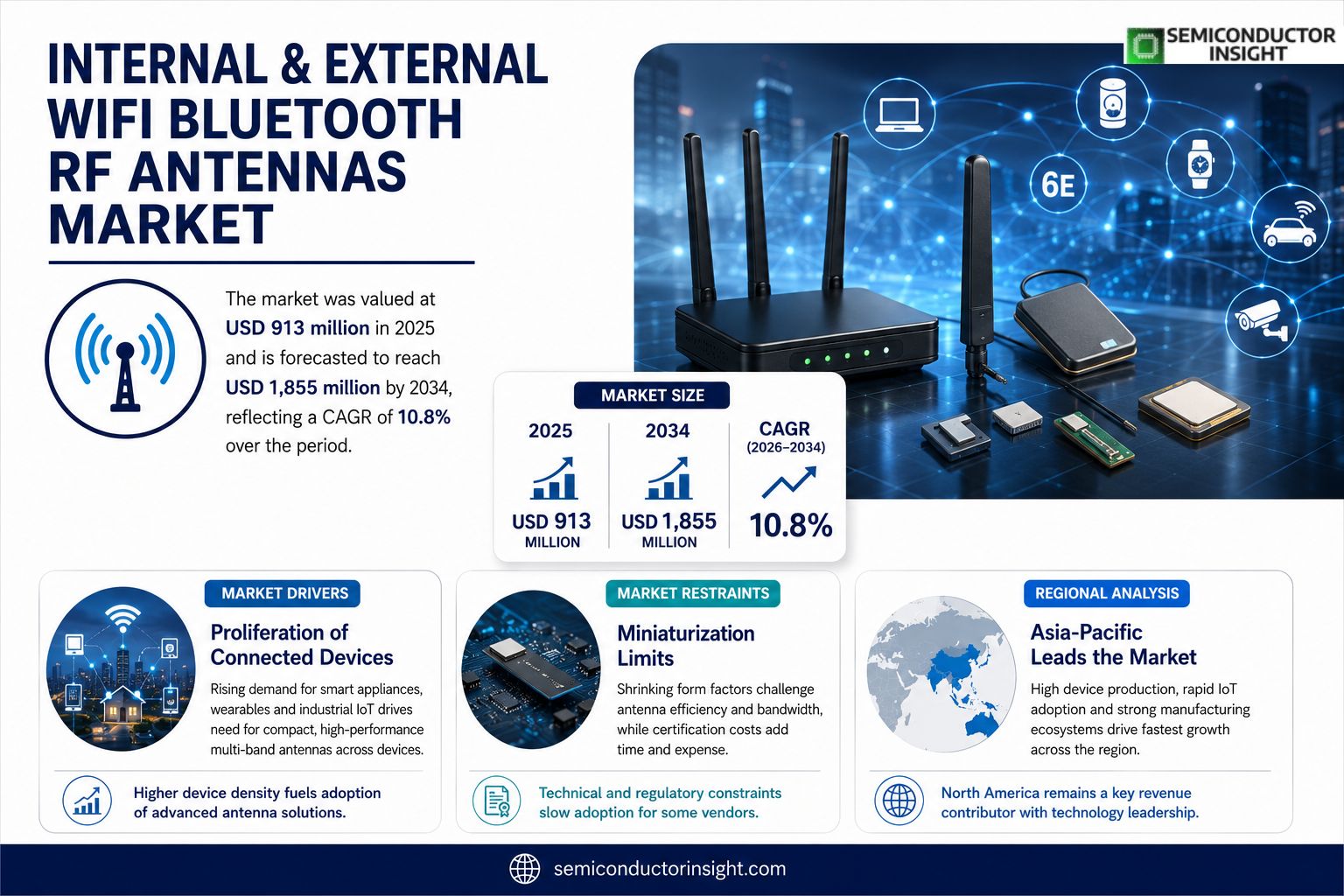
Internal & External WiFi Bluetooth RF Antennas market was valued at USD 913 million in 2025 and is forecasted to reach USD 1,855 million by 2034, reflecting a CAGR of 10.8% over the period.
Internal and external Wi‑Fi and Bluetooth RF antennas serve as short‑range connectivity components across a broad spectrum of devices. Their function includes transmitting and receiving signals, extending coverage, and supporting coexistence on bands such as 2.4 GHz, 5 GHz and 6 GHz while coping with limited space, complex mounting positions and interference among protocols. Designs range from ceramic chip antennas and FR4/PCB structures to flexible FPC/PIFA internal solutions and external rod or blade types, often offering multi‑band support for MIMO, Wi‑Fi 6E/7 and Bluetooth integration. Typical applications span routers, access points, laptops, wearables, smart‑home gadgets, industrial IoT gear and in‑vehicle terminals, with customers ranging from brand owners and ODMs to module makers and system integrators.
MARKET DRIVERS
Proliferation of Connected Devices
Manufacturers of smart appliances, wearables, and industrial IoT nodes are embedding higher‑performance antenna modules to meet user expectations for seamless connectivity. Internal & External WiFi Bluetooth RF Antennas Market therefore benefits from a surge in device counts, prompting OEMs to prioritize compact, low‑loss designs that can operate across crowded spectrum bands.
Regulatory Push for Spectrum Efficiency
New regional standards that tighten out‑of‑band emission limits force designers to adopt antennas with tighter impedance control and superior isolation. Companies that can deliver products meeting these stricter masks gain a competitive edge, driving investment in advanced modeling tools and novel substrate materials.
➤ “Design cycles are shrinking because antenna performance now dictates overall product timing.”
End‑users are also demanding longer battery life, which translates into a requirement for antennas that maximize link budget while consuming minimal power. Suppliers that align their roadmaps with these efficiency targets are positioned to capture larger shares of Internal & External WiFi Bluetooth RF Antennas Market as manufacturers trim bill of materials.
MARKET CHALLENGES
Cost Sensitivity in High‑Volume Segments
While performance pressures rise, price points for mass‑market devices remain tightly constrained. OEMs often negotiate multi‑year contracts that compress margins, forcing antenna vendors to balance material costs against the need for tighter tolerances.
Other Challenges
Supply‑Chain Volatility
Fluctuations in copper and specialty polymer prices, combined with logistics bottlenecks, can delay prototype validation and scale‑up, eroding confidence in timely product launches.
MARKET RESTRAINTS
Miniaturization Limits
Designers constantly push antenna dimensions below 5 mm to fit into slender chassis. However, electromagnetic theory imposes lower bounds on bandwidth and efficiency, creating a technical ceiling that many manufacturers struggle to overcome.Regulatory certification processes, especially for Bluetooth LE 5.3, add lead time and testing expense, discouraging smaller firms from entering the fray.
MARKET OPPORTUNITIES
Integration with 5G‑Enabled Edge Devices
Edge gateways that amalgamate Wi‑Fi, Bluetooth, and emerging 5G links require multi‑band antenna architectures. Companies that can provide integrated solutions with shared feed networks stand to secure contracts worth tens of millions of dollars.Furthermore, the rise of smart‑city infrastructuretraffic sensors, public‑safety cameras, and environmental monitorscreates a niche where rugged, weather‑proof external antennas are in demand. Tailoring coatings for corrosion resistance while preserving RF performance opens a profitable product line within Internal & External WiFi Bluetooth RF Antennas Market.
Internal & External WiFi Bluetooth RF Antennas Market Trends
Shift Toward Multi‑Band Integrated Antennas
The evolution of Wi‑Fi from single‑band to dual‑band and now tri‑band operation has forced designers to treat the antenna as a performance‑critical subsystem rather than a generic part. In Internal & External WiFi Bluetooth RF Antennas Market, manufacturers are bundling ceramic, PIFA and flexible PCB technologies to achieve radiation efficiency across 2.4 GHz, 5 GHz and the newly opened 6 GHz spectrum. This convergence reduces the bill of materials for devices that must support Wi‑Fi 6E, Wi‑Fi 7 and high‑fidelity Bluetooth audio simultaneously. The result is a noticeable uptick in orders for semi‑custom solutions that embed impedance tuning and polarization control directly into the chassis, a move that improves link stability in dense deployments such as office campuses and smart‑factory floors.
Other Trends
Supply‑Side Consolidation
Component suppliers with deep RF expertise are aligning with connector and cable businesses to present end‑to‑end services. Large diversified groups such as TE and Molex leverage their logistics networks to secure long‑term contracts with OEMs, while specialist firms like Taoglas focus on rapid prototype cycles and material innovation. The competitive hierarchy now rewards players that can transition from catalog parts to scenario‑specific, semi‑custom designs within weeks. Regions with strong manufacturing agilityparticularly Mainland China, Taiwan and South Koreaare gaining traction by offering flexible volume thresholds and localized certification support, a factor that is reshaping the sourcing strategies of brand owners and system integrators.
Demand Drivers from Emerging Connectivity Standards
Device categories ranging from wearables to in‑vehicle infotainment systems are adopting Wi‑Fi 6E and Wi‑Fi 7 to meet bandwidth‑intensive applications like AR/VR streaming and real‑time sensor fusion. Simultaneously, Bluetooth LE Audio mandates higher fidelity and lower latency, prompting manufacturers to integrate dual‑protocol antennas that maintain isolation while sharing the same form factor. These technical demands translate into a measurable increase in antenna count per device and a shift toward higher frequency coverage. Companies that can deliver compact, multi‑band packages with robust coexistence mechanisms are positioned to capture the next wave of growth in Internal & External WiFi Bluetooth RF Antennas Market.
COMPETITIVE LANDSCAPE
Key Industry Players
Internal & External WiFi Bluetooth RF Antennas Market Overview
Among the tier‑1 suppliers, TE Connectivity, Molex and Amphenol dominate the supply chain by bundling antennas with connectors, cables and engineering services. Their breadth of manufacturing capacity enables them to meet the volume requirements of OEMs, while their system‑level expertise shortens device‑to‑market cycles for industrial routers and automotive infotainment modules. The three firms have each announced road‑maps that extend into multi‑band, 6 GHz‑capable solutions, positioning them to capture the bulk of revenue as Wi‑Fi 6E and Wi‑Fi 7 deployments accelerate. Their competitive edge stems not only from scale but from the ability to provide semi‑custom tuning packages that address tight space constraints in laptops, wearables and edge‑compute gateways.Niche innovators such as Taoglas, Antenova, 2J, PCTEL, Maxtena, Ezurio, and the Asian manufacturers (C&T RF, Shenzhen Sunway, Dongguan RenFeng) bring depth in RF architecture and rapid prototyping. These players specialize in ceramic chip, FPC and PIFA formats that satisfy the miniaturization push in smartphones and smart‑home sensors. Several of them have leveraged regional production hubs to deliver fast‑turnaround samples for Bluetooth LE Audio and BLE‑mesh applications. Their focus on scenario‑specific performancesuch as high‑gain external rods for in‑vehicle telematics or flexible antennas for wearablescreates differentiated value for customers willing to trade price for tailored link reliability. As the market moves toward integrated Wi‑Fi + Bluetooth modules, firms that can co‑design antenna‑module ensembles are likely to win design‑wins in emerging verticals like industrial IoT and autonomous vehicles.
List of Key Internal & External WiFi Bluetooth RF Antennas Companies Profiled
- TE Connectivity
- Molex
- Amphenol
- Taoglas
- Antenova Ltd.
- 2J Antennas
- PCTEL
- Maxtena Inc.
- Ezurio
- C&T RF Antennas
- Shenzhen Sunway Communication Co., Ltd.
- Dongguan RenFeng Electronic Technology Co., Ltd.
Segment Analysis:
| Segment Category | Sub-Segments | Key Insights |
| By Type |
|
Internal Antennas are favored for devices where space is limited, offering flexibility through ceramic, FPC and PIFA designs; they enable tighter integration with PCB layouts and support multi‑band operation while maintaining radiation efficiency. External Antennas provide higher gain and more robust coverage for routers, access points and vehicular terminals, allowing designers to address challenging installation positions and external interference through rod or blade formats. |
| By Application |
|
Consumer Electronics drive the demand for miniaturized, multi‑band internal antennas that co‑exist with Bluetooth and Wi‑Fi 6E/7, emphasizing seamless integration and low profile. Industrial IoT prioritizes durability, wide‑band coverage and customizable form factors to sustain reliable links in harsh environments. In‑Vehicle solutions focus on robust mounting, multi‑band support and antenna placement flexibility to meet automotive compliance and connectivity performance targets. |
| By End User |
|
System Integrators seek semi‑custom antenna solutions that align with specific RF tuning, certification support and rapid time‑to‑market, valuing partners that provide design‑in services. OEMs focus on reliability and long‑term supply assurance, preferring vendors that bundle connectors, cables and design assistance. ODMs prioritize flexible, low‑cost catalog parts that can be quickly adapted to diverse device portfolios. |
| By Frequency Coverage |
|
Tri‑Band Solutions have become a differentiator as devices adopt Wi‑Fi 6E and Wi‑Fi 7, requiring antennas that maintain efficiency across a broader spectrum while managing interference. Designers value the ability to integrate tri‑band capability within a single form factor, reducing BOM complexity and supporting future‑proof connectivity. |
| By Integration Level |
|
Semi‑Custom Design Services are emerging as the preferred value proposition, enabling customers to tailor antenna performance to specific device constraints while still leveraging standardized manufacturing. Suppliers that bundle simulation, tuning and certification help customers accelerate product development and mitigate regulatory risk. |
Regional Analysis: Internal & External WiFi Bluetooth RF Antennas Market
North America
Manufacturers are diversifying foundry partners and increasing inventory buffers to mitigate geopolitical disruptions, ensuring uninterrupted delivery of antenna modules to OEMs across the United States and Canada.
Recent FCC updates promote broader spectrum access for Wi‑Fi 6E and future 7 devices, prompting antenna designers to re‑engineer form factors for higher throughput without compromising power budgets.
Large‑scale corporate campuses are embedding mesh Wi‑Fi solutions that rely on compact external antennas, driving demand for products that balance range extension with aesthetic integration.
Alliances between chipset firms and academic labs accelerate prototypes that combine internal and external antenna architectures, shortening time‑to‑market for next‑gen wireless platforms.
Europe
European nations exhibit a nuanced landscape where stringent electromagnetic‑compatibility regulations shape antenna design philosophies. German and Swedish OEMs favour modular external antennas that can be retrofitted across product generations, enabling cost‑effective upgrades. Meanwhile, France’s emphasis on sustainable manufacturing drives the adoption of low‑loss materials, aligning performance goals with environmental commitments. The region’s fragmented but highly skilled supplier base creates opportunities for niche players that can navigate diverse certification regimes while delivering tailored solutions for automotive and industrial IoT deployments.
Asia‑Pacific
Asia‑Pacific’s rapid consumer‑electronics turnover fuels a relentless push for miniaturised internal antennas that fit within ultra‑slim smartphones and wearables. Chinese manufacturers dominate volume production, yet South Korean and Taiwanese firms lead in high‑frequency antenna research, especially for emerging 6 GHz and 7 GHz bands. The competitive pressure encourages aggressive price positioning, but quality differentials emerge through proprietary antenna‑in‑package (AiP) technologies that promise superior gain without enlarging device footprints.
South America
In South America, market growth is anchored by expanding broadband initiatives that require robust indoor coverage solutions. Brazil’s telecom operators are trialling external antenna arrays to supplement legacy infrastructure, while Argentina’s automotive sector seeks integrated RF modules for connected‑car prototypes. Local distributors are prioritising after‑sales support and firmware updates, recognizing that reliability concerns can outweigh pure cost considerations in emerging economies.
Middle East & Africa
The Middle East & Africa region presents a heterogeneous demand profile, where luxury‑grade external antennas dominate high‑end hospitality and oil‑field monitoring applications, whereas sub‑Saharan nations focus on affordable internal antenna solutions for basic smartphone penetration. UAE’s investment in smart‑city projects stimulates demand for versatile Wi‑Fi 6‑compatible antenna designs, while South Africa’s push for localized manufacturing introduces opportunities for joint ventures that blend design expertise with regional assembly capabilities.
Report Scope
This market research report provides a comprehensive analysis of the Internal & External WiFi Bluetooth RF Antennas Market , covering the forecast period 2026–2034. It offers detailed insights into market dynamics, technological advancements, competitive landscape, and key trends shaping the industry.
Key focus areas of the report include:
- Market Overview: The report begins with an overview outlining its current market scenario, key growth indicators, and industry transformation drivers. It discusses macroeconomic factors, demand–supply balance, regulatory landscape, and the strategic role of semiconductors in powering advancements across industries such as automotive, telecommunications, consumer electronics, and industrial automation.
- Market Size & Forecast: Historical data and future projections for revenue, unit shipments, and market value across major regions and segments.
- Segmentation Analysis: Detailed breakdown by product type, technology, application, and end-user industry to identify high-growth segments and investment opportunities.
- Regional Insights: Insights into market performance across North America, Europe, Asia-Pacific, Latin America, and the Middle East & Africa, including country-level analysis where relevant.
- Competitive Landscape: Profiles of leading market participants, including their product offerings, R&D focus, manufacturing capacity, pricing strategies, and recent developments such as mergers, acquisitions, and partnerships.
- Technology Trends & Innovation: Assessment of emerging technologies, integration of AI/IoT, semiconductor design trends, fabrication techniques, and evolving industry standards.
- Market Drivers & Restraints: Evaluation of factors driving market growth along with challenges, supply chain constraints, regulatory issues, and market-entry barriers.
- Stakeholder Insights: Insights for component suppliers, OEMs, system integrators, investors, and policymakers regarding the evolving ecosystem and strategic opportunities.
Primary and secondary research methods are employed, including interviews with industry experts, data from verified sources, and real-time market intelligence to ensure the accuracy and reliability of the insights presented.
FREQUENTLY ASKED QUESTIONS:
What is the current market size of Internal & External WiFi Bluetooth RF Antennas Market?
-> Internal & External WiFi Bluetooth RF Antennas Market was valued at USD 913 million in 2025 and is expected to reach USD 1855 million by 2034, at a CAGR of 10.8%.
Which key companies operate in Internal & External WiFi Bluetooth RF Antennas Market?
-> Key players include TE Connectivity, Molex, Amphenol, Taoglas, 2J Antennas, Antenova, PCTEL, Maxtena, among others.
What are the key growth drivers?
-> Key growth drivers include adoption of Wi‑Fi 6E/7 and Bluetooth LE audio, increasing IoT device density, expansion of 6 GHz spectrum, and demand for miniaturized, multi‑band antenna solutions.
Which region dominates the market?
-> Asia‑Pacific is the fastest‑growing region, while North America remains a dominant market in terms of revenue.
What are the emerging trends?
-> Emerging trends include multi‑band MIMO antennas, integrated Wi‑Fi 7/6E‑Bluetooth modules, AI‑driven antenna design optimization, and scenario‑specific semi‑custom solutions for automotive and industrial edge applications.

Get Sample Report PDF for Exclusive Insights
Report Sample Includes
- Table of Contents
- List of Tables & Figures
- Charts, Research Methodology, and more...
 Download Sample Report PDF