5G Millimeter Wave Antenna Market Insights
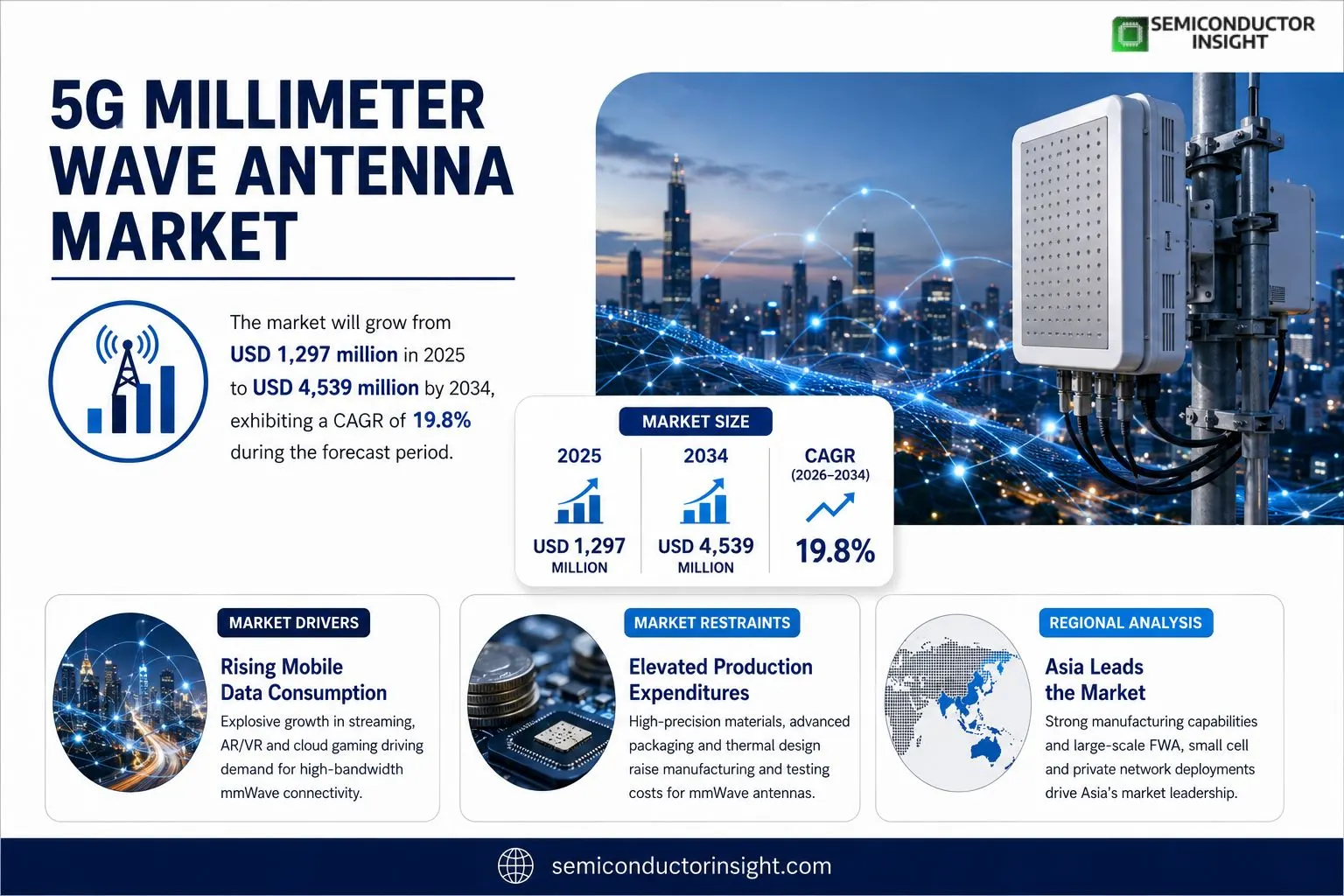
5G Millimeter Wave Antenna market size was valued at USD 1,297 million in 2025. The market will grow from USD 1,297 million in 2025 to USD 4,539 million by 2034, exhibiting a CAGR of 19.8% during the forecast period.
5G millimeter‑wave antennas are high‑frequency RF transmission components that operate on the FR2 spectrum (24 GHz‑41 GHz). They address the inherent challenges of mmWave propagationhigh path loss, limited indoor penetration and short cell radiusby employing array architectures, beamforming, dual‑polarisation and low‑loss waveguide techniques. Typical delivery formats include phased‑array modules, Antenna‑in‑Package (AiP) products and embedded‑antenna system units for O‑RAN radios, fixed wireless access (FWA) gear and smart terminals.The industry has moved from isolated antenna elements toward fully integrated system modules because customers now value reduced link loss, higher EIRP and faster time‑to‑market over single‑parameter specifications. Demand concentrates on FWA deployments, CPE devices, small cells and private‑network installations where capacity and latency matter most. Regional supply chains reflect strong East Asian manufacturing combined with North American and European system design expertise; this geographic balance supports a resilient ecosystem as operators expand high‑band spectrum usage.
MARKET DRIVERS
Rising Mobile Data Consumption
The surge in video streaming, augmented reality applications, and cloud gaming is forcing operators to seek bandwidths that traditional sub‑6 GHz solutions cannot satisfy. As a result, 5G Millimeter Wave Antenna Market is experiencing a swift migration toward higher‑frequency arrays that can sustain multi‑gigabit throughput.
Telecom‑Led Infrastructure Expansion
Major carriers are committing billions to dense small‑cell deployments in urban cores. These rollouts demand compact, high‑gain antennas capable of overcoming the propagation challenges of millimeter‑wave bands, thereby fueling supplier pipelines and stimulating R&D investment.
➤ Deployments that exceed 70 % of a city’s high‑traffic zones are projected to require a three‑fold increase in antenna density within the next 24 months.
Beyond capacity, 5G Millimeter Wave Antenna Market is benefitting from economies of scale as volume production drives down unit costs, enabling midsize operators to justify extensive rollout plans.
MARKET CHALLENGES
Spectrum Congestion and Interference Management
Millimeter‑wave bands are susceptible to blockage by foliage, rain, and building materials. Operators must integrate sophisticated beam‑forming algorithms, which increase system complexity and raise the bar for antenna design excellence.
Other Challenges
Regulatory Hurdles
National regulators are still harmonising allocation tables, and disparate licensing regimes across regions create uncertainty for manufacturers aiming for standardized product lines.
MARKET RESTRAINTS
Elevated Production Expenditures
Fabricating antenna arrays that operate reliably at 24 GHz–100 GHz requires precision tooling and advanced substrate materials. These inputs inflate capital outlays, especially for entrants lacking established supply‑chain relationships.Furthermore, the need for rigorous thermal management and tight tolerances drives up testing costs, limiting the speed at which new designs can be brought to market.
MARKET OPPORTUNITIES
Smart‑City Connectivity Initiatives
Municipalities are investing in connected‑infrastructuretraffic management, surveillance, and public Wi‑Fithat relies on high‑capacity backhaul. Millimeter‑wave antennas that can be mounted on street furniture or lampposts present a compelling solution to meet these bandwidth needs.In parallel, the automotive sector’s push toward vehicle‑to‑everything (V2X) communications is opening a niche for compact, ruggedized antennas that can operate reliably at high frequencies, promising a new revenue stream for vendors adept at meeting automotive grade standards.
5G Millimeter Wave Antenna Market Trends
System‑Level Integration and Module Commercialization
The industry has moved from isolated antenna elements to highly integrated modules that combine phased‑array architectures, beam‑forming circuitry, and thermal management in a single package. This evolution reflects a strategic shift: suppliers now compete on the ability to deliver turnkey solutions that meet O‑RAN specifications, reduce BOM complexity, and shorten time‑to‑market for network operators. For customers, the decisive factor is whether a module can sustain high effective isotropic radiated power while keeping link loss minimal in dense urban deployments. As a result, performance metrics such as EIRP stability, array calibration speed, and power efficiency have become the primary differentiators, pushing manufacturers toward deeper co‑design of RF front‑ends and digital control logic. The commercial implication is a higher barrier to entry for newcomers that lack advanced packaging capabilities, while incumbents can leverage system‑level expertise to capture larger contract portfolios.
Other Trends
Demand Concentration in Fixed Wireless Access and Private Networks
Operators are allocating capital to Fixed Wireless Access (FWA) and enterprise‑grade private 5G networks because millimeter‑wave bandwidth directly addresses capacity shortfalls in crowded downtown cores and industrial campuses. The ability of 5G millimeter‑wave antennas to deliver multi‑gigabit per second links over short distances makes them a viable substitute for fiber in cost‑sensitive projects. Consequently, OEMs are prioritizing AiP and embedded‑antenna system units that fit into compact CPE enclosures, enabling rapid deployment without extensive site work. This demand pattern forces suppliers to emphasize ruggedization, low‑profile form factors, and seamless integration with existing back‑haul solutions, thereby shaping product roadmaps toward highly modular, upgradeable designs. Business outcomes include shorter rollout cycles, reduced capex for service providers, and new revenue streams for system integrators targeting niche verticals such as manufacturing, logistics, and campus‑wide connectivity.
Regional Supply Chain Specialization and Competitive Landscape
East Asian manufacturers dominate wafer‑level processes and advanced packaging, while North American firms lead in O‑RAN radio unit architecture and high‑performance RF front‑end design. Japanese players excel in phased‑array modules and RoF implementations; Korean companies focus on repeaters and DAS solutions; Taiwanese firms supply critical AiP components and testing infrastructure. The United States contributes terminal‑grade modules and intelligent repeaters, whereas Nordic enterprises differentiate with low‑loss waveguide antennas for infrastructure use. This geographic distribution creates a multi‑pole ecosystem where no single region can dictate market direction. For investors and partners, the implication is a need to coordinate cross‑border development programs that align packaging expertise with system‑level design, ensuring that supply‑chain resilience and intellectual‑property considerations are balanced against the speed of commercial deployment.
COMPETITIVE LANDSCAPE
Key Industry Players
5G Millimeter Wave Antenna Market: Competitive Overview
Qualcomm dominates the high‑frequency RF front‑end segment by leveraging its deep chipset expertise and extensive IP portfolio that integrates beam‑forming control with power amplification. Its ability to ship integrated modules that meet O‑RAN specifications gives it a strategic foothold among telecom equipment vendors seeking turnkey solutions. The market is tiered: a handful of innovators command the majority of revenue, while a broader cohort of specialized firms supplies niche arrays, antenna‑in‑package (AiP) products, and repeater‑grade solutions. Consolidation pressure stems from the need to combine antenna array design, thermal management, and large‑scale manufacturing under one roof, prompting collaborations that blur traditional supplier boundaries.Beyond the headline names, several regionally strong players shape the competitive fabric. Japan’s Murata and Kyocera excel in compact AiP modules that marry low‑loss substrates with robust RF front‑ends, targeting enterprise private networks. South Korean Samsung and Doosan focus on high‑power phased‑array units and distributed‑antenna systems for dense urban deployments. Taiwanese firms such as ASE Technology and FRTek contribute advanced packaging and testing capabilities that accelerate time‑to‑market for OEMs. European innovatorsincluding Gapwaves AB, Sivers Semiconductors AB, and Movandidifferentiate through novel waveguide‑type antennas and silicon‑photonic RoF architectures, appealing to niche sectors like industrial IoT and vehicle‑mounted communications. The collective emphasis on system‑level performance, rather than isolated antenna gain, raises entry barriers and forces smaller entrants to specialize or partner with larger integrators.
List of Key 5G Millimeter Wave Antenna Companies Profiled
- Qualcomm Incorporated
- Murata Manufacturing Co., Ltd.
- Qorvo, Inc.
- Samsung Electronics Co., Ltd.
- Fujikura Ltd.
- Kyocera Corporation
- Sumitomo Electric Industries, Ltd.
- Doosan Corporation
- FRTek Co., Ltd.
- TMY Technology, Inc.
- Movandi Corporation
- Gapwaves AB
- Sivers Semiconductors AB
- ASE Technology Holding Co., Ltd.
Segment Analysis:
| Segment Category | Sub-Segments | Key Insights |
| By Type |
|
Phased Array Antenna Module
|
| By Application |
|
Fixed Wireless Access (FWA)
|
| By End User |
|
Enterprise Private Network Operators
|
| By Integration Level |
|
System‑Level Solutions
|
| By Value Driver |
|
Performance Optimization
|
Regional Analysis: 5G Millimeter Wave Antenna Market
North America
The FCC’s recent decision to open additional mmWave bands has accelerated carrier confidence, while Canadian regulators mirror this openness with flexible licensing frameworks. This alignment reduces uncertainty, encouraging vendors to allocate R&D resources toward antenna solutions that meet the newly defined emission masks and power limits, thereby shortening product cycles.
Capital flows are increasingly directed toward small‑cell densification in subway stations, stadiums, and stadiums, where mmWave antennas can deliver multi‑gigabit throughput. Infrastructure firms are partnering with antenna manufacturers to co‑design compact modules that integrate seamlessly into existing pole‑mount and rooftop assets.
Legacy telecom equipment suppliers are bolstering their portfolios through acquisitions of niche antenna start‑ups, while pure‑play specialists leverage their expertise in silicon‑based phased arrays to capture high‑margin segments focused on enterprise and private‑network deployments.
The surge in AR/VR applications, autonomous‑vehicle testing, and ultra‑low‑latency cloud gaming is stretching network capacity to its limits, prompting operators to upgrade to mmWave antenna systems that can sustain massive concurrent streams without compromising reliability.
Europe
European carriers are progressing from pilot to commercial phases, concentrating on high‑density districts such as London, Paris, and Berlin. Policy harmonization across the EU has produced a unified band plan that eases cross‑border equipment deployment, yet local zoning rules still impose constraints on antenna placement. Consequently, vendors are tailoring low‑profile arrays that blend into historic façades while delivering the necessary gain for mmWave links. The automotive sector, which dominates European manufacturing, is also driving demand for vehicle‑mounted antennas that support V2X services, creating a parallel market for OTA‑upgrade‑ready hardware.
Asia‑Pacific
In Asia‑Pacific, the market is fragmented between early adopters like South Korea and Japan and emerging participants such as India and Indonesia. Urban megacities face acute spectrum scarcity, prompting governments to allocate dedicated mmWave corridors for public‑private partnership projects. The competitive pressure forces antenna designers to prioritize cost efficiency without sacrificing beam‑steering precision, leading to a surge in modular panel solutions that can be mass‑produced and rapidly installed on existing infrastructure.
South America
South American operators are leveraging mmWave deployments to leapfrog legacy 4G coverage gaps, especially in Brazil’s coastal metros and Colombia’s capital. Government incentives for broadband expansion have spawned joint‑venture programs that fund small‑cell rollouts, creating fertile ground for antenna suppliers that can offer ruggedized kits capable of withstanding tropical humidity and variable power conditions. Market entrants are also exploring hybrid fiber‑mmWave backhaul architectures to balance capacity and cost.
Middle East & Africa
The Middle East’s wealth concentration around Dubai, Abu Dhabi, and Riyadh fuels premium 5G services, where luxury venues demand ultra‑high‑throughput mmWave antenna installations. In Africa, however, the narrative is more about connectivity uplift; governments are piloting mmWave pilots in Kenya and Nigeria to provide resilient broadband to underserved urban districts. Vendors that can adapt antenna form factors to scarce power and limited site‑acquisition options stand to gain a foothold in these divergent market environments.
Report Scope
This market research report provides a comprehensive analysis of the 5G Millimeter Wave Antenna Market , covering the forecast period 2026–2034. It offers detailed insights into market dynamics, technological advancements, competitive landscape, and key trends shaping the industry.
Key focus areas of the report include:
- Market Overview: The report begins with an overview outlining its current market scenario, key growth indicators, and industry transformation drivers. It discusses macroeconomic factors, demand–supply balance, regulatory landscape, and the strategic role of semiconductors in powering advancements across industries such as automotive, telecommunications, consumer electronics, and industrial automation.
- Market Size & Forecast: Historical data and future projections for revenue, unit shipments, and market value across major regions and segments.
- Segmentation Analysis: Detailed breakdown by product type, technology, application, and end-user industry to identify high-growth segments and investment opportunities.
- Regional Insights: Insights into market performance across North America, Europe, Asia-Pacific, Latin America, and the Middle East & Africa, including country-level analysis where relevant.
- Competitive Landscape: Profiles of leading market participants, including their product offerings, R&D focus, manufacturing capacity, pricing strategies, and recent developments such as mergers, acquisitions, and partnerships.
- Technology Trends & Innovation: Assessment of emerging technologies, integration of AI/IoT, semiconductor design trends, fabrication techniques, and evolving industry standards.
- Market Drivers & Restraints: Evaluation of factors driving market growth along with challenges, supply chain constraints, regulatory issues, and market-entry barriers.
- Stakeholder Insights: Insights for component suppliers, OEMs, system integrators, investors, and policymakers regarding the evolving ecosystem and strategic opportunities.
Primary and secondary research methods are employed, including interviews with industry experts, data from verified sources, and real-time market intelligence to ensure the accuracy and reliability of the insights presented.
FREQUENTLY ASKED QUESTIONS:
What is the current market size of 5G Millimeter Wave Antenna Market?
-> 5G Millimeter Wave Antenna Market was valued at USD 1,297 million in 2025 and is expected to reach USD 4,539 million by 2034, at a CAGR of 19.8% during the forecast period.
Which key companies operate in 5G Millimeter Wave Antenna Market?
-> Key players include Qualcomm Incorporated, Murata Manufacturing Co., Ltd., Qorvo, Inc., Samsung Electronics Co., Ltd., Fujikura Ltd., Kyocera Corporation, Sumitomo Electric Industries, Ltd., Doosan Corporation, FRTek Co., Ltd., TMY Technology, Inc., Movandi Corporation, Gapwaves AB, Sivers Semiconductors AB, ASE Technology Holding Co., Ltd..
What are the key growth drivers?
-> Key growth drivers include Fixed Wireless Access (FWA), Customer Premises Equipment (CPE), small cells, O‑RAN radio units, indoor distribution, urban coverage extension, and enterprise private networks.
Which region dominates the market?
-> Asia dominates the supply side of the 5G millimeter wave antenna ecosystem, while North America shows the strongest demand growth driven by FWA deployments and private network initiatives.
What are the emerging trends?
-> Emerging trends include highly integrated phased‑array modules, Antenna‑in‑Package (AiP) solutions, O‑RAN compatible radio units, advanced beam‑forming and beam‑switching technologies, and co‑development of system‑level solutions for private 5G networks.

Get Sample Report PDF for Exclusive Insights
Report Sample Includes
- Table of Contents
- List of Tables & Figures
- Charts, Research Methodology, and more...
 Download Sample Report PDF