FBAR Filters Market Insights
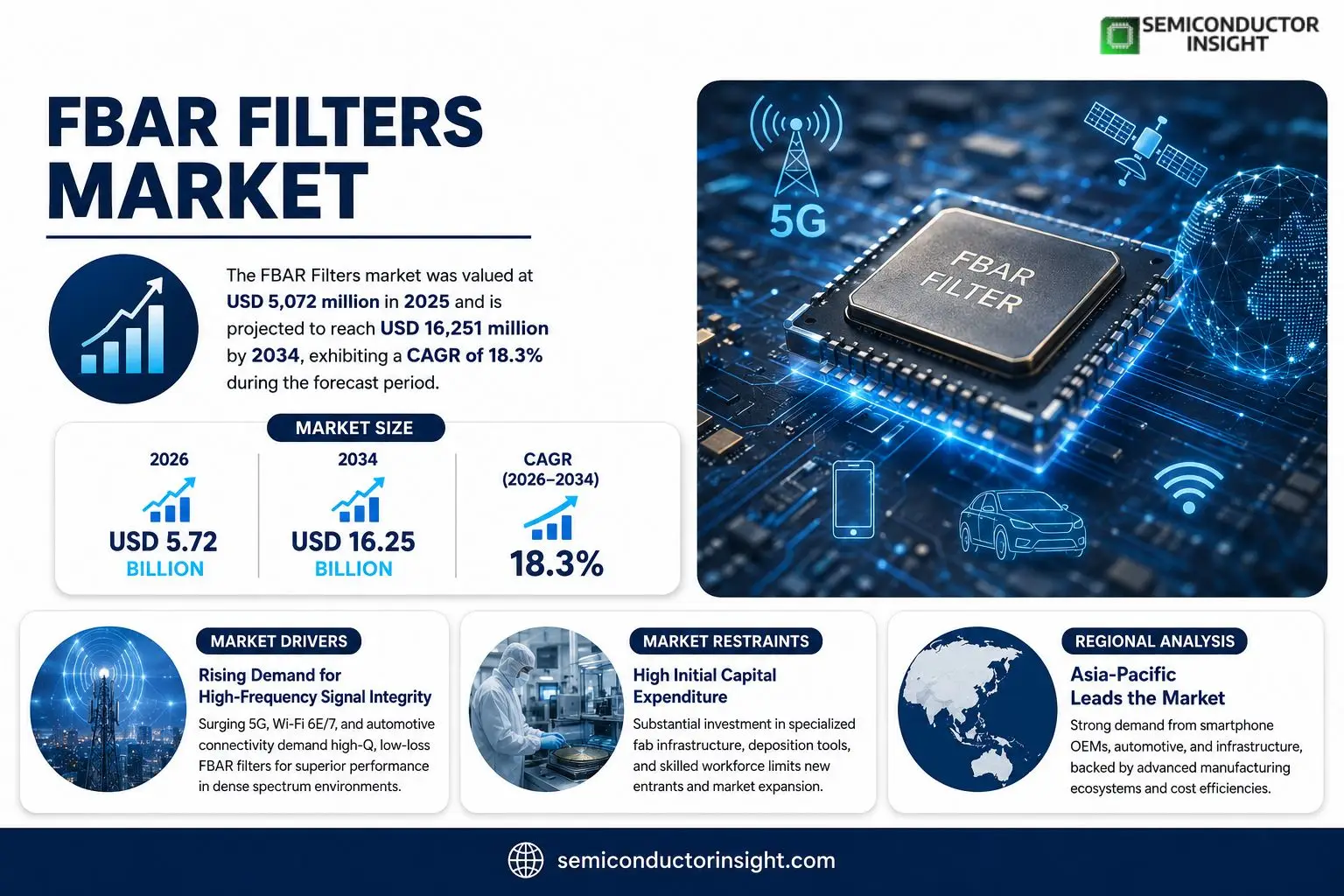
FBAR Filters market was valued at USD 5,072 million in 2025 and reaches USD 16,251 million by 2034, delivering a CAGR of 18.3% over the forecast period.
Film Bulk Acoustic Resonator (FBAR) filtersoften grouped with broader BAW RF filtersare compact RF front‑end components that convert radio‑frequency electrical signals into bulk acoustic vibrations through piezoelectric thin films such as AlN or ScAlN. By arranging resonator arrays these devices achieve precise band‑selection, adjacent‑channel rejection and signal coexistence management for increasingly crowded spectrum environments including 5G, Wi‑Fi 6E/7, automotive wireless links and satellite communications. Core technology variants comprise air‑cavity FBAR, SMR BAW, temperature‑compensated TC‑FBAR and XBAR/XBAW architectures; typical form factors range from discrete band‑pass filters and duplexers to multiplexers and integrated RF front‑end modules. Primary customers include smartphone OEMs, Wi‑Fi router manufacturers, automotive communication equipment suppliers and satellite system integrators; business models span standard component sales, customized filter design and wafer‑foundry services.
MARKET DRIVERS
Increasing Demand for High‑Frequency Signal Integrity
The proliferation of millimeter‑wave communication systems forces manufacturers to seek components that preserve signal fidelity at gigahertz frequencies. FBAR Filters address this need by offering low insertion loss and sharp selectivity, which directly improves device performance in 5G base stations and automotive radars.
Regulatory Push for Electromagnetic Compatibility
Stricter EMC standards across Europe and North America compel equipment makers to integrate filtering solutions that meet tighter out‑of‑band emission limits. The ability of FBAR Filters to provide deep stop‑bands without bulky form factors makes them a preferred choice for compliance‑driven product designs.
➤ “The shift toward miniaturized, high‑Q resonators is reshaping the RF front‑end landscape, and FBAR technology sits at the core of that transformation.”
Beyond compliance, OEMs recognize that integrating FBAR modules can reduce bill‑of‑materials costs by eliminating multiple discrete components, thereby accelerating time‑to‑market for next‑generation devices.
MARKET CHALLENGES
Manufacturing Yield Volatility
The micro‑fabrication steps required for FBAR productionespecially thin‑film deposition and precise etchingare susceptible to process drift. Yield fluctuations translate into price pressure, particularly for low‑volume specialty applications where cost sensitivity is high.
Other Challenges
Material Compatibility Issues
Integrating FBARs with diverse substrate materials (e.g., GaN, SiC) can introduce thermal mismatch, leading to frequency drift over the product lifecycle. Companies must invest in robust packaging designs to mitigate these effects.
MARKET RESTRAINTS
High Initial Capital Expenditure
Establishing a dedicated FBAR fab line entails substantial upfront investment in clean‑room infrastructure, specialized deposition equipment, and skilled labor. This financial barrier discourages new entrants and limits market consolidation to firms with deep pockets.
MARKET OPPORTUNITIES
Emergence of Integrated RF‑Photonic Platforms
Convergence of RF and photonic technologies in data‑center interconnects creates a niche where ultra‑compact, high‑Q FBAR filters can coexist with silicon‑photonic waveguides. Early adopters stand to capture premium margins by delivering differentiated, bandwidth‑efficient solutions.
FBAR Filters Market Trends
Spectrum Congestion Elevates Filter Complexity
The surge in wireless traffic across 5G, Wi‑Fi 6E/7, and emerging satellite links compresses the usable spectrum, compelling device designers to squeeze more bands into tighter silicon footprints. FBAR Filters, with their high‑Q resonators, deliver the narrow‑band selectivity required to isolate adjacent channels while keeping insertion loss low. This technical advantage translates into higher receiver sensitivity and lower power drawattributes that modern smartphones and automotive telematics prioritize to extend battery life and meet regulatory emissions limits. Consequently, FBAR Filters Market is reshaping RF front‑end architectures, prompting OEMs to replace legacy SAW components with integrated duplexers and multiplexers built on bulk‑acoustic technology.
Other Trends
Material Innovation Expands Frequency Reach
Recent progress in piezoelectric thin‑film chemistry, especially the shift from conventional AlN to Sc‑doped AlN and single‑crystal variants, raises electromechanical coupling coefficients. Higher coupling permits wider bandwidths and operation at frequencies above 10 GHz, a range essential for forthcoming 6G prototypes and high‑throughput satellite constellations. Manufacturers that secure these material patents can offer temperature‑compensated (TC‑FBAR) solutions with minimal drift, reducing the need for external calibration circuits. The downstream effect is a simplification of module design and a faster time‑to‑market for carriers seeking to roll out new spectrum bands.
Regional Competition Fuels Platform Differentiation
In North America, firms such as Broadcom and Qorvo leverage deep integration with handset ecosystems to co‑design RF front‑end modules that embed FBAR filters directly into multi‑chip packages. Asian players, notably Murata in Japan and a cohort of Chinese foundries, concentrate on wafer‑level process platforms that enable high‑volume production of standardized FBAR cells. Taiwanese vendors contribute niche packaging expertise that trims module thickness for wearables. This geographic diversity creates a competitive environment where intellectual‑property licensing, foundry capacity, and supply‑chain resilience become decisive factors. Companies that align their roadmap with the material and packaging advances discussed earlier can capture premium segments in mobile, automotive, and defense applications, while also mitigating risks associated with single‑source dependence.
COMPETITIVE LANDSCAPE
Key Industry Players
Competitive Dynamics in the FBAR Filters Market
U.S. manufacturers dominate the high‑frequency segment of FBAR filters, leveraging deep IP in piezoelectric thin‑film processes and extensive R&D budgets. Broadcom’s portfolio extends beyond discrete filters to integrated front‑end modules that support carrier aggregation in flagship smartphones, while Qorvo has differentiated itself through a broad SMR‑BAW line that caters to both mobile handsets and automotive Wi‑Fi solutions. Qualcomm, traditionally a chipset supplier, now offers customized filter‑chip co‑design services that embed FBAR directly into system‑on‑chip packages, enhancing power efficiency for 5G and emerging Wi‑Fi 7 platforms. Skyworks focuses on duplexer architectures that simplify antenna routing in compact devices, and MACOM provides a spectrum of high‑Q resonators for defense and satellite communications. Akoustis (under Space Exploration Technologies Corp.) operates a wafer‑foundry model, granting customers access to scalable production of temperature‑compensated FBARs, a capability that strengthens its position in markets demanding stringent stability across temperature extremes.Beyond the leading tier, a diverse set of Asian firms adds depth and regional resilience to the supply chain. Japan’s Murata has rolled out XBAR products that push frequency limits into the sub‑6 GHz and mmWave bands, addressing the bandwidth appetite of 5G infrastructure. TAIYO YUDEN combines FBAR with SAW and multilayer ceramic technologies, targeting niche industrial IoT applications where reliability is paramount. Chinese players such as ROFS Microsystems, QuantGrav, MEMSonics, EPIC MEMS, and Newsonic are ramping up domestic production of FBAR and TC‑FBAR devices, often backed by government subsidies aimed at reducing import reliance. Taiwan’s Walsin Technology contributes RF BAW components that feed regional handset assemblers, while Communication Semiconductors (GCS) offers a foundry platform that supports third‑party customization across the spectrum of frequency bands. Collectively, these companies drive incremental innovation in material scienceScAlN, single‑crystal filmsand packaging density, creating a competitive environment where differentiation hinges on material performance, foundry throughput, and the ability to co‑engineer modules for emerging standards such as Wi‑Fi 7 and future 6G.
List of Key FBAR Filters Companies Profiled
- Broadcom Inc.
- Qorvo, Inc.
- Skyworks Solutions, Inc.
- Qualcomm Incorporated
- Akoustis Technologies (Space Exploration Technologies Corp.)
- MACOM Technology Solutions Holdings, Inc.
- TAIYO YUDEN CO., LTD.
- Murata Manufacturing Co., Ltd.
- ROFS Microsystems (Tianjin) Co., Ltd.
- Nanjing QuantGrav Microelectronics Technology Co., Ltd.
- Wuhan MEMSonics Technologies Co., Ltd.
- EPIC MEMS (Xiamen) Co., Ltd.
- Shenzhen Newsonic Semiconductor Co., Ltd.
- Walsin Technology Corporation
- Communication Semiconductors, LLC
Segment Analysis:
| Segment Category | Sub-Segments | Key Insights |
| By Type |
|
Air‑cavity FBAR drives market adoption through:
|
| By Application |
|
Mobile Communications remains the core growth engine because:
|
| By End User |
|
Smartphone OEMs prioritize FBAR filters to:
|
| By Technology Route |
|
XBAR / XBAW is gaining traction because:
|
| By Functional Form |
|
RF Front‑End Module stands out by:
|
Regional Analysis: FBAR Filters Market
Europe
European firms are experimenting with piezoelectric composites that improve electromechanical coupling, a move that reduces insertion loss while preserving compact footprints. This material focus aligns with regional sustainability goals, as manufacturers seek lower‑impact processes without sacrificing acoustic performance.
The EU’s stringent electromagnetic compatibility directives compel filter designers to anticipate tighter emission limits. Suppliers that embed compliance into early design stages gain a strategic edge, allowing OEMs to accelerate time‑to‑market for compliant products.
Cross‑border research consortia, often anchored by university labs, catalyze rapid prototyping of FBAR technologies. These hubs facilitate knowledge transfer, ensuring that breakthroughs transition swiftly from academic proof‑of‑concept to production‑ready designs.
In response to recent disruptions, European manufacturers are diversifying wafer suppliers and investing in on‑site testing capabilities. This approach mitigates lead‑time volatility and reinforces confidence among downstream assemblers.
North America
North American OEMs are prioritizing integration density, urging FBAR filter providers to shrink module sizes while maintaining bandwidth agility. The market is shaped by a culture of rapid product cycles, where vehicle‑to‑cloud communication standards evolve swiftly. Vendors that can deliver design‑for‑manufacturability kits enable North American designers to iterate faster, reducing engineering overhead. Moreover, the region’s investment in 5G infrastructure fuels demand for high‑frequency filters, prompting a reallocation of R&D budgets toward ultra‑wideband solutions that support emerging spectrum allocations.
Asia‑Pacific
The Asia‑Pacific landscape is dominated by high‑volume consumer electronics manufacturers who stress cost efficiency without compromising performance. Local supply chains benefit from proximity to silicon foundries, allowing quick feedback loops between wafer fabrication and filter tuning. Yet, rising consumer expectations for seamless connectivity compel manufacturers to explore hybrid filter architectures that blend FBAR with conventional resonators. This dual‑approach helps address disparate frequency needs across smartphones, wearables, and smart home devices, reinforcing the region’s reputation for agile adaptation.
South America
In South America, emerging automotive production hubs are turning to FBAR filters as a means to meet safety and connectivity benchmarks. While the market remains nascent, local suppliers are forming joint ventures with established European players to acquire process know‑how. These collaborations are designed to shorten technology transfer cycles, enabling South American manufacturers to embed advanced filters in next‑generation vehicles that target both domestic and export markets.
Middle East & Africa
The Middle East & Africa region is witnessing a modest uptake of FBAR filters driven by defense and aerospace initiatives that require robust, miniaturized solutions for radar and communication systems. Strategic partnerships with filter specialists are facilitating technology ingress, while regional investment funds are earmarking capital for local fab capabilities. This nascent ecosystem positions the region to gradually move from import reliance toward a more self‑sufficient supply base.
Report Scope
This market research report provides a comprehensive analysis of the FBAR Filters Market , covering the forecast period 2026–2034. It offers detailed insights into market dynamics, technological advancements, competitive landscape, and key trends shaping the industry.
Key focus areas of the report include:
- Market Overview: The report begins with an overview outlining its current market scenario, key growth indicators, and industry transformation drivers. It discusses macroeconomic factors, demand–supply balance, regulatory landscape, and the strategic role of semiconductors in powering advancements across industries such as automotive, telecommunications, consumer electronics, and industrial automation.
- Market Size & Forecast: Historical data and future projections for revenue, unit shipments, and market value across major regions and segments.
- Segmentation Analysis: Detailed breakdown by product type, technology, application, and end-user industry to identify high-growth segments and investment opportunities.
- Regional Insights: Insights into market performance across North America, Europe, Asia-Pacific, Latin America, and the Middle East & Africa, including country-level analysis where relevant.
- Competitive Landscape: Profiles of leading market participants, including their product offerings, R&D focus, manufacturing capacity, pricing strategies, and recent developments such as mergers, acquisitions, and partnerships.
- Technology Trends & Innovation: Assessment of emerging technologies, integration of AI/IoT, semiconductor design trends, fabrication techniques, and evolving industry standards.
- Market Drivers & Restraints: Evaluation of factors driving market growth along with challenges, supply chain constraints, regulatory issues, and market-entry barriers.
- Stakeholder Insights: Insights for component suppliers, OEMs, system integrators, investors, and policymakers regarding the evolving ecosystem and strategic opportunities.
Primary and secondary research methods are employed, including interviews with industry experts, data from verified sources, and real-time market intelligence to ensure the accuracy and reliability of the insights presented.
FREQUENTLY ASKED QUESTIONS:
What is the current market size of FBAR Filters Market?
-> FBAR Filters Market was valued at USD 5,072 million in 2025 and is expected to reach USD 16,251 million by 2034.
Which key companies operate in FBAR Filters Market?
-> Key players include Broadcom Inc., Qorvo, Inc., Qualcomm Incorporated, Skyworks Solutions, Inc., MACOM Technology Solutions Holdings, Inc., Akoustis Technologies (GCS), TAIYO YUDEN Co., Ltd., Murata Manufacturing Co., Ltd.
What are the key growth drivers?
-> Key growth drivers include scarcity of wireless spectrum, increasing RF front‑end complexity, rollout of 5G, Wi‑Fi 6E/7, automotive wireless connectivity, satellite communications and the transition toward 6G.
Which region dominates the market?
-> Asia‑Pacific leads in revenue due to strong demand from smartphone and automotive sectors, while North America remains a significant market contributor.
What are the emerging trends?
-> Emerging trends include temperature‑compensated TC‑FBAR, XBAR/XBAW high‑frequency solutions, ScAlN piezoelectric materials, wafer‑level packaging, and integrated RF front‑end modules.
Get Sample Report PDF for Exclusive Insights
Report Sample Includes
- Table of Contents
- List of Tables & Figures
- Charts, Research Methodology, and more...
 Download Sample Report PDF