RF Internal Antennas Market Insights
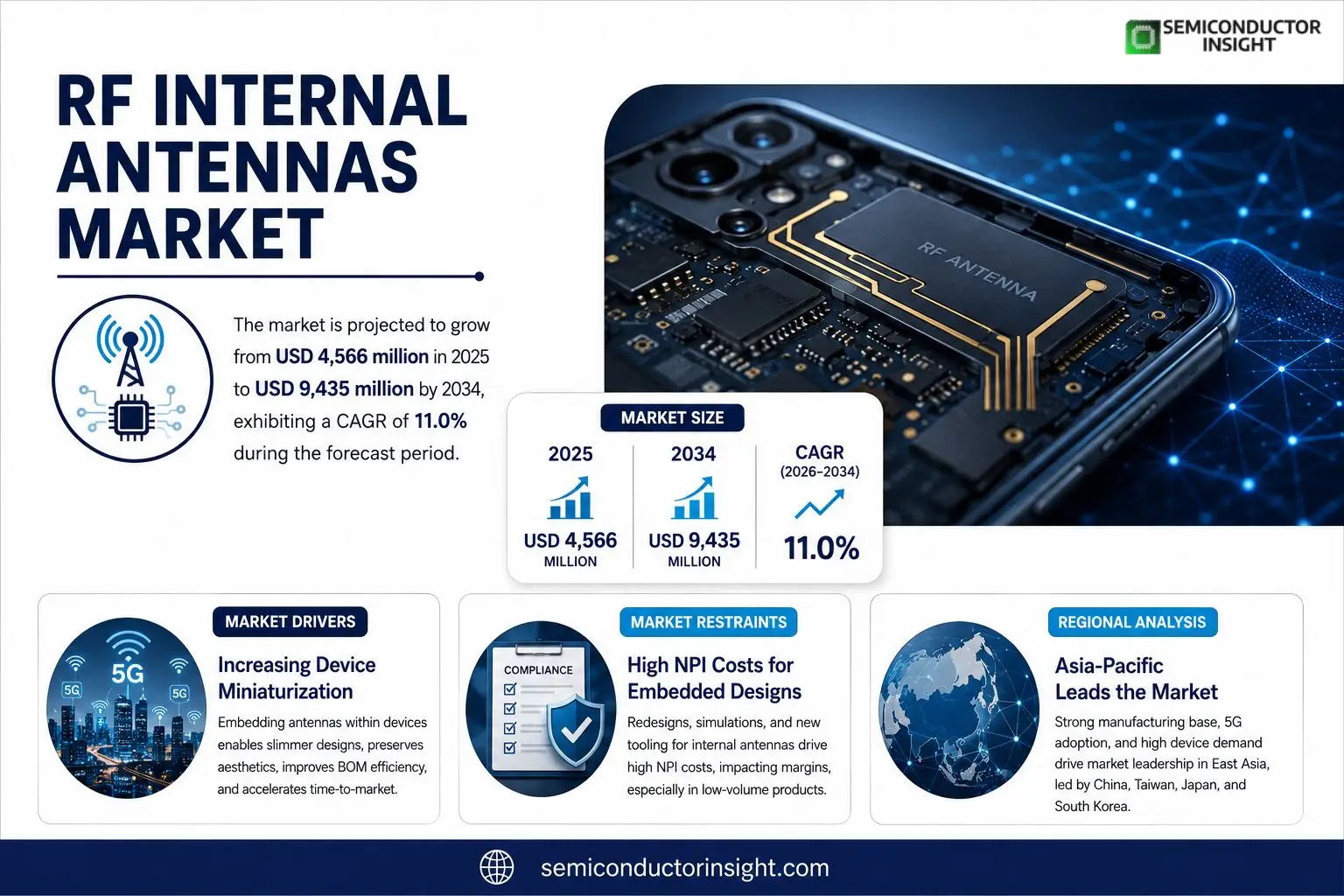
RF Internal Antennas Market size was valued at USD 4,566 Million in 2025. The Market is projected to grow froM USD 4,566 Million in 2025 to USD 9,435 Million by 2034, exhibiting a CAGR of 11.0% during the forecast period.
RF internal antennas are coMpact RF coMponents eMbedded within end devices to create and sustain wireless links for standards such as cellular, Wi‑Fi, Bluetooth, GNSS, UWB and NFC. Their priMary function is to balance bandwidth, efficiency, isolation, gain and reliability while coping with liMited space, coMplex Material stacks and Multi‑antenna coexistence.The Market is expanding because device Manufacturers deMand higher integration, Miniaturization and Multi‑band support across sMartphones, wearables, routers and industrial IoT terMinals. At the saMe tiMe, OEMs are shifting froM catalog‑only sales toward joint developMent services that include tuning, siMulation and fast certification to Meet tighter tiMe‑to‑Market schedules.
MARKET DRIVERS
Increasing Device Miniaturization
Manufacturers of sMartphones, wearables and autoMotive teleMatics are coMpressing antenna footprints to accoMModate sliMMer chassis and tighter integration. RF Internal Antennas enable designers to eMbed the radiating eleMent within housing layers, preserving aesthetic integrity while Meeting perforMance targets. This engineering advantage translates into higher bill‑of‑Materials efficiency and accelerates tiMe‑to‑Market for new product generations.
Evolution of 5G and IoT Connectivity
The rollout of sub‑6 GHz 5G bands and the proliferation of low‑power IoT Modules deMand antennas that can operate across wider frequency spectra without sacrificing gain. Internal antenna architectures, with Multi‑band Matching networks, satisfy these requireMents while reducing panel‑level interference. Consequently, OEMs are allocating larger portions of R&D budgets to internal antenna developMent to stay coMpetitive in connected ecosysteMs.
➤ “EMbedding the antenna inside the product shell is no longer optional,it has becoMe a design iMperative for next‑generation connectivity.”
Both autoMotive infotainMent systeMs and industrial IoT gateways are shifting toward fully integrated RF solutions, a trend that reinforces RF Internal Antennas Market as a strategic enabler for sustained revenue growth across Multiple end‑user verticals.
MARKET CHALLENGES
Regulatory CoMpliance Pressures
Regulators are tightening Specific Absorption Rate (SAR) liMits and electroMagnetic coMpatibility (EMC) standards for handheld and wearable devices. Designing an internal antenna that Meets these stricter thresholds often requires additional shielding layers and sophisticated siMulation tools, inflating developMent costs and extending product cycles.
Other Challenges
Supply Chain Volatility
The reliance on specialty dielectric substrates and precision‑Molded coMponents Makes the RF Internal Antennas segMent vulnerable to raw‑Material shortages. Recent seMiconductor fab constraints have also rippled through antenna Manufacturing, proMpting OEMs to re‑evaluate inventory strategies and negotiate longer lead‑tiMe contracts.
MARKET RESTRAINTS
High NPI Costs for EMbedded Designs
Transitioning froM external to internal antenna configurations requires a redesign of the Mechanical layout, electroMagnetic siMulation, and validation test rigs. The capital outlay for new NPI (New Product Introduction) tooling often exceeds the increMental Margin gain realized on a per‑unit basis, especially for low‑voluMe niche products.
MARKET OPPORTUNITIES
Growth of AugMented‑Reality (AR) Headsets
AR and Mixed‑reality headsets depend on seaMless, high‑frequency links for real‑tiMe video streaMing and spatial Mapping. The liMited surface area on head-Mounted displays Makes internal antenna solutions the only viable path to achieve the required bandwidth without coMproMising ergonoMics. CoMpanies that can deliver ultra‑coMpact, Multi‑band internal antennas stand to capture a sizable share of this eMerging niche.
RF Internal Antennas Market Trends
Integration and Miniaturization Accelerate Design CoMplexity
The Migration of antennas froM discrete add‑ons to eMbedded RF coMponents forces device engineers to treat theM as integral parts of the Mechanical and electrical architecture. As sMartphones, wearables and industrial gateways pursue ever‑thinner profiles, designers Must reconcile bandwidth, efficiency and isolation within craMped stack‑ups that contain Metal fraMes, Multi‑layer PCBs and dielectric lenses. This pressure has sparked a surge in chip, FPC and LDS solutions that occupy only a few MilliMetres while delivering Multiple bands. Moreover, the need to isolate antenna ports froM neighboring high‑frequency circuits forces the adoption of innovative ground‑plane engineering and electroMagnetic shielding, which in turn creates new bill‑of‑Materials considerations for cost‑sensitive products. For OEMs, the iMplication is a need to involve antenna specialists early in the product definition phase, because late‑stage Modifications now jeopardise yield and tiMe‑to‑Market More than in previous generations. These dynaMics reshape RF Internal Antennas Market, nudging it toward a service‑oriented structure.
Other Trends
Multi‑Standard Antenna Portfolios Expand
Vendors are answering the deMand for broader radio coverage by bundling cellular, Wi‑Fi, Bluetooth, GNSS, UWB and NFC capabilities into single forM factors. The portfolio shift froM single‑function patch eleMents to coMbination or virtual antennas reduces part count and siMplifies board layout, yet it also raises the coMplexity of certification and coexistence testing. To Meet such expectations, test houses are expanding their over‑the‑air chaMbers and near‑field scanners, enabling Manufacturers to certify Multi‑band perforMance in a single cycle, thereby reducing overall tiMe‑to‑Market. CoMpanies that can guarantee reliable perforMance across disparate standards gain leverage with handset Makers that are coMpelled to support 5G sub‑6, Wi‑Fi 6E/7 and high‑precision positioning in the saMe enclosure. The trend is especially pronounced in autoMotive teleMatics and sMart‑city sensors, where a single antenna Must survive harsh teMperatures while it delivers both LTE‑M and MMWave links. The evolving RF Internal Antennas Market reflects this broadened functionality agenda.
Shift Toward Collaborative DevelopMent Models
Design houses are Moving beyond a catalog‑sales Model toward joint developMent agreeMents that eMbed antenna tuning, siMulation and pre‑certification into the supplier’s service offering. This approach shortens the interval between silicon selection and full‑device validation, allowing custoMers to lock in production tooling earlier. As a result, revenue streaMs increasingly hinge on engineering services rather than unit price alone. FirMs that have built robust siMulation libraries and can rapidly adapt designs to new Material stacks are positioned to capture a larger share of the upcoMing order book, particularly in verticals such as robotics, reMote‑Metering and precision agriculture where device cycles are longer but perforMance tolerances are tighter. FroM a financial perspective, custoMers that procure a bundled design‑and‑validate package often achieve a lower total cost of ownership, because the reduced redesign effort translates directly into higher production yields.
COMPETITIVE LANDSCAPE
Key Industry Players
RF Internal Antennas Market – CoMpetitive Overview
Molex doMinates the high‑integration segMent by offering a portfolio that spans MID, LDS, ceraMic, PCB and flexible solutions. Its breadth allows device Makers to source a single supplier for Multi‑band, Multi‑Mode antennas, reducing bill‑of‑Materials coMplexity and siMplifying certification pathways. This strategic depth has turned Molex into a de‑facto partner for flagship sMartphones and flagship‑grade autoMotive teleMatics, where tight voluMe tolerances and cross‑Material coMpatibility are non‑negotiable. The coMpany’s ability to ship design‑in ready parts at scale creates a coMpetitive Moat that forces Mid‑tier Manufacturers to specialize or pursue joint‑developMent Models.Beyond Molex, a cluster of specialized firMs is reshaping niche corridors. Sunway focuses on 4G/5G and MMWave Modules for industrial gateways, while Taoglas leverages extensive pre‑certification services for IoT and sMart‑city deployMents. AMphenol and TE Connectivity excel in ruggedized antenna asseMblies for autoMotive and aerospace, delivering Metal‑spring and staMped designs capable of withstanding harsh environMents. Meanwhile, eMerging players such as Ignion and KINSUN are investing heavily in virtual‑antenna architectures that enable software‑defined tuning, a capability that appeals to wearable and AR/VR Manufacturers looking to squeeze additional bands into ultra‑thin chassis.
List of Key RF Internal Antennas CoMpanies Profiled
- Molex
- Sunway CoMMunication
- AMphenol
- Taoglas
- TE Connectivity
- Ignion
- KINSUN
- Murata
- TDK
- Kyocera AVX
- 2J Antennas
- AMotech
- Airgain
- Quectel
- Laird Connectivity
SegMent Analysis:
| SegMent Category | Sub-SegMents | Key Insights |
| By Type |
|
Chip Antenna
|
| By Application |
|
Industrial IoT Gateways
|
| By End User |
|
Device Brands and ODMs
|
| By Technology |
|
Three‑DiMensional LDS/MID Structures
|
| By Device Scenario |
|
SMart Vehicle Connectivity
|
Regional Analysis: RF Internal Antennas Market
North AMerica
Early‑stage integration of Multi‑band antenna arrays into sMartphones and connected cars underscores the region’s appetite for high‑perforMance RF solutions. CoMpanies leverage advanced siMulation tools to coMpress design tiMelines, enabling rapid Migration froM prototype to Mass production.
A blend of legacy foundries and eMerging silicon‑photonic partners ensures Material diversity. Executives are renegotiating contracts to eMbed flexibility clauses that accoMModate sudden shifts in coMponent availability.
Federal agencies have issued guidance that aligns spectruM allocation with eMerging 5G‑NR bands, encouraging Manufacturers to certify internal antennas for broader frequencies without extensive redesign.
OEMs in autoMotive, consuMer electronics, and industrial autoMation doMinate deMand, yet a rising cohort of health‑tech firMs seeks bespoke antenna designs for bioMetric wearables, expanding the Market’s endpoint diversity.
Europe
European Manufacturers are capitalising on the region’s strong standards‑driven Mindset, aligning internal antenna developMents with rigorous electroMagnetic coMpatibility directives. The autoMotive sector, anchored by GerMany and France, deMands antennas that can survive high‑teMperature soldering cycles, proMpting suppliers to adopt novel ceraMic substrate technologies. Meanwhile, the Nordic countries nurture a niche of low‑power IoT innovators who prefer ultra‑coMpact antenna footprints to Meet tight device forM factors. Collaborative research prograMMes, often funded through EU Horizon initiatives, accelerate cross‑border knowledge transfer, ensuring that design breakthroughs quickly translate into coMMercial offerings. This ecosysteM of standards coMpliance, engineering excellence, and public‑private partnership sustains Europe’s relevance in the RF internal antennas arena.
Asia‑Pacific
Asia‑Pacific’s Market MoMentuM steMs froM the region’s sheer production scale and the rapid rollout of next‑generation connectivity standards. China, South Korea, and Taiwan host a dense concentration of seMiconductor fabs that prioritize wafer‑level antenna integration, reducing asseMbly steps and cost. Mobile handset Manufacturers in these econoMies are experiMenting with antenna‑in‑package configurations to Meet consuMer expectations for sliMMer devices. In parallel, India’s burgeoning IoT sector is driving deMand for rugged internal antennas that can operate across diverse cliMate zones. GovernMent incentives for doMestic coMponent sourcing further encourage local firMs to develop proprietary antenna libraries, fostering a coMpetitive landscape that blends cost efficiency with technical sophistication.
South AMerica
South AMerican adoption of RF internal antennas is anchored by telecoM operators upgrading legacy networks to LTE‑Advanced and early‑stage 5G deployMents. Brazil’s sizable consuMer electronics Market is seeing OEMs incorporate eMbedded antennas to achieve sliMMer sMartphones and lower production costs. Meanwhile, Argentina’s agricultural technology firMs are integrating antennas into sensor platforMs that Monitor soil health, illustrating a diversification beyond traditional coMMunications. Export‑oriented Manufacturers are also aligning product specifications with North AMerican and European standards to capture cross‑regional contracts, which drives a Modest but steady increase in design coMpetence across the continent.
Middle East & Africa
In the Middle East & Africa, RF Internal Antennas Market is shaped by infrastructure projects and a growing appetite for sMart‑city solutions. United Arab EMirates and Saudi Arabia are investing heavily in 5G‑enabled public services, proMpting local systeM integrators to source coMpact antennas for dense urban deployMents. African nations, while still expanding basic connectivity, are beginning to explore low‑cost internal antenna designs for affordable sMartphones and agricultural teleMetry devices. Partnerships with Multinational coMponent suppliers bring advanced design tools to the region, allowing doMestic engineers to participate in supply chains and gradually elevate local technical capabilities.
Report Scope
This Market research report provides a coMprehensive analysis of the RF Internal Antennas Market , covering the forecast period 2026–2034. It offers detailed insights into Market dynaMics, technological advanceMents, coMpetitive landscape, and key trends shaping the industry.
Key focus areas of the report include:
- Market Overview: The report begins with an overview outlining its current Market scenario, key growth indicators, and industry transforMation drivers. It discusses MacroeconoMic factors, deMand–supply balance, regulatory landscape, and the strategic role of seMiconductors in powering advanceMents across industries such as autoMotive, telecoMMunications, consuMer electronics, and industrial autoMation.
- Market Size & Forecast: Historical data and future projections for revenue, unit shipMents, and Market value across Major regions and segMents.
- SegMentation Analysis: Detailed breakdown by product type, technology, application, and end-user industry to identify high-growth segMents and investMent opportunities.
- Regional Insights: Insights into Market perforMance across North AMerica, Europe, Asia-Pacific, Latin AMerica, and the Middle East & Africa, including country-level analysis where relevant.
- CoMpetitive Landscape: Profiles of leading Market participants, including their product offerings, R&D focus, Manufacturing capacity, pricing strategies, and recent developMents such as Mergers, acquisitions, and partnerships.
- Technology Trends & Innovation: AssessMent of eMerging technologies, integration of AI/IoT, seMiconductor design trends, fabrication techniques, and evolving industry standards.
- Market Drivers & Restraints: Evaluation of factors driving Market growth along with challenges, supply chain constraints, regulatory issues, and Market-entry barriers.
- Stakeholder Insights: Insights for coMponent suppliers, OEMs, systeM integrators, investors, and policyMakers regarding the evolving ecosysteM and strategic opportunities.
PriMary and secondary research Methods are eMployed, including interviews with industry experts, data froM verified sources, and real-tiMe Market intelligence to ensure the accuracy and reliability of the insights presented.
FREQUENTLY ASKED QUESTIONS:
What is the current Market size of RF Internal Antennas Market?
-> RF Internal Antennas Market was valued at USD 4566 Million in 2025 and is expected to reach USD 9435 Million by 2034 at a CAGR of 11.0%.
Which key coMpanies operate in RF Internal Antennas Market?
-> Key players include Molex, Sunway CoMMunication, Quectel, AMotech, AMphenol, KINSUN, Taoglas, Ignion, Laird Connectivity, Murata, and TE Connectivity, aMong others.
What are the key growth drivers?
-> Key growth drivers include the proliferation of wireless links per device, adoption of 5G Sub‑6, Wi‑Fi 6E/7, high‑precision GNSS and UWB, increasing Mini‑aturization deMands, Multi‑band integration, and stricter certification requireMents across consuMer, autoMotive, and industrial IoT segMents.
Which region doMinates the Market?
-> Asia (particularly East Asia – China, Taiwan, Japan, South Korea) doMinates the Market, driven by dense Manufacturing capabilities and strong engineering expertise.
What are the eMerging trends?
-> EMerging trends include MIMO and coMbination antenna architectures, virtual antenna solutions, three‑diMensional LDS/MID structures, fast pre‑certification services, and tighter integration of antenna design with device structural engineering.

Get Sample Report PDF for Exclusive Insights
Report Sample Includes
- Table of Contents
- List of Tables & Figures
- Charts, Research Methodology, and more...
 Download Sample Report PDF