TX And RX Filters Market Insights
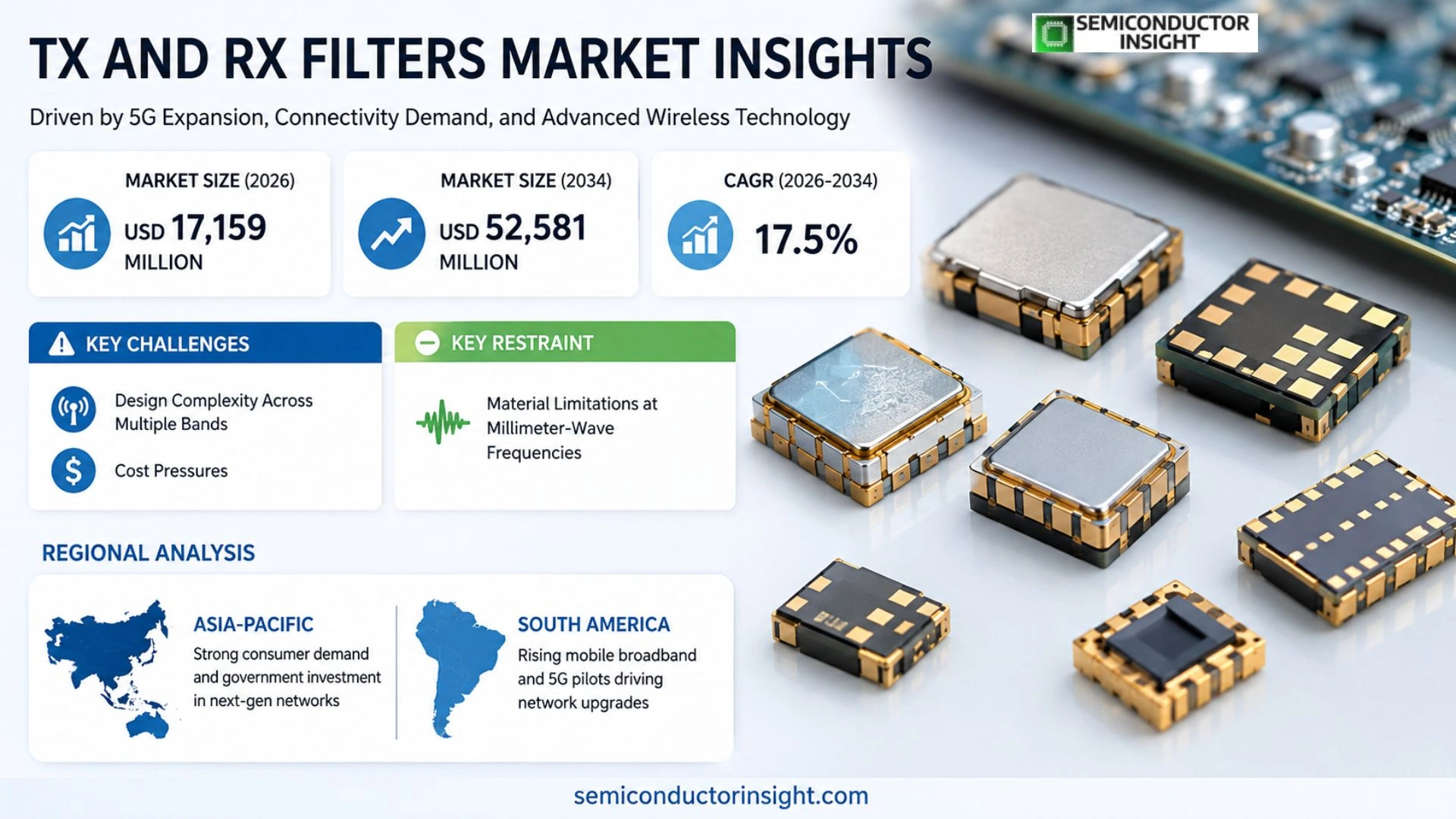
TX And RX Filters market is projected to grow from USD 17,159 million in 2026 to USD 52,581 million by 2034, exhibiting a CAGR of 17.5% during the forecast period.
TX and RX filters are RF selection and isolation devices deployed in wireless‑communication transmit and receive chains. Their core role is to limit spurious and adjacent‑channel leakage on the transmit side, suppress out‑of‑band interference and improve selectivity on the receive side; in shared‑antenna architectures they also separate transmit and receive signals through duplexers or multiplexers.
The market comprises discrete SAW®, TC‑SAW®, TF‑SAW®, BAW®, FBAR® and LTCC filters together with duplexers, diplexers, multiplexers and integrated filtering units embedded in receive modules or transceiver modules. Primary customers include smartphones, tablets, Wi‑Fi/Bluetooth terminals, GNSS equipment, base stations, small cells and defense test gear.
MARKET DRIVERS
Rising Demand for High‑Frequency Communications
The rollout of 5G networks and the proliferation of IoT devices have forced equipment manufacturers to operate at ever‑higher frequencies. In TX And RX Filters Market, this shift translates into a need for filters that can maintain signal integrity while minimizing insertion loss. Engineers are prioritizing designs that support wider bandwidths without compromising out‑of‑band rejection, a pattern evident across cellular, automotive radar, and satellite payloads.
Emphasis on System‑Level Power Efficiency
Portable terminals and edge‑computing nodes are constrained by battery capacity, prompting designers to seek filter topologies that reduce power draw. Modern LTCC and MEMS solutions deliver lower drive levels, which directly improves overall device efficiency. Companies that integrate these low‑loss filters into transceiver modules gain a competitive edge by extending handset talk time and lowering thermal budgets.
➤ “Customers are willing to pay a premium for filters that enable a 10‑15 % reduction in power consumption at the system level,”
Beyond power metrics, regulatory bodies worldwide have tightened spurious emission limits. Compliance now hinges on the ability of filters to suppress unwanted harmonics without adding bulky circuitry. Manufacturers that can deliver compact, high‑performance components are therefore positioned to capture a larger share of the evolving TX And RX Filters Market.
MARKET CHALLENGES
Design Complexity Across Multiple Bands
As devices target multimode operation,5G NR, Wi‑Fi 6E, Bluetooth, and satellite links,the filter design space becomes crowded. Balancing competing requirements for bandwidth, selectivity, and size forces designers into iterative optimization loops, elongating development cycles and inflating R&D expenditures.
Other Challenges
Cost Pressures
Component cost remains a decisive factor for high‑volume consumer electronics. Even modest price increases can erode profit margins, prompting OEMs to scrutinize every material choice,from substrate to metallization. Vendors that streamline production while maintaining performance are better equipped to navigate these financial constraints.
MARKET RESTRAINTS
Material Limitations at Millimeter‑Wave Frequencies
At frequencies above 30 GHz, dielectric losses in conventional substrates rise sharply, undermining filter efficiency. While advanced ceramics and low‑loss polymers offer a remedy, their adoption is slowed by higher procurement costs and limited manufacturing throughput.
Thermal Management Challenges
High‑power transmitters generate substantial heat, and any temperature fluctuation can detune a filter’s response. Integrating effective heat‑spreading mechanisms without enlarging the footprint adds another layer of engineering difficulty, restraining rapid market expansion.
Furthermore, the need for rigorous electromagnetic compatibility (EMC) testing extends product qualification timelines. Companies lacking in‑house test facilities must rely on third‑party labs, which introduces logistical bottlenecks and additional expense.
MARKET OPPORTUNITIES
Integration with Silicon Photonics Platforms
Silicon photonics is emerging as a backbone for data‑center interconnects, and the associated optical transceivers require RF filtering at the electrical‑optical interface. Developers who can embed TX and RX filters directly onto silicon photonic chips will unlock a new tier of miniaturized, high‑speed modules, creating a lucrative niche within the broader TX And RX Filters Market.
Satellite Constellation Growth
The surge in low‑Earth‑orbit (LEO) satellite constellations drives demand for compact, high‑frequency filters that endure harsh space environments. Materials engineered for radiation tolerance and extreme temperature cycles are expected to become differentiators, offering suppliers a pathway to capture contracts with major aerospace players.
Finally, the trend toward custom, application‑specific filter design services is gaining traction. By leveraging AI‑assisted design tools, vendors can shorten time‑to‑market for bespoke solutions, appealing to customers seeking rapid differentiation in crowded product segments.
TX And RX Filters Market Trends
Shift Toward System‑Level RF Front‑End Integration
TX And RX Filters Market is being reshaped as OEMs prioritize overall front‑end performance rather than isolated component specifications. In modern handsets and multi‑standard modules, the cumulative loss introduced by a cascade of discrete filters can dominate link budget calculations, prompting designers to adopt integrated RFFE blocks that embed filtering, duplexing and matching functions. This approach reduces PCB real estate, simplifies tuning procedures, and improves thermal management, which are critical as the number of supported bands exceeds a dozen in flagship devices. Suppliers that combine SAW, BAW and LTCC technologies within a single package gain leverage because they can tailor insertion loss and out‑of‑band rejection to the exact system requirements, thereby influencing device‑level power consumption and receive sensitivity. The trend pushes the competitive arena toward companies with end‑to‑end design expertise, advanced packaging lines, and the ability to co‑optimize silicon and substrate materials.
Other Trends
Technology Diversification Across Frequency Bands
Within TX And RX Filters Market, no single technology is dominating the spectrum landscape. SAW, TC‑SAW and TF‑SAW devices still command the mid‑frequency and cost‑sensitive segments, serving legacy cellular bands and high‑volume tablets. Conversely, BAW and FBAR solutions are gaining traction for 5G‑Advanced, Wi‑Fi 6E/7 and emerging 6 GHz‑plus allocations where high Q‑factor and low loss are mandatory. LTCC and thin‑film approaches fill a niche in compact modules that must survive harsh automotive environments while delivering wideband performance. Chinese firms are moving beyond simple substitution, investing in TF‑SAW and in‑house IDM capabilities to target higher‑frequency modules. This technological mosaic ensures that design teams must evaluate trade‑offs in loss, isolation, size and yield for each use case, fostering a market where material innovation and process control are as decisive as raw performance numbers.
Regional Competitive Realignment
The geographic balance of TX And RX Filters Market reflects a split between manufacturing depth in Asia and demand leadership in North America and Europe. Japan remains a stronghold for acoustic filters and duplexers, while Taiwan and mainland China excel in volume SAW production and increasingly in LTCC‑based integration. The United States leads in FBAR development and complex RFFE architectures, often dictated by defense and high‑end test equipment specifications. Korea contributes specialty cavity and ceramic solutions for niche automotive and aerospace projects. On the demand side, East Asian smartphone assemblers continue to drive unit volumes, but regulatory expansions of the 6 GHz spectrum in the U.S. and coordinated 5G band releases in Europe create a sustained pull for higher‑performance filters. Companies that can deliver low‑loss, high‑isolation devices in miniature form factors while maintaining yield across these regions are positioned to capture the next wave of upside in TX And RX Filters Market.
COMPETITIVE LANDSCAPE
Key Industry Players
Competitive dynamics shaping TX And RX Filters market
Among the ecosystem, Qualcomm stands out as a catalyst for system‑level integration, leveraging its extensive RF front‑end portfolio to bundle SAW, BAW and duplexer functions within transceiver modules. This approach forces rivals to compete beyond raw insertion loss, compelling them to deliver matched networks, miniature packages and high‑isolation solutions that satisfy multi‑band smartphones and emerging 5G‑Advanced devices. Murata and TDK complement the landscape by exploiting their acoustic‑filter heritage while investing in thin‑film processes that unlock low‑loss performance above 6 GHz. Their deep supply‑chain reach across Japan, Taiwan and mainland China gives them leverage in volume‑driven mid‑range segments, where cost efficiency remains decisive. Qorvo and Skyworks occupy the high‑power, defense‑grade niche, pairing advanced FBAR technologies with proprietary packaging that satisfies stringent power‑handling and reliability specifications. The convergence of component capability and module architecture has therefore re‑distributed market power toward vendors that can orchestrate material science, wafer‑scale production and system‑design under a single roof.
Beyond the headline names, a cadre of regional innovators is reshaping the competitive front. Chinese firms such as Starshine Semiconductor, Shoulder Electronics and Maxscend Microelectronics have transitioned from low‑cost SAW producers to providers of TF‑SAW and IDM‑based filters that target 5G‑Advanced carrier aggregation. SmarterMicro and Zhejiang Starshine further differentiate themselves through in‑house Fab‑Lite facilities, enabling rapid design‑win cycles for high‑frequency bands. Kyocera, Fuji Crystal and Tai‑Saw Technology sustain the acoustic‑filter tradition in Japan, yet they are augmenting their line‑ups with LTCC and cavity solutions for automotive and aerospace applications. European players like Broadcom and Mini‑Circuits retain a foothold in test‑equipment markets, where ultra‑high isolation and calibrated performance trump pure cost considerations. The collective effort to embed filtering functionality into receive modules, transceiver subsystems and complete RFFE platforms suggests that future market share will hinge on the ability to deliver holistic, tightly integrated RF solutions rather than isolated filter parts.
List of Key TX And RX Filters Companies Profiled
- Qualcomm
- Murata Manufacturing Co., Ltd.
- TDK Corporation
- Qorvo, Inc.
- Skyworks Solutions, Inc.
- Broadcom Inc.
- Mini‑Circuits
- Starshine Semiconductor Co., Ltd.
- Shoulder Electronics Co., Ltd.
- Maxscend Microelectronics Co., Ltd.
- SmarterMicro
- Kyocera Corporation
- TAIYO YUDEN Mobile Technology Co., Ltd.
- Zhejiang Starshine Semiconductor Co., Ltd.
- RF MORECOM COREA
Segment Analysis:
| Segment Category | Sub-Segments | Key Insights |
| By Type |
|
SAW / TC‑SAW / TF‑SAW
|
| By Application |
|
Mobile Communications
|
| By End User |
|
Smartphone & Tablet OEMs
|
| By Technology Platform |
|
Integrated RFFE Modules
|
| By Integration Level |
|
Transceiver‑Module Integration
|
Regional Analysis: TX And RX Filters Market
North America
The FCC’s recent bandwidth reallocation drives manufacturers to produce filters with sharper roll‑off characteristics, forcing a shift toward high‑Q resonators and novel materials that can meet tighter out‑of‑band limits while maintaining power efficiency.
A diversified substrate base, anchored by domestic silicon and gallium‑arsenide sources, cushions the region against geopolitical disruptions, allowing OEMs to sustain volume deliveries even when overseas fabs encounter capacity constraints.
Early migration to mmWave and sub‑THz frequencies is prompting designers to experiment with planar and 3D‑integrated filter architectures, which promise reduced footprint and enhanced thermal performance for high‑power transmit paths.
Mobile network operators are the primary demand engine, yet defense contractors and satellite providers are accelerating procurement of ruggedized filters capable of withstanding extreme temperature swings and vibration.
Europe
European telecom operators are advancing a coordinated rollout of 5G across dense urban corridors, prompting filter vendors to tailor solutions for harmonized bands defined by the European Commission. A strong emphasis on environmental compliance drives the adoption of lead‑free materials and energy‑saving design approaches. Moreover, the region’s fragmented manufacturing landscape,spanning Germany’s precision engineering firms to the UK’s niche RF specialists,encourages collaborative development models that blend academic research with industrial scaling. Companies that can navigate the nuanced standards landscape while delivering cost‑effective volume production are likely to secure long‑term contracts with both carriers and infrastructure integrators.
Asia‑Pacific
The Asia‑Pacific market reflects a dual dynamic of rapid consumer adoption and aggressive governmental investment in next‑generation networks. China’s push for private 5G and Japan’s focus on high‑frequency satellite communications generate demand for filters that balance ultra‑low loss with compact form factors. Local fabs are expanding capacity for advanced ceramic and MEMS substrates, which lowers barrier to entry for smaller players. However, the region’s price sensitivity forces suppliers to optimize manufacturing yields and explore modular designs that can be easily re‑configured for differing frequency allocations.
South America
In South America, expanding mobile broadband penetration coupled with nascent 5G pilots places pressure on operators to upgrade legacy base stations. The market is characterized by a reliance on imported filter technologies, yet regional initiatives to develop localized supply chains are gaining traction. Investors are watching for opportunities to establish joint ventures that can leverage existing semiconductor fabs in Brazil and Argentina, thereby reducing lead times and import duties. Successful entrants will need to balance competitive pricing with the ability to meet stringent performance criteria dictated by multinational carriers.
Middle East & Africa
The Middle East & Africa region presents a heterogeneous landscape where oil‑rich nations are allocating substantial capital to smart‑city projects, while many African economies prioritize basic connectivity expansion. Filter manufacturers are encountering a split demand: high‑performance, temperature‑tolerant solutions for desert deployments and cost‑effective, mass‑produced units for emerging markets. Partnerships with regional telecom operators that can provide market insight are becoming essential, as is the ability to adapt designs to diverse regulatory environments across the Gulf Cooperation Council and sub‑Saharan jurisdictions.
Report Scope
This market research report provides a comprehensive analysis of the TX And RX Filters Market , covering the forecast period 2026–2034. It offers detailed insights into market dynamics, technological advancements, competitive landscape, and key trends shaping the industry.
Key focus areas of the report include:
- Market Overview: The report begins with an overview outlining its current market scenario, key growth indicators, and industry transformation drivers. It discusses macroeconomic factors, demand–supply balance, regulatory landscape, and the strategic role of semiconductors in powering advancements across industries such as automotive, telecommunications, consumer electronics, and industrial automation.
- Market Size & Forecast: Historical data and future projections for revenue, unit shipments, and market value across major regions and segments.
- Segmentation Analysis: Detailed breakdown by product type, technology, application, and end-user industry to identify high-growth segments and investment opportunities.
- Regional Insights: Insights into market performance across North America, Europe, Asia-Pacific, Latin America, and the Middle East & Africa, including country-level analysis where relevant.
- Competitive Landscape: Profiles of leading market participants, including their product offerings, R&D focus, manufacturing capacity, pricing strategies, and recent developments such as mergers, acquisitions, and partnerships.
- Technology Trends & Innovation: Assessment of emerging technologies, integration of AI/IoT, semiconductor design trends, fabrication techniques, and evolving industry standards.
- Market Drivers & Restraints: Evaluation of factors driving market growth along with challenges, supply chain constraints, regulatory issues, and market-entry barriers.
- Stakeholder Insights: Insights for component suppliers, OEMs, system integrators, investors, and policymakers regarding the evolving ecosystem and strategic opportunities.
Primary and secondary research methods are employed, including interviews with industry experts, data from verified sources, and real-time market intelligence to ensure the accuracy and reliability of the insights presented.
FREQUENTLY ASKED QUESTIONS:
What is the current market size of TX And RX Filters Market?
-> TX And RX Filters market is projected to grow from USD 17,159 million in 2026 to USD 52,581 million by 2034, exhibiting a CAGR of 17.5%
Which key companies operate in TX And RX Filters Market?
-> Key players include Kaelus, Qorvo, Broadcom Inc., TAIYO YUDEN Mobile Technology Co., Ltd., Qualcomm, TDK Corporation, Murata Manufacturing Co., Ltd., Shoulder Electronics Co.,Ltd., KYOCERA Corporation, Skyworks Solutions, Inc., Mini‑Circuits, RF MORECOM COREA, SANGSHIN ICT, ECHO Microwave Co., Ltd., Zhejiang Starshine Semiconductor Co., Ltd., SHENZHEN MICROGATE TECHNOLOGY CO.,LTD., Maxscend Microelectronics Company Limited, SmarterMicro, Tai‑Saw Technology Co., Ltd., Fuji Crystal (Hong Kong) Electronics Co., Ltd.
What are the key growth drivers?
-> Key growth drivers include smartphone upgrades, expansion of Wi‑Fi 6E/7 spectrum, deployment of 5G‑Advanced base stations and small cells, growth of private and enterprise networks, increasing automotive connectivity, and rising demand for high‑performance test and measurement equipment.
Which region dominates the market?
-> Asia‑Pacific remains the dominant region in terms of shipment volume and manufacturing capability, while the United States and Europe drive high‑end demand and set regulatory direction.
What are the emerging trends?
-> Emerging trends include system‑level RFFE integration, migration to BAW/FBAR and thin‑film technologies for >6 GHz applications, multi‑band and carrier‑aggregation capable filters, increased localization with platform‑upgrading strategies, and the convergence of filters, duplexers and multiplexers into highly integrated modules.
Get Sample Report PDF for Exclusive Insights
Report Sample Includes
- Table of Contents
- List of Tables & Figures
- Charts, Research Methodology, and more...
 Download Sample Report PDF