RF External Antennas Market Insights
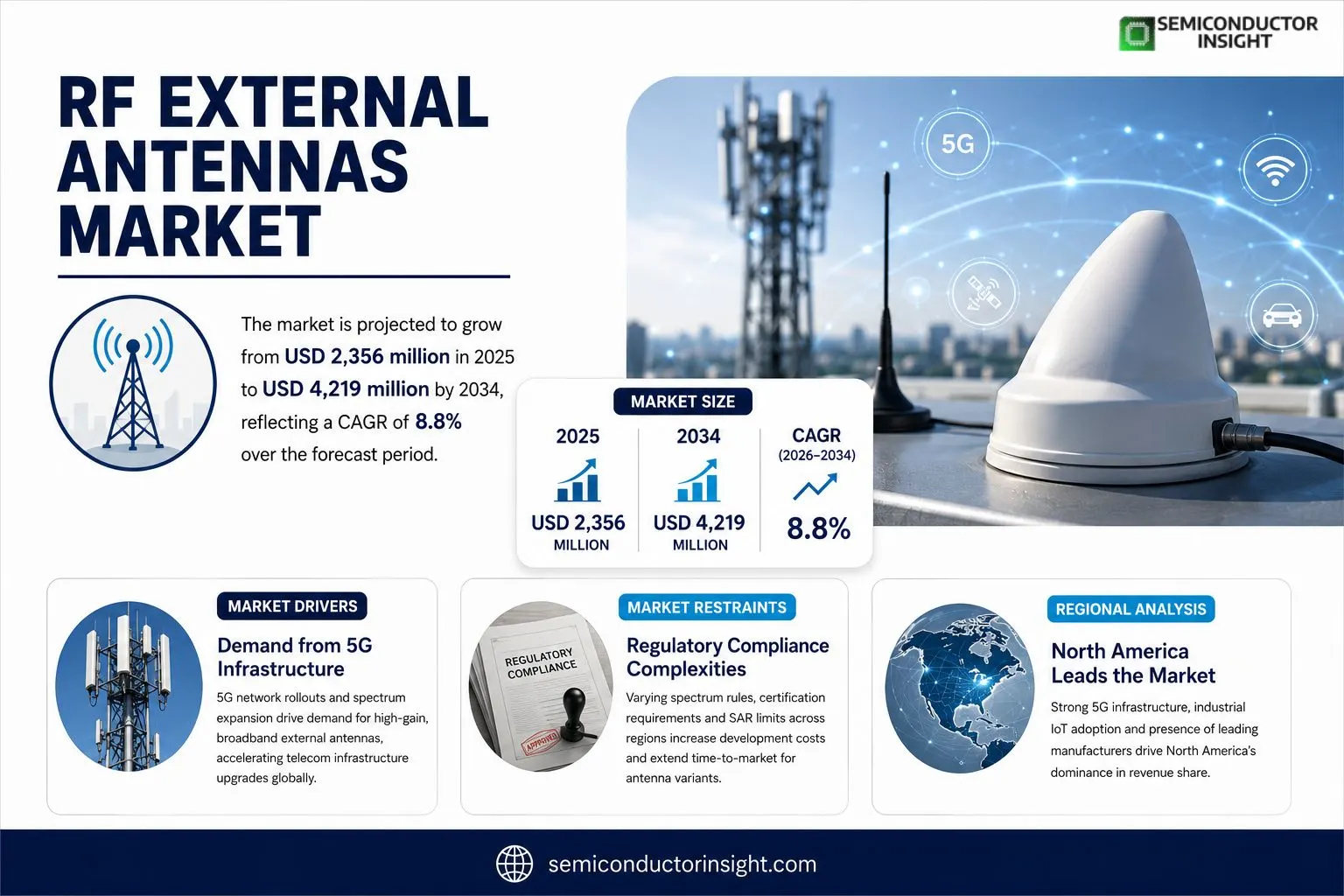
RF External Antennas Market was valued at USD 2,356 million in 2025 and will reach USD 4,219 million by 2034, reflecting a CAGR of 8.8% over the forecast period.
RF external antennas are wireless connectivity and positioning components mounted on the exterior of a device or its enclosure. Their primary function is to deliver stable transmission and reception, improve link reliability and enable flexible system layouts for cellular, Wi‑Fi, GNSS and short‑range communications in environments with high interference. Products have evolved from single‑function cellular or positioning units into integrated solutions that combine 5G, LTE, Wi‑Fi, GNSS and even V2X capabilities within adhesive‑mount, magnetic‑mount, screw‑mount, panel‑mount or low‑profile puck designs.The expansion is fueled by rising demand for connected vehicles, industrial IoT gateways and smart‑city infrastructure where robust external interfaces are essential. European and U.S. suppliers focus on heavy‑duty and public‑safety applications with high IP ratings; Japanese/Korean firms dominate automotive GNSS segments; Chinese/Taiwanese companies excel in cost‑effective 5G IoT modules. Regulatory support for additional spectrum bands and ongoing upgrades to Wi‑Fi standards further reinforce market momentum, encouraging manufacturers to prioritize wideband coverage, low self‑interference and durable mounting solutions.
MARKET DRIVERS
Demand from 5G Infrastructure
The rollout of 5G networks has created a quantitative surge in the need for high‑gain, broadband RF External Antennas. Operators are replacing legacy equipment with antenna arrays capable of supporting millimeter‑wave bands, a shift that directly lifts the overall market size. This migration is not merely a technical upgrade; it reshapes revenue models for OEMs that can supply modular, weather‑hardened solutions.
Adoption in Automotive Telemetry
Connected‑car platforms now embed multiple RF External Antennas to maintain reliable V2X communication in diverse urban environments. Automakers that integrate steer‑able antenna modules achieve lower latency and greater signal integrity, translating into a competitive edge for safety‑critical services. Consequently, the automotive segment contributes a growing share of total spend.
➤ Industry analysts note that each 1% increase in 5G base‑station density can add roughly $12 million to RF External Antennas Market within a single fiscal year.
Both the telecommunications upgrade cycle and the automotive electrification agenda generate parallel growth streams, ensuring that capital allocation toward antenna design, testing, and certification remains robust throughout the next product cycles.
MARKET CHALLENGES
Regulatory Compliance Complexities
Varying spectral masks and SAR limits across jurisdictions force manufacturers to custom‑engineer each antenna variant. The need for multiple certification dossiers inflates time‑to‑market and erodes margins, particularly for small‑to‑mid‑size players lacking dedicated compliance teams.
Other Challenges
Supply Chain Vulnerabilities
The reliance on specialty substrates such as low‑loss laminates and high‑conductivity metals ties RF External Antennas Market to volatile raw‑material prices. Recent geopolitical tensions have exposed the fragility of single‑source supply lines, prompting firms to diversify but at the cost of higher inventory levels.
MARKET RESTRAINTS
High Material Costs
Advanced dielectric materials required for broadband performance command premiums that push unit costs upward. End‑users, especially in cost‑sensitive sectors, may defer upgrades, creating a ceiling on market expansion.
Limited Design Flexibility
Physical constraints imposed by vehicle aerodynamics or building facades restrict antenna form factor options. When designers cannot reconcile performance with form, projects are either re‑engineered with inferior solutions or postponed, dampening demand momentum.
MARKET OPPORTUNITIES
Integration with IoT Edge Devices
Edge gateways deployed in factories and smart‑city nodes increasingly require compact, high‑efficiency RF External Antennas to sustain uninterrupted data flows. Vendors that can integrate antenna modules directly onto PCB footprints capture new revenue streams within the broader IoT ecosystem.
Emerging Satellite Constellations
The launch of low‑Earth‑orbit (LEO) communication constellations opens a niche for ground‑station antennas that operate across diverse frequency bands. Manufacturers that adapt existing external‑antenna platforms for satellite uplink/downlink can tap a high‑value market segment with relatively modest R&D investment.
Customizable Low‑Profile Solutions
Demand for aesthetically discreet antennas in consumer electronics and public infrastructure is rising. By offering plug‑and‑play, low‑profile designs, suppliers can differentiate themselves and command premium pricing, especially in markets where visual impact drives purchasing decisions.
RF External Antennas Market Trends
Integration of Multi‑Protocol Antenna Solutions
RF External Antennas Market is seeing a decisive shift from single‑function designs toward platforms that marshal 5G, LTE, Wi‑Fi, GNSS and even V2X capabilities inside a single enclosure. Manufacturers are responding to the need for broader bandwidth, reduced self‑interference and streamlined device layouts, especially where space is at a premium. By consolidating several radio interfaces, OEMs lower part counts, simplify bill‑of‑materials and enhance overall link reliability. This transition also opens pricing power for suppliers that can bundle functions without compromising weather resistance or profile height, thereby influencing procurement strategies across automotive, industrial routers and smart‑city deployments.
Other Trends
Regional Specialization and Supply Dynamics
European and U.S. vendors dominate heavy‑duty and public‑safety segments, emphasizing high IP ratings, rugged mounts and wide‑band performance. Their product roadmaps often feature modular ports that cater to demanding industrial environments. In contrast, Japanese and Korean firms focus on automotive integration, delivering exposed‑mount designs that align with vehicle bodywork and exploit local expertise in chassis electronics. Suppliers from mainland China and Taiwan prioritize cost‑effective 5G‑IoT solutions, leveraging rapid prototyping and flexible mounting options for fast‑cycle smart‑meter and asset‑tracking devices. This geographic diversification reduces supply risk for system integrators but also creates distinct value propositions that buyers must evaluate against performance and durability criteria.
Regulatory and Spectrum Influences on Adoption
Recent regulatory actions expanding access to mid‑band spectrum have accelerated the rollout of Wi‑Fi 6E, Wi‑Fi 7 and next‑generation cellular services. As device manufacturers seek compliant external interfaces, antenna suppliers are compelled to certify products against tighter emission standards and to demonstrate long‑term environmental durability. The convergence of spectrum availability, stricter certification regimes and the proliferation of connected vehicles and smart‑infrastructure projects reinforces the relevance of external antenna solutions. Companies that can align product development with these policy shifts are positioned to capture incremental revenue streams while helping end‑users meet certification timelines and field‑service expectations.
COMPETITIVE LANDSCAPE
Key Industry Players
Competitive Dynamics in the RF External Antennas Market
The upper tier of the market is dominated by a handful of multinational firms that have turned external antenna modules into strategic product lines. Molex, TE Connectivity, Amphenol, and Taoglas each operate design centers and leverage deep relationships with automotive OEMs and industrial router manufacturers to secure long‑term supply contracts. Their portfolios have migrated from single‑function cellular elements to truly integrated packages that bundle 5G, LTE, Wi‑Fi, GNSS and emerging V2X capabilities. This breadth allows them to command premium pricing while offering robust environmental ratings that satisfy heavy‑duty vehicle and public‑safety specifications. The resulting competitive posture emphasizes breadth of frequency coverage, low self‑interference, and modular mounting options, which in turn forces mid‑size rivals to either specialize or partner with these leaders for co‑development projects.Beyond the flagship tier, a diverse set of niche innovators sustains the market’s vibrancy by targeting specific form factors or regional applications. C&T RF Antennas and Linx Technologies focus on low‑profile shark‑fin and panel solutions for European smart‑city deployments, whereas PCTEL and Airgain have carved out strong positions in high‑IP‑rated industrial antennas for harsh environments. Companies such as INPAQ Technology and Yokowo Co., Ltd. excel in compact puck designs for IoT trackers, while Chinese entrants like Shenzhen Kinghelm Electronics and YUECHUNG INTERNATIONAL CORP. provide cost‑effective alternatives that accelerate time‑to‑market for volume‑driven smart‑metering projects. This tier of players often differentiates through rapid customization cycles, localized support, and aggressive pricing, which keeps the overall supply chain resilient and responsive to shifting regulatory or protocol demands.
List of Key RF External Antennas Companies Profiled
- Molex
- TE Connectivity
- Amphenol
- Taoglas
- C&T RF Antennas
- Linx Technologies
- PCTEL
- Airgain
- INPAQ Technology
- Yokowo Co., Ltd.
- Shenzhen Kinghelm Electronics Co., Ltd.
- YUECHUNG INTERNATIONAL CORP.
- Mobile Mark
- 2J Antennas
- Panorama Antennas
Segment Analysis:
| Segment Category | Sub-Segments | Key Insights |
| By Type |
|
Combination Antenna
|
| By Application |
|
Automotive Communications
|
| By End User |
|
Industrial Equipment Manufacturers
|
| By Form Factor |
|
Shark‑Fin
|
| By Installation Method |
|
Adhesive Mount
|
Regional Analysis: RF External Antennas Market
North America
The FCC’s incremental opening of millimeter‑wave spectrum forces carriers to adopt external antenna arrays that can deliver requisite beamforming. Simultaneously, streamlined certification pathways for low‑power IoT devices accelerate time‑to‑market for niche antenna models, encouraging vendors to explore fragmentary frequency bands.
Beyond mobile operators, manufacturing plants are commissioning private LTE and 5G networks for robotics, prompting a rise in ruggedized external antennas that survive harsh vibration and temperature swings.
Near‑shoring initiatives have shortened lead times for critical components such as high‑efficiency antenna substrates, allowing OEMs to respond faster to carrier rollout schedules while mitigating exposure to geopolitical disruptions.
Collaborative labs in Silicon Valley and Boston are prototyping meta‑surface panels that embed beam steering directly into the antenna surface, a development that could redefine the form factor of external solutions.
Europe
European telecom operators are pre‑emptively adapting to the EU’s 5G rollout schedule, which mandates extensive coverage in high‑frequency bands. This compels vendors to deliver externally mounted arrays capable of dynamic tilting to overcome dense urban canyons. Simultaneously, the EU’s strong emphasis on sustainability drives manufacturers toward recyclable antenna housings and low‑impact production processes, creating a niche for eco‑focused product lines. The region’s fragmented regulatory environment, however, requires a portfolio of region‑specific certifications, prompting larger players to consolidate local testing facilities to retain market share.
Asia‑Pacific
The Asia‑Pacific arena is distinguished by rapid urbanisation and aggressive 5G penetration targets set by China, Japan, South Korea, and India. Operators in these markets prioritize external antennas that can be mass‑produced at low cost while retaining performance across a wide temperature spectrum. Moreover, the proliferation of smart‑city initiatives fuels demand for outdoor broadband nodes, pushing suppliers to innovate modular panels that integrate seamlessly with street furniture. Competitive pressure from low‑cost manufacturers creates a parallel market segment focused on robust, yet affordable, antenna solutions for rural connectivity projects.
South America
In South America, the rollout of 5G is currently at an exploratory stage, but investors are eyeing external antenna deployments to bridge connectivity gaps in remote Andean and Amazonian regions. The continent’s varied topography necessitates antennas with high gain and directional versatility, leading local integrators to favour adaptable mounting hardware. Economic volatility has also encouraged operators to adopt leasing models for antenna infrastructure, which in turn spurs suppliers to offer service‑oriented contracts that bundle maintenance with equipment supply.
Middle East & Africa
The Middle East & Africa region presents a dichotomy of ultra‑high‑capacity urban projects and expansive, low‑density rural networks. Wealth‑driven megacities such as Dubai and Riyadh demand aesthetically integrated external antennas that compliment skyline architecture, prompting designers to embed antenna elements within decorative façades. Conversely, African markets rely on rugged, weather‑proof solutions to survive desert heat and heavy rains. The limited local manufacturing base forces many operators to import antenna modules, creating an opportunity for OEMs that can guarantee consistent supply despite logistical challenges.
Report Scope
This market research report provides a comprehensive analysis of the RF External Antennas Market , covering the forecast period 2026–2034. It offers detailed insights into market dynamics, technological advancements, competitive landscape, and key trends shaping the industry.
Key focus areas of the report include:
- Market Overview: The report begins with an overview outlining its current market scenario, key growth indicators, and industry transformation drivers. It discusses macroeconomic factors, demand–supply balance, regulatory landscape, and the strategic role of semiconductors in powering advancements across industries such as automotive, telecommunications, consumer electronics, and industrial automation.
- Market Size & Forecast: Historical data and future projections for revenue, unit shipments, and market value across major regions and segments.
- Segmentation Analysis: Detailed breakdown by product type, technology, application, and end-user industry to identify high-growth segments and investment opportunities.
- Regional Insights: Insights into market performance across North America, Europe, Asia-Pacific, Latin America, and the Middle East & Africa, including country-level analysis where relevant.
- Competitive Landscape: Profiles of leading market participants, including their product offerings, R&D focus, manufacturing capacity, pricing strategies, and recent developments such as mergers, acquisitions, and partnerships.
- Technology Trends & Innovation: Assessment of emerging technologies, integration of AI/IoT, semiconductor design trends, fabrication techniques, and evolving industry standards.
- Market Drivers & Restraints: Evaluation of factors driving market growth along with challenges, supply chain constraints, regulatory issues, and market-entry barriers.
- Stakeholder Insights: Insights for component suppliers, OEMs, system integrators, investors, and policymakers regarding the evolving ecosystem and strategic opportunities.
Primary and secondary research methods are employed, including interviews with industry experts, data from verified sources, and real-time market intelligence to ensure the accuracy and reliability of the insights presented.
FREQUENTLY ASKED QUESTIONS:
What is the current market size of RF External Antennas Market?
-> RF External Antennas Market was valued at USD 2356 million in 2025 and is expected to reach USD 4219 million by 2034.
Which key companies operate in RF External Antennas Market?
-> Key players include Molex, C&T RF Antennas, Linx Technologies, Abracon, Pulse Electronics, TE Connectivity, Eteily Technologies, Taoglas, INPAQ Technology, Wieson Technologies, MARS Antennas & RF Systems, Amphenol, Mobile Mark, 2J Antennas, Panorama Antennas, HUBER+SUHNER, PCTEL, Airgain, Poynting, Digi International, Yokowo Co., Ltd., HARADA Industry Co., Ltd., HANKOOK ANTENNA Co., Ltd., KNCTEK, Quectel Wireless Solutions Co., Ltd., Shenzhen Kinghelm Electronics Co., Ltd., YUECHUNG INTERNATIONAL CORP., Joymax Inc..
What are the key growth drivers?
-> Key growth drivers include spectrum expansion, upgrades to Wi‑Fi 6E/7 and 5G standards, regulatory support for 6 GHz band access, rising demand from automotive communications, fleet management, industrial IoT, smart city infrastructure, and the need for multi‑protocol, weather‑resistant external antennas.
Which region dominates the market?
-> North America leads in revenue share due to strong presence of U.S. and European‑style suppliers, while Asia‑Pacific exhibits the fastest growth rate driven by China, Japan, and South Korea investments.
What are the emerging trends?
-> Emerging trends include highly integrated combination antennas (5G/LTE/Wi‑Fi/GNSS/V2X), low‑profile automotive shark‑fin and puck designs, industrial‑grade antennas with elevated IP ratings, and accessory antennas tailored for modular IoT ecosystems.

Get Sample Report PDF for Exclusive Insights
Report Sample Includes
- Table of Contents
- List of Tables & Figures
- Charts, Research Methodology, and more...
 Download Sample Report PDF