2 Way Power Dividers Market Insights
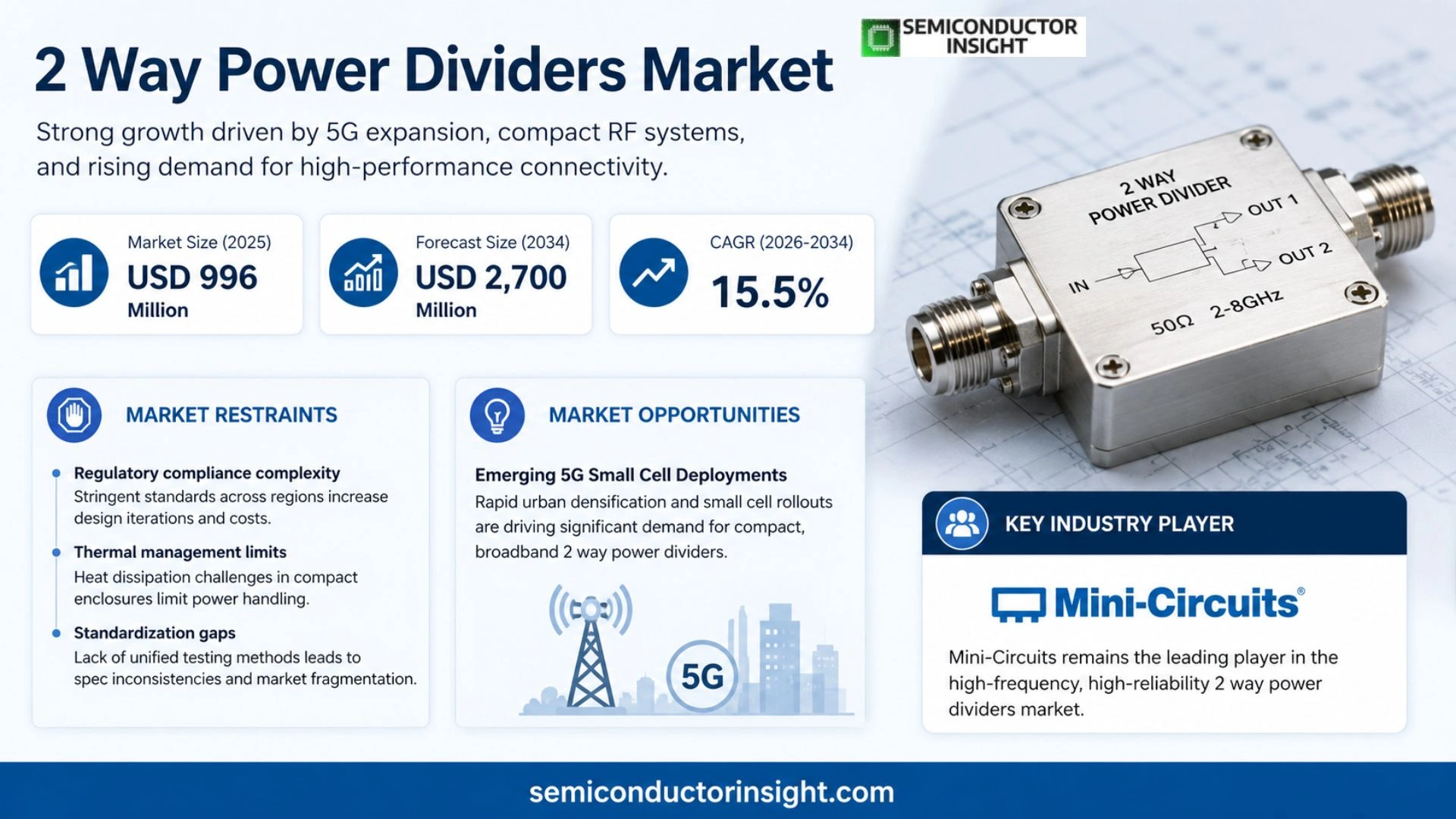
2 Way Power Dividers market was valued at USD 996 million in 2025 and reaches USD 2700 million by 2034, reflecting a CAGR of 15.5% over the forecast period.
Bidirectional power dividers are core passive devices that enable bidirectional distribution and combining of radio‑frequency signals. They employ specific circuit topologies to achieve low‑loss transmission and are suited for multi‑band communication systems.
The market expands as demand from communication base stations, satellite communications, radar systems and testing equipment grows alongside the rollout of 5G‑A and satellite internet projects. Upstream raw materials such as high‑frequency substrates, ceramic dielectrics and precision metal components remain largely imported, while domestic manufacturers gain share in mid‑ and low‑frequency segments through cost‑effective delivery.
MARKET DRIVERS
Growing Demand in Telecommunications Infrastructure
The rollout of 5G and the densification of fiber‑backhauled sites are prompting network operators to seek compact, high‑performance splitters. 2 Way Power Dividers that maintain low insertion loss while covering a broad frequency band are becoming indispensable as carriers upgrade mid‑haul and access layers. The push for greater spectrum efficiency translates directly into higher unit sales for these components.
Shift Toward Miniaturized RF Components
Device manufacturers are redesigning base‑station cabinets to accommodate tighter form factors. A reduced footprint for power dividers enables OEMs to meet the weight and space constraints of emerging edge‑computing nodes. Miniaturization also cuts material costs, creating a virtuous loop that accelerates adoption.
➤ Design flexibility fuels widespread deployment across both legacy and next‑gen networks.
Finally, the convergence of satellite‑ground hybrids demands splitters that can operate from sub‑GHz up to millimeter‑wave bands. Suppliers that can certify broadband performance across this span are positioned to capture a disproportionate share of 2 Way Power Dividers Market.
MARKET CHALLENGES
Cost Pressures from Alternative Technologies
Integrated antenna arrays and active beam‑forming modules are beginning to embed division functionality, eroding the price advantage of discrete splitters. Manufacturers must therefore justify their bill‑of‑materials by emphasizing superior loss characteristics and thermal stability.
Other Challenges
Supply Chain Bottlenecks
The reliance on high‑purity ceramic substrates and precision milling tools has exposed the sector to lead‑time volatility, especially when demand spikes coincide with semiconductor shortages.
MARKET RESTRAINTS
Regulatory Compliance Complexity
Regional emission standards impose stringent return‑loss and isolation criteria. Achieving certification across the Americas, EU, and APAC often requires multiple design iterations, inflating development budgets and slowing time‑to‑market.
Thermal Management Limits
Power handling capabilities are bounded by the ability to dissipate heat in confined enclosures. When deployment density rises, insufficient thermal design can trigger reliability concerns, prompting operators to favor higher‑rated alternatives.
Standardization Gaps
Absent a universally accepted test methodology for wideband splitters, vendors encounter divergent specifications from different equipment makers. This fragmentation hampers economies of scale and discourages new entrants.
MARKET OPPORTUNITIES
Emerging 5G Small Cell Deployments
Urban densification projects are driving the installation of thousands of low‑power nodes per square kilometer. Each node typically requires a pair of broadband dividers, creating a sizable incremental demand that outpaces traditional macro‑cell upgrades.
IoT Edge Connectivity
Factory automation and smart‑city sensors rely on RF front‑ends that incorporate splitters to manage multiple antenna paths. Suppliers that tailor low‑cost, ruggedized designs for harsh environments can unlock a new revenue stream within 2 Way Power Dividers Market.
Integration with Photonic‑RF Platforms
Hybrid photonic‑RF solutions are gaining traction for high‑frequency transport. Embedding passive power division within these platforms reduces cabling overhead and opens collaborative opportunities between optical and RF manufacturers.
2 Way Power Dividers Market Trends
Escalating Demand from 5G‑A and Satellite Networks
In 2025 2 Way Power Dividers Market recorded sales of 5.68 million units at an average price of US$192, generating US$996 million in revenue. The volume surge reflects the rollout of 5G‑A base stations and the expansion of satellite broadband constellations, both of which require precise, low‑loss power division to feed multiple antenna paths. Device designers are pushing toward higher frequency bands and tighter integration, prompting customers to seek components that combine miniaturization with consistent performance across broad spectra. As a result, manufacturers are prioritizing wafer‑level processes and advanced ceramic dielectrics to meet the tighter loss budgets demanded by modern communication equipment. The upward pressure on unit shipments has also tightened the gap between production capacity (7.12 million units) and actual sales, creating room for new entrants that can capitalize on the excess capacity while offering competitive margins in the 26‑33 % range. This environment rewards firms that can align raw‑material sourcing with the need for faster time‑to‑market, especially as government‑backed initiatives accelerate the deployment of high‑frequency infrastructure in both civilian and defense sectors.
Other Trends
Supply Chain Constraints and Domestic Substitution
Upstream, high‑frequency substrates and precision metal structures remain heavily dependent on imported sources, a vulnerability that has sharpened after recent geopolitical tensions. The limited domestic output of specialty ceramics creates a bottleneck for manufacturers targeting the ultra‑wideband and high‑reliability segments, where loss performance cannot tolerate material compromises. Midstream producers are responding by increasing automation in packaging and test phases, yet the precision required for high‑frequency assemblies still trails the capabilities of leading overseas firms. Domestic companies have made notable inroads in the mid‑ and low‑frequency bands by leveraging cost‑effective local supply chains, allowing them to capture a larger share of the base‑station market. This shift is fostering a parallel strategy: while some players double‑down on import‑reliant high‑frequency products, others invest in R&D to develop indigenous substrates, aiming to close the performance gap and reduce exposure to external supply shocks.
Technology Evolution Toward Integrated Intelligent Modules
Product development is gravitating toward integrated modules that embed filtering, monitoring, and power‑division functions within a single package. The move is spurred by the need to shrink overall system footprints and to simplify board‑level designs for 6G pre‑research initiatives, which anticipate ultra‑wideband, low‑loss requirements. Novel dielectric materials and advanced multilayer ceramic packaging are extending usable frequencies while maintaining acceptable thermal characteristics. Companies that can bundle intelligence,such as on‑chip telemetry for health monitoring,into their dividers are poised to command premium pricing, especially as downstream users demand greater reliability for radar, testing equipment, and emerging autonomous platforms. The convergence of higher frequency operation, smarter packaging, and a push for domestic material independence creates a competitive landscape where firms that master both the material science and the system‑level integration will shape the next phase of 2 Way Power Dividers Market.
COMPETITIVE LANDSCAPE
Key Industry Players
Global 2 Way Power Dividers Competitive Overview
Mini‑Circuits remains the benchmark operator in the high‑frequency, high‑reliability segment of 2 Way Power Dividers market. Its portfolio of broadband and ultra‑wideband dividers benefits from a legacy of precision ceramic substrates and sophisticated packaging, which translates into a gross margin consistently at the upper end of the industry range. The firm’s worldwide distribution network, combined with long‑term contracts with major telecom equipment makers, reinforces a market structure where a handful of overseas firms dictate technology standards while commanding premium pricing. This concentration of capability creates a clear hierarchy: elite suppliers occupy the top tier, mid‑range players fill the bulk of the volume market, and emerging domestic manufacturers target cost‑sensitive niches.
Beyond the headline leader, a diverse set of companies supplements the ecosystem. Chinese firms such as ChengDu Leader Microwave Technology and Keenlion have leveraged local supply chains to replace imported substrates in the mid‑frequency band, delivering competitive cost structures that appeal to base‑station OEMs. Smaller innovators,including Anoison, Qualwave, and Deti Microwave,focus on integrated solutions that embed filtering or monitoring functions, positioning themselves for emerging 5G‑A and satellite‑internet deployments. At the same time, specialists like Pulsar Microwave and KRYTAR, Inc. sustain relevance by offering customized partitioning ratios and ruggedized housings for defense and aerospace applications. Collectively, these niche players diversify product roadmaps, accelerate adoption of new dielectric materials, and push the industry toward greater modularity and system‑level integration.
List of Key 2 Way Power Dividers Companies Profiled
- Mini‑Circuits
- Pulsar Microwave
- Anoison
- Keenlion
- Qualwave
- KRYTAR, Inc.
- ChengDu Leader Microwave Technology Co.,Ltd.
- Concept Microwave
- Deti Microwave
- Maniron
- Rfecho
- Raditek
- Apex Microwave Co.,Ltd.
- Bracke Manufacturing
Segment Analysis:
| Segment Category | Sub-Segments | Key Insights |
| By Type |
|
Broadband dominates the landscape as designers pursue higher data‑rate capabilities in emerging 5G‑A and 6G infrastructures. It is prized for its ability to sustain low insertion loss across wide frequency spans, enabling flexible deployment in both terrestrial and satellite links. [• Preference for modular packaging that simplifies integration • Emphasis on thermal management to sustain performance at elevated power levels • Growing demand for designs that accommodate multiple bands within a single footprint] |
| By Application |
|
Satellite Communications is emerging as the most compelling application, driven by the rapid expansion of low‑earth‑orbit constellations. Engineers value the low‑loss, high‑isolation characteristics that enable robust uplink/downlink sharing across multiple transponders. [• Need for ultra‑wideband operation to support broadband services • Push for miniaturized form‑factors that fit constrained payload bays • Integration with frequency‑agile front‑ends to accommodate dynamic spectrum allocation] |
| By End User |
|
Telecom Operators lead the demand curve, as network roll‑outs require dense arrays of power dividers to manage signal distribution in massive MIMO and beamforming architectures. Their focus on reliability and lifecycle cost shapes supplier strategies. [• Preference for components with proven long‑term stability • Demand for supply‑chain resilience and domestic substitution of high‑frequency substrates • Desire for turnkey modules that reduce integration effort and testing overhead] |
| By Frequency Band |
|
High Frequency segments are gaining traction as next‑generation radar and space‑borne payloads push into millimeter‑wave territories. The market values innovative dielectric materials and precision machining that preserve low loss at extreme frequencies. [• Exploration of novel ceramic substrates to overcome loss constraints • Tight tolerances in fabrication to maintain phase balance • Integration of built‑in monitoring to assure performance in hostile environments] |
| By Integration Level |
|
Integrated Modules are emerging as the preferred architecture, driven by the push for compact, multi‑functional RF front‑ends. Suppliers are bundling filtering, power division, and monitoring within a single package to reduce BOM complexity. [• Emphasis on co‑design of PCB and module to minimize parasitics • Adoption of advanced packaging (e.g., flip‑chip, wafer‑level) for tighter integration • Focus on scalable design that can be customized for diverse frequency bands] |
Regional Analysis: 2 Way Power Dividers Market
Federal acquisition rules require compliance with stringent electromagnetic compatibility standards, which steers procurement toward vendors with certified testing capabilities. These regulations indirectly shape supply‑chain selections and product development roadmaps.
Defense communication suites, satellite payloads, and high‑frequency test equipment dominate consumption patterns. Each segment values performance predictability, encouraging long‑term contracts that stabilize market revenues.
Established firms leverage scale to offer integrated design services, while niche players differentiate through ultra‑low‑loss ceramic technologies. The competitive tension drives continuous product refinement across the value chain.
Europe
European aerospace manufacturers increasingly request dividers that can operate across broader bandwidths, a shift driven by the continent’s push toward multi‑function satellite constellations. National research programs in Germany and France are exploring low‑dielectric‑constant substrates, which may lower system weight and improve thermal management. Regulatory alignment under the European Union’s Radio Equipment Directive creates a uniform compliance framework, simplifying cross‑border sourcing for system integrators. Vendors that can certify conformity across multiple member states gain a distinct advantage in tender processes.
Asia‑Pacific
The Asia‑Pacific region exhibits a rapid escalation in telecom infrastructure rollout, especially in emerging economies where 5G rollouts accelerate demand for high‑frequency power distribution components. Chinese and South Korean manufacturers are investing heavily in automated assembly lines to meet volume pressures while preserving precision. Additionally, defense modernization initiatives across Japan and India call for ruggedized dividers capable of withstanding harsh environmental exposure, prompting local suppliers to explore advanced packaging solutions.
South America
South American markets remain under‑penetrated, yet recent government‑funded satellite projects in Brazil and Argentina expose a nascent need for reliable power division solutions. Operators are transitioning from legacy analog systems to digital platforms, a move that necessitates higher performance specifications. While import reliance persists, regional distributors are beginning to negotiate joint‑development agreements with North American firms to localize production and reduce lead times.
Middle East & Africa
In the Middle East, defense spending and oil‑field telemetry advancements generate a modest but growing appetite for precision dividers. United Arab Emirates’ focus on smart‑city communications introduces new use‑cases that blend civilian and military requirements, encouraging suppliers to adopt flexible design kits. African nations, largely reliant on satellite connectivity for remote education and health services, are slowly integrating more sophisticated RF front‑ends, creating opportunities for niche players willing to offer tailored technical support.
Report Scope
This market research report provides a comprehensive analysis of the 2 Way Power Dividers Market , covering the forecast period 2026–2034. It offers detailed insights into market dynamics, technological advancements, competitive landscape, and key trends shaping the industry.
Key focus areas of the report include:
- Market Overview: The report begins with an overview outlining its current market scenario, key growth indicators, and industry transformation drivers. It discusses macroeconomic factors, demand–supply balance, regulatory landscape, and the strategic role of semiconductors in powering advancements across industries such as automotive, telecommunications, consumer electronics, and industrial automation.
- Market Size & Forecast: Historical data and future projections for revenue, unit shipments, and market value across major regions and segments.
- Segmentation Analysis: Detailed breakdown by product type, technology, application, and end-user industry to identify high-growth segments and investment opportunities.
- Regional Insights: Insights into market performance across North America, Europe, Asia-Pacific, Latin America, and the Middle East & Africa, including country-level analysis where relevant.
- Competitive Landscape: Profiles of leading market participants, including their product offerings, R&D focus, manufacturing capacity, pricing strategies, and recent developments such as mergers, acquisitions, and partnerships.
- Technology Trends & Innovation: Assessment of emerging technologies, integration of AI/IoT, semiconductor design trends, fabrication techniques, and evolving industry standards.
- Market Drivers & Restraints: Evaluation of factors driving market growth along with challenges, supply chain constraints, regulatory issues, and market-entry barriers.
- Stakeholder Insights: Insights for component suppliers, OEMs, system integrators, investors, and policymakers regarding the evolving ecosystem and strategic opportunities.
Primary and secondary research methods are employed, including interviews with industry experts, data from verified sources, and real-time market intelligence to ensure the accuracy and reliability of the insights presented.
FREQUENTLY ASKED QUESTIONS:
What is the current market size of 2 Way Power Dividers Market?
-> 2 Way Power Dividers market reaches USD 2700 million by 2034, reflecting a CAGR of 15.5% over the forecast period.
Which key companies operate in 2 Way Power Dividers Market?
-> Key players include Mini‑Circuit, Pulsar Microwave, Anoison, Keenlion, Qualwave, KRYTAR, Inc., ChengDu Leader Microwave Technology Co.,Ltd., Concept Microwave, Deti Microwave, Maniron, Rfecho, Raditek, Apex Microwave Co.,Ltd., Bracke Manufacturing.
What are the key growth drivers?
-> Key growth drivers include deployment of 5G‑A networks, expansion of satellite internet infrastructure, rising demand for higher‑frequency and miniaturized RF components, integration of multifunctional modules, and increasing military‑civilian integration initiatives.
Which region dominates the market?
-> Asia dominates the market, driven by strong production capacity, robust demand from communication base stations, satellite communications, and radar system deployments.
What are the emerging trends?
-> Emerging trends include development of ultra‑wideband low‑loss devices, advanced dielectric materials, sophisticated packaging technologies, integrated filtering‑monitoring modules, and pre‑research activities for 6G‑era applications.
Get Sample Report PDF for Exclusive Insights
Report Sample Includes
- Table of Contents
- List of Tables & Figures
- Charts, Research Methodology, and more...
 Download Sample Report PDF