5G RF Front End Devices Market Insights
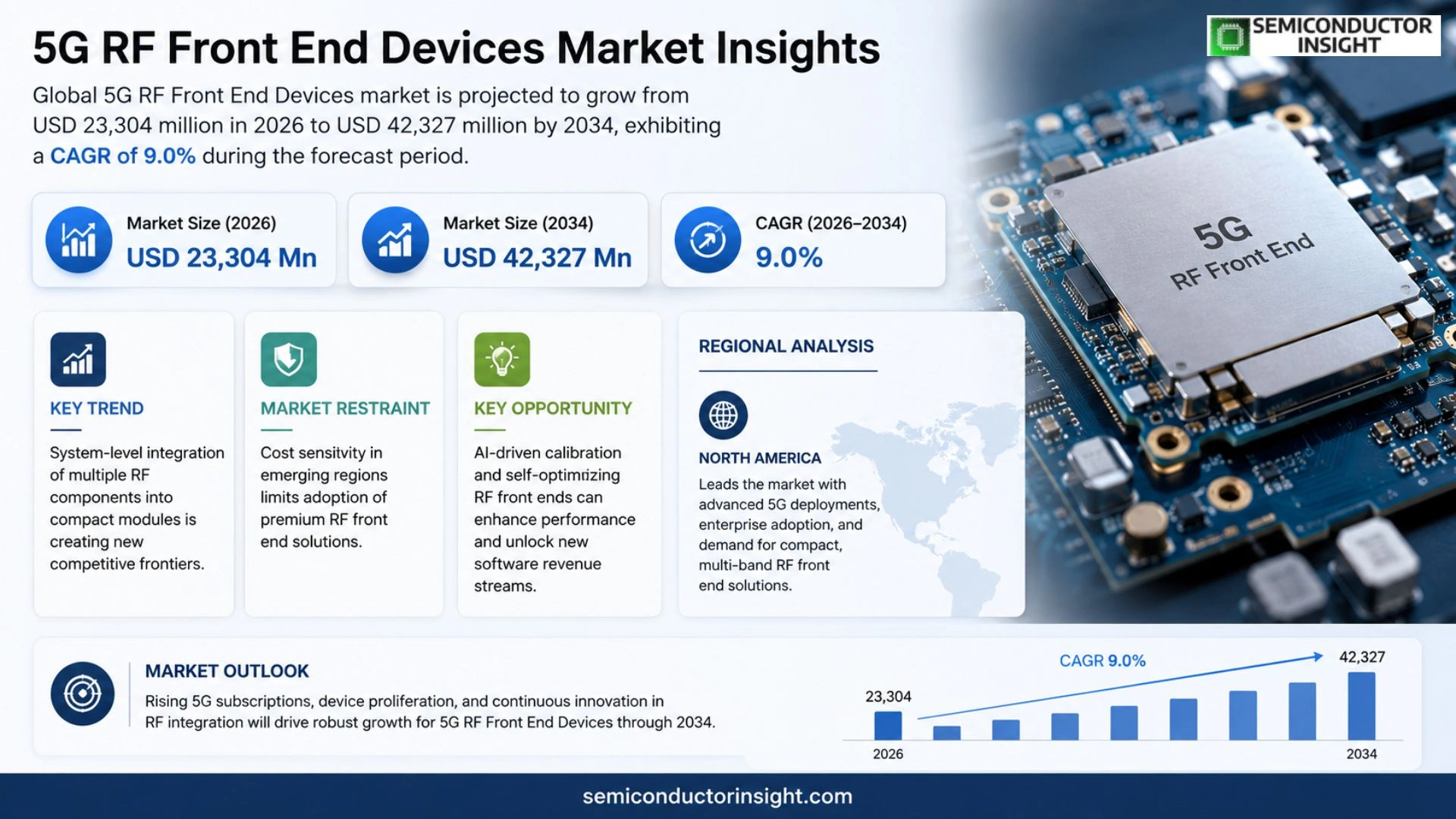
Global 5G RF Front End Devices market is projected to grow from USD 23,304 million in 2026 to USD 42,327 million by 2034, exhibiting a CAGR of 9.0% during the forecast period.
5G RF front‑end devices constitute the essential hardware layer linking the baseband or transceiver to the antenna. Their principal functions include transmit power amplification, low‑noise receive amplification, path switching, band selection, duplexing and multiplexing isolation, impedance matching, antenna tuning, and integration of millimeter‑wave or high‑frequency modules under multi‑band, multi‑mode and high‑concurrency conditions. The portfolio spans discrete components,such as power amplifiers, low‑noise amplifiers, RF switches, filters, duplexers, multiplexers and baluns,as well as integrated front‑end modules, transceiver modules and antenna modules that combine several functions.
The expansion of this segment is supported by rising demand from smartphone manufacturers, module vendors and automotive connectivity suppliers alongside growing shipments for fixed wireless access equipment and macro‑base station infrastructure. Materials such as GaN, RF‑SOI, BAW and LTCC are advancing in parallel, shifting competition toward higher integration efficiency, broader bandwidth and lower loss solutions that meet stringent space and power constraints.
MARKET DRIVERS
Escalating Data Traffic Demands
The surge in mobile video streaming, cloud gaming, and enterprise IoT deployments compels operators to densify networks, which in turn raises the performance bar for front‑end modules. Higher bandwidth requirements force manufacturers to adopt advanced materials and packaging techniques that can handle wider frequency ranges without compromising linearity.
Regulatory Momentum for Spectrum Refarming
Governments worldwide are reallocating mid‑band spectrum for 5G services, creating a fertile environment for silicon‑based tunable filters and power amplifiers. This regulatory shift shortens the path from prototype to volume production, encouraging capital investment in new fabs and design tools.
➤ “Operators that secure flexible front‑end architectures now enjoy a measurable edge in latency and coverage, translating into faster revenue realization.”
Meanwhile, the rollout of massive MIMO arrays demands tighter integration between antenna modules and RF front‑end chips. Co‑design approaches that merge antenna engineering with semiconductor design reduce signal loss, thereby improving overall system efficiency for 5G RF Front End Devices Market.
MARKET CHALLENGES
Manufacturing Yield Constraints
Advanced processes such as 28 nm GaN or 65 nm SiGe achieve exceptional performance but suffer from tighter tolerances, leading to lower yields on early silicon runs. The cost premium associated with scrap and re‑work pressures OEMs to balance performance aspirations with realistic production targets.
Other Challenges
Supply‑Chain Volatility
The reliance on a limited pool of specialty substrate providers amplifies exposure to geopolitical tensions and raw‑material shortages, which can delay product launches and inflate bill‑of‑materials.
In addition, thermal management remains a persistent hurdle; as power density climbs, conventional cooling solutions become inadequate, prompting designers to explore novel heat‑spreaders and integrated thermoelectric elements.
MARKET RESTRAINTS
Cost Sensitivity in Emerging Regions
While high‑income markets can absorb the premium of cutting‑edge front‑end components, many emerging economies prioritize affordability over absolute performance. This price elasticity limits the immediate upside for manufacturers targeting those geographies.
MARKET OPPORTUNITIES
Integration of AI‑Driven Calibration
Embedding machine‑learning algorithms within RF front‑end chips enables real‑time adaptation to changing channel conditions. Such self‑optimizing behavior not only enhances user experience but also reduces the need for frequent manual firmware updates, opening a revenue stream for licensing the underlying software layer.
5G RF Front End Devices Market Trends
System‑Level Integration Drives New Competitive Frontiers
The most visible shift in 5G RF Front End Devices Market is the migration from isolated discrete components toward fully integrated front‑end modules. Manufacturers now bundle power amplifiers, low‑noise amplifiers, switches, filters and matching networks into single packages that satisfy multi‑band, multi‑mode requirements while respecting strict size and power budgets. For handset designers, the decisive factor is no longer the peak gain of a single PA, but the balance achieved across the entire RF chain,efficient multiband switching, thermal stability, and platform compatibility. Infrastructure customers echo this sentiment; they value linearity, bandwidth coverage and module‑level reliability over the performance of individual chips. Consequently, firms that can translate disparate device know‑how into system‑level solutions gain bargaining power, secure longer design cycles and command higher margins.
Other Trends
Broadening Application Portfolio Extends Growth Beyond Handsets
While smartphones continue to dominate shipment volume, 5G RF Front End Devices Market is increasingly fed by fixed wireless access, automotive connectivity, industrial IoT and small‑cell deployments. Base‑station and small‑cell vendors demand high‑efficiency PAs and ultra‑low‑loss filters that can operate across mid‑band and millimeter‑wave spectra, whereas automotive suppliers prioritize compact modules that survive harsh thermal environments. The emergence of connected‑vehicle platforms and edge‑router solutions introduces a new set of performance criteria,robustness to vibration, rapid re‑configuration and compliance with automotive safety standards. This diversification reduces the market’s reliance on handset cycles and creates parallel revenue streams that can sustain volume growth even if consumer upgrade rates moderate.
Regional Supply‑Chain Realignment Shapes Future Market Structure
Geopolitical considerations and the quest for supply‑chain resilience have sharpened regional delineations in 5G RF Front End Devices Market. United States operators remain leaders in high‑power GaN amplifiers and advanced filtering technologies, while Japanese firms excel in precision passive components and miniaturized fabrication. Korean players continue to push the envelope in millimeter‑wave module integration, and Chinese and Taiwanese companies are closing the gap by expanding from single‑function switches toward full‑stack transceiver modules. This distributed capability set encourages OEMs to adopt multi‑sourcing strategies, mitigating single‑point failures and fostering collaborative development across borders. Vendors that can navigate these regional strengths and present a harmonized portfolio are better positioned to capture long‑term contracts and influence standard‑setting bodies.
COMPETITIVE LANDSCAPE
Key Industry Players
Competitive dynamics in the global 5G RF Front End Devices market
Qorvo continues to dominate the front‑end segment by leveraging its GaN power‑amplifier portfolio and vertically integrated module design. The company’s ability to package PA, LNA and switch functions into a single substrate reduces BOM cost for handset makers and shortens time‑to‑market for infrastructure vendors. This system‑level approach has translated into a sizable share of both mid‑band and mmWave shipments, compelling rivals to reposition their product roadmaps toward multi‑function modules rather than isolated discrete parts.
Beyond the tier‑one incumbents, a cohort of specialist firms is reshaping niche opportunities. Japanese players such as Murata and Taiyo Yuden excel in high‑Q passive components that are critical for low‑loss filter banks, while Korean firms like Samsung Electro‑Mechanics and pSemi focus on high‑power GaN devices for base‑station arrays. Emerging Chinese integrators,including Jiangsu Maxscend, Vanchip (Tianjin) and RFHIC,are expanding from switch and LNA portfolios into full‑stack front‑end modules, driven by domestic carrier procurement mandates. These companies collectively broaden the supply base and introduce price pressure that benefits system‑integrators seeking diversified sourcing.
List of Key 5G RF Front End Devices Companies Profiled
- Qualcomm
- Qorvo
- Skyworks Solutions
- Infineon Technologies
- Texas Instruments
- Murata Manufacturing
- Broadcom Inc.
- NXP Semiconductors N.V.
- pSemi Corporation
- Akoustis, Inc.
- MACOM Technology Solutions Holdings, Inc.
- TDK Corporation
- Taiyo Yuden Co., Ltd.
- RFHIC Corporation
- Samsung Electro‑Mechanics Co., Ltd.
- Jiangsu Maxscend Microelectronics Company Limited
- Vanchip (Tianjin) Technology Co., Ltd.
- Beijing OnMicro Electronics Technology Co., Ltd.
- Guangzhou SmarterMicro Electronics Co., Ltd.
Segment Analysis:
| Segment Category | Sub-Segments | Key Insights |
| By Type |
|
Integrated Front‑End Modules dominate strategic interest because they combine amplification, filtering and switching in a single package, enabling:
|
| By Application |
|
Macro Base Stations & Active Antenna Systems are the leading application segment as network operators prioritize:
|
| By End User |
|
Smartphone Manufacturers drive the most diversified demand, focusing on:
|
| By Integration Level |
|
Fully Integrated Multi‑Function Modules are gaining prominence because they:
|
| By Material Technology |
|
GaN Technology stands out as the catalyst for next‑generation front‑end performance, offering:
|
Regional Analysis: 5G RF Front End Devices Market
North America
Carrier investments in mid‑band spectrum, coupled with a surge in private‑network projects, are compelling OEMs to prioritize devices that can handle multiple carrier aggregates without sacrificing linearity. The push for energy‑efficient hardware in data‑center edge nodes further fuels demand for compact front‑end architectures.
The FCC’s recent rulings on spectrum sharing and its streamlined certification pathway have reduced time‑to‑market for new front‑end designs, encouraging a faster product turnover and rewarding firms with agile compliance processes.
Concentrated wafer‑fab capacity in the United States, alongside strategic stockpiling of key passive components, has insulated the region from some global shortages, yet rising labor costs are prompting a shift toward advanced packaging in lower‑cost jurisdictions.
Legacy RF manufacturers are defending market share through incremental improvements, while a new wave of silicon‑photonic entrants is targeting niche segments such as beam‑forming arrays, reshaping the competitive hierarchy.
Europe
European operators are concentrating on dense‑urban deployments, which places emphasis on front‑end devices capable of seamless dual‑polarization and precise beam steering. The EU’s spectrum harmonization agenda encourages component standardization across member states, giving advantage to suppliers that can offer modular solutions adaptable to both low‑ and mid‑band frequencies. Moreover, the region’s strong emphasis on sustainability is driving specifications for lower power consumption and recyclable materials, prompting R&D investment in gallium‑nitride technologies. Defense and aerospace programs within NATO also contribute a distinct set of requirements, reinforcing the need for hardened, high‑reliability modules.
Asia-Pacific
Asia‑Pacific is characterized by rapid network densification in megacities and an accelerating rollout of private‑network use cases in manufacturing hubs. Chinese and Korean operators favor front‑end architectures that integrate tightly with their domestic chipset ecosystems, leading to a competitive environment where cost efficiency and high‑volume production dominate design choices. At the same time, emerging markets such as India and Indonesia are seeking versatile devices that can span a wide frequency range, encouraging vendors to develop broadband solutions that balance performance with affordability. The region’s vibrant semiconductor manufacturing base provides a strategic advantage in terms of lead times and integration depth.
South America
In South America, carrier expansion is still in a growth phase, which translates into a focus on scalable front‑end modules that can be upgraded as spectrum allocations evolve. Countries like Brazil and Mexico are prioritizing equipment that supports both existing 4G LTE bands and new 5G mid‑band allocations, creating a market for dual‑band solutions. Economic constraints and import‑tax structures push operators toward locally assembled devices, fostering partnerships between global manufacturers and regional assemblers to meet price‑sensitivity while maintaining performance thresholds.
Middle East & Africa
The Middle East and Africa present a heterogeneous picture; wealthier Gulf states are deploying high‑capacity networks for smart‑city initiatives, demanding front‑end devices with superior linearity for massive‑MIMO arrays. Conversely, many African nations are focusing on coverage extensions, where ruggedized, low‑cost modules are essential. The divergence in investment levels encourages a dual‑track strategy for suppliers: premium, feature‑rich designs for the Gulf market and simplified, resilient solutions for broader African deployment, each backed by localized support frameworks.
Report Scope
This market research report provides a comprehensive analysis of the 5G RF Front End Devices Market , covering the forecast period 2026–2034. It offers detailed insights into market dynamics, technological advancements, competitive landscape, and key trends shaping the industry.
Key focus areas of the report include:
- Market Overview: The report begins with an overview outlining its current market scenario, key growth indicators, and industry transformation drivers. It discusses macroeconomic factors, demand–supply balance, regulatory landscape, and the strategic role of semiconductors in powering advancements across industries such as automotive, telecommunications, consumer electronics, and industrial automation.
- Market Size & Forecast: Historical data and future projections for revenue, unit shipments, and market value across major regions and segments.
- Segmentation Analysis: Detailed breakdown by product type, technology, application, and end-user industry to identify high-growth segments and investment opportunities.
- Regional Insights: Insights into market performance across North America, Europe, Asia-Pacific, Latin America, and the Middle East & Africa, including country-level analysis where relevant.
- Competitive Landscape: Profiles of leading market participants, including their product offerings, R&D focus, manufacturing capacity, pricing strategies, and recent developments such as mergers, acquisitions, and partnerships.
- Technology Trends & Innovation: Assessment of emerging technologies, integration of AI/IoT, semiconductor design trends, fabrication techniques, and evolving industry standards.
- Market Drivers & Restraints: Evaluation of factors driving market growth along with challenges, supply chain constraints, regulatory issues, and market-entry barriers.
- Stakeholder Insights: Insights for component suppliers, OEMs, system integrators, investors, and policymakers regarding the evolving ecosystem and strategic opportunities.
Primary and secondary research methods are employed, including interviews with industry experts, data from verified sources, and real-time market intelligence to ensure the accuracy and reliability of the insights presented.
FREQUENTLY ASKED QUESTIONS:
What is the current market size of 5G RF Front End Devices Market?
-> 5G RF Front End Devices market is projected to grow from USD 23,304 million in 2026 to USD 42,327 million by 2034, exhibiting a CAGR of 9.0%
Which key companies operate in 5G RF Front End Devices Market?
-> Key players include Qualcomm, Qorvo, Skyworks Solutions, Infineon Technologies, Texas Instruments, Murata, Broadcom Inc, NXP Semiconductors, Samsung Electro-Mechanics, and TDK Corporation, among others.
What are the key growth drivers?
-> Key growth drivers include global 5G network deployments, increasing demand for high‑speed mobile terminals, expansion of automotive connectivity, and the rollout of fixed wireless access and small‑cell infrastructure.
Which region dominates the market?
-> Asia‑Pacific is the fastest‑growing region, while North America remains a dominant market due to strong incumbent technology providers.
What are the emerging trends?
-> Emerging trends include high‑integration front‑end modules, GaN‑based power amplifiers, multi‑band RF switch technologies, and advanced packaging such as LTCC and IPD.
Get Sample Report PDF for Exclusive Insights
Report Sample Includes
- Table of Contents
- List of Tables & Figures
- Charts, Research Methodology, and more...
 Download Sample Report PDF