AiP (Antenna in Package) Module Market Insights
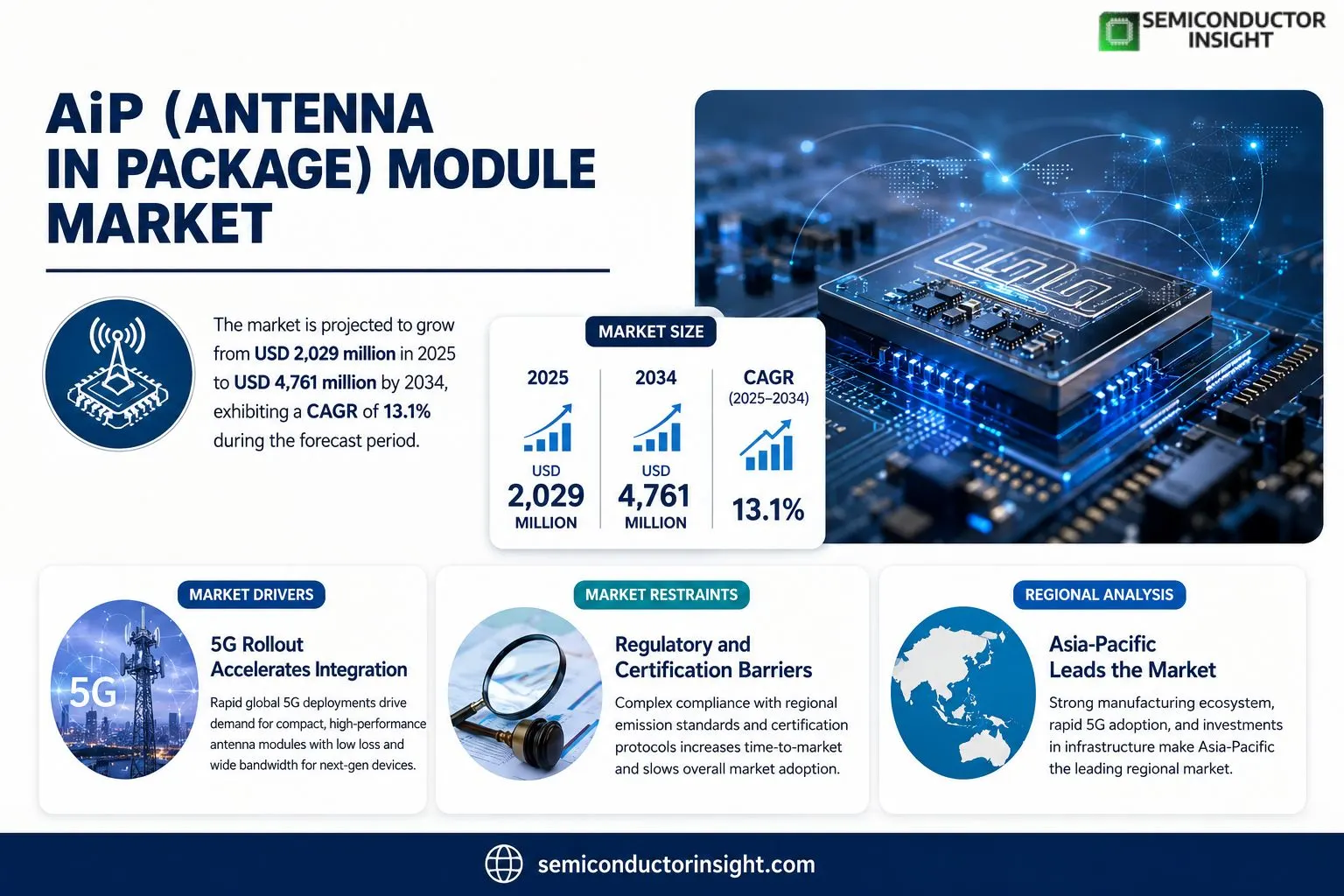
AiP (Antenna in Package) Module market size was valued at USD 2,029 million in 2025 and is forecasted to reach USD 4,761 million by 2034, reflecting a compound annual growth rate of 13.1% over the forecast horizon.
An AiP module is a highly integrated packaging solution designed for high‑frequency wireless communications. It combines the antenna element with the RF chip, power amplifier, filter, switch or transceiver inside a single package, thereby shortening signal paths, reducing transmission loss and crosstalk, while improving miniaturisation, thermal managementand production consistency. The technology serves millimetre‑wave smartphones, fixed wireless access terminals, small cells, O‑RUs, private‑network equipment, satellite communication terminalsand WiGig/IoT scenarios.The upward trajectory stems from the shift of mobile and infrastructure networks toward millimetre‑wave bands where discrete antennas create severe loss and layout constraints. By co‑designing antennas and front‑end circuitry at the package level, AiP mitigates these issues and enables compact high‑gain solutions. Spectrum allocations by the FCC in the United States and harmonised bands across Europe have unlocked new deployment opportunities, prompting leading suppliers such as Qualcomm Technologies Inc., Murata Manufacturing Co., Ltd., ASE Group and Amkor Technology to expand their portfolios.
MARKET DRIVERS
5G Rollout Accelerates Integration
The deployment of 5G infrastructure compels handset manufacturers to adopt compact, high‑performance antenna solutions. **AiP (Antenna in Package) Module Market** players that can deliver modules with low loss and wide bandwidth are seeing increased demand from tier‑one OEMs eager to meet carrier‑grade specifications while preserving slim device form‑factors.
Expansion of IoT Ecosystems
The proliferation of connected sensors, wearables, and smart‑city deployments creates a need for antenna modules that can operate across multiple frequency bands. Companies that embed multi‑band capability directly into the package reduce bill‑of‑materials costs, a factor that is driving procurement preferences across the IoT supply chain.
➤ Design teams that consolidate antenna and RF front‑end functions into a single package achieve up to 30 % reduction in PCB area, opening space for additional functionality.
Manufacturers are also attracted by the **time‑to‑market advantage** offered by mature AiP module libraries. When a design can be sourced off‑the‑shelf, the validation cycle shortens dramatically, a benefit that resonates with fast‑paced consumer product roadmaps.
MARKET CHALLENGES
Complexity of Multi‑Band Design
Creating a single package that satisfies disparate band requirements without compromising efficiency demands sophisticated electromagnetic simulation tools. Smaller firms often lack the capital to invest in such capabilities, leaving them vulnerable to design‑risk penalties.
Other Challenges
Cost Sensitivity
Even though integrated modules lower assembly steps, the upfront material cost for high‑frequency substrates remains elevated. Budget‑constrained OEMs may revert to discrete antenna configurations for cost‑critical products.
MARKET RESTRAINTS
Regulatory and Certification Barriers
Compliance with regional emission standards and antenna certification protocols introduces additional lead time. Vendors that cannot streamline certification for diverse markets face slower adoption rates, which throttles overall market velocity.
MARKET OPPORTUNITIES
Automotive Radar and Connectivity
The surge in advanced driver‑assistance systems (ADAS) and vehicle‑to‑everything (V2X) communications calls for compact arrays capable of high‑frequency operation. **AiP (Antenna in Package) Module Market** entrants that can certify modules for automotive temperature cycles stand to capture a growing slice of the automotive electronics spend.
AiP (Antenna in Package) Module Market Trends
Integration Efficiency as a Competitive Lever
The most visible shift in AiP (Antenna in Package) Module Market stems from the need to compress the RF signal path as frequencies climb into the millimeter‑wave domain. By co‑locating the antenna element with the front‑end circuitry inside a single package, manufacturers can slash transmission loss, curb crosstalk, and tame thermal hotspots that otherwise would demand larger PCB real‑estate. This engineering advantage translates into thinner, lighter handsets and more predictable performance for infrastructure gear. Companies that have mastered package‑level electromagnetic co‑design are able to offer modules that meet the stringent power‑efficiency targets of today’s 5G smartphones while also delivering the gain and directivity required by emerging private‑network equipment. The practical outcome is a stronger pricing posture and longer product lifecycles for firms that control the full supply chain—from substrate material selection through OTA validation.
Other Trends
Application Diversification Beyond Handsets
Although the smartphone segment supplied the early momentum, the AiP ecosystem is now seeing robust uptake in fixed wireless access (FWA) terminals, small‑cell O‑RUs, and satellite communication payloads. These verticals impose higher antenna‑array counts and broader bandwidth envelopes, prompting module vendors to deliver phased‑array solutions and custom‑design services. The shift is amplified by regulatory progress that has opened additional millimeter‑wave bands in North America and Europe, encouraging operators to roll out dense small‑cell clusters that rely on compact, high‑gain AiP modules. For equipment makers, the ability to integrate antenna and RF front‑end in a single unit reduces BOM complexity and accelerates time‑to‑market, a decisive factor when competition centers on rapid network densification.
Regional Concentration and Emerging Partnerships
Production capability remains clustered in East Asia, where legacy expertise in advanced packaging, high‑frequency substrate fabrication, and silicon‑photonic integration creates a formidable barrier to entry. Taiwan, Japan, South Korea, and mainland China host the majority of assembly lines and test facilities, while U.S. and European designers contribute innovative RF‑chip IP and simulation tools. Recent joint ventures between substrate suppliers and semiconductor houses illustrate a trend toward closed‑loop development, allowing participants to align material properties with antenna array geometry from the earliest design phases. This collaborative model not only shortens development cycles but also opens pathways for differentiated module offerings that can command premium margins in markets demanding ultra‑reliable low‑latency connectivity.
COMPETITIVE LANDSCAPEKey Industry Players
AiP Module Market: Competitive Overview
The AiP ecosystem is dominated by a handful of vertically integrated firms that combine advanced RF silicon, high‑frequency substrates, and precision packaging under one roof. Qualcomm Technologies leverages its extensive 5G chipset portfolio to offer antenna‑in‑package solutions that align tightly with its silicon reference designs, giving it a price‑setting advantage in the smartphone segment. Murata Manufacturing complements its passive component leadership with dedicated AiP lines, where the control over ceramic substrates and module assembly translates into consistently low insertion loss across millimeter‑wave bands. ASE Technology Holding and Amkor Technology operate large‑scale foundry‑style packaging facilities, enabling volume‑driven cost efficiencies for both standard and customized modules, a positioning that makes them preferred partners for network‑equipment OEMs seeking reliable supply for O‑RUs and small‑cell deployments. Collectively, these leaders shape a market structure where scale, design‑to‑silicon co‑engineering, and broad testing capabilities dictate competitive positioning.Beyond the tier‑one conglomerates, a diverse set of specialists injects innovation into niche applications. Sivers Semiconductors supplies infrastructure‑grade phased‑array modules that address the high‑gain requirements of private‑network backhaul. Hanwha NxMD integrates its mmWave antenna arrays with power amplifiers, targeting carrier‑grade base‑station hardware. Auden Techno and TMY Technology focus on compact O‑RU and fixed‑wireless‑access terminals, leveraging custom LTCC stacks to shorten signal paths. Chengdu Kesai Technology brings a strong substrate‑material expertise to Chinese satellite‑communication terminals. Kyocera, LG Innotek, and Shinko Electric each contribute unique material or assembly know‑how that supports emerging WiGig and high‑frequency IoT devices. PTI’s rapid‑prototyping services round out the landscape, offering joint‑development packages that let smaller OEMs experiment with AiP designs without committing to full‑scale production. This mix of large‑scale integrators and focused innovators creates a competitive environment where collaboration, intellectual‑property depth, and the ability to deliver turnkey testing are decisive factors.
List of Key AiP Companies Profiled
- Qualcomm Technologies, Inc.
- Murata Manufacturing Co., Ltd.
- ASE Technology Holding Co., Ltd.
- Amkor Technology, Inc.
- Insight SiP SAS
- Sivers Semiconductors AB
- Hanwha NxMD Co., Ltd.
- Auden Techno Corp.
- TMY Technology, Inc.
- Chengdu Kesai Technology Co., Ltd.
- Kyocera Corporation
- LG Innotek Co., Ltd.
- Shinko Electric Co., Ltd.
- PTI (Proasic Technology Inc.)
- Silicon Labs (optional)
Segment Analysis:
| Segment Category | Sub-Segments | Key Insights |
| By Type |
|
Standard Modules
|
| By Application |
|
Smartphones and Mobile Terminals
|
| By End User |
|
Network Infrastructure Providers
|
| By Integration Level |
|
Antenna Plus RF Chip Integration
|
| By Delivery Model |
|
Custom Modules and Solutions
|
Regional Analysis: AiP (Antenna in Package) Module Market
Asia‑Pacific
The Asia‑Pacific ecosystem has become the de‑facto accelerator for AiP (Antenna in Package) Module Market. A confluence of dense urban centers, aggressive 5G rollouts, and a manufacturing base that spans from Taiwan to Vietnam creates a pressure cooker for innovation. Companies are re‑engineering substrate materials to squeeze higher frequency performance into ever‑smaller footprints, a necessity as smartphones, wearables, and IoT nodes proliferate across the region. The regulatory climate, particularly in China, incentivizes integrated solutions that reduce bill‑of‑materials and streamline certification pathways, prompting OEMs to favor package‑level antenna designs over traditional discrete components.Local design houses are leveraging close proximity to foundries, trimming lead times and enabling rapid iteration cycles. This proximity fuels a feedback loop where design constraints and fab capabilities evolve in lockstep, shortening the time from concept to silicon. Meanwhile, the rise of automotive‑grade connectivity in India and Southeast Asia adds a layer of demand for robust, high‑gain antenna modules that can survive harsh environments without compromising form factor. Tier‑1 automotive suppliers are already signaling intent to adopt AiP modules for vehicle‑to‑everything (V2X) communications, anticipating stricter emission standards and the need for seamless connectivity.
From a strategic perspective, firms that embed antenna functions early in the package design are establishing defensible IP portfolios. The competitive advantage lies not merely in performance metrics but in the ability to lock in supply chains that deliver consistent RF characteristics at volume. As handset makers push toward sub‑6 GHz and mmWave coexistence, the pressure to harmonize antenna patterns across heterogeneous bands drives deeper collaboration between semiconductor giants and antenna specialists. The net effect is a market dynamic where Asia‑Pacific not only contributes the bulk of volume but also shapes the technology roadmap for the next decade.
Manufacturers are collapsing the traditional bill‑of‑materials hierarchy by embedding antenna patterns directly onto wafer‑level substrates. This integration trims assembly steps, slashes cost, and improves yield consistency, especially in high‑volume smartphone production lines across South Korea and China.
Emerging spectrum allocations in the 3.5 GHz and 28 GHz bands have prompted governments to endorse package‑level solutions that meet tight out‑of‑band emission limits, accelerating adoption among network equipment providers.
The push for V2X and infotainment connectivity in emerging Asian markets is nudging auto OEMs to qualify AiP modules that can endure temperature extremes while delivering reliable high‑frequency performance.
Collaborative design hubs in Singapore and Japan are pioneering simulation tools that align antenna layout with standard package footprints, reducing redesign cycles and fostering cross‑industry standards.
North America
The United States and Canada are anchoring their growth on high‑value applications such as aerospace telemetry and defense communications. Federal contracts emphasize low‑observable antenna solutions, prompting semiconductor firms to embed stealth‑compatible patterns directly into the package. Meanwhile, the region’s strong IP enforcement environment encourages firms to invest in proprietary antenna‑in‑package architectures that can be licensed to partners, creating a revenue stream beyond pure silicon sales.
Europe
European manufacturers are leveraging the region’s rigorous electromagnetic compatibility (EMC) standards to differentiate their AiP offerings. In sectors like automotive and industrial automation, the emphasis on safety‑critical connectivity drives adoption of package‑level antennas that can be validated against stringent EU directives. Collaborative research programs funded by the EU are also fostering joint ventures between telecom equipment makers and material scientists, accelerating the transition from prototype to volume production.
South America
Growth in Brazil and Argentina is being fueled by expanding mobile broadband penetration and a nascent IoT ecosystem in agriculture. Operators seeking to densify networks without inflating capex are turning to integrated antenna modules that simplify base‑station design. Local fabless firms are beginning to partner with Asian foundries, importing design expertise while tailoring solutions to the region’s frequency allocations and climate conditions.
Middle East & Africa
In the Middle East, sovereign wealth funds are channeling capital into smart‑city initiatives that require pervasive connectivity, prompting telecom players to adopt compact antenna modules for indoor and outdoor deployments. African markets, meanwhile, are witnessing a surge in low‑cost smartphones where space constraints make AiP solutions attractive. Regional distributors are building ecosystems that bundle antenna‑in‑package modules with device‑level certifications, easing entry barriers for emerging manufacturers.
Report Scope
This market research report provides a comprehensive analysis of the AiP (Antenna in Package) Module Market , covering the forecast period 2026–2034. It offers detailed insights into market dynamics, technological advancements, competitive landscape, and key trends shaping the industry.
Key focus areas of the report include:
- Market Overview: The report begins with an overview outlining its current market scenario, key growth indicators, and industry transformation drivers. It discusses macroeconomic factors, demand–supply balance, regulatory landscape, and the strategic role of semiconductors in powering advancements across industries such as automotive, telecommunications, consumer electronics, and industrial automation.
- Market Size & Forecast: Historical data and future projections for revenue, unit shipments, and market value across major regions and segments.
- Segmentation Analysis: Detailed breakdown by product type, technology, application, and end-user industry to identify high-growth segments and investment opportunities.
- Regional Insights: Insights into market performance across North America, Europe, Asia-Pacific, Latin America, and the Middle East & Africa, including country-level analysis where relevant.
- Competitive Landscape: Profiles of leading market participants, including their product offerings, R&D focus, manufacturing capacity, pricing strategies, and recent developments such as mergers, acquisitions, and partnerships.
- Technology Trends & Innovation: Assessment of emerging technologies, integration of AI/IoT, semiconductor design trends, fabrication techniques, and evolving industry standards.
- Market Drivers & Restraints: Evaluation of factors driving market growth along with challenges, supply chain constraints, regulatory issues, and market-entry barriers.
- Stakeholder Insights: Insights for component suppliers, OEMs, system integrators, investors, and policymakers regarding the evolving ecosystem and strategic opportunities.
Primary and secondary research methods are employed, including interviews with industry experts, data from verified sources, and real-time market intelligence to ensure the accuracy and reliability of the insights presented.
FREQUENTLY ASKED QUESTIONS:
What is the current market size of AiP (Antenna in Package) Module Market?
-> AiP (Antenna in Package) Module Market was valued at USD 2029 million in 2025 and is expected to reach USD 4761 million by 2034.
Which key companies operate in AiP (Antenna in Package) Module Market?
-> Key players include Qualcomm Technologies, Inc., Murata Manufacturing Co., Ltd., Insight SiP SAS, Sivers Semiconductors AB, Hanwha NxMD Co., Ltd., Auden Techno Corp., TMY Technology, Inc., Chengdu Kesai Technology Co., Ltd.
What are the key growth drivers?
-> Key growth drivers include rise of 5G mmWave smartphones, expansion of fixed wireless access (FWA) deployments, rollout of small cells and O‑RUs, growing demand for satellite communication terminals, and the need for compact, low‑loss, high‑frequency antenna solutions.
Which region dominates the market?
-> Asia (East Asia) is the dominant region, led by Taiwan, Japan, South Korea and China, while also showing rapid growth across the broader Asia‑Pacific.
What are the emerging trends?
-> Emerging trends include development of phased‑array antenna modules, AI‑assisted design and simulation, advanced substrate materials (LTCC, HDI, FOWLP), and increased integration of antenna with RF front‑end circuitry in standardized and custom modules.

Get Sample Report PDF for Exclusive Insights
Report Sample Includes
- Table of Contents
- List of Tables & Figures
- Charts, Research Methodology, and more...
 Download Sample Report PDF