MEMS Switch (RF, DC contact) Market Insights
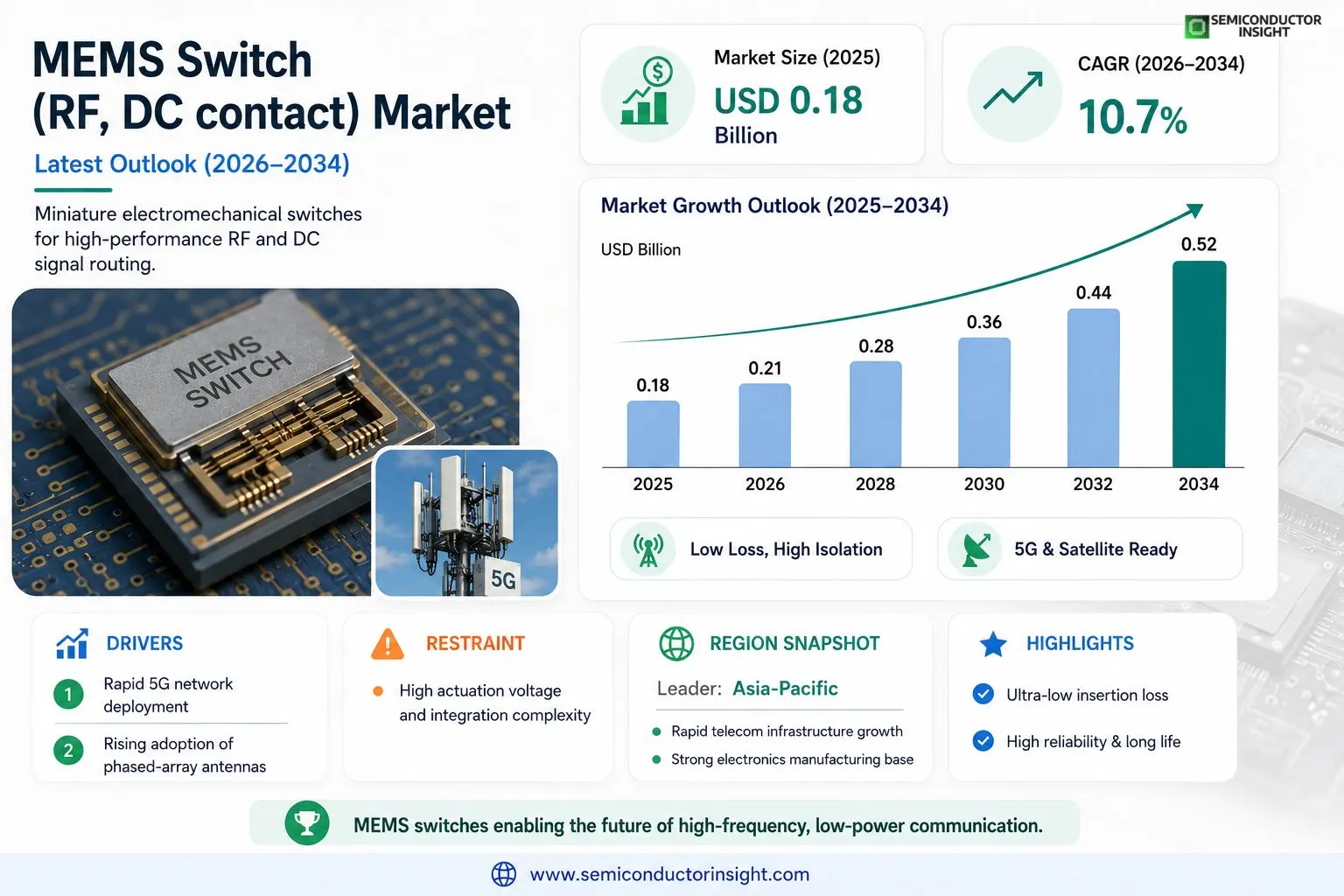
Global MEMS Switch (RF, DC contact) market size was valued at USD 0.18 billion in 2025. The market is projected to grow from USD 0.21 billion in 2026 to USD 0.52 billion by 2034, exhibiting a CAGR of 10.7% during the forecast period.
MEMS (Micro-Electro-Mechanical Systems) switches, encompassing both RF (Radio Frequency) and DC contact variants, are miniaturized electromechanical devices fabricated using semiconductor manufacturing techniques. These switches operate by physically moving a microscale mechanical element to establish or break an electrical contact, offering superior performance characteristics compared to conventional solid-state alternatives. The product category includes series switches, shunt switches, and hybrid configurations, widely deployed across telecommunications infrastructure, aerospace and defense systems, consumer electronics, and test and measurement equipment.
The market is gaining significant momentum driven by the rapid global rollout of 5G networks, increasing adoption of phased-array antenna systems, and the growing need for low-loss, high-isolation switching solutions in advanced wireless communication platforms. Furthermore, the expanding use of MEMS switches in satellite communication payloads and defense electronic warfare systems is reinforcing demand across key end-use verticals. Strategic collaborations and product innovations among leading players such as Menlo Micro, Analog Devices, Inc., and Integrated Device Technology (IDT) continue to shape the competitive landscape, further accelerating market growth across global regions.
MARKET DRIVERS
Rising Demand for High-Frequency Communication Infrastructure
Global MEMS Switch (RF, DC contact) Market is experiencing sustained momentum driven by the rapid expansion of 5G wireless networks and next-generation communication infrastructure. MEMS-based RF switches offer exceptionally low insertion loss, high isolation, and minimal power consumption compared to conventional solid-state alternatives, making them increasingly preferred in millimeter-wave and sub-6 GHz frequency bands. As telecom operators accelerate base station deployments and small cell installations worldwide, demand for precision switching components capable of managing complex signal routing has grown considerably. The MEMS Switch market benefits directly from these infrastructure investments, particularly in applications requiring reliable signal integrity at high frequencies.
Proliferation of Advanced Defense and Aerospace Electronics
Defense modernization programs across North America, Europe, and the Asia-Pacific region represent a significant growth driver for MEMS Switch (RF, DC contact) Market. Military radar systems, electronic warfare platforms, satellite communication terminals, and phased-array antennas increasingly rely on MEMS RF switches due to their radiation hardness, compact form factor, and ability to operate reliably across wide temperature ranges. DC contact MEMS switches, in particular, are valued in aerospace applications for their near-zero power hold state and high linearity, properties that reduce thermal management burdens in space-constrained avionics. Ongoing procurement cycles and rising defense budgets across key geographies continue to sustain strong order pipelines for MEMS switch manufacturers serving this vertical.
➤ MEMS RF switches demonstrate insertion loss values typically below 0.5 dB at frequencies up to 20 GHz, a performance characteristic that continues to differentiate them from PIN diode and FET-based switching solutions in demanding signal routing applications.
The convergence of Internet of Things ecosystems and smart device proliferation further amplifies demand across MEMS Switch (RF, DC contact) Market. Wearable electronics, smart home modules, and industrial wireless sensors increasingly integrate MEMS switches to achieve antenna tuning and band-switching functionality within highly miniaturized circuit architectures. The ability of MEMS technology to deliver GHz-range switching performance within micron-scale packages aligns well with the dimensional constraints of modern consumer and industrial IoT hardware, reinforcing the market’s foundational growth trajectory across multiple end-use segments.
MARKET CHALLENGES
Manufacturing Complexity and Yield Variability in MEMS Fabrication
One of the most persistent challenges confronting MEMS Switch (RF, DC contact) Market is the inherent complexity of microfabrication processes required to produce consistent, high-reliability switching elements. MEMS switches depend on suspended mechanical structures at the microscale, and fabrication tolerances directly influence actuation voltage, contact resistance, and operational lifetime. Achieving reproducible yield across high-volume production runs remains technically demanding, with variations in thin-film deposition, photolithography, and release etching capable of introducing performance deviations that affect end-product quality. These manufacturing intricacies translate into elevated production costs and constrain the ability of smaller market participants to scale competitively.
Other Challenges
Reliability Under Cyclic Mechanical Stress
DC contact MEMS switches are subject to mechanical fatigue and contact degradation over extended switching cycles, particularly in applications with high actuation frequency. Contact stiction, surface contamination, and micro-welding at the contact interface remain active engineering concerns that influence lifetime specifications and warranty commitments, posing qualification hurdles especially in safety-critical aerospace and defense deployments.
Packaging and Hermetic Sealing Requirements
MEMS switch performance is highly sensitive to environmental contaminants, necessitating hermetic or near-hermetic packaging solutions that add cost and complexity to the overall component assembly. Moisture ingress and particulate contamination can alter the mechanical response of suspended switch elements, making packaging engineering a critical but cost-intensive aspect of product development within MEMS Switch (RF, DC contact) Market.
MARKET RESTRAINTS
High Actuation Voltage Requirements Limiting Integration Flexibility
A notable restraint on broader adoption within MEMS Switch (RF, DC contact) Market is the relatively high actuation voltage that electrostatically driven MEMS switches typically require, often ranging from 20 V to 80 V depending on switch geometry and gap dimensions. Modern semiconductor systems operate predominantly at supply voltages of 1.8 V to 3.3 V, necessitating dedicated voltage upconversion circuitry that adds board space, bill-of-materials cost, and potential reliability concerns. This voltage incompatibility creates an integration barrier when competing against RF CMOS switches that operate natively within standard logic supply ranges, particularly in cost-sensitive consumer electronics and mobile handset applications where design simplicity is a commercial priority.
Competition from Established Solid-State Switching Technologies
MEMS Switch (RF, DC contact) Market faces sustained competitive pressure from mature solid-state switching technologies, including PIN diodes, GaAs pHEMT FETs, and SOI CMOS RF switches. These alternatives benefit from decades of process maturity, extensive qualification histories, established supply chains, and competitive pricing at volume. While MEMS switches outperform solid-state options on key linearity and power consumption metrics, procurement decisions in high-volume commercial segments are frequently driven by total cost of ownership and supplier qualification depth rather than peak technical performance alone. This competitive dynamic restrains the pace of MEMS switch penetration into mainstream consumer and telecommunications applications despite their inherent technical advantages.
MARKET OPPORTUNITIES
Expansion into Satellite Communication and Low Earth Orbit Applications
The accelerating deployment of Low Earth Orbit satellite constellations presents a compelling growth opportunity for MEMS Switch (RF, DC contact) Market. Phased-array antennas used in LEO ground terminals and onboard satellite payloads require large numbers of individually controllable RF switching elements to enable beam steering and frequency agility. MEMS RF switches, with their low power consumption in both actuated and hold states, minimal signal distortion at microwave and millimeter-wave frequencies, and radiation tolerance, are technically well suited to meet the stringent performance requirements of this emerging segment. As commercial satellite broadband services scale globally, component demand within this application space is expected to grow materially over the coming years.
Integration with Advanced Test and Measurement Instrumentation
High-performance test and measurement equipment represents an established yet expanding opportunity segment for MEMS Switch (RF, DC contact) Market. Automated test equipment, vector network analyzers, and signal routing matrices used in semiconductor wafer testing, antenna characterization, and RF component validation require switching matrices capable of maintaining signal fidelity across broad frequency ranges with minimal parasitic loading. MEMS switches offer a technically superior alternative to electromechanical relays in these applications, delivering comparable isolation and linearity with significantly faster switching speeds and longer operational lifetimes. As test complexity increases with the proliferation of multi-band and wideband wireless devices, the value proposition of MEMS-based switching matrices in precision instrumentation environments strengthens accordingly.
Emerging Opportunities in Reconfigurable and Cognitive Radio Systems
The ongoing development of reconfigurable radio architectures and cognitive radio platforms offers a forward-looking growth avenue for MEMS Switch (RF, DC contact) Market. Software-defined radios designed for dynamic spectrum access require antenna front-end components capable of rapid, low-loss reconfiguration across multiple frequency bands and polarization states. DC contact MEMS switches, with their near-ideal off-state isolation and ohmic contact characteristics, enable the construction of agile RF front-end modules that can adapt to changing spectral environments without compromising receiver sensitivity or transmitter efficiency. As spectrum management regulations evolve and dynamic spectrum sharing frameworks mature across major markets, demand for the precision switching capabilities that MEMS technology provides is positioned to expand across both commercial and government communication platforms.
MEMS Switch (RF, DC contact) Market Trends
5G Network Expansion Driving Demand for MEMS Switch (RF, DC contact) Solutions
MEMS Switch (RF, DC contact) Market is experiencing robust momentum, primarily fueled by the accelerating global rollout of 5G telecommunications infrastructure. As network operators and equipment manufacturers transition toward higher-frequency bands and more complex antenna architectures, the demand for low-loss, high-isolation switching solutions has intensified significantly. MEMS switches, encompassing both RF and DC contact variants, offer measurable performance advantages over conventional solid-state alternatives, including lower insertion loss, higher linearity, and improved isolation characteristics , attributes that are increasingly critical in next-generation wireless communication platforms. The widespread deployment of phased-array antenna systems, which require precise and reliable signal routing at the component level, has further reinforced the strategic relevance of MEMS Switch (RF, DC contact) technology across the telecommunications sector.
Other Trends
Aerospace, Defense, and Satellite Applications Expanding Market Scope
Beyond commercial telecommunications, MEMS Switch (RF, DC contact) Market is witnessing growing adoption across aerospace, defense, and satellite communication verticals. Defense electronic warfare systems demand switching components capable of operating reliably under demanding environmental conditions while maintaining high switching speed and signal integrity. MEMS-based RF and DC contact switches meet these stringent requirements, making them increasingly preferred in radar systems, electronic countermeasure platforms, and military communication equipment. Simultaneously, satellite communication payload designers are integrating MEMS switches to reduce system weight and power consumption , both critical constraints in space-borne applications. This cross-sector demand diversification is broadening the addressable market for MEMS Switch (RF, DC contact) solutions beyond traditional consumer and infrastructure segments.
Strategic Collaborations and Product Innovation Reshaping the Competitive Landscape
Leading participants in MEMS Switch (RF, DC contact) Market, including Menlo Micro, Analog Devices, Inc., and Integrated Device Technology (IDT), are actively investing in product innovation and forging strategic partnerships to strengthen their market positioning. These collaborations are accelerating the commercialization of advanced MEMS switch designs optimized for specific end-use requirements, including series switches, shunt switches, and hybrid configurations. Manufacturers are increasingly focusing on improving device reliability, cycle life, and packaging compatibility to meet the evolving demands of test and measurement equipment, consumer electronics, and industrial automation sectors.
Semiconductor Fabrication Advancements Supporting MEMS Switch Miniaturization
Continuous advancements in semiconductor manufacturing techniques are enabling the production of increasingly miniaturized MEMS Switch (RF, DC contact) components with enhanced performance characteristics. As fabrication precision improves, manufacturers can achieve tighter dimensional tolerances and more consistent mechanical behavior in microscale switching elements, translating directly into improved device repeatability and yield. This technological progression is lowering production costs over time and enabling broader adoption of MEMS Switch (RF, DC contact) solutions across both high-volume consumer electronics applications and specialized industrial deployments, supporting sustained market expansion across global regions.
COMPETITIVE LANDSCAPE
Key Industry Players
MEMS Switch (RF, DC Contact) Market , Competitive Dynamics and Leading Innovators Shaping Global Landscape
Global MEMS Switch (RF, DC contact) market is characterized by a moderately consolidated competitive landscape, with a handful of technologically advanced players commanding significant market share. Menlo Micro stands out as a frontrunner, having pioneered its Ideal Switch® platform leveraging gold-contact MEMS technology to deliver ultra-low insertion loss and high-power handling capabilities across RF and DC switching applications. Analog Devices, Inc. (ADI) maintains a strong foothold through its broad portfolio of high-performance RF MEMS switching solutions tailored for telecommunications infrastructure and defense electronics. Integrated Device Technology (IDT), now part of Renesas Electronics, continues to contribute specialized switching ICs that complement MEMS-based signal routing architectures. The competitive intensity is further amplified by the accelerating global 5G rollout, phased-array antenna adoption, and growing demand for low-loss, high-isolation switching in next-generation wireless platforms, prompting both established semiconductor firms and specialized MEMS startups to intensify R&D investments and expand their product portfolios.
Beyond the dominant players, several niche but strategically significant companies are reinforcing the MEMS Switch market’s competitive fabric. Cavendish Kinetics, acquired by Qorvo, brought pioneering RF MEMS tuning technology that has been integrated into mobile and IoT device platforms, enhancing antenna performance at the component level. Teledyne DALSA and SiTime Corporation contribute advanced MEMS fabrication and timing solutions that support switching ecosystem development. Companies such as WiSpry and DelfMEMS have carved specialized positions in tunable RF MEMS components for reconfigurable antenna systems. Meanwhile, defense and aerospace-focused players including Northrop Grumman and BAE Systems leverage proprietary MEMS switch technologies for electronic warfare, radar, and satellite communication payloads. The market is also witnessing growing participation from Asia-Pacific semiconductor manufacturers, including Murata Manufacturing and Toshiba, who are scaling MEMS switch production to meet surging demand in consumer electronics and 5G base station equipment. Strategic collaborations, licensing agreements, and vertical integration strategies remain key competitive differentiators as the market is projected to grow from USD 0.21 billion in 2026 to USD 0.52 billion by 2034 at a CAGR of 10.7%.
List of Key MEMS Switch (RF, DC Contact) Companies Profiled
- Menlo Micro
- Analog Devices, Inc. (ADI)
- Integrated Device Technology (IDT) , Renesas Electronics
- Qorvo (Cavendish Kinetics)
- Teledyne DALSA
- Murata Manufacturing Co., Ltd.
- WiSpry, Inc.
- DelfMEMS
- SiTime Corporation
- Northrop Grumman Corporation
- BAE Systems
- Toshiba Corporation
- Omron Corporation
- Panasonic Corporation
- TTM Technologies, Inc.
Segment Analysis:
| Segment Category | Sub-Segments | Key Insights |
| By Type |
|
RF MEMS Switches represent the leading type segment, driven by surging demand for high-performance switching solutions in next-generation wireless communication infrastructure.
|
| By Application |
|
Telecommunications Infrastructure stands as the dominant application segment, propelled by the accelerating global rollout of 5G networks and the associated demand for high-frequency, low-loss switching components.
|
| By End User |
|
Defense and Government Organizations emerge as the leading end-user segment, reflecting the critical role of MEMS switches in advanced electronic warfare, radar, and secure communications systems.
|
| By Actuation Mechanism |
|
Electrostatic Actuation is the predominant mechanism adopted across the MEMS switch landscape, owing to its well-established fabrication compatibility and energy-efficient operating characteristics.
|
| By Packaging Type |
|
Wafer-Level Packaging (WLP) is rapidly consolidating its position as the leading packaging format for MEMS switches, driven by the relentless push toward board-level miniaturization across high-volume electronics applications.
|
Regional Analysis: MEMS Switch (RF, DC Contact) Market
North America
North America’s defense sector remains one of the most significant end-use segments for MEMS Switch RF technology. Military-grade phased-array radar, electronic warfare systems, and satellite communication platforms require highly reliable, miniaturized RF and DC contact switching components. Ongoing procurement programs and modernization initiatives by the U.S. Department of Defense continue to fuel specialized demand throughout the region.
The rapid deployment of 5G networks across the United States and Canada has created substantial demand for high-frequency MEMS Switch (RF, DC contact) components. Telecom operators require low-loss, high-isolation switching solutions capable of supporting millimeter-wave frequency bands. MEMS switches offer distinct performance advantages over traditional PIN diode or FET-based alternatives, accelerating their adoption in base station and small-cell architectures.
North America hosts a dense network of university research centers, national laboratories, and private R&D facilities dedicated to MEMS technology advancement. This ecosystem continuously delivers breakthroughs in reliability, power handling, and packaging of RF and DC contact MEMS switches. Collaborative research grants and technology transfer programs between institutions and commercial entities further strengthen the region’s innovation pipeline.
A well-defined regulatory framework and compliance infrastructure in North America supports accelerated commercialization of MEMS Switch products. Industry standards bodies such as IEEE and JEDEC provide clear qualification pathways, reducing time-to-market for new RF and DC contact switching devices. This regulatory clarity encourages both established players and emerging startups to invest confidently in product development and large-scale manufacturing.
Europe
Europe represents a strategically significant region within MEMS Switch (RF, DC contact) Market landscape, characterized by strong industrial electronics, automotive, and telecommunications sectors. Germany, France, and the United Kingdom are the primary contributors, each fostering unique demand dynamics rooted in their respective industrial strengths. The European automotive industry’s accelerating transition toward advanced driver-assistance systems and vehicle-to-everything communication platforms has opened new application avenues for RF MEMS switching components. Additionally, Europe’s commitment to sovereign technological capability, particularly in semiconductor and microelectronics manufacturing, has prompted policy-driven investment under initiatives such as the European Chips Act. Research institutions across the continent, including Fraunhofer Institutes and IMEC, maintain active MEMS development programs that support regional supply resilience. The growing defense modernization agenda among NATO member states further generates consistent demand for ruggedized RF and DC contact MEMS switch solutions tailored to mission-critical applications.
Asia-Pacific
Asia-Pacific is emerging as one of the fastest-growing regions for MEMS Switch (RF, DC contact) Market, propelled by the region’s commanding position in consumer electronics manufacturing, telecommunications infrastructure expansion, and increasing defense expenditure. China, Japan, South Korea, and Taiwan collectively form a powerful production and consumption hub for MEMS-based components. The aggressive rollout of 5G networks across major Asian economies is driving substantial procurement of RF switching solutions for base stations, handsets, and smart infrastructure. Japan and South Korea are recognized for their precision MEMS fabrication expertise, while China’s domestic push to develop indigenous semiconductor capabilities continues to stimulate local MEMS Switch production. India is also emerging as a noteworthy growth market, supported by government-backed electronics manufacturing schemes and increasing telecom investments. The convergence of high-volume consumer electronics demand with expanding industrial and defense applications positions Asia-Pacific as a critical growth frontier through 2034.
South America
South America occupies a developing but gradually expanding role in Global MEMS Switch (RF, DC contact) market. Brazil stands out as the region’s largest market, driven by its relatively advanced telecommunications infrastructure and growing industrial electronics sector. The ongoing expansion of 4G coverage and the early-stage deployment of 5G networks in urban centers are beginning to generate demand for RF MEMS switching components at the network equipment level. While local manufacturing capacity for MEMS devices remains limited, regional system integrators and OEMs increasingly source RF and DC contact MEMS switches from global suppliers. Government-led digital transformation programs and investments in smart city infrastructure across Brazil, Argentina, and Chile are expected to gradually broaden the application base for MEMS Switch technology over the forecast horizon. Supply chain development and technical skills enhancement will be key to unlocking the region’s full market potential.
Middle East & Africa
The Middle East and Africa region presents a nascent yet progressively important segment of MEMS Switch (RF, DC contact) Market. In the Middle East, the Gulf Cooperation Council countries , particularly the UAE, Saudi Arabia, and Qatar , are leading adoption through large-scale smart city initiatives, 5G infrastructure projects, and defense modernization programs. Sovereign wealth fund investments in technology infrastructure and strategic partnerships with global semiconductor companies are creating favorable conditions for market entry. Africa, while at an earlier stage of adoption, is witnessing growing demand for RF switching solutions tied to expanding mobile broadband networks and rural connectivity programs. The region’s increasing focus on digital infrastructure as an economic development enabler is anticipated to steadily drive awareness and procurement of MEMS Switch RF and DC contact components. Long-term growth will largely depend on the maturation of local technical ecosystems and deeper integration with global electronics supply chains.
Report Scope
This market research report provides a comprehensive analysis of the MEMS Switch (RF, DC contact) Market , covering the forecast period 2026–2034. It offers detailed insights into market dynamics, technological advancements, competitive landscape, and key trends shaping the industry.
Key focus areas of the report include:
- Market Overview: The report begins with an overview outlining its current market scenario, key growth indicators, and industry transformation drivers. It discusses macroeconomic factors, demand–supply balance, regulatory landscape, and the strategic role of semiconductors in powering advancements across industries such as automotive, telecommunications, consumer electronics, and industrial automation.
- Market Size & Forecast: Historical data and future projections for revenue, unit shipments, and market value across major regions and segments.
- Segmentation Analysis: Detailed breakdown by product type, technology, application, and end-user industry to identify high-growth segments and investment opportunities.
- Regional Insights: Insights into market performance across North America, Europe, Asia-Pacific, Latin America, and the Middle East & Africa, including country-level analysis where relevant.
- Competitive Landscape: Profiles of leading market participants, including their product offerings, R&D focus, manufacturing capacity, pricing strategies, and recent developments such as mergers, acquisitions, and partnerships.
- Technology Trends & Innovation: Assessment of emerging technologies, integration of AI/IoT, semiconductor design trends, fabrication techniques, and evolving industry standards.
- Market Drivers & Restraints: Evaluation of factors driving market growth along with challenges, supply chain constraints, regulatory issues, and market-entry barriers.
- Stakeholder Insights: Insights for component suppliers, OEMs, system integrators, investors, and policymakers regarding the evolving ecosystem and strategic opportunities.
Primary and secondary research methods are employed, including interviews with industry experts, data from verified sources, and real-time market intelligence to ensure the accuracy and reliability of the insights presented.
FREQUENTLY ASKED QUESTIONS:
What is the current market size of MEMS Switch (RF, DC contact) Market?
-> Global MEMS Switch (RF, DC contact) Market was valued at USD 0.18 billion in 2025 and is projected to grow from USD 0.21 billion in 2026 to USD 0.52 billion by 2034, exhibiting a CAGR of 10.7% during the forecast period.
Which key companies operate in MEMS Switch (RF, DC contact) Market?
-> Key players include Menlo Micro, Analog Devices, Inc., and Integrated Device Technology (IDT), among others.
What are the key growth drivers?
-> Key growth drivers include the rapid global rollout of 5G networks, increasing adoption of phased-array antenna systems, growing need for low-loss, high-isolation switching solutions in advanced wireless communication platforms, and expanding use of MEMS switches in satellite communication payloads and defense electronic warfare systems.
Which region dominates the market?
-> Asia-Pacific is the fastest-growing region, driven by rapid telecommunications infrastructure expansion and 5G deployment, while North America remains a significant market owing to strong aerospace, defense, and advanced wireless communication sectors.
What are the emerging trends?
-> Emerging trends include miniaturized MEMS switch architectures, integration into phased-array and beamforming antenna systems, growing deployment in satellite communication payloads, and strategic collaborations and product innovations among leading market participants to address evolving demands in telecommunications and defense electronics.

Get Sample Report PDF for Exclusive Insights
Report Sample Includes
- Table of Contents
- List of Tables & Figures
- Charts, Research Methodology, and more...
 Download Sample Report PDF