Analog Front-End IC (AFE IC) Market Insights
Analog Front-End IC (AFE IC) market was valued at USD 2,854 million in 2025 and is projected to reach USD 5,290 million by 2032, reflecting a compound annual growth rate of 9.3% over the forecast horizon.
An Analog Front‑End IC (AFE IC) is an integrated circuit that conditions analog signals from sensors by amplifying, filtering, multiplexing and converting them into digital data via an on‑chip ADC interface. In 2025 AFE‑IC production reached approximately 868 million units at an average price of about USD 3.6 per unit, while annual capacity stood at roughly 1,085 million units. The component sits in the midstream of the semiconductor value chain, linking upstream analog design and wafer fabrication with downstream applications such as industrial sensing, medical instrumentation, automotive electronics and IoT systems.
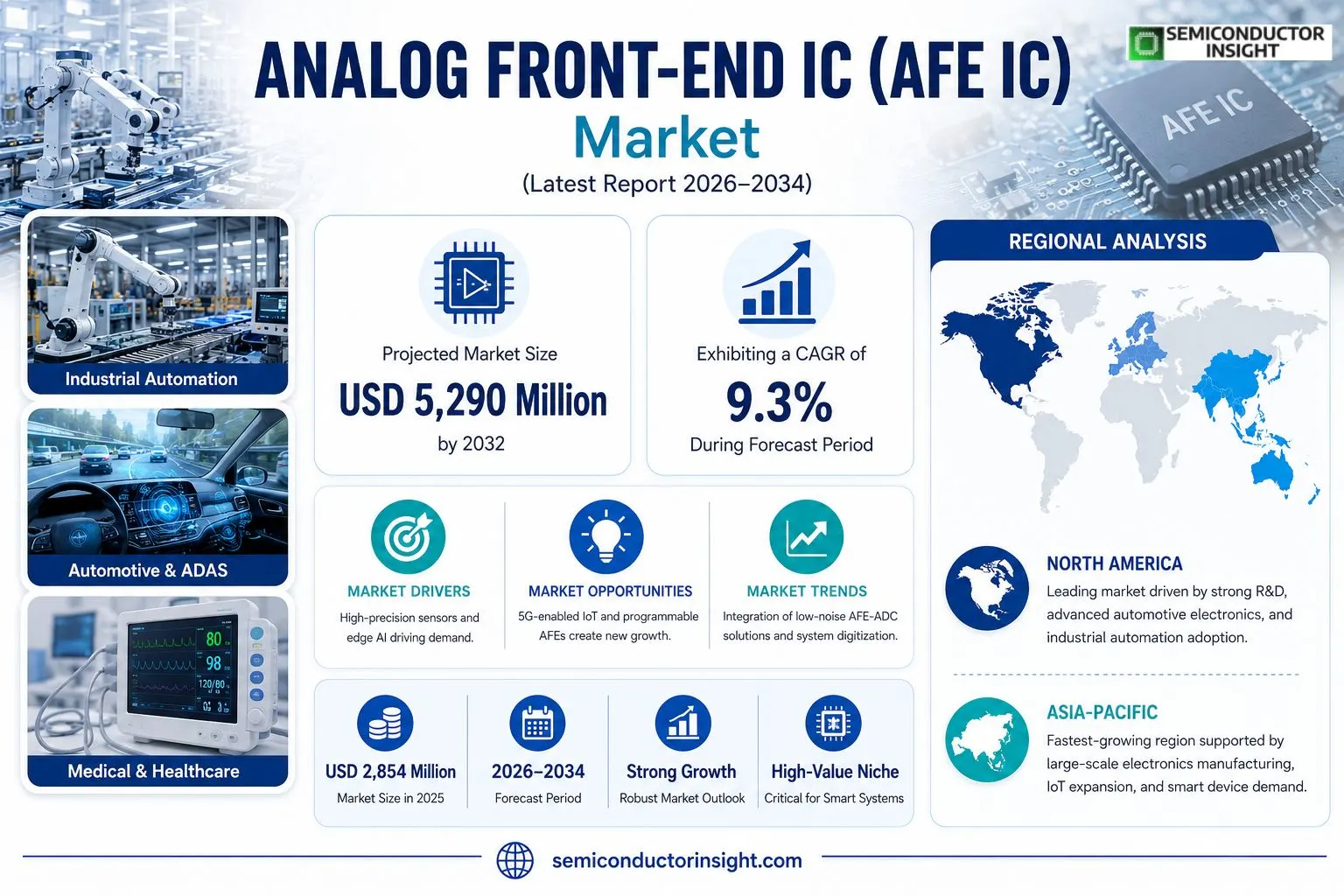
MARKET DRIVERS
Rising Demand for High‑Resolution Sensors
The automotive sector’s shift toward advanced driver‑assistance systems (ADAS) and electric‑vehicle power‑train monitoring has created a sustained appetite for ultra‑low‑noise, high‑precision analog front‑end solutions. Manufacturers that can deliver sub‑microvolt offset voltages are gaining traction with OEMs seeking to tighten sensor‑fusion algorithms, thereby improving safety margins and vehicle efficiency.
Integration of AI at the Edge
Edge‑AI processors require analog front‑ends that can condition disparate analog signals while maintaining low latency. The confluence of AI inference on microcontrollers and the need for real‑time data conditioning pushes system designers toward AFE ICs that embed programmable gain amplifiers and sigma‑delta converters on a single die. Such integration reduces board count and accelerates time‑to‑market for smart‑sensor products.
➤ Designers who prioritize power‑efficiency in AFE ICs are unlocking new revenue streams in wearable health monitors, where battery life directly dictates user adoption.
Ultimately, the convergence of stringent performance requirements, cost pressure, and a proliferating ecosystem of connected devices fuels a virtuous cycle: higher demand drives R&D investment, which in turn delivers more capable AFE ICs that open additional application niches.
MARKET CHALLENGES
Complexity of Mixed‑Signal Design
Designing an AFE IC that simultaneously satisfies high bandwidth, low distortion, and minimal power draw involves trade‑offs across analog, digital, and layout domains. Small design teams often lack the depth to optimize all parameters, leading to longer development cycles and higher non‑recurring engineering costs.
Other Challenges
Regulatory Compliance
Medical and automotive applications are subject to rigorous safety and electromagnetic compatibility standards. Achieving certification can delay product launches, especially when regional authorities mandate distinct test protocols for the same device family.
MARKET RESTRAINTS
Supply‑Chain Volatility for Semiconductor Materials
Fluctuations in silicon wafer availability and lead times for high‑purity passive components have tightened inventory buffers for AFE IC manufacturers. When capacity constraints arise, customers are forced to either accept longer lead times or pivot to legacy parts, both of which suppress incremental sales.Furthermore, the reliance on a limited number of foundries for advanced process nodes amplifies exposure to geopolitical tensions. Any disruption in fab capacity translates quickly into price spikes, eroding margin expectations for both suppliers and downstream device makers.
MARKET OPPORTUNITIES
Emergence of 5G‑Enabled IoT Nodes
5G rollouts are extending high‑speed connectivity to remote sensors used in smart‑cities, industrial automation, and precision agriculture. These nodes require AFE ICs capable of handling wide‑dynamic‑range RF front‑ends while preserving signal fidelity for downstream analytics. Companies that tailor AFE architectures for 5G bands can capture a growing slice of the IoT infrastructure market.Another promising avenue lies in the development of programmable AFE platforms that allow customers to reconfigure gain, filter characteristics, and sampling rates via software. This flexibility reduces the need for multiple part numbers, enabling a “one‑chip‑fits‑all” strategy that aligns with the modular design philosophies of next‑generation hardware ecosystems.
Analog Front-End IC (AFE IC) Market Trends
Expansion of Sensor‑Centric End Markets
The surge in automotive electrification, wearable health monitors, and factory‑floor automation has lifted demand for precise signal conditioning. As vehicles incorporate higher‑voltage power‑train sensors and medical devices require sub‑microvolt noise floors, designers turn to AFE ICs that merge amplification, filtering, and conversion in a single package. This shift elevates the value of low‑noise architecture, because a cleaner front‑end directly reduces downstream analog‑to‑digital error and shortens product development cycles. Consequently, suppliers that can guarantee sub‑3 nV/√Hz performance are commanding premium pricing, reflected in a reported gross profit margin of roughly 62 % for the sector.
Other Trends
Manufacturing Capacity and Pricing Dynamics
production of AFE ICs reached about 868 million units in 2025, while fab capacity stood at 1.085 billion units, indicating a headroom of roughly 25 % that manufacturers are likely to fill as automotive and IoT orders accelerate. Average unit price of US$ 3.6 remains stable, but incremental integrationcombining AFE functions with ADC coreshas begun to squeeze per‑chip revenue, prompting firms to focus on higher‑value, programmable designs that justify a price premium.
Rise of Integrated AFE‑ADC Solutions
Design houses such as Texas Instruments and Analog Devices are expanding portfolios that embed ADCs directly within AFE blocks. This integration reduces board‑level component count, lowers overall system power, and enhances calibration consistency. For end‑users, the benefit translates into smaller form factors for wearable devices and tighter thermal budgets for automotive sensors. The market trajectory from a 2.85 billion‑dollar valuation in 2025 toward a 5.29 billion‑dollar size by 2032 underscores the commercial incentive to adopt these monolithic solutions, especially as system‑level digitization becomes a baseline requirement across most verticals.
COMPETITIVE LANDSCAPEKey Industry Players
Analog Front-End IC Market Competitive Overview
Texas Instruments remains the de‑facto anchor of the AFE IC space, leveraging its expansive mixed‑signal portfolio and deep relationships with automotive OEMs and industrial sensor manufacturers. In 2025 the company captured roughly one‑third of revenue, a share sustained by aggressive pricing of its 3‑to‑12‑bit AFE‑ADC families and a steady pipeline of ultra‑low‑noise parts targeting automotive electrification. TI’s vertical integrationfrom wafer fab to advanced packagingallows it to retain margin advantage while supplying high‑volume customers that demand both performance consistency and supply‑chain reliability. The firm’s recent redesign of its AFE architecture to embed programmable gain amplifiers has opened a niche in IoT gateways, where flexibility outweighs pure cost considerations.Beyond the market leader, several midsized and specialist firms shape competitive dynamics. Analog Devices distinguishes itself through precision‑focused designs, particularly in medical instrumentation where its low‑noise front‑ends command premium pricing. STMicroelectronics and Infineon both exploit European automotive mandates, delivering radiation‑hardened AFE modules for electric‑vehicle power‑train monitoring. NXP and Renesas target automotive infotainment and body‑control networks, integrating AFE functionality directly into their system‑on‑chip offerings to reduce board count. Meanwhile, Skyworks, Broadcom, and ON Semiconductor pursue niche segments such as wireless infrastructure and industrial automation, often through strategic acquisitions that add multiplexing or programmable‑filter capabilities. Emerging players like ROHM, Silicon Labs, and Qorvo are expanding their portfolios with multi‑channel AFE solutions that appeal to high‑throughput sensor arrays used in smart factories, thereby diversifying the competitive field and pressuring incumbents to innovate on integration density.
List of Key Analog Front-End IC Companies Profiled
- Texas Instruments
- Analog Devices
- STMicroelectronics
- Infineon Technologies
- Skyworks Solutions
- NXP Semiconductors
- Microchip Technology
- Broadcom Inc.
- Renesas Electronics
- ON Semiconductor
- ROHM Semiconductor
- Silicon Labs
- Qorvo
- Maxim Integrated
- Cypress Semiconductor
Segment Analysis:
| Segment Category | Sub-Segments | Key Insights |
| By Type |
|
Discrete AFE IC dominates early adoption because it offers:
|
| By Application |
|
Industrial Automation leads due to:
|
| By End User |
|
OEM Sensor Designers command attention because:
|
| By Functional Integration Level |
|
AFE + ADC Integrated Solutions are favoured because:
|
| By Signal Type |
|
Voltage AFE IC leads the conversation by:
|
Regional Analysis: Analog Front-End IC (AFE IC) Market
North America
Engineers are leveraging newer silicon‑on‑insulator processes to compress noise floors, enabling front‑end chips that can handle sub‑millivolt signals without sacrificing bandwidth. The emphasis on integration reduces the need for discrete components, delivering cost‑effective solutions for OEMs.
Recent material shortages have prompted manufacturers to diversify wafer sources and adopt multi‑fab strategies. This shift minimizes lead‑time volatility and safeguards volume commitments for high‑volume automotive programs.
Tightened emission standards and EMC regulations compel designers to embed compliance features at the silicon level. Early certification pathways reduce time‑to‑market for products targeting safety‑critical sectors.
End‑users in aerospace and medical imaging are prioritizing front‑end solutions that deliver deterministic performance across temperature extremes, driving collaborative development cycles with chip suppliers.
Europe
European firms continue to champion precision analog front‑end designs for automotive safety and industrial automation. The region’s emphasis on sustainability translates into demand for low‑power architectures that can be paired with renewable‑energy sensors. Collaborative consortiums across Germany, France and the Nordics accelerate standardisation, allowing manufacturers to unlock cross‑border market access with minimal redesign effort.
Asia‑Pacific
Asia‑Pacific’s rapid adoption of consumer electronics and smart‑city infrastructure creates a fertile ground for cost‑sensitive analog front‑end solutions. Manufacturers in China, Japan and South Korea are investing in advanced packaging to achieve higher integration density, thereby meeting the volume demands of wearable health monitors and high‑definition imaging devices.
South America
In South America, emerging automotive assembly plants and expanding telecommunications networks stimulate interest in reliable front‑end modules that can operate under diverse climatic conditions. Local design houses are increasingly partnering with silicon vendors to tailor products for regional specifications, fostering a nascent ecosystem of bespoke solutions.
Middle East & Africa
The Middle East & Africa region sees growing deployment of oil‑field instrumentation and renewable‑energy monitoring systems, both of which rely on high‑precision analog front‑end interfaces. Investment in local testing facilities is enhancing confidence in product performance, encouraging multinational firms to establish dedicated support channels for the market.
Report Scope
This market research report provides a comprehensive analysis of the Analog Front-End IC (AFE IC) Market , covering the forecast period 2026–2034. It offers detailed insights into market dynamics, technological advancements, competitive landscape, and key trends shaping the industry.
Key focus areas of the report include:
- Market Overview: The report begins with an overview outlining its current market scenario, key growth indicators, and industry transformation drivers. It discusses macroeconomic factors, demand–supply balance, regulatory landscape, and the strategic role of semiconductors in powering advancements across industries such as automotive, telecommunications, consumer electronics, and industrial automation.
- Market Size & Forecast: Historical data and future projections for revenue, unit shipments, and market value across major regions and segments.
- Segmentation Analysis: Detailed breakdown by product type, technology, application, and end-user industry to identify high-growth segments and investment opportunities.
- Regional Insights: Insights into market performance across North America, Europe, Asia-Pacific, Latin America, and the Middle East & Africa, including country-level analysis where relevant.
- Competitive Landscape: Profiles of leading market participants, including their product offerings, R&D focus, manufacturing capacity, pricing strategies, and recent developments such as mergers, acquisitions, and partnerships.
- Technology Trends & Innovation: Assessment of emerging technologies, integration of AI/IoT, semiconductor design trends, fabrication techniques, and evolving industry standards.
- Market Drivers & Restraints: Evaluation of factors driving market growth along with challenges, supply chain constraints, regulatory issues, and market-entry barriers.
- Stakeholder Insights: Insights for component suppliers, OEMs, system integrators, investors, and policymakers regarding the evolving ecosystem and strategic opportunities.
Primary and secondary research methods are employed, including interviews with industry experts, data from verified sources, and real-time market intelligence to ensure the accuracy and reliability of the insights presented.
FREQUENTLY ASKED QUESTIONS:
What is the current market size of Analog Front-End IC (AFE IC) Market?
-> Analog Front-End IC (AFE IC) Market was valued at USD 2,854 million in 2025 and is expected to reach USD 5,290 million by 2032, growing at a CAGR of 9.3% during the forecast period.
Which key companies operate in Analog Front-End IC (AFE IC) Market?
-> Key players include Texas Instruments, Analog Devices, STMicroelectronics, Infineon, Skyworks, NXP, Microchip, Broadcom, Renesas, On Semiconductor.
What are the key growth drivers?
-> Key growth drivers include sensor proliferation, system‑level digitization, high‑precision medical devices, automotive electrification, and industrial automation.
Which region dominates the market?
-> The reference does not specify a single dominant region; the market is ly distributed with strong activity across North America, Europe, and Asia‑Pacific.
What are the emerging trends?
-> Emerging trends include integration of low‑noise architectures, mixed‑signal CMOS/BiCMOS processes, AI‑enabled signal conditioning, and expanding IoT applications.
Get Sample Report PDF for Exclusive Insights
Report Sample Includes
- Table of Contents
- List of Tables & Figures
- Charts, Research Methodology, and more...
 Download Sample Report PDF