AI Power Management IC (PMIC) Market Insights
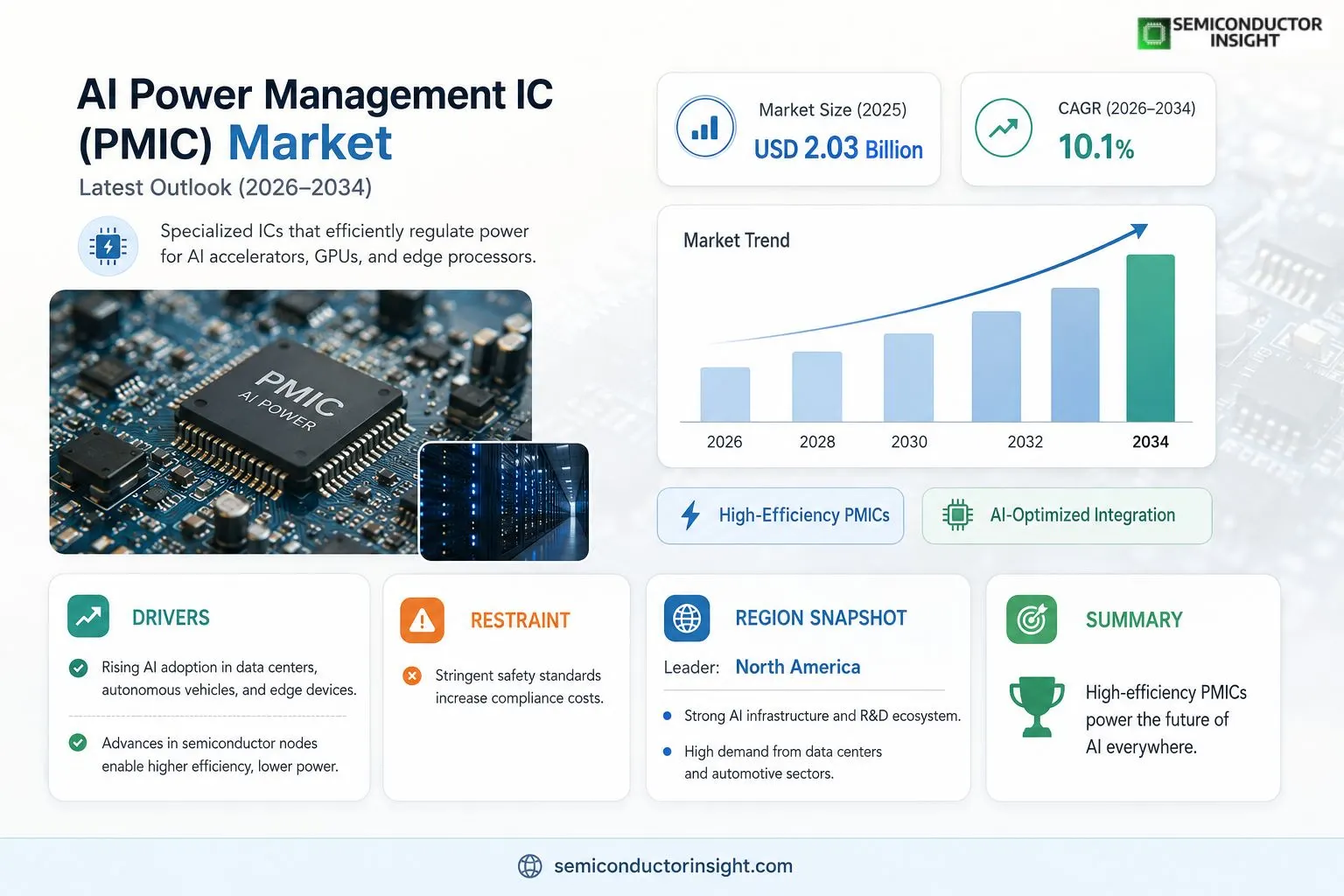
Global AI Power Management IC (PMIC) market size was valued at USD 2.03 billion in 2025. The market is projected to grow from USD 2.12 billion in 2026 to USD 4.78 billion by 2034, exhibiting a CAGR of 10.1% during the forecast period.
AI Power Management Integrated Circuits are specialized semiconductor devices that regulate voltage, current and power sequencing for artificial‑intelligence accelerators, GPUs and edge processors. These PMICs combine buck‑boost converters, load‑switches and monitoring functions into a single package, enabling compact board layouts while delivering the high‑efficiency power conversion required by compute‑intensive AI workloads.The market is experiencing rapid expansion because AI adoption across data centers, autonomous vehicles and smart‑edge devices drives demand for ultra‑efficient power solutions. Furthermore, stringent energy‑consumption standards and the need for thermal management accelerate innovation in PMIC design. Key players such as Texas Instruments, Analog Devices, Infineon Technologies and STMicroelectronics are launching AI‑optimized PMIC families that integrate digital control loops and machine‑learning‑ready telemetry features.
MARKET DRIVERS
Growing Demand for Edge AI Devices
The rapid adoption of edge‑AI processors in smartphones, autonomous vehicles, and industrial IoT gateways is driving the need for highly efficient power management solutions. AI Power Management IC (PMIC) Market players are benefitting from tighter integration requirements that reduce board space and improve thermal performance.
Advances in Semiconductor Process Nodes
Sub‑nanometer process technologies enable PMICs to deliver lower quiescent currents and higher voltage conversion efficiency. These technical gains directly support the power‑budget constraints of AI accelerators, making the market more attractive for OEMs seeking longer battery life.
➤ “Energy‑aware AI chips are becoming a baseline requirement for next‑generation consumer electronics.”
Overall, the convergence of AI workloads and power‑saving innovations is creating a strong growth trajectory for the sector, with revenue projected to expand at a double‑digit compound annual growth rate over the next five years.
MARKET CHALLENGES
Design Complexity and Integration Costs
Integrating advanced PMICs with heterogeneous AI compute blocks demands sophisticated design tools and expertise. Smaller design teams often face steep learning curves, which can delay time‑to‑market and increase engineering expenditures.
Other Challenges
Supply Chain Volatility
Fluctuations in semiconductor fab capacity and raw material availability add uncertainty to production schedules, compelling manufacturers to hold higher safety stock and impacting profit margins.
MARKET RESTRAINTS
Regulatory and Safety Standards
Stringent safety certifications for automotive and medical AI applications impose additional testing cycles. Compliance costs can limit the willingness of smaller vendors to enter AI Power Management IC (PMIC) Market, concentrating market share among a few large suppliers.
MARKET OPPORTUNITIES
Emerging AI‑Optimized Wearables
Wearable devices that combine health monitoring with on‑device AI inference are projected to create new demand pockets. These products require ultra‑low‑power PMICs capable of managing multi‑voltage domains, presenting a clear niche for innovative manufacturers.
AI Power Management IC (PMIC) Market Trends
AI‑Optimized Power Efficiency Gains
AI Power Management IC (PMIC) Market is being reshaped by the convergence of advanced digital control loops and machine‑learning‑ready telemetry embedded directly within power modules. Leading semiconductor firms such as Texas Instruments, Analog Devices, Infineon Technologies and STMicroelectronics have introduced families that combine buck‑boost converters, load‑switches and real‑time monitoring in a single package. This integration reduces board‑level component count, shortens design cycles and delivers conversion efficiencies above 95 % for AI accelerators and edge processors. Stricter energy‑consumption standards in data‑center and automotive domains push manufacturers to embed adaptive voltage scaling and predictive thermal management, allowing systems to maintain performance while staying within tight power envelopes. The result is a rapid uptake of compact, high‑efficiency PMIC solutions across compute‑intensive AI workloads.
Other Trends
Data‑Center Power Scaling
Within AI Power Management IC (PMIC) Market, data‑center operators are prioritizing power‑density enhancements to support expanding AI inference clusters. Modern PMIC designs now support multi‑phase output architectures that can deliver several amps per rail while preserving low ripple, essential for high‑performance GPUs and tensor processing units. Integrated thermal sensors enable dynamic load‑sharing across modules, reducing hotspots and extending hardware lifespan. Additionally, the adoption of programmable digital interfaces allows operators to fine‑tune voltage profiles in response to workload variability, improving overall energy use effectiveness without compromising computational throughput.
Edge Device Integration
Edge deployments,including autonomous vehicles, smart‑camera arrays and industrial IoT sensors,are driving the next wave of innovation in AI Power Management IC (PMIC) Market. Compact, low‑noise converters that operate across wide input ranges are now paired with on‑chip AI inference engines, enabling real‑time decision making at the sensor level. Manufacturers are embedding secure key‑storage and over‑the‑air firmware update capabilities within PMICs to meet rising cybersecurity requirements for edge nodes. The convergence of power management and edge AI functionality reduces latency, lowers bill‑of‑materials, and supports battery‑operated scenarios where every milliwatt counts. As deployment volumes increase, the market will see greater standardization of interface protocols and collaborative development between chipset designers and AI algorithm providers, ensuring that power delivery remains synchronized with evolving computational demands.
COMPETITIVE LANDSCAPEKey Industry Players
AI Power Management IC (PMIC) Market – Competitive Overview
Global AI Power Management IC (PMIC) market was valued at USD 2.03 billion in 2025 and is projected to reach USD 4.78 billion by 2034, driven by a CAGR of 10.1 %. Leading semiconductor firms such as Texas Instruments, Analog Devices, Infineon Technologies and STMicroelectronics dominate the space by offering AI‑optimized PMIC families that combine buck‑boost converters, load‑switches and integrated telemetry. These products enable compact board layouts and high‑efficiency power conversion for AI accelerators, GPUs and edge processors, satisfying the stringent power‑density and thermal‑management requirements of data‑center, autonomous‑vehicle and smart‑edge deployments.Competitive dynamics are increasingly shaped by differentiated digital control loops, machine‑learning‑ready monitoring, and system‑in‑package (SiP) integration. Companies like NXP Semiconductors, Renesas Electronics and ON Semiconductor are expanding their portfolios with multi‑channel, voltage‑scalable solutions, while Murata Manufacturing and Rohm focus on ultra‑compact modules for edge AI devices. Strategic alliances with foundries and ecosystem partners enable rapid iteration, and portfolio breadth across automotive, industrial and consumer segments creates a resilient competitive moat.
List of Key AI Power Management IC (PMIC) Companies Profiled
- Texas Instruments
- Analog Devices
- Infineon Technologies
- STMicroelectronics
- NXP Semiconductors
- Renesas Electronics
- ON Semiconductor
- Murata Manufacturing
- Rohm Semiconductor
- Microchip Technology
- Maxim Integrated
- Skyworks Solutions
- Qualcomm
- Broadcom
- MediaTek
Segment Analysis:
| Segment Category | Sub-Segments | Key Insights |
| By Type |
|
Switching PMICs are pivotal for AI workloads because they deliver high efficiency across wide input ranges and support dynamic power scaling required by AI accelerators.
|
| By Application |
|
Data Center AI Accelerators dominate the application landscape as they demand robust power management to sustain continuous high‑performance compute.
|
| By End User |
|
Cloud Service Providers prioritize AI PMICs that can improve overall data‑center energy efficiency while ensuring uptime for massive AI training clusters.
|
| By Power Architecture |
|
Buck‑Boost Architectures are emerging as the leading power architecture because they seamlessly handle variable supply conditions in edge AI devices.
|
| By Integration Level |
|
System‑in‑Package (SiP) PMICs are gaining traction as they embed power management alongside compute and memory within a single package, streamlining system design.
|
Regional Analysis: North America
United States
The data center sector is a major consumer of AI PMICs, driven by the immense power requirements of AI training and inference workloads. Efficiency in data center power management is critical for reducing operational costs and environmental impact.
The integration of AI in automotive applications, particularly for autonomous driving and advanced driver-assistance systems (ADAS), fuels demand for specialized PMICs that can handle the power demands of complex AI algorithms.
The growth of edge computing, where AI processing is performed closer to the data source, necessitates power-efficient PMICs suitable for resource-constrained environments.
AI is increasingly integrated into consumer electronics, from smartphones and wearables to smart home devices, creating demand for compact and power-optimized PMICs.
Europe
Europe is a significant and growing market for AI PMICs. The region benefits from a strong foundation in semiconductor technology, particularly in countries like Germany, France, and the UK. European initiatives focused on digital transformation and AI development are fostering innovation and driving demand. Key applications include AI in industrial automation, healthcare, and transportation. The emphasis on energy efficiency and sustainability also plays a role in shaping the PMIC market in Europe. Regional players are increasingly collaborating with global leaders to address the evolving power management needs of AI applications. The focus is shifting towards power solutions that support both high performance and low energy consumption.
Asia-Pacific
Asia-Pacific is projected to be the fastest-growing market for AI PMICs. China leads the region in terms of AI investment and adoption, creating a substantial demand for power management solutions. Other key markets include Japan, South Korea, and India. The growth is fueled by the increasing deployment of AI in sectors such as manufacturing, retail, and telecommunications. Government support for AI development and the expansion of digital infrastructure further contribute to market expansion. The Asia-Pacific region presents significant opportunities for PMIC suppliers catering to the growing needs of AI-powered devices and systems. The market is characterized by a mix of established and emerging players.
South America
South America represents an emerging market for AI PMICs. While currently smaller than other regions, the market is poised for growth driven by increasing investments in technology and AI applications. Brazil and Mexico are key markets within the region. The adoption of AI in sectors like agriculture, finance, and logistics is expected to drive demand for specialized power management solutions. However, challenges such as limited infrastructure and economic volatility may constrain growth in the near term. Opportunities exist for PMIC suppliers to cater to the specific needs of the South American market.
Middle East & Africa
The Middle East & Africa is a developing market for AI PMICs. The region is witnessing increasing investments in digital transformation and AI initiatives across various sectors, including healthcare, energy, and finance. Countries like the UAE, Saudi Arabia, and South Africa are driving demand. The expansion of smart cities and the increasing adoption of IoT devices are also contributing to market growth. However, factors such as limited technological infrastructure and economic uncertainties may pose challenges. The market is expected to witness significant growth in the coming years as AI adoption accelerates.
Report Scope
This market research report provides a comprehensive analysis of the AI Power Management IC (PMIC) Market , covering the forecast period 2026–2034. It offers detailed insights into market dynamics, technological advancements, competitive landscape, and key trends shaping the industry.
Key focus areas of the report include:
- Market Overview: The report begins with an overview outlining its current market scenario, key growth indicators, and industry transformation drivers. It discusses macroeconomic factors, demand–supply balance, regulatory landscape, and the strategic role of semiconductors in powering advancements across industries such as automotive, telecommunications, consumer electronics, and industrial automation.
- Market Size & Forecast: Historical data and future projections for revenue, unit shipments, and market value across major regions and segments.
- Segmentation Analysis: Detailed breakdown by product type, technology, application, and end-user industry to identify high-growth segments and investment opportunities.
- Regional Insights: Insights into market performance across North America, Europe, Asia-Pacific, Latin America, and the Middle East & Africa, including country-level analysis where relevant.
- Competitive Landscape: Profiles of leading market participants, including their product offerings, R&D focus, manufacturing capacity, pricing strategies, and recent developments such as mergers, acquisitions, and partnerships.
- Technology Trends & Innovation: Assessment of emerging technologies, integration of AI/IoT, semiconductor design trends, fabrication techniques, and evolving industry standards.
- Market Drivers & Restraints: Evaluation of factors driving market growth along with challenges, supply chain constraints, regulatory issues, and market-entry barriers.
- Stakeholder Insights: Insights for component suppliers, OEMs, system integrators, investors, and policymakers regarding the evolving ecosystem and strategic opportunities.
Primary and secondary research methods are employed, including interviews with industry experts, data from verified sources, and real-time market intelligence to ensure the accuracy and reliability of the insights presented.
FREQUENTLY ASKED QUESTIONS:
What is the current market size of AI Power Management IC (PMIC) Market?
-> AI Power Management IC (PMIC) Market was valued at USD 2.03 billion in 2025 and is expected to reach USD 4.78 billion by 2034, exhibiting a CAGR of 10.1% during the forecast period.
Which key companies operate in AI Power Management IC (PMIC) Market?
-> Key players include Texas Instruments, Analog Devices, Infineon Technologies, and STMicroelectronics, among others.
What are the key growth drivers?
-> Key growth drivers include rapid AI adoption in data centers, autonomous vehicles, and smart‑edge devices, as well as stringent energy‑consumption standards and the need for advanced thermal‑management solutions.
Which region dominates the market?
-> The market shows strong activity across major semiconductor hubs, with particularly high demand in North America, Europe, and Asia‑Pacific due to extensive AI‑hardware deployments.
What are the emerging trends?
-> Emerging trends include AI‑optimized PMIC families that integrate digital control loops, machine‑learning‑ready telemetry, and higher integration of buck‑boost converters and load‑switches.
Get Sample Report PDF for Exclusive Insights
Report Sample Includes
- Table of Contents
- List of Tables & Figures
- Charts, Research Methodology, and more...
 Download Sample Report PDF