Active Phased Array Multifunction Radar Market Insights
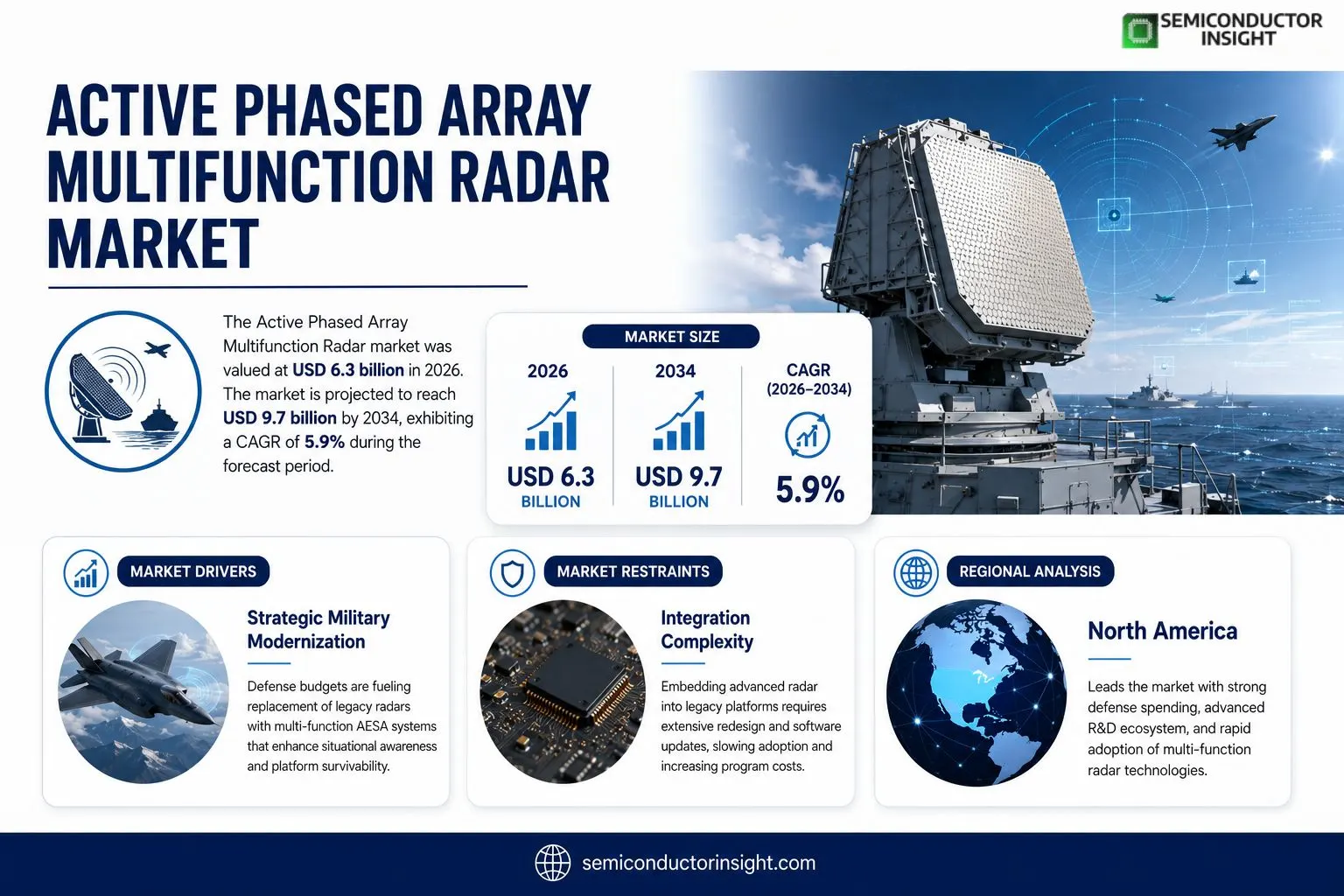
Active Phased Array Multifunction Radar Market size was valued at USD 6.3 billion in 2026. The Market is projected to reach USD 9.7 billion by 2034, exhibiting a CAGR of approximately 5.9 % during the forecast period.
Active phased array radaralso known as Electronically Scanned Array (AESA) radaradjusts beam direction electronically by varying signal phase across an antenna surface array.Each radiator houses its own transmit/receive module, enabling independent generation and reception of electromagnetic waves.This design yields lower power consumption, higher resolution and greater reliability compared with mechanical scanning or passive arrays, although unit cost remains relatively high.The upward trend reflects defense programs seeking multi‑function sensors that merge surveillance, tracking and fire‑control on one platform.At the same time, civilian applications such as air‑traffic control, weather
Market DRIVERS
Strategic Military Modernization
Active Phased Array Multifunction Radar Market is being reshaped by defense ministries that prioritize platform survivability and situational awareness. Nations are allocating multi‑year budgets to replace aging mechanically‑scanned radars with solid‑state arrays that can track dozens of targets simultaneously. This shift is less about incremental upgrades and more about redefining operational doctrine, which forces OEMs to accelerate development cycles.
Advancements in Digital Beamforming
Recent breakthroughs in high‑speed digital signal processors enable real‑time beam steering without moving parts, dramatically reducing maintenance overhead. The resulting agility allows a single radar to perform surveillance, tracking, and fire‑control functions, consolidating hardware footprints on land, sea, and air platforms. Operators value the flexibility because it translates into lower lifecycle costs while preserving combat effectiveness.
➤ “The ability to switch beams in microseconds gives commanders a decisive edge in contested airspaces.” – Senior Analyst, Defense Technology Forum
Because procurement cycles now favor multi‑role solutions, system integrators are bundling radar suites with advanced data‑link packages. This synergy fuels a virtuous loop: better data sharing drives higher demand for sensors that can feed richer information streams, reinforcing the Market’s upward trajectory.
Market CHALLENGES
High Capital Outlay
Developing and fielding a full‑scale active phased array requires substantial upfront investment in semiconductor fabs and test facilities. End‑users often confront budget ceilings that restrict acquisition to a limited number of units, delaying fleet‑wide rollout. The financial pressure compels manufacturers to explore cost‑sharing arrangements, yet the balance between performance and affordability remains delicate.
Other Challenges
Supply Chain Constraints
The reliance on advanced gallium nitride (GaN) components creates vulnerability to semiconductor shortages. Recent geopolitical tensions have amplified lead times for critical chips, compelling program managers to maintain larger safety stocks and inflate project budgets.
Market RESTRAINTS
Integration Complexity
Embedding an active phased array into legacy platforms demands extensive software rewrites and mechanical redesigns. Many operators possess mixed fleets where older vessels cannot accommodate the power and cooling requirements of modern arrays. This incompatibility forces a staggered upgrade path, slowing overall Market penetration.
Market OPPORTUNITIES
Emerging Naval Platforms
Newly commissioned frigates and littoral combat ships are being designed from the keel up with space, weight, and power budgets aligned to active phased arrays. These platforms present a clear opening for radar vendors to secure long‑term contracts that include upgrade pathways for future software enhancements, ensuring relevance as threat environments evolve.
Active Phased Array Multifunction Radar Market Trends
Convergence of Military and Civilian Applications
Active Phased Array Multifunction Radar Market is witnessing a blending of defense‑oriented requirements with civilian operational needs. Modern radar suites now embed high‑resolution tracking, rapid beam steering, and integrated communication links that satisfy both battlefield situational awareness and air‑traffic management mandates. This cross‑pollination reduces development duplication, allowing manufacturers to amortize research costs over a broader customer base. As national security agencies prioritize multi‑role platforms, procurement budgets increasingly allocate funds to systems that can be re‑purposed for weather monitoring, maritime surveillance, and disaster response. The resulting economies of scale improve unit economics, while the expanded user community stimulates incremental upgrades that keep the technology at the cutting edge.
Other Trends
Cost Pressure and Component Consolidation
Despite the technical advantages of active arrays, the high price of individual transmit/receive modules remains a barrier for smaller air forces and commercial operators. Suppliers are therefore pursuing silicon‑based MMIC (Monolithic Microwave Integrated Circuit) production lines to replace legacy gallium‑arsenide assemblies. This shift drives down bill‑of‑materials costs and shortens lead times, but it also introduces new reliability considerations that OEMs must address through rigorous lifecycle testing. At the same time, strategic partnerships between radar manufacturers and semiconductor fabs are reshaping the supply chain, creating a more resilient ecosystem that can absorb fluctuations in raw‑material pricing. Buyers are watching these developments closely, as lower acquisition costs broaden the pool of potential adopters and accelerate Market penetration.
Regional Adoption Accelerated by Infrastructure Modernization
In North America, legacy air‑defense networks are being replaced with multifunction radars that support both sovereign surveillance and civilian air‑space integration, driven by federal modernization programs. Europe follows a similar pattern, with NATO members standardizing on common radar architectures to facilitate data sharing across borders. Asian Pacific economies, particularly China, Japan, and South Korea, are investing heavily in indigenous production capabilities, aligning radar deployment with expanding commercial aviation traffic and maritime trade routes. These regional initiatives create pockets of rapid growth, compelling original equipment manufacturers to tailor firmware updates and support services to local regulatory frameworks. The net effect is a more heterogeneous Market where competitive advantage hinges on the ability to deliver flexible, upgradeable solutions that respect both defense doctrines and civilian safety standards.
COMPETITIVE LANDSCAPE
Key Industry Players
Active Phased Array Multifunction Radar Competitive Overview
Raytheon Technologies, Thales Group and Lockheed Martin dominate the high‑end segment of the active phased‑array Market, leveraging deep defense contracts and sustained R&D pipelines that feed both combat‑aircraft upgrades and naval ship‑borne solutions. Their ability to integrate AESA modules into legacy platforms creates a barrier for newcomers, while joint‑venture arrangements with subsystem specialists help them retain a sizable share of revenue. Northrop Grumman and BAE Systems complement this tier by focusing on specialized radar‑fusion architectures for air‑defence and land‑based air‑surveillance systems, often securing multi‑year procurement deals in Europe and the United States. The concentration of these firms around Tier‑1 defense budgets means that strategic shiftssuch as increased demand for multi‑functionality across air, sea, and ground domainstranslate directly into higher order volumes and stronger bargaining power with tier‑2 suppliers.Beyond the giants, a cadre of regional players is expanding the competitive perimeter. Mitsubishi Electric and Leonardo have carved niches in the Asia‑Pacific and European Markets by offering cost‑efficient, modular radar families adaptable to both civilian air‑traffic control and military platforms. Saab, Israel Aerospace Industries and Elbit Systems exploit their expertise in low‑observable and electronic‑warfare‑ready radars, targeting customers that value rapid fielding and bespoke firmware. Chinese incumbentsChina Electronics Technology Group Corp and Nanjing Research Institute of Electronics Technologyare accelerating production capacity, supported by domestic defence spending and export incentives. Meanwhile firms such as Rohde & Schwarz, Hensoldt and General Dynamics provide critical subsystems and signal‑processing solutions that underpin the broader ecosystem, ensuring that supply‑chain resilience remains a key competitive lever.
List of Key Active Phased Array Multifunction Radar Companies Profiled
- Raytheon Technologies
- Thales Group
- Lockheed Martin
- Northrop Grumman
- BAE Systems
- Mitsubishi Electric
- Leonardo
- Saab
- Israel Aerospace Industries
- Elbit Systems
- China Electronics Technology Group Corp (CETC)
- Nanjing Research Institute of Electronics Technology
- Rohde & Schwarz
- Hensoldt
- General Dynamics
Segment Analysis:
| Segment Category | Sub-Segments | Key Insights |
| By Type |
|
Airborne
|
| By Application |
|
Navy
|
| By End User |
|
Military
|
| By Frequency Band |
|
X‑band
|
| By Deployment Mode |
|
Fixed Installation
|
Regional Analysis: Active Phased Array Multifunction Radar Market
North America
Recent budget allocations emphasize multi‑mission radar modules that can be retrofitted onto existing platforms, reducing lifecycle costs. Procurement officials favor solutions with proven interoperability, prompting a shift toward open‑architecture designs that facilitate incremental upgrades without wholesale replacement.
Integration of advanced digital beamforming with AI‑driven target classification is reshaping system engineering. Companies that blend hardware miniaturization with software‑defined radar functions are gaining an edge, as operators demand rapid re‑tasking capabilities in contested environments.
A concentration of silicon‑foundries, RF‑module specialists, and defense integrators creates a resilient supply chain. This ecosystem supports rapid prototyping, which shortens the gap between concept validation and full‑scale deployment for active phased‑array radars.
Export‑control regimes are being calibrated to balance national security with the need for allied collaboration. Streamlined licensing for dual‑use radar technologies encourages joint development programs across NATO members, reinforcing Market cohesion.
Europe
European nations are leveraging Active Phased Array Multifunction Radar Market to meet both NATO interoperability standards and national security objectives. Collaborative research initiatives, such as those coordinated by the European Defence Agency, blend academic expertise with industrial capacity, accelerating the maturation of low‑observable radar signatures. National defense ministries are increasingly favoring modular architectures that allow member states to share upgrades, thereby reducing procurement redundancy. The emphasis on sustainability drives a push toward power‑efficient designs, aligning radar development with broader carbon‑reduction policies across the continent.
Asia‑Pacific
In the Asia‑Pacific, rising maritime tensions and expanding air‑space surveillance requirements are prompting governments to adopt multifunction radar suites capable of multi‑domain operation. Indigenous development programs in countries like Japan and South Korea focus on integrating high‑resolution synthetic aperture modes, offering a competitive alternative to legacy imports. Meanwhile, emerging economies are seeking technology transfer agreements to accelerate local production, positioning the region as a future hub for cost‑effective radar manufacturing.
South America
South American defence planners are responding to evolving border security challenges by investing in scalable radar platforms that can be deployed across diverse terrains. Joint exercises with North American partners expose regional forces to active‑array capabilities, stimulating demand for training simulators and support infrastructure. The Market sees a gradual shift from single‑function radars toward systems that combine surveillance, tracking, and electronic warfare functions, reflecting a broader strategic desire for versatile assets.
Middle East & Africa
The Middle East & Africa region is witnessing a gradual transition from legacy mechanical radars to digitally steered arrays, driven by the need for rapid response to aerial threats. Countries with significant oil and gas infrastructure are emphasizing integration of radar data into critical‑asset protection networks. Partnerships with Western OEMs provide access to the latest beamforming technologies, while local defense firms focus on customizing user interfaces for regional command structures, fostering a growing ecosystem around Active Phased Array Multifunction Radar Market.
Report Scope
This Market research report provides a comprehensive analysis of the Active Phased Array Multifunction Radar Market , covering the forecast period 2026–2034. It offers detailed insights into Market dynamics, technological advancements, competitive landscape, and key trends shaping the industry.
Key focus areas of the report include:
- Market Overview: The report begins with an overview outlining its current Market scenario, key growth indicators, and industry transformation drivers. It discusses macroeconomic factors, demand–supply balance, regulatory landscape, and the strategic role of semiconductors in powering advancements across industries such as automotive, telecommunications, consumer electronics, and industrial automation.
- Market Size & Forecast: Historical data and future projections for revenue, unit shipments, and Market value across major regions and segments.
- Segmentation Analysis: Detailed breakdown by product type, technology, application, and end-user industry to identify high-growth segments and investment opportunities.
- Regional Insights: Insights into Market performance across North America, Europe, Asia-Pacific, Latin America, and the Middle East & Africa, including country-level analysis where relevant.
- Competitive Landscape: Profiles of leading Market participants, including their product offerings, R&D focus, manufacturing capacity, pricing strategies, and recent developments such as mergers, acquisitions, and partnerships.
- Technology Trends & Innovation: Assessment of emerging technologies, integration of AI/IoT, semiconductor design trends, fabrication techniques, and evolving industry standards.
- Market Drivers & Restraints: Evaluation of factors driving Market growth along with challenges, supply chain constraints, regulatory issues, and Market-entry barriers.
- Stakeholder Insights: Insights for component suppliers, OEMs, system integrators, investors, and policymakers regarding the evolving ecosystem and strategic opportunities.
Primary and secondary research methods are employed, including interviews with industry experts, data from verified sources, and real-time Market intelligence to ensure the accuracy and reliability of the insights presented.
FREQUENTLY ASKED QUESTIONS:
What is the current Market size of Active Phased Array Multifunction Radar Market?
-> Active Phased Array Multifunction Radar Market was valued at USD million in 2026 and is expected to reach USD million by 2034.
Which key companies operate in Active Phased Array Multifunction Radar Market?
-> Key players include Raytheon Technologies, Thales, Mitsubishi Electric, China Electronics Technology Group Corporation, among others.
What are the key growth drivers?
-> Key growth drivers include advancements in electronic scanning technology, increasing defense spending, and expanding civilian applications such as weather forecasting and air traffic control.
Which region dominates the Market?
-> Asia shows strong growth due to substantial defense budgets and emerging civilian uses, while North America remains a leading Market.
What are the emerging trends?
-> Emerging trends include integration of artificial intelligence for target detection, miniaturization for missile‑borne platforms, and multi‑function capabilities combining surveillance and communication.
Get Sample Report PDF for Exclusive Insights
Report Sample Includes
- Table of Contents
- List of Tables & Figures
- Charts, Research Methodology, and more...
 Download Sample Report PDF