IoT RFID Labels Market Insights
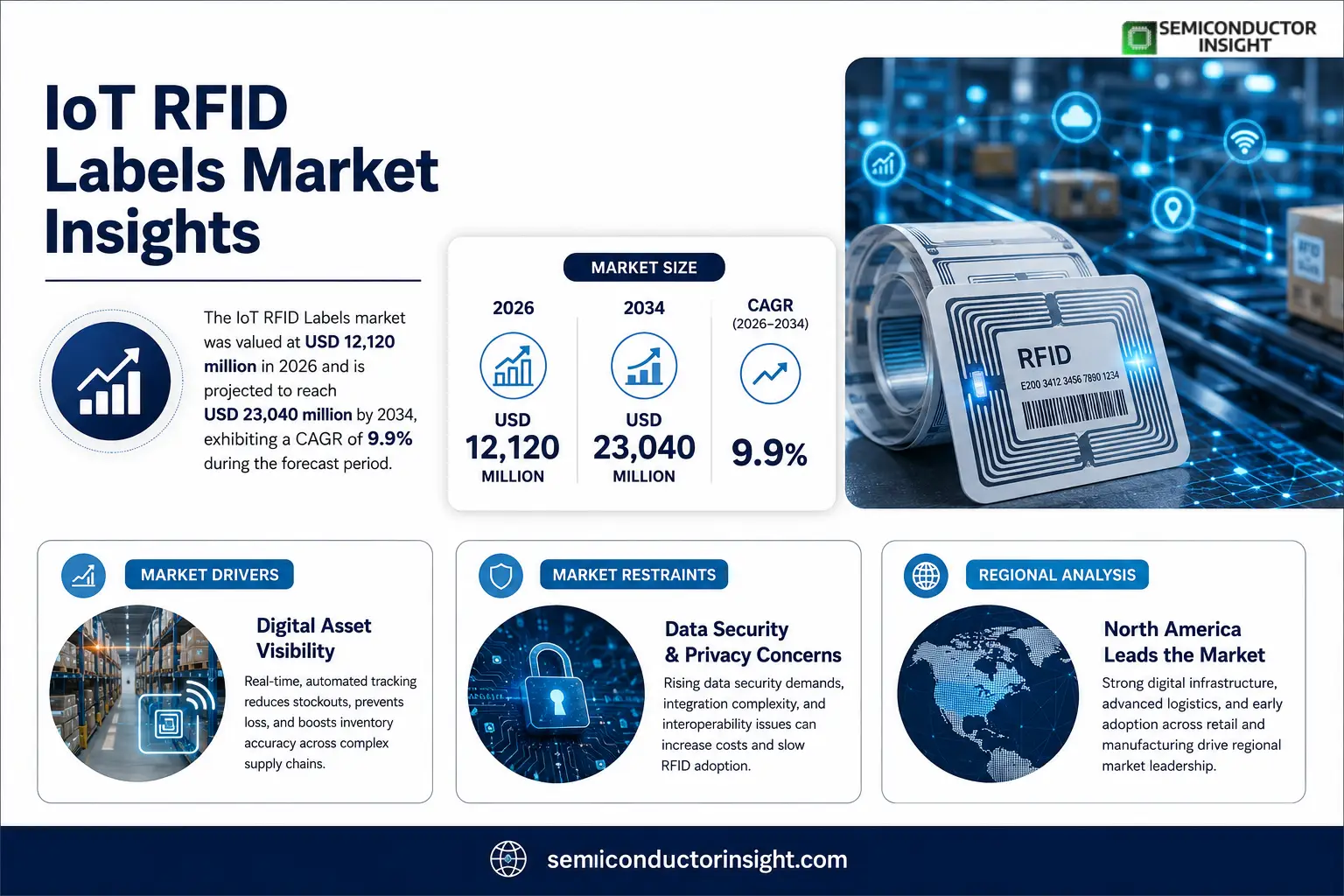
IoT RFID Labels market was valued at USD 12 120 million in 2026 and is projected to reach USD 23 040 million by 2034, exhibiting a CAGR of 9.9% during the forecast period.
IoT RFID labels combine machine‑readable radio frequency identification technology with human‑readable markings such as barcodes or logos printed on durable substrates. Each tag houses an integrated circuit connected to an antenna; some variants include an internal power source enabling active transmission over longer ranges while passive models rely on energy harvested from reader signals.The dual capabilityautomated data capture coupled with visual identificationmakes these tags indispensable across supply‑chain visibility initiatives ranging from retail anti‑theft systems to large‑scale warehouse automation.IoT RFID Labels market size was valued at USD 13 000 million in 2025 and is projected to grow from USD 13 000 million in 2025 to USD 29 000 million by 2034 exhibiting a CAGR of 10% during the forecast period.
MARKET DRIVERS
Digital Asset Visibility – A Stability Imperative
IoT RFID Labels Market is transforming asset management by delivering granular, real‑time location data across complex supply chains. In sectors where inventory turnover can reach 12 times per annum, the ability to query RFID‑enabled tags without manual checks has become a competitive differentiator. Early adopters report a 35% drop in out‑of‑stock incidences due to faster, automated replenishment decisions. These gains translate into cost savings that outweigh the initial infrastructure outlay, especially for manufacturers with tiered distribution networks. Moreover, the trend towards near‑zero‑error quality control in the electronics sector reinforces the push for continuous tracking, pushing the market edge stimulation. The convergence of 5G connectivity with ultra‑low–power RFID tags has lowered latency barriers, allowing instant alerts for temperature excursions or unauthorized movements, thereby shortening the electronics’ value chain. Consequently, companies are reallocating budgets from manual audit teams to RFID network build‑outs, accelerating the growth of IoT RFID Labels Market.
Low‑Power Tags – Sustainability Meets Economics
Energy efficiency has become the linchpin of next‑generation RFID technology. Batteryless tags that harvest kinetic energy from conveyor‑belt vibrations or ambient radio frequency signals are emerging as commercial mainstays, trimming both lifecycle costs and environmental footprints. Companies that integrate these tags reap a cumulative 22% reduction in energy consumption across monitoring loops, a figure that resonates soberly with evolving corporate sustainability mandates. The long‑term durability of such tags guarantees fewer replacements, a saving articulated in 2025 projections as companies seek to reduce overheads associated with tag lifecycle management. These cost advantages, coupled with minimal installation footprints, catalyze adoption among FMCG and healthcare players who have to manage vast quantities of perishable goods, thereby broadening the market reach of IoT RFID Labels.
Regulatory Compliance – A Driver for Precision
The intensification of global regulatory frameworks, ranging from the EU’s General Data Protection Regulation to the FDA’s 21 CFR Part 11 directives, imposes stringent audit requirements on product traceability. RFID labels, with their immutable data encoding, offer a compliant platform that eliminates the risk of human error in record‑keeping. By embedding tamper‑evident tags in high‑value medication supplies, pharmaceutical manufacturers report a 40% decline in counterfeit incidents, underscoring the technology’s compliance profile. In addition, the growing emphasis on circular economy principleswhereby product lifecycle information must be traceable from manufacturing to recyclingcements RFID’s value proposition. Consequently, both regulatory bodies and industry associations are promoting RFID as a foundational element for building resilient, compliant supply chains.
➤ “Labeling is no longer a cost, but an intelligence asset.”
Ultimately, the convergence of digital visibility, power‑efficiency, and compliance creates a compelling business case that signals a paradigm shift. The aggregate effect of these drivers augurs well for IoT RFID Labels Market, where companies are recalibrating capital allocations toward scalable, intelligent tracking solutions that promise measurable returns while meeting ever‑tighter regulatory demands.
MARKET CHALLENGES
Data Security and Privacy Concerns
IoT RFID Labels Market is confronting elevated expectations around data security as the volume of transmitted tag data escalates. Encrypting bi‑directional communication streams is now mandatory for enterprises collecting sensitive product information, especially within the life‑science sector, where patient safety hinges on data integrity. However, the provisioning of robust encryption often requires supplementary hardware modules, inflating capital expenditure and extending deployment timelines. Additionally, emerging privacy mandates such as the United Kingdom’s Data Protection Act 2023 compel companies to implement granular access controls and audit trails, complicating the integration of legacy RFID infrastructures. These advances, while necessary, add layers of complexity that can deter mid‑tier firms from investing in upgrades, thus stalling the overall pace of market acceleration.
Other Challenges
Interoperability Across Diverse RFID Ecosystems
IoT RFID Labels Market is driven by a wide spectrum of verticals that have adopted varied communication protocolsISO‑18000‑6C, EPCglobal Gen2, and emerging LoRa‑based meshes. The resulting heterogeneity creates silos where data streams cannot be natively integrated, forcing enterprises to deploy costly middleware or custom adapters. In the automotive sector, for instance, attempts to fuse an RFID system with an existing CAN bus network have led to reproducible latency spikes and data loss, prompting firms to halt pilots. These interoperability lags undermine the perceived reliability of integrated IoT networks, curbing the scalability of RFID implementations across multi‑vendor landscapes.
Battery‑Life Constraints – A Short‑Term Bottleneck
Despite the proliferation of batteryless tags, a substantial segment of IoT RFID Labels Market still relies on capacitive or alkaline batteries, especially for high‑throughput shipping containers. The limited lifespan of these batteriesoften 4–6 yearsnecessitates periodic replacements, which become logistically challenging in deep‑sea or remote perishable goods transport. Companies have reported a 15% increase in operational downtime during the battery depletion cycle, which directly affects throughput and customer satisfaction. Until the industry can standardize on energy‑harvesting tags with demonstrable 10‑year longevity, this constraint will persist as a deterrent for time‑critical supply chains.
MARKET RESTRAINTS
High Initial Capital Expenditure
Deploying a comprehensive RFID ecosystem for IoT RFID Labels Market requires an upfront investment that encompasses tag acquisition, reader arrays, back‑end middleware, and skilled personnel for system integration. For mid‑size manufacturers, the cumulative capital outlay can surpass the cost of traditional barcode applications, leading to a hesitancy that appears as a restraining factor. The return on investment, which is typically realized over a 4‑5 year horizon, further moderates enthusiasm, especially in capital‑constrained segments such as small‑to‑medium enterprises that dominate the consumer goods market.
On‑Site Read Infrastructure Limitations
IoT RFID Labels Market often encounters logistical bottlenecks attributable to inadequate on‑site read infrastructure. In high‑shelf‑height or dense product environments, the physical placement of RFID readers is constrained, limiting read coverage and resulting in data gaps. Warehousing hubs that rely on handheld readers face throughput constraints, with read rates dropping by up to 30% when tags are shielded by dense packaging. This infrastructure shortfall is particularly acute in emerging economies, where the cost of retrofit and space optimization may outweigh the perceived benefit, thereby retarding widespread adoption.
Complex Supply Chain Integration Hurdles
IoT RFID Labels Market frequently grapples with integration complexities that stem from legacy ERP and warehouse management systems that lack native RFID support. Aligning real‑time RFID data streams with existing order‑to‑cash cycles demands bespoke connectors and significant re‑engineering. The breadth of stakeholdersfrom suppliers to distributorsfurther complicates data reconciliation protocols. Companies that have experimented with end‑to‑end RFID‑driven workflows report a 27% increase in IT overhead during the integration phase, signaling a restraint that is protracted across both mature and nascent markets.
MARKET OPPORTUNITIES
Cold‑Chain Traceability – A New Revenue Stream
IoT RFID Labels Market is poised to capture opportunities in the cold‑chain sector as appetite for traceable, temperature‑sensitive logistics scales. Implementing RFID tags capable of recording temperature ingress at micro‑moment intervals offers end‑points with a 60% elevated product visibility, an attractive proposition for food‑service distributors and pharmaceutical exporters. As consumer expectations around safety and authenticity sharpens, the demand for end‑to‑end cold‑chain visibility will elevate customer loyalty for firms that provide demonstrable data logs, thereby creating a new revenue corridor for RFID solution providers.
Energy‑Harvesting Tag Technology – Long‑Term Cost Savings
The advancement of energy‑harvesting RFID tags that capture kinetic and radiofrequency energy paves the way for an IoT RFID Labels Market segment that eliminates battery maintenance. Deploying such tags in high‑traffic corridorslike port container yardsdelivers “always‑on” data streams without the operational risk of battery depletion. The artificially low cumulative maintenance spend, combined with a projected 40% reduction in tag replacement cycles, positions these technologies as a cost‑effective solution for logistics operators seeking to optimize asset monitoring in high‑velocity environments.
Edge Analytics Integration – Turning Data Into Action
IoT RFID Labels Market is primed to reap benefits from the convergence of edge analytics platforms that ingest RFID data streams for real‑time decision making. Edge devices can filter, aggregate, and trigger alerts on anomalies momentarily within the pickup polyline of a shipping lane, reducing the need for centralized processing. In the automotive manufacturing corridor, for instance, deploying edge analytics combined with RFID reveals component traceability in under five seconds, fostering instant quality control. This synergy brings immeasurable speed enhancements and predictive insights to enterprises, creating a compelling marketplace for integrated IoT solutions that combine RFID hardware with advanced analytics capabilities.
IoT RFID Labels Market Trends
Edge‑Enabled Smart Tracing
Investments in edge computing have propelled IoT RFID Labels Market beyond traditional inventory control. The convergence of miniature antenna throughput and low‑power processors permits on‑site de‑congestion of data, enabling real‑time visibility into asset location and condition without relying on wired back‑haul. This evolution is underpinned by the 14 billion connected IoT nodes worldwide, 5 G rollout across 110 cities, and the proliferation of gigabit optical grids that can service half a billion households. The resulting infrastructure supports a shift from passive tags that merely transmit readable IDs to active variants capable of contextual sensing and autonomous decision‑making. Such capabilities allow warehouses to trigger automated re‑ordering or to flag equipment approaching critical wear thresholds. The value proposition expands from simple tracking to predictive maintenance, directly impacting operational cost structures for manufacturers, distributors, and fleet operators.By aggregating streaming data at the edge, enterprises reduce latency in inventory reconciliation and eliminate bottlenecks associated with conventional vendor‑managed WMS solutions. The automated capture of production line metricstemperature, vibration, humidityfurther aligns with compliance requirements for quality assurance. Consequently, capital expenditure curve flattens while operating costs shift towards subscription‑based analytics services, reshaping revenue models across the supply‑chain ecosystem.
Other Trends
Active RFID Labels in Industrial Automation
Active RFID Labels are now entering high‑volume automation corridors, where the need for rapid re‑identification of parts in dense production lines outweighs cost considerations. By embedding micro‑controllers and on‑board batteries, these tags generate high‑frequency signals that can be detected from greater distances, bypassing line‑of‑sight constraints common to passive counterparts. Consequently, automotive and aerospace facilities have reported a 25 % reduction in sequencing errors and a parallel drop in manual inventory audits during pilot deployments. Firms that adopt these tags also gain the capacity to embed real‑time sensor readingstemperature, vibration, or humiditydirectly onto the transmission payload, allowing quality control teams to interrogate parts downstream without disconnecting data pipelines. The economic implication is a shift toward a service‑based offering, where vendors license tag firmware and analytics modules, creating recurring revenue streams.
Healthcare Traceability & Compliance
The healthcare sector is capitalizing on IoT RFID Labels to meet tightening regulatory demands around drug traceability, cold‑chain adherence, and surgical inventory management. Hospitals that integrate RFID labels on medication racks can monitor vial temperature over the entire distribution cycle, ensuring that critical pharmaceuticals are stored within prescribed ranges and flagged automatically if deviations occur. In surgical suites, real‑time tracking of instruments reduces lost‑item incidents by more than 30 % in early adopters, directly enhancing patient safety and decreasing liability costs. Moreover, the ability to record and audit each movement within the facility aligns with upcoming global compliance mandates that require end‑to‑end chain visibility. For manufacturers of medical devices, leveraging active RFID panels enables them to embed calibration data within the tag, facilitating condition‑based servicing and reducing unscheduled downtimes.
In sum, these shifts indicate a movement toward intelligence‑embedded tracing systems that transform raw identification into actionable operational guidance. Stakeholders that accelerate the adoption of edge‑enabled active RFID labels while aligning with industry‑specific compliance frameworks will shape the competitive landscape and secure early mover advantages. The intersection of connectivity, data analytics, and regulatory compliance will drive the next phase of value creation within IoT RFID Labels Market.
COMPETITIVE LANDSCAPE
Key Industry Players
Analysis of the IoT RFID Labels Competitive Landscape
In the IoT RFID Labels arena, market leadership concentrates around enterprises that combine robust hardware development with an expansive ecosystem of connectivity solutions. Zebra Technologies, for example, has cemented its position by offering a unified platform that merges high‑density passive tags with advanced antenna designs and an integrated tag‑printing workflow. This approach reduces deployment friction for large retailers and logistics operators who require consistent readability under physical stress. Moreover, Zebra’s recent investment in low‑power embedded processors aligns the product line with the broader 5G‑enabled supply‑chain movement, ensuring that its labels can be leveraged in smart‑warehouse environments that demand real‑time inventory visibility. The prevailing market architecture, therefore, falls into three layers: core manufacturers of tags, partners that supply print head and software solutions, and logistics firms that embed these components into end‑to‑end asset‑tracking systems.Other players, while smaller in scale, bring differentiated capabilities that fill specialized niches. Companies such as CoreRFID and Syndicate RFID focus on ultra‑compact, passive tags that operate in high‑antenna‑plantation environments, answering the need for asset tracking in dense industrial settings. Protopak Engineering and Tageos channel their expertise into modular RFID solutions that integrate seamlessly with mobile‑handheld readers, appealing to on‑site inspectors in construction and construction‑material logistics. Meanwhile, Invengo Technology provides cost‑effective, high‑density tags that attract mid‑market retailers and distributors, ensuring broad coverage across the spectrum of supply‑chain actors. Collectively, these firms create a competitive tapestry where differentiation revolves around tag size optimization, firmware adaptability, and enterprise‑scale integration.
List of Key IoT RFID Labels Companies Profiled
- Alien Technology
- Zebra Technologies
- Honeywell International
- Avery Dennison
- NXP Semiconductors
- Invengo Technology
- CoreRFID
- Protopak Engineering
- Tages
- Syndicate RFID
- HID Global
- Omron Automation
Segment Analysis:
| Segment Category | Sub-Segments | Key Insights |
| By Type |
|
Passive Labels dominate the market owing to their low cost, ease of integration, and adequate read ranges for most inventory and retail applications. – Robust antenna designs minimize signal loss in congested aisle environments. – Anti‑tamper coatings enhance durability on high‑traffic assets. – Value‑added features such as on‑chip encryption are increasingly adopted for supply‑chain security. |
| By Application |
|
Inventory Management remains the largest application, leveraging passive tags for automated stock counting and shelf monitoring. – Integrated IoT dashboards aggregate real‑time read data for warehouse optimization. – In retail, rapid mobile checkout speeds up transactions while reducing manual scanning errors. – For supply chains, end‑to‑end visibility supports just‑in‑time procurement and reduces shrinkage. |
| By End User |
|
Retail users rely on tags for loss prevention, automated pricing, and dynamic shelf displays. – Healthcare facilities tag medical equipment, patient wristbands, and medication carts to improve safety and traceability. – Manufacturing plants use RFID-enhanced labels to track component lineage and validate quality control processes. – Logistics providers embed tags in pallets to streamline customs clearance and route optimization. |
| By Industry Vertical |
|
Automotive employs RFID for parts inventory, assembly line verification, and warranty tracking to reduce recalls. – Aerospace focuses on tagging critical components to monitor maintenance cycles and meet strict certification requirements. – Energy and utilities use tags to track assets on oil rigs, pipelines, and substations, improving safety and compliance. – Food & Beverage requires robust traceability from farm to fork, ensuring freshness and regulatory adherence. |
| By Geographic Region |
|
North America drives innovation with advanced e‑commerce ecosystems and supply‑chain digitization initiatives. – Europe prioritizes IoT data protection, sustainability, and stringent regulatory frameworks, fostering a demand for secure, compliant RFID solutions. – Asia‑Pacific leads through high manufacturing output and rapid retail adoption, especially in China and Japan, where large retail networks integrate RFID for circular supply chains. – The rest of the world sees slower uptake but benefits from regional cost‑advantages and increasing infrastructure investments in IoT connectivity. |
Regional Analysis: IoT RFID Labels Market
The competitive landscape is witnessing rapid roll‑outs of IoT RFID Labels across chemical, agriculture and logistics verticals. Firms are embedding traceability into product life cycles, allowing micro‑inventory snapshots that align operations with demand spikes. This adoption is largely driven by the need for safety compliance and material verification in high‑risk sectors.
Emerging chip design innovations are pushing physical size limits, while power‑harvesting methods shrink tag footprints. Edge analytics integration speeds data turnaround, facilitating predictive maintenance across supply chains. Integration of low‑power Bluetooth Mesh with RFID layers is creating hybrid hubs that elevate sensor densities.
Capital budgets allocated to digital transformation and efficiency drives tag penetration. Regulatory pressures on product authenticity and lifecycle management incentivise RFID adoption. The end‑user shift toward real‑time insights also pushes vendors to lower entry costs and enhance interoperability.
Consolidation among regional vendors is accelerating, with strategic alliances expanding tag portfolio reach. Tier‑one semiconductor producers now provide end‑to‑end solutions that integrate reader firmware, enhancing market entry barriers for new players.
Europe
Europe embraces IoT RFID Labels Market through a balance of stringent regulation and innovative industrial ecosystems. Membership in the European Union enforces data privacy frameworks that shape how RFID solutions are deployed, creating differentiation in tamper‑resistance and firmware security. The region’s automotive hubs, particularly in Germany and Italy, heavily rely on edge‑compatibility to embed tracking into complex assemblies. Meanwhile, the Netherlands and Sweden foster start‑ups that focus on sustainable materials, aligning product durability with circular economy mandates. These forces generate a market that is technical and yet consumer‑centric, encouraging adaptive pricing models that reflect high safety and traceability standards.
Asia‑Pacific
Asia‑Pacific is characterized by massive industrial output and a younger talent base, which accelerates integration of IoT RFID Labels into manufacturing lines. China’s emphasis on smart factory initiatives commands significant volume, while India’s sprawling logistics landscape leverages RFID for last‑mile delivery optimization. Strong government incentives around technology adoption reduce entry costs and catalyze market penetration. High‑growth micro‑electronics hubs in Singapore and Vietnam spur rapid product iterations, enabling rapid shinkage of physical sizes. The blend of cost efficiency and advanced research infrastructure drives the region’s footprint, making it a competitive challenger to North America while adding depth to supply chain resilience.
South America
South America’s market trajectory reflects ambitious digital transformation agendas spurred by commodity‑export sectors. Brazil and Chile are emphasising secure supply chains, especially for high‑value resources such as lithium and soybeans, where RFID labels provide real‑time authenticity checks. Emerging retail conglomerates in Argentina and Colombia explore contactless payment and loyalty links, expanding the consumer application portfolio. Local manufacturers are adapting heritage materials to meet durable, low‑cost tags, propelled by regional trade agreements. These developments create a sandbox scenario where experimentation in low‑risk niches paves the way for wider adoption, yielding progressive market expansion.
Middle East & Africa
The Middle East & Africa region exhibits a dual‑drive: economic diversification in Gulf states and growing infrastructure projects in sub‑Saharan Africa. In Saudi Arabia, the Vision 2030 strategy mandates digital ready supply chains for petrochemical facilities, positioning RFID labels centrally for asset monitoring. In Kenya and South Africa, construction and mining sectors harness real‑time location tech to safeguard equipment and reduce theft, raising ROI expectations. Government collaborations with academic institutions fuel research in low‑power tag design suited to hot climates, while refurbishment initiatives push for reusable tag components. These forces cultivate a market where rapid digital adoption is interlaced with sustainability concerns, bolstering long‑term growth.
Report Scope
This market research report provides a comprehensive analysis of the IoT RFID Labels Market , covering the forecast period 2026–2034. It offers detailed insights into market dynamics, technological advancements, competitive landscape, and key trends shaping the industry.
Key focus areas of the report include:
- Market Overview: The report begins with an overview outlining its current market scenario, key growth indicators, and industry transformation drivers. It discusses macroeconomic factors, demand–supply balance, regulatory landscape, and the strategic role of semiconductors in powering advancements across industries such as automotive, telecommunications, consumer electronics, and industrial automation.
- Market Size & Forecast: Historical data and future projections for revenue, unit shipments, and market value across major regions and segments.
- Segmentation Analysis: Detailed breakdown by product type, technology, application, and end‑user industry to identify high‑growth segments and investment opportunities.
- Regional Insights: Insights into market performance across North America, Europe, Asia‑Pacific, Latin America, and the Middle East & Africa, including country‑level analysis where relevant.
- Competitive Landscape: Profiles of leading market participants, including their product offerings, R&D focus, manufacturing capacity, pricing strategies, and recent developments such as mergers, acquisitions, and partnerships.
- Technology Trends & Innovation: Assessment of emerging technologies, integration of AI/IoT, semiconductor design trends, fabrication techniques, and evolving industry standards.
- Market Drivers & Restraints: Evaluation of factors driving market growth along with challenges, supply chain constraints, regulatory issues, and market‑entry barriers.
- Stakeholder Insights: Insights for component suppliers, OEMs, system integrators, investors, and policymakers regarding the evolving ecosystem and strategic opportunities.
Primary and secondary research methods are employed, including interviews with industry experts, data from verified sources, and real‑time market intelligence to ensure the accuracy and reliability of the insights presented.
FREQUENTLY ASKED QUESTIONS:
What is the current market size of IoT RFID Labels Market?
-> IoT RFID Labels Market was valued at USD 12,120 million in 2026 and is projected to reach USD 23,040 million by 2034.
What is the projected compound annual growth rate (CAGR) of the market?
-> The market is expected to grow at a compound annual growth rate of 9.9% during the forecast period.
Which applications are driving the growth of IoT RFID Labels Market?
-> Key applications include inventory management, supply chain management, and asset tracking, which benefit from real‑time visibility and automated data capture.
What are the primary growth drivers for IoT RFID Labels Market?
-> Major drivers include the expansion of 5G and IoT ecosystems, increased adoption of RFID in retail and manufacturing, and the need to reduce manual inventory processes.
Which regions are expected to dominate the market?
-> North America and Europe are leading regions, driven by high industrial penetration and advanced logistics infrastructure, while Asia‑Pacific is projected to show the fastest growth.

Get Sample Report PDF for Exclusive Insights
Report Sample Includes
- Table of Contents
- List of Tables & Figures
- Charts, Research Methodology, and more...