Forklift Battery Charger Market Insights
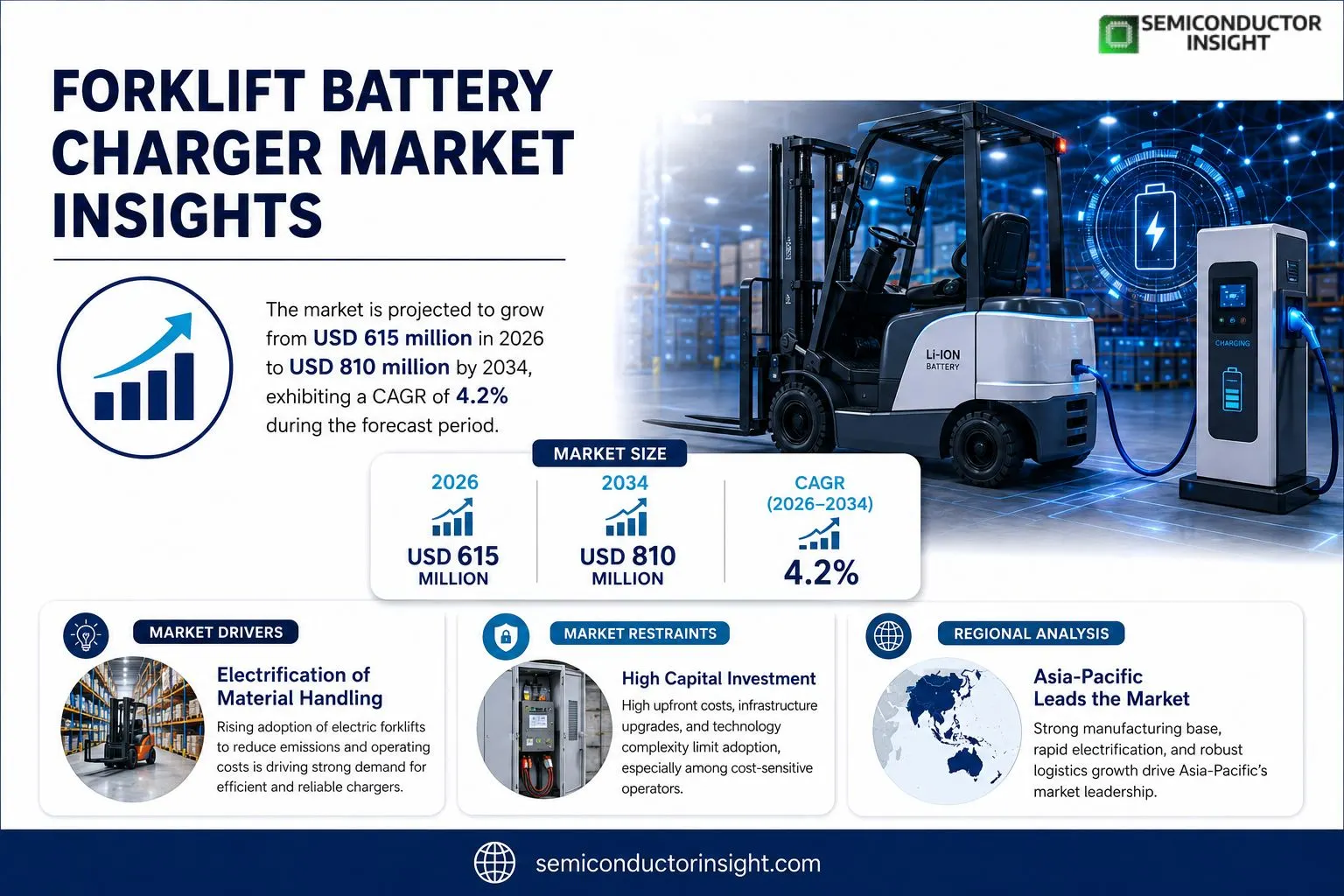
Forklift Battery Charger market size was valued at USD 615 million in 2025. The market will grow from USD 615 million in 2025 to USD 810 million by 2034, showing a CAGR of 4.2% during the forecast period.
Forklift Battery Chargers are charging systems built for electric forklift batteries employed in material‑handling and warehousing environments. They can be off‑board, on‑board, modular or high‑frequency units and are engineered for repeated charge cycles, battery protection and high fleet uptime. Products commonly support flooded lead‑acid, AGM, TPPL and lithium‑ion chemistries while integrating smart algorithms, temperature compensation, communication interfaces and safety controls that extend battery life and improve operational efficiency.The segment advances steadily because warehouse automation and e‑commerce logistics increase demand for reliable power solutions, while ongoing electrification pushes operators toward smarter charging strategies. Companies such as EnerSys highlight modular high‑frequency chargers and battery‑charger matching tools; Delta‑Q notes that charger selection directly influences uptime, reliability and total cost of ownership for lift‑truck fleets. Nevertheless, manufacturers face pricing pressure, configuration complexity and rapid evolution of battery technologies that require continuous innovation.
MARKET DRIVERS
Electrification of Material Handling
Warehouse operators are replacing diesel‑powered lift trucks with electric alternatives to cut fuel costs and meet carbon‑reduction targets. This shift creates a steady demand for high‑efficiency charging units, because operators need equipment that can replenish batteries quickly during short shift changes. Fast‑charge capability therefore becomes a decisive factor when facilities evaluate new capital spending.
Advances in Battery Chemistry
Modern lithium‑ion cells deliver higher energy density and longer cycle life than traditional lead‑acid packs. As fleets adopt these batteries, charger manufacturers are redesigning power electronics to handle higher voltages while maintaining safety standards. The ability to support multiple battery chemistries gives vendors a competitive edge, prompting a surge in R&D budgets across the sector.
➤ “Operators that integrate smart‑grid‑ready chargers can shift load to off‑peak hours, reducing electricity bills by up to 15 %.”
Regulatory pressure on greenhouse‑gas emissions is encouraging businesses to adopt energy‑management solutions that include network‑connected chargers. By aggregating load data, enterprises gain visibility into utilization patterns, enabling predictive maintenance and avoiding unexpected downtime. Such operational intelligence translates into tighter margins and higher asset turnover.
MARKET CHALLENGES
Infrastructure Compatibility
Many older distribution centers lack the electrical capacity required for next‑generation high‑power chargers. Retrofitting buildings involves capital outlays that can outweigh short‑term savings, especially for small‑to‑mid‑size operators. Consequently, firms often postpone upgrades, slowing the overall adoption curve for advanced charging solutions.
Other Challenges
Standardization Gaps
The industry still contends with fragmented connector standards and inconsistent communication protocols. Without a unified framework, integration with warehouse management systems becomes cumbersome, raising the total cost of ownership for end‑users.
MARKET RESTRAINTS
Capital Intensity
High upfront investment for intelligent charger units, coupled with the need for ancillary power upgrades, poses a barrier for cost‑sensitive players. When cash flow is constrained, companies prioritize immediate operational needs over long‑term efficiency gains, tempering market momentum.Additionally, the short product life cycles of some charger models compel businesses to plan for frequent technology refreshes, which can deter firms from committing to large‑scale deployments.
MARKET OPPORTUNITIES
Integration with Energy‑Management Platforms
Emerging software suites that orchestrate battery charging, renewable‑energy sourcing, and demand‑response participation present a lucrative avenue for charger manufacturers. By offering open APIs, vendors can embed their hardware into broader enterprise energy strategies, unlocking recurring revenue streams tied to software licensing and data analytics.Forklift Battery Charger Market stands to benefit from the growing emphasis on circular economy practices. Programs that reclaim and refurbish used batteries generate a steady flow of partially depleted packs that require specialized charging cycles, creating niche demand for adaptive charger designs.
Forklift Battery Charger Market Trends
Rise of Intelligent Charging Systems
Manufacturers are embedding adaptive algorithms that read battery temperature, state‑of‑charge and load patterns in real time. This capability trims idle time for electric lift‑truck fleets, because chargers can pause, resume or switch power levels without operator intervention. Operators who have moved from manual timing to data‑driven charging report fleet uptime improvements of 8‑12 %, a margin that directly lifts order‑fulfilment rates in high‑velocity e‑commerce warehouses. The shift is fueled by the convergence of low‑cost semiconductor modules and cloud‑based fleet‑monitoring platforms, which together lower the total cost of ownership for mid‑size distributors that previously relied on legacy, fixed‑rate chargers.
Other Trends
Smart Algorithm Integration
Smart charging logic now leverages machine‑learning models trained on thousands of charge‑discharge cycles across different battery chemistries—lead‑acid, AGM, TPPL and emerging lithium‑ion packs. By predicting optimal voltage ramps, the system extends battery life by up to 20 % while reducing peak demand on facility power grids. For OEMs, the ability to certify a single charger across multiple chemistries cuts engineering effort and inventory complexity, enabling quicker rollout of new forklift models in response to warehouse automation projects.
Shift Toward Modular High‑Frequency Chargers
High‑frequency topology delivers power density that allows chargers to shrink to half the footprint of conventional designs while maintaining a 2‑10 kW output range. The modular architecture means a plant can start with a single 5 kW unit and later stack additional modules to serve a larger fleet without extensive rewiring. This flexibility aligns with the incremental capital‑expenditure approach favored by logistics operators expanding their automation footprint. Moreover, the reduced heat generation of high‑frequency designs eases cooling requirements, driving down ancillary costs such as coolant pumps and ventilation engineering.
COMPETITIVE LANDSCAPE
Key Industry Players
Competitive dynamics shaping the forklift battery charger market
EnerSys dominates the segment through a combination of extensive product breadth and deep integration with OEM forklift manufacturers. Its portfolio spans high‑frequency modular chargers, intelligent on‑board systems, and the proprietary “Battery‑Charger Matching” suite that synchronises charging curves with a wide array of battery chemistries. This breadth allows EnerSys to capture both low‑margin volume orders and premium contracts that require advanced diagnostics and remote monitoring. The company’s control over key upstream components—such as power‑management ICs and thermal management modules—helps streamline cost structures and accelerate time‑to‑market for new charger designs. Consequently, EnerSys sets pricing benchmarks and influences technology adoption patterns across the supply chain, compelling rivals to either specialize or pursue strategic alliances to remain competitive.Beyond the market leader, a diverse set of firms occupies niche but strategically important positions. Delta‑Q Technologies leverages its strong European distribution network to focus on high‑efficiency, three‑phase chargers for lithium‑ion fleets, while Micropower concentrates on compact, single‑phase units for small‑scale material‑handling operations in Asia. Guangdong AiPower New Energy Technology and YEWY are rapidly expanding their presence in China by coupling charger sales with localized battery‑management services. First Power and Fronius target the industrial automation niche with modular, plug‑and‑play systems that integrate seamlessly with existing warehouse control software. European specialists such as S.P.E. Elettronica Industriale, ZIVAN, and FRIWO Gerätebau GmbH differentiate through robust safety certifications and custom voltage solutions for legacy lead‑acid fleets. Companies like Paul Vahle GmbH & Co. KG, HOPPECKE, Conductix‑Wampfler, BENNING, and Wiferion add depth to the market by supplying high‑current power modules, specialized connectors, and wireless charging concepts that address emerging fleet‑management requirements.
List of Key Forklift Battery Charger Companies Profiled
- Delta‑Q Technologies
- Micropower
- Guangdong AiPower New Energy Technology
- YEWY
- First Power
- Fronius
- EnerSys
- S.P.E. Elettronica Industriale
- ZIVAN
- FRIWO Gerätebau GmbH
- Paul Vahle GmbH & Co. KG
- HOPPECKE
- Conductix‑Wampfler
- BENNING
- Wiferion
Segment Analysis:
| Segment Category | Sub-Segments | Key Insights |
| By Type |
|
Off‑board charger dominates due to its flexibility and ease of maintenance. • Enables centralized control and smart algorithm integration. • Supports multiple battery chemistries across fleet. • Reduces downtime through rapid swap capability. |
| By Application |
|
Warehouse logistics is the leading application where uptime and energy efficiency are critical. • High‑turnover environments drive demand for intelligent charging cycles. • Integration with warehouse management systems enhances fleet coordination. • Emphasis on safety controls reduces accident risk. |
| By End User |
|
Third‑party logistics providers lead the market because they manage diverse fleets across multiple client sites. • Require scalable charger solutions that can be deployed rapidly. • Prioritize remote monitoring and predictive maintenance features. • Value modular designs that simplify upgrades. |
| By Technology |
|
Smart/IoT‑enabled chargers are gaining traction as fleets pursue data‑driven uptime improvements. • Provide real‑time battery health diagnostics. • Enable centralized fleet management dashboards. • Facilitate over‑the‑air firmware updates for continuous optimization. |
| By Service Model |
|
Managed charging services are emerging as a preferred model for operators seeking operational simplicity. • Providers handle installation, monitoring, and maintenance. • Shifts cost structure from CAPEX to OPEX, aligning with budget flexibility. • Enhances compliance with safety and environmental standards. |
Regional Analysis: Forklift Battery Charger Market
North America
State agencies across the United States and Canada have introduced voluntary certification programs that reward facilities installing energy‑efficient chargers. Although federal mandates are limited, the growing alignment with green‑building standards nudges operators toward equipment that meets higher efficiency metrics, influencing procurement decisions and supplier positioning.
The transition from conventional to smart chargers is accelerated by the need to accommodate higher‑capacity lithium batteries. Vendors emphasize modular designs and over‑the‑air firmware updates, enabling customers to extend charger lifecycles without costly hardware retrofits, which resonates with cost‑conscious distributors.
Proximity to component manufacturers in the Midwest reduces lead times for critical power electronics. This geographical advantage allows firms to adopt just‑in‑time inventory strategies, minimizing stock‑holding costs while maintaining the ability to respond quickly to fluctuations in demand from e‑commerce fulfillment hubs.
Warehouse managers prioritize chargers that deliver rapid turnaround without compromising battery lifespan. The appeal of platforms offering predictive maintenance alerts and customizable charging profiles drives a shift toward premium offerings, even as budget‑constrained operators seek incremental upgrades rather than full system replacements.
Europe
European markets exhibit a distinct focus on regulatory compliance, with the EU’s ecodesign directives setting stringent efficiency thresholds for material‑handling equipment. Manufacturers respond by designing chargers that not only meet these standards but also integrate with broader energy‑management systems deployed in smart warehouses. The region’s fragmented logistics landscape, spanning mature Western economies and fast‑growing Central and Eastern European hubs, creates varied demand patterns. In Western Europe, high‑value distribution centers favor sophisticated chargers capable of handling dense battery packs, whereas Eastern players often opt for cost‑effective solutions that balance performance with capital constraints. Collaborative initiatives between OEMs and research institutions are yielding innovations such as bidirectional chargers that enable energy back‑feeding, a capability aligned with the continent’s push toward grid‑flexibility. These developments reinforce Europe’s reputation as an incubator for advanced charging technologies within Forklift Battery Charger Market.
Asia‑Pacific
The Asia‑Pacific region is characterized by rapid expansion of e‑commerce infrastructure and a surge in automated warehouses, especially in China, India, and Southeast Asia. While the market is still in a growth phase, the sheer scale of operations compels manufacturers to offer high‑capacity chargers that support intensive charging cycles. Local players often differentiate themselves through aggressive pricing and localized service networks, enabling quicker response times for maintenance visits. Meanwhile, multinational firms leverage regional innovation centers to customize chargers for emerging battery chemistries, addressing the varied power quality challenges across the sub‑region. This blend of cost sensitivity and technological ambition creates a dynamic environment where product differentiation hinges on reliability and adaptability rather than brand prestige alone.
South America
In South America, logistics providers are increasingly modernizing fleets to meet rising demand from agribusiness and consumer goods distribution. The market is still transitioning from conventional to electric forklifts, which places Forklift Battery Charger Market at an early adoption stage. Companies that can bundle charger solutions with financing options find traction, as many operators face capital constraints yet recognize the long‑term benefits of reduced energy consumption. Additionally, regional trade agreements are facilitating the flow of components, allowing local assemblers to offer semi‑finished charger modules that can be customized on‑site, thereby shortening implementation timelines and reducing import dependencies.
Middle East & Africa
The Middle East and Africa present a mixed picture, with oil‑rich Gulf states investing heavily in green logistics to diversify their economies, while many African nations focus on cost‑effective electrification of material‑handling fleets. In the Gulf, high‑temperature operating conditions drive the development of chargers with enhanced thermal management, ensuring battery safety and longevity. In contrast, African markets prioritize rugged designs that can withstand erratic power supplies and limited maintenance infrastructure. Partnerships between manufacturers and regional distributors are emerging as a strategic avenue to deliver training and after‑sales support, fostering confidence among end‑users and gradually expanding the market footprint for advanced charger technologies.
Report Scope
This market research report provides a comprehensive analysis of the Forklift Battery Charger Market , covering the forecast period 2026–2034. It offers detailed insights into market dynamics, technological advancements, competitive landscape, and key trends shaping the industry.
Key focus areas of the report include:
- Market Overview: The report begins with an overview outlining its current market scenario, key growth indicators, and industry transformation drivers. It discusses macroeconomic factors, demand–supply balance, regulatory landscape, and the strategic role of semiconductors in powering advancements across industries such as automotive, telecommunications, consumer electronics, and industrial automation.
- Market Size & Forecast: Historical data and future projections for revenue, unit shipments, and market value across major regions and segments.
- Segmentation Analysis: Detailed breakdown by product type, technology, application, and end-user industry to identify high-growth segments and investment opportunities.
- Regional Insights: Insights into market performance across North America, Europe, Asia-Pacific, Latin America, and the Middle East & Africa, including country-level analysis where relevant.
- Competitive Landscape: Profiles of leading market participants, including their product offerings, R&D focus, manufacturing capacity, pricing strategies, and recent developments such as mergers, acquisitions, and partnerships.
- Technology Trends & Innovation: Assessment of emerging technologies, integration of AI/IoT, semiconductor design trends, fabrication techniques, and evolving industry standards.
- Market Drivers & Restraints: Evaluation of factors driving market growth along with challenges, supply chain constraints, regulatory issues, and market-entry barriers.
- Stakeholder Insights: Insights for component suppliers, OEMs, system integrators, investors, and policymakers regarding the evolving ecosystem and strategic opportunities.
Primary and secondary research methods are employed, including interviews with industry experts, data from verified sources, and real-time market intelligence to ensure the accuracy and reliability of the insights presented.
FREQUENTLY ASKED QUESTIONS:
What is the current market size of Forklift Battery Charger Market?
-> Forklift Battery Charger Market was valued at USD 615 million in 2025 and is expected to reach USD 810 million by 2034 with a CAGR of 4.2% during the forecast period.
Which key companies operate in Forklift Battery Charger Market?
-> Key players include Delta-Q Technologies, Micropower, Guangdong AiPower New Energy Technology, YEWY, First Power, Fronius, EnerSys, S.P.E. Elettronica Industriale, ZIVAN, FRIWO Gerätebau GmbH, Paul Vahle GmbH & Co. KG, HOPPECKE, Conductix-Wampfler, BENNING, Wiferion.
What are the key growth drivers?
-> Key growth drivers include warehouse automation, e‑commerce logistics expansion, electrification of material handling equipment, the need for higher fleet uptime and energy efficiency, and the adoption of smart charging algorithms.
Which region dominates the market?
-> Asia‑Pacific holds the largest market share, driven by extensive manufacturing bases, rapid adoption of electric forklifts, and strong logistics infrastructure.
What are the emerging trends?
-> Emerging trends include high‑frequency intelligent chargers, AI/IoT‑enabled battery‑charger matching, modular and scalable charging solutions, and integration of temperature compensation and safety controls.

Get Sample Report PDF for Exclusive Insights
Report Sample Includes
- Table of Contents
- List of Tables & Figures
- Charts, Research Methodology, and more...
 Download Sample Report PDF