6 Inch Silicon Carbide Substrate Market Insights
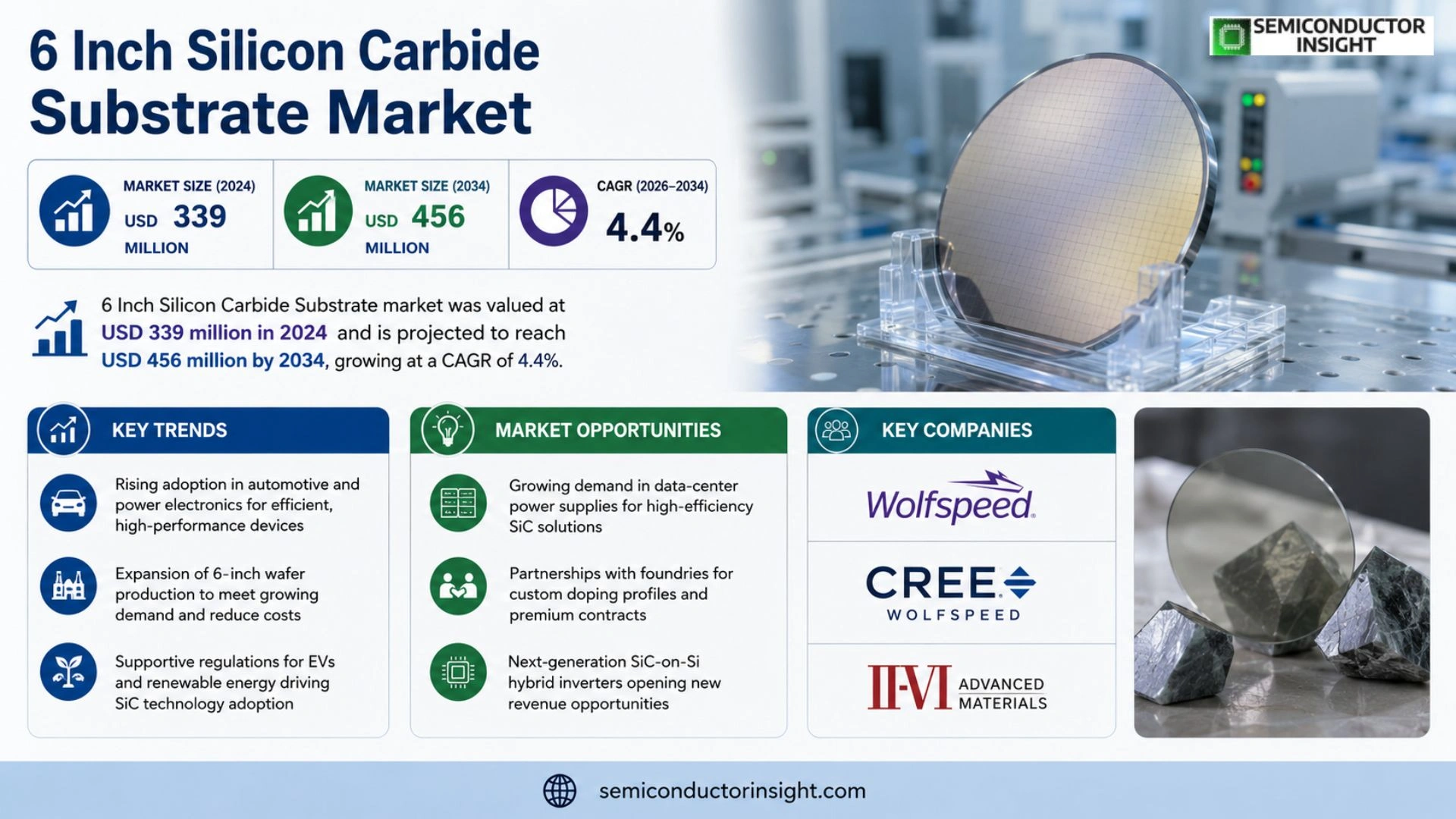
Global 6 Inch Silicon Carbide Substrate market was valued at USD 339 million in 2024 and is set to reach USD 456 million by 2034, reflecting a CAGR of 4.4% over the forecast period.
Silicon carbide substrates (wafers) are single‑crystal wafers produced through cutting, grinding, polishing and cleaning of SiC crystals. As a semiconductor substrate, they enable power devices and microwave RF components after epitaxial growth and device fabrication.
The market gains momentum because automotive electrification drives demand for high‑efficiency power modules, while telecom expansion fuels RF device needs. Recent capacity expansions by manufacturers such as Cree (Wolfspeed) and II‑VI Advanced Materials further support supply, and cost reductions in crystal growth technology broaden adoption across emerging applications.
MARKET DRIVERS
Rising Power‑Density Demands in Power Electronics
The surge in electric‑vehicle adoption and renewable‑energy integration has forced system designers to squeeze more performance out of each watt. 6 Inch Silicon Carbide Substrate Market participants are benefitting because SiC substrates enable converters that run cooler, switch faster, and occupy less board space. Manufacturers that can deliver consistent 150‑200 µm thicknesses are seeing orders climb by double‑digit percentages year‑over‑year.
Cost‑Efficiency Gains through Scaling
Recent investments in larger epitaxial reactors have trimmed per‑wafer cost by roughly 12 % while preserving defect densities below 5 cm⁻². This economies‑of‑scale effect is encouraging tier‑1 OEMs to qualify 6‑inch SiC substrates for next‑generation inverters, creating a virtuous loop of volume‑driven price compression and market share expansion.
➤ “The transition from 4‑inch to 6‑inch platforms is no longer a strategic option; it is a competitive necessity for players seeking to stay ahead in high‑power applications.”
Combined, these forces are reshaping sourcing strategies. Companies that align their supply chains with the emerging 6‑inch footprint can capture margin upside, while those clinging to legacy formats risk obsolescence as OEM specifications tighten.
MARKET CHALLENGES
Supply‑Chain Fragility for High‑Purity SiC Wafers
Although capacity has risen, the pool of certified silicon carbide boules remains limited. A single plant outage can shave 8‑10 % off global output, prompting buyers to hold safety stock and negotiate longer lead times. This volatility complicates forecasting for downstream assemblers.
Other Challenges
Yield Management
Maintaining yields above 85 % on 6‑inch substrates requires meticulous defect monitoring and tight thermal budgets. Any lapse translates directly into higher scrap rates, eroding the cost advantage gained from scaling.
MARKET RESTRAINTS
Regulatory and Environmental Hurdles
Stringent emission standards for carbide‑furnace operations have forced several producers to retrofit scrubbers, inflating capital expenditures by up to 15 %. In regions with aggressive environmental enforcement, the lag in compliance can delay plant expansions, tempering the pace at which new capacity enters the market.
Furthermore, trade tariffs affecting raw silicon imports create cost uncertainty for manufacturers that rely on imported feedstock. Companies must either diversify supplier bases or absorb higher input prices, both of which can suppress short‑term pricing power.
MARKET OPPORTUNITIES
Emerging Applications in Data‑Center Power Supplies
Data centers are beginning to replace traditional silicon‑based converters with SiC solutions to achieve higher efficiency at tighter thermal envelopes. The projected demand for 6‑inch substrates in this niche could grow at a modest 6 % annual rate, opening a revenue stream that complements automotive and renewable segments.
Partnerships with Foundries for Custom Doping Profiles
Foundries that co‑develop tailored doping gradients can differentiate their product lines, offering substrates optimized for high‑frequency switching. Early adopters stand to secure premium contracts, especially as OEMs seek to push voltage ratings beyond 1.2 kV.
Finally, the rollout of next‑generation inverter architectures,such as silicon‑carbide‑on‑silicon (SiC‑on‑Si) hybrids,requires a reliable supply of 6‑inch substrates. Companies that position themselves as preferred vendors for these hybrid designs will capture a strategic foothold as the industry shifts toward more complex power‑management topologies.
6 Inch Silicon Carbide Substrate Market Trends
Increasing Adoption in Power‑Electronics Applications
6 Inch Silicon Carbide Substrate Market has moved beyond niche uses as automotive power converters and data‑center inverters demand robust, high‑temperature devices. The material’s superior breakdown voltage and low on‑resistance allow designers to shrink heat‑sink footprints while cutting total system cost. Manufacturers have enlarged 6‑inch wafer lines to leverage volume discounts, and the resulting price compression is prompting engineering teams to replace silicon with SiC in new designs. Regulatory efficiency standards for electric vehicles and renewable‑energy installations further tighten the need for energy‑dense converters. By 2031 the market is set to climb from $339 million in 2024 to roughly $456 million, reflecting steady adoption across the power‑electronics value chain.
Other Trends
Shift Toward Higher Conductivity Grades
Customers are requesting wafers with elevated conductivity to support epitaxial layers used in high‑frequency RF modules and advanced power devices. This demand originates from telecom operators seeking compact RF amplifiers that can operate at higher power densities without thermal runaway. Suppliers responding to the trend have invested in crystal‑growth techniques that improve uniformity across the 6‑inch surface, thereby reducing defect density and boosting yield. The ripple effect is evident in pricing tiers: premium conductivity substrates command a modest premium, yet the overall margin improves because higher‑grade material enables manufacturers to sell fewer wafers per device, lowering assembly costs downstream.
Geographic Diversification and Supply‑Chain Resilience
Regional analysis shows North America maintaining a strong foothold due to legacy equipment manufacturers, while Asian producers accelerate capacity expansions to satisfy local automotive OEMs. The diversification reduces reliance on a single hub and mitigates risk from geopolitical disruptions. Companies are also establishing secondary polishing sites in Europe to ensure uninterrupted delivery to the RF market, which has tight lead‑time expectations. This strategic spread not only safeguards revenue streams but also creates bargaining power for buyers who can source from multiple corridors, encouraging competitive pricing and continuous innovation across the supply chain.
COMPETITIVE LANDSCAPE
Key Industry Players
Competitive Overview of 6‑Inch Silicon Carbide Substrate Market
Cree’s Wolfspeed division remains the anchor of the 6‑inch SiC substrate segment, leveraging its vertically integrated crystal‑growth facilities in the United States to secure a stable supply of high‑quality wafers for power‑device manufacturers. Recent capital expenditures have expanded its 6‑inch line capacity, enabling the company to meet the escalating demand from automotive‑power and renewable‑energy sectors while preserving premium pricing power. Wolfspeed’s strategic focus on advancing epitaxial processes and its strong intellectual‑property portfolio have reinforced its position as the de‑facto benchmark for performance and reliability, compelling downstream OEMs to align product roadmaps with Wolfspeed’s technology cadence.
Beyond the market leader, a cohort of specialized firms is reshaping the competitive map. II‑VI Advanced Materials has differentiated itself through a diversified product mix that includes semi‑insulated substrates, while ROHM leverages its deep semiconductor expertise to capture a slice of the RF‑device niche. Japanese players such as Showa Denko and South‑Korean SK Siltron contribute regional depth, often partnering with domestic chipmakers to accelerate time‑to‑market. Smaller but agile entrants,including Norstel, SICC Materials, TankeBlue Semiconductor, Synlight, CENGOL, and Mitsubishi Electric,focus on niche process optimizations or cost‑effective production, thereby widening the overall supplier base and creating incremental pricing pressures across the value chain.
List of Key 6 Inch Silicon Carbide Substrate Companies Profiled
- Cree (Wolfspeed)
- Wolfspeed
- II‑VI Advanced Materials
- II‑VI Advanced Materials
- ROHM
- Norstel
- SICC Materials
- Showa Denko
- TankeBlue Semiconductor
- SK Siltron
- Synlight
- CENGOL
- Mitsubishi Electric
Segment Analysis:
| Segment Category | Sub-Segments | Key Insights |
| By Type |
|
Conductivity
|
| By Application |
|
Power Device
|
| By End User |
|
Automotive
|
| By Process Technology |
|
Epitaxial Growth
|
| By Market Trend |
|
High‑Efficiency Devices
|
Regional Analysis: 6 Inch Silicon Carbide Substrate Market
Asia‑Pacific
Rising adoption of electric vehicles and renewable‑energy converters is compelling OEMs to seek silicon carbide substrates that can sustain higher voltage and temperature thresholds. Local policy frameworks that subsidize green‑technology deployments further amplify demand across the region’s industrial base.
The proximity of wafer‑fab plants to raw‑material sources in China diminishes logistical bottlenecks. However, geopolitical tensions occasionally prompt firms to diversify sourcing, prompting a modest but growing network of secondary suppliers in Southeast Asia.
Advanced epitaxial techniques such as chemical‑vapor deposition have achieved consistent thickness control at the six‑inch scale, enabling device designers to push efficiency limits in power converters and RF modules.
Regional standards bodies are tightening efficiency benchmarks for power electronics, indirectly mandating the transition to silicon carbide technologies. Compliance requirements are thus converting regulatory pressure into a market catalyst.
North America
North America remains a substantial consumer of six‑inch silicon carbide substrates, primarily because of its mature semiconductor design houses and a strong emphasis on high‑performance computing. End‑users in aerospace and defense sectors value the material’s ability to sustain extreme thermal cycles, prompting a steady stream of procurement. While domestic capacity is limited, strategic alliances with Asian fab operators allow American firms to secure supply without compromising design agility. The market is further buoyed by federal grants aimed at accelerating low‑carbon power solutions, which indirectly elevate substrate demand.
Europe
European manufacturers exhibit a cautious but progressive stance toward 6 Inch Silicon Carbide Substrate Market. The continent’s focus on automotive safety and efficiency standards drives interest in silicon carbide for traction‑inverter applications. However, fragmented production capabilities mean many OEMs rely on imports, fostering a cross‑border trade dynamic. Ongoing EU initiatives that fund clean‑energy research create a pipeline of innovation, encouraging local players to experiment with substrate‑integrated designs. This blend of regulatory impetus and collaborative procurement sustains a moderate growth trajectory.
South America
In South America, the market is nascent but gaining traction through renewable‑energy projects, especially solar‑farm installations that require robust power‑conversion hardware. Countries such as Brazil are beginning to import six‑inch substrates to support domestic inverter manufacturers, marking a shift from legacy silicon solutions. Limited local fabrication capacity forces reliance on external supply chains, which raises cost sensitivity but also opens opportunities for joint‑venture models that could bring partial upstream capability closer to end users.
Middle East & Africa
The Middle East & Africa region displays a divergent pattern; wealth‑driven data‑center expansions in the Gulf are prompting demand for high‑efficiency power modules, while African markets are still exploring basic electrification. Import‑centric procurement dominates, yet several Gulf states have announced sovereign‑wealth‑fund initiatives to develop localized semiconductor ecosystems. These policy signals suggest a future where substrate supply could gradually be internalized, especially if regional fab projects secure sufficient financing.
Report Scope
This market research report provides a comprehensive analysis of the 6 Inch Silicon Carbide Substrate Market , covering the forecast period 2026–2034. It offers detailed insights into market dynamics, technological advancements, competitive landscape, and key trends shaping the industry.
Key focus areas of the report include:
- Market Overview: The report begins with an overview outlining its current market scenario, key growth indicators, and industry transformation drivers. It discusses macroeconomic factors, demand–supply balance, regulatory landscape, and the strategic role of semiconductors in powering advancements across industries such as automotive, telecommunications, consumer electronics, and industrial automation.
- Market Size & Forecast: Historical data and future projections for revenue, unit shipments, and market value across major regions and segments.
- Segmentation Analysis: Detailed breakdown by product type, technology, application, and end-user industry to identify high-growth segments and investment opportunities.
- Regional Insights: Insights into market performance across North America, Europe, Asia-Pacific, Latin America, and the Middle East & Africa, including country-level analysis where relevant.
- Competitive Landscape: Profiles of leading market participants, including their product offerings, R&D focus, manufacturing capacity, pricing strategies, and recent developments such as mergers, acquisitions, and partnerships.
- Technology Trends & Innovation: Assessment of emerging technologies, integration of AI/IoT, semiconductor design trends, fabrication techniques, and evolving industry standards.
- Market Drivers & Restraints: Evaluation of factors driving market growth along with challenges, supply chain constraints, regulatory issues, and market-entry barriers.
- Stakeholder Insights: Insights for component suppliers, OEMs, system integrators, investors, and policymakers regarding the evolving ecosystem and strategic opportunities.
Primary and secondary research methods are employed, including interviews with industry experts, data from verified sources, and real-time market intelligence to ensure the accuracy and reliability of the insights presented.
FREQUENTLY ASKED QUESTIONS:
What is the current market size of 6 Inch Silicon Carbide Substrate Market?
-> 6 Inch Silicon Carbide Substrate market is set to reach USD 456 million by 2034, reflecting a CAGR of 4.4% over the forecast period.
Which key companies operate in 6 Inch Silicon Carbide Substrate Market?
-> Key players include Cree (Wolfspeed), II-VI Advanced Materials, ROHM, Norstel, SICC Materials, Showa Denko, TankeBlue Semiconductor, SK Siltron, Synlight, CENGOL, among others.
What are the key growth drivers?
-> Key growth drivers include rising demand for power devices and RF devices, rapid expansion of electric‑vehicle and renewable‑energy sectors, and the need for high‑efficiency semiconductor components.
Which region dominates the market?
-> Asia dominates the market, driven by strong semiconductor manufacturing bases in China, Japan, and South Korea, while North America and Europe also show significant adoption.
What are the emerging trends?
-> Emerging trends include development of high‑conductivity and semi‑insulated wafers, integration of silicon carbide substrates in AI‑enabled power electronics, and increased focus on sustainable manufacturing processes.
Get Sample Report PDF for Exclusive Insights
Report Sample Includes
- Table of Contents
- List of Tables & Figures
- Charts, Research Methodology, and more...
 Download Sample Report PDF