5G Modem-RF Transceiver (mmWave, Sub-6) Market Insights
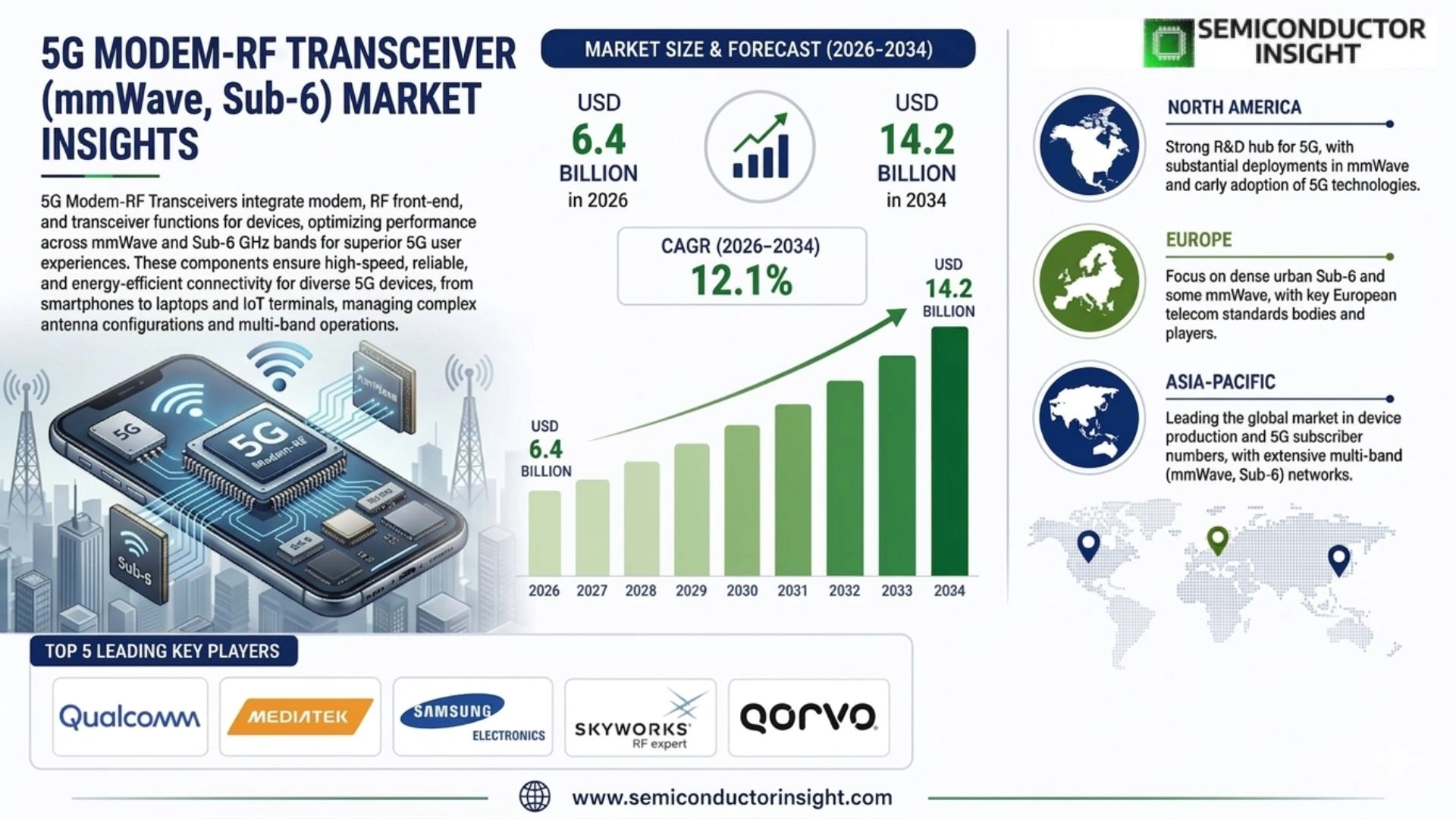
5G Modem-RF Transceiver (mmWave, Sub-6) Market size was valued at USD 5.8 billion in 2025. The market is projected to grow from USD 6.4 billion in 2026 to USD 14.2 billion by 2034, exhibiting a CAGR of 12.1% during the forecast period.
5G Modem-RF Transceivers are critical semiconductor components that integrate modem functionality with radio frequency transceivers to enable high-speed wireless communication across mmWave and Sub-6 GHz spectrum bands. These advanced systems handle signal modulation, demodulation, amplification, and conversion between digital baseband and analog RF signals, supporting the ultra-high data rates, low latency, and massive connectivity promised by 5G networks. They encompass technologies for both coverage-focused Sub-6 GHz bands and capacity-intensive mmWave frequencies, facilitating applications ranging from enhanced mobile broadband to fixed wireless access and industrial IoT.
The market is experiencing robust growth due to several factors, including the accelerated global deployment of 5G infrastructure, surging demand for high-performance smartphones and connected devices, and the expansion of data-intensive applications such as augmented reality, autonomous vehicles, and smart cities. Furthermore, advancements in integrated modem-RF designs are improving power efficiency and thermal performance, which is essential for widespread adoption in consumer electronics. Initiatives by key players in the market are also expected to fuel the market growth. For instance, Qualcomm has continued to advance its Snapdragon X series modem-RF systems with enhanced mmWave and Sub-6 support for superior connectivity. MediaTek, Qualcomm, Samsung Electronics, and Broadcom are some of the key players that operate in the market with a wide range of portfolios.
MARKET DRIVERS
Global 5G Network Rollout and Spectrum Allocation
5G Modem-RF Transceiver (mmWave, Sub-6) Market is experiencing robust growth driven by the accelerated global deployment of 5G infrastructure. Operators worldwide are expanding both Sub-6 GHz networks for broad coverage and mmWave deployments for high-capacity urban and enterprise applications. This dual-spectrum approach requires advanced modem-RF transceiver solutions capable of supporting simultaneous operation and aggregation across frequency bands.
Rising Demand for High-Speed Data and Low-Latency Applications
Explosive growth in data-intensive applications such as 4K/8K video streaming, augmented and virtual reality, and industrial IoT is fueling demand for high-performance 5G Modem-RF Transceiver technologies. mmWave bands deliver multi-gigabit speeds essential for fixed wireless access and dense urban environments, while Sub-6 GHz provides the balanced coverage and capacity needed for widespread adoption. Integration of AI-powered beamforming and efficient power management in transceiver designs further enhances performance.
➤ The antennas and transceivers segment continues to hold significant market share in mmWave solutions, reflecting their critical role in enabling beam management and high-frequency performance.
Additionally, the proliferation of 5G-enabled smartphones, CPE devices, and automotive applications is accelerating the need for compact, power-efficient modem-RF transceiver modules that support both mmWave and Sub-6 frequencies seamlessly.
MARKET CHALLENGES
Signal Propagation and Coverage Limitations
mmWave frequencies in 5G Modem-RF Transceiver systems face inherent propagation challenges, including high path loss and poor penetration through obstacles. This necessitates dense small cell deployments and advanced beamforming techniques, increasing overall network complexity and costs for operators transitioning to full 5G capabilities.
Other Challenges
Integration Complexity
Combining mmWave and Sub-6 GHz capabilities within compact modem-RF transceiver modules presents significant engineering hurdles related to thermal management, signal integrity, and multi-band coexistence.
High Development Costs
Designing and manufacturing advanced RF transceivers for millimeter-wave frequencies involves substantial R&D investment and specialized semiconductor processes, creating barriers for smaller players in the 5G Modem-RF Transceiver (mmWave, Sub-6) ecosystem.
MARKET RESTRAINTS
Deployment Costs and Infrastructure Requirements
High costs associated with mmWave infrastructure deployment continue to restrain faster market expansion for 5G Modem-RF Transceiver (mmWave, Sub-6) solutions. The need for dense networks of small cells and sophisticated antenna arrays significantly elevates capital expenditure compared to traditional Sub-6 GHz macro deployments.
Technical and Supply Chain Complexities
Advanced semiconductor processes required for high-frequency transceivers, combined with ongoing supply chain vulnerabilities for specialized components, limit scalability. Challenges in power efficiency and thermal management for mmWave operations further constrain widespread adoption in power-sensitive devices.
MARKET OPPORTUNITIES
Enterprise and Industrial 5G Applications
Private 5G networks for smart factories, ports, and Industry 4.0 implementations present substantial growth avenues for 5G Modem-RF Transceiver (mmWave, Sub-6) technologies. These environments benefit from the ultra-high speeds and low latency of mmWave combined with the reliable coverage of Sub-6 GHz, driving demand for customized transceiver solutions.
Technological Advancements and Hybrid Deployments
Ongoing innovations in integrated SoC designs, improved beamforming algorithms, and cost reductions in RF front-end components are creating opportunities for broader market penetration. Hybrid Sub-6/mmWave aggregation capabilities in next-generation modems position the market for accelerated growth through 2030 and beyond.
Trends
Integration Advancements Driving 5G Performance
5G Modem-RF Transceiver (mmWave, Sub-6) Market continues to evolve as these critical semiconductor components integrate modem functionality with radio frequency transceivers to support high-speed wireless communication. These systems efficiently manage signal modulation, demodulation, amplification, and conversion between digital baseband and analog RF signals across both mmWave and Sub-6 GHz bands. This integration enables the ultra-high data rates, low latency, and massive connectivity that define modern 5G networks, powering applications from enhanced mobile broadband to fixed wireless access and industrial IoT.
Other Trends
Rising Demand for Connected Consumer Devices
Surging demand for high-performance smartphones and a wide array of connected devices is propelling the adoption of advanced 5G Modem-RF Transceivers. Manufacturers are prioritizing components that deliver superior connectivity while maintaining compatibility with both coverage-focused Sub-6 GHz bands and high-capacity mmWave frequencies. This trend reflects the growing consumer expectation for seamless experiences in data-intensive use cases.
Expansion into Data-Intensive Applications
The proliferation of applications such as augmented reality, autonomous vehicles, and smart cities is creating sustained momentum for sophisticated transceiver solutions. These technologies require robust support for both mmWave and Sub-6 spectrum to handle complex connectivity demands, encouraging ongoing innovation in transceiver architectures that balance performance with practical deployment needs.
Focus on Power Efficiency and Thermal Management
Advancements in integrated modem-RF designs are significantly improving power efficiency and thermal performance, which are essential for broader adoption in consumer electronics and other battery-powered devices. Leading industry participants including Qualcomm with its Snapdragon X series, alongside MediaTek, Samsung Electronics, and Broadcom, continue to enhance their portfolios to address these technical challenges. Their efforts in developing next-generation solutions with better mmWave and Sub-6 support are strengthening overall market capabilities and facilitating more reliable 5G connectivity across diverse environments. Global 5G infrastructure deployment remains a key catalyst, as operators expand network coverage and capacity to meet escalating data requirements worldwide.
COMPETITIVE LANDSCAPE
Key Industry Players
5G Modem-RF Transceiver (mmWave, Sub-6) Market Competitive Analysis
Qualcomm maintains a dominant position in the 5G Modem-RF Transceiver market, leveraging its highly integrated Snapdragon X series modem-RF systems that deliver superior performance across both mmWave and Sub-6 GHz bands. The competitive landscape is characterized by a concentrated structure among a few semiconductor leaders capable of developing advanced integrated solutions that combine modem functionality with RF transceivers, power amplifiers, and antenna tuning technologies. These players drive innovation in power efficiency, thermal management, and multi-band support essential for 5G deployment in smartphones, infrastructure, and IoT devices.
Other significant players include MediaTek with its Dimensity platform, Samsung Electronics through its Exynos modem-RF solutions, and Broadcom offering complementary RF components. Additional niche contributors such as Huawei’s HiSilicon, Intel, and specialized RF firms like Qorvo and Skyworks Solutions enhance the ecosystem with targeted innovations in beamforming, front-end modules, and mmWave capabilities, fostering a dynamic environment of technological advancement and strategic partnerships.
List of Key 5G Modem-RF Transceiver Companies Profiled
- Qualcomm
- MediaTek
- Samsung Electronics
- Broadcom
- Huawei Technologies (HiSilicon)
- Intel Corporation
- Analog Devices
- Qorvo
- Skyworks Solutions
- NXP Semiconductors
- Texas Instruments
- UNISOC
- pSemi
- Infineon Technologies
- Keysight Technologies
Segment Analysis:
| Segment Category | Sub-Segments | Key Insights |
| By Type |
|
Sub-6 GHz Transceivers dominate due to their superior propagation characteristics enabling broader network coverage. They excel in balancing performance with practical deployment needs across diverse environments. These solutions support seamless integration into existing infrastructure while delivering reliable high-speed connectivity essential for everyday applications. |
| By Application |
|
Smartphones and Consumer Devices represent the primary application area as manufacturers prioritize ultra-fast data speeds and low latency for immersive experiences. Advanced features like augmented reality and high-definition video streaming drive continuous innovation in transceiver designs. These components enable superior battery efficiency and thermal management critical for portable devices. |
| By End User |
|
Consumer Electronics Manufacturers lead adoption by integrating cutting-edge connectivity solutions to differentiate their product offerings. They demand highly optimized modem-RF systems that support multiple frequency bands while maintaining compact designs. Collaboration with semiconductor leaders accelerates the development of next-generation features tailored for user-centric experiences. |
| By Integration Level |
|
Fully Integrated Modem-RF Systems gain preference for their compact footprint and enhanced power efficiency. They streamline design processes for device makers by reducing component count and simplifying supply chains. This approach also facilitates better thermal performance and overall system reliability in demanding 5G environments. |
| By Technology Focus |
|
Beamforming Capabilities emerge as a critical technology focus to maximize signal strength and coverage in challenging conditions. They enable dynamic adaptation to user movement and environmental factors for consistent performance. Integration of intelligent algorithms further enhances spectrum utilization and interference mitigation across both mmWave and Sub-6 deployments. |
Regional Analysis: 5G Modem-RF Transceiver (mmWave, Sub-6) Market
Asia-Pacific
Asia-Pacific excels in pioneering hybrid mmWave and Sub-6 transceiver architectures that balance speed with coverage. Regional R&D centers focus on advanced packaging techniques and AI-driven signal optimization, resulting in solutions that excel in high-density deployments while maintaining energy efficiency critical for widespread 5G Modem-RF Transceiver (mmWave, Sub-6) adoption.
Proactive policies supporting spectrum allocation and infrastructure investment create fertile ground for market expansion. Governments prioritize 5G as a cornerstone of economic transformation, encouraging local innovation in Modem-RF systems that support industrial IoT and digital economy initiatives across the region.
Close partnerships between device makers, network operators, and component suppliers streamline the commercialization of next-generation transceivers. This collaborative model accelerates testing and validation of mmWave capabilities, ensuring solutions meet diverse regional requirements from megacities to rural broadband extensions.
Emerging applications in autonomous vehicles, smart manufacturing, and immersive media continue to fuel demand for high-performance 5G Modem-RF Transceiver (mmWave, Sub-6) solutions. The region’s focus on sustainable technology development emphasizes power optimization and material innovation for long-term market leadership.
North America
North America demonstrates strong momentum in 5G Modem-RF Transceiver (mmWave, Sub-6) Market through cutting-edge research and enterprise-focused deployments. The emphasis lies on enterprise applications and private networks where mmWave delivers exceptional throughput for industrial settings, while Sub-6 ensures reliable wide-area coverage. Innovation centers prioritize advanced features like enhanced MIMO and dynamic spectrum sharing, supporting seamless integration with existing infrastructure. Regulatory frameworks encourage investment in spectrum efficiency, enabling operators to optimize transceiver performance for urban and suburban environments. The region’s robust tech ecosystem fosters competition that drives continuous improvements in thermal efficiency and form factor reduction, making solutions suitable for diverse use cases from connected vehicles to fixed wireless access.
Europe
Europe maintains a balanced approach in 5G Modem-RF Transceiver (mmWave, Sub-6) Market with focus on regulatory compliance, sustainability, and cross-border harmonization. Emphasis on green technology influences transceiver designs that prioritize energy efficiency and reduced environmental impact. Collaborative projects between member states advance standardization efforts, ensuring interoperability across mmWave and Sub-6 implementations. The market benefits from strong demand in automotive and healthcare sectors, where reliable low-latency connections are paramount. Strategic investments target rural connectivity alongside smart city initiatives, creating opportunities for versatile transceiver solutions that adapt to varied geographical and demographic needs while upholding stringent performance and security standards.
South America
South America is experiencing gradual advancement in 5G Modem-RF Transceiver (mmWave, Sub-6) Market, primarily through urban center deployments and government-led digital inclusion programs. Challenges related to infrastructure and geography direct focus toward Sub-6 solutions for broader coverage, with selective mmWave applications in high-density areas. Emerging partnerships with global technology providers help local operators incorporate modern transceiver technologies that enhance network reliability. Growing interest in digital economy transformation supports demand for solutions enabling e-commerce, remote education, and basic industrial connectivity. The region shows potential for accelerated growth as cost-effective implementations become available and spectrum policies evolve to support wider 5G Modem-RF Transceiver adoption.
Middle East & Africa
Middle East & Africa presents a diverse landscape for 5G Modem-RF Transceiver (mmWave, Sub-6) Market, with Gulf nations leading through ambitious smart city and digital transformation visions. Strategic investments target high-performance mmWave deployments in commercial hubs, complemented by Sub-6 for expansive coverage across challenging terrains. African markets focus on leapfrogging connectivity gaps using efficient transceiver solutions for mobile broadband expansion. The emphasis remains on creating resilient networks capable of supporting emerging digital services while addressing power constraints and environmental factors. Cross-regional collaborations facilitate knowledge transfer and technology localization, positioning the area for steady, sustainable integration of advanced 5G Modem-RF capabilities.
Report Scope
This market research report provides a comprehensive analysis of the 5G Modem-RF Transceiver (mmWave, Sub-6) Market , covering the forecast period 2026–2034. It offers detailed insights into market dynamics, technological advancements, competitive landscape, and key trends shaping the industry.
Key focus areas of the report include:
- Market Overview: The report begins with an overview outlining its current market scenario, key growth indicators, and industry transformation drivers. It discusses macroeconomic factors, demand–supply balance, regulatory landscape, and the strategic role of semiconductors in powering advancements across industries such as automotive, telecommunications, consumer electronics, and industrial automation.
- Market Size & Forecast: Historical data and future projections for revenue, unit shipments, and market value across major regions and segments.
- Segmentation Analysis: Detailed breakdown by product type, technology, application, and end-user industry to identify high-growth segments and investment opportunities.
- Regional Insights: Insights into market performance across North America, Europe, Asia-Pacific, Latin America, and the Middle East & Africa, including country-level analysis where relevant.
- Competitive Landscape: Profiles of leading market participants, including their product offerings, R&D focus, manufacturing capacity, pricing strategies, and recent developments such as mergers, acquisitions, and partnerships.
- Technology Trends & Innovation: Assessment of emerging technologies, integration of AI/IoT, semiconductor design trends, fabrication techniques, and evolving industry standards.
- Market Drivers & Restraints: Evaluation of factors driving market growth along with challenges, supply chain constraints, regulatory issues, and market-entry barriers.
- Stakeholder Insights: Insights for component suppliers, OEMs, system integrators, investors, and policymakers regarding the evolving ecosystem and strategic opportunities.
Primary and secondary research methods are employed, including interviews with industry experts, data from verified sources, and real-time market intelligence to ensure the accuracy and reliability of the insights presented.
FREQUENTLY ASKED QUESTIONS:
What is the current market size of 5G Modem-RF Transceiver (mmWave, Sub-6) Market?
-> 5G Modem-RF Transceiver (mmWave, Sub-6) Market was valued at USD 5.8 billion in 2025 and is expected to reach USD 14.2 billion by 2034.
Which key companies operate 5G Modem-RF Transceiver (mmWave, Sub-6) Market?
-> Key players include MediaTek, Qualcomm, Samsung Electronics, and Broadcom, among others.
What are the key growth drivers?
-> Key growth drivers include accelerated global deployment of 5G infrastructure, surging demand for high-performance smartphones and connected devices, and the expansion of data-intensive applications such as augmented reality, autonomous vehicles, and smart cities.
Which region dominates the market?
-> Asia-Pacific is the fastest-growing region with strong adoption in key markets.
What are the emerging trends?
-> Emerging trends include advancements in integrated modem-RF designs for better power efficiency, enhanced mmWave and Sub-6 support, and integration for AI/IoT applications.

Get Sample Report PDF for Exclusive Insights
Report Sample Includes
- Table of Contents
- List of Tables & Figures
- Charts, Research Methodology, and more...
 Download Sample Report PDF