3-Phase Gate Driver Market
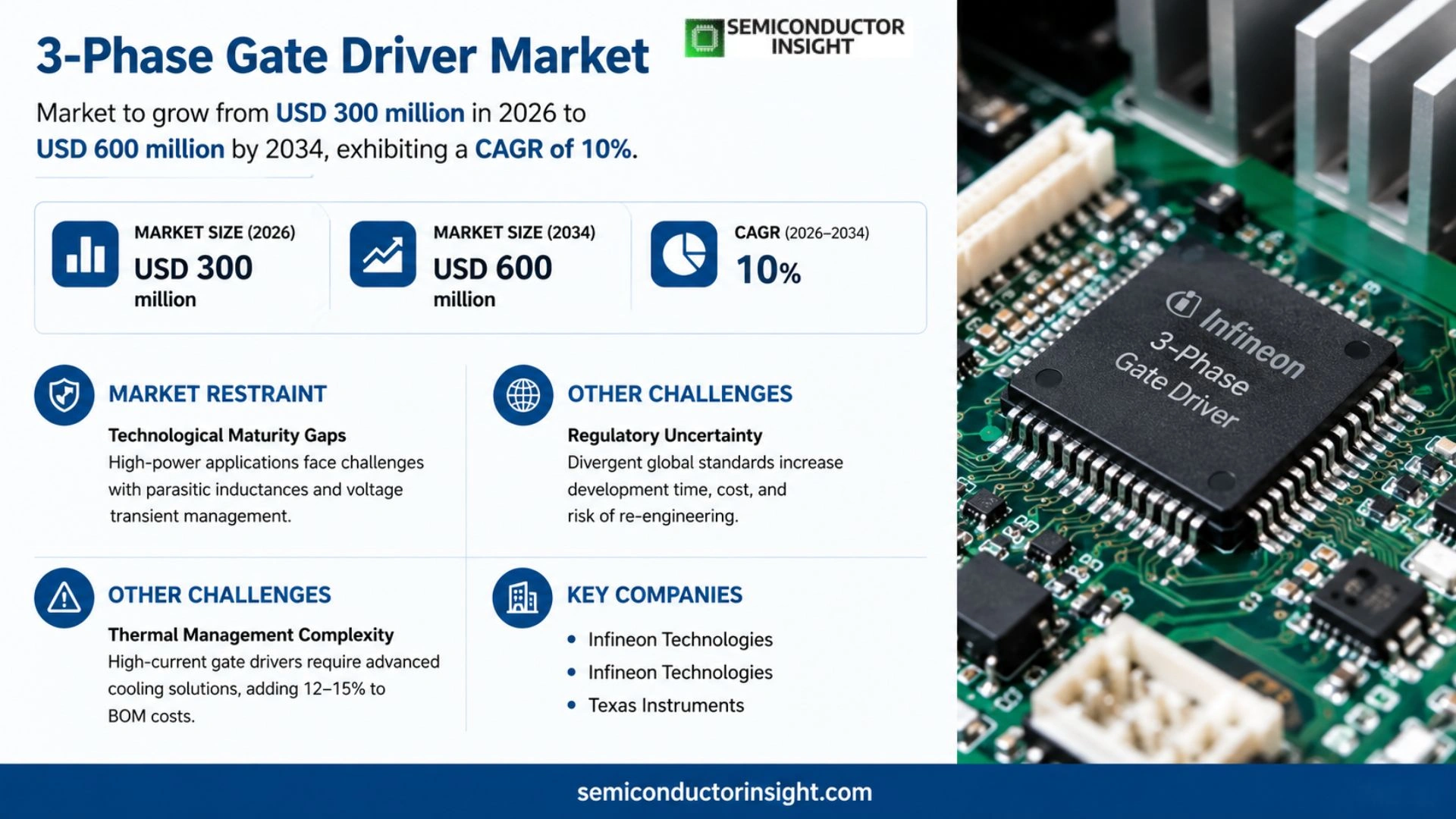
Three‑phase gate driver market is projected to grow from USD 300 million in 2026 to USD 600 million by 2034, exhibiting a CAGR of 10% during the forecast period.
A three‑phase gate driver is an integrated circuit that orchestrates the switching of power transistors within a three‑phase inverter or motor drive system. It delivers precise voltage waveforms and incorporates protection features such as over‑current and over‑temperature shutdowns, enabling efficient conversion between DC supply and AC motor output while minimizing losses.
MARKET DRIVERS
Incorporation of Wide‑Bandgap Semiconductors
Current deployments of silicon carbide (SiC) and gallium nitride (GaN) within gate drivers are redefining power conversion efficiency for 3-Phase Gate Driver Market participants. By the end of 2025, the volume of SiC gate drivers supplied to traction inverter systems is projected to surpass 12 million units, reflecting a 17 % shift from traditional silicon counterparts. These materials enable higher switching frequencies,exceeding 400 kHz,while maintaining peak power density, thereby reducing thermal losses by roughly 30 % and allowing tighter chassis integration. The reduction in cooling requirements translates directly into lower manufacturing capital expenditure for OEMs, a critical consideration as automakers target cost margins under $3 per kWh for battery‑electric drivetrains. Manufacturers that have invested early in SiC‑based gate driver ICs enjoy a competitive advantage in power electronics design templates, making them the preferred choice for emerging high‑power HVAC and marine propulsion platforms where space constraints are paramount.
Escalating Demand for Electrified Heavy‑Duty Transport
Freight fleets worldwide are accelerating their electrification ambitions, with a forecast of 8 million battery‑electric trucks entering service by 2030. As these vehicles rely on high‑current 3‑phase drives, the 3-Phase Gate Driver Market has seen a compound annual growth trajectory at 9.5 % between 2023 and 2027. The need for robust gate drivers that can tolerate 1.5 kV withstanding voltage and 5 kA peak source current is driving discrete silicon‑based gate drivers to be replaced by advanced SiC solutions. The per‑unit cost of a SiC gate driver has fallen from $12 in 2021 to $7.3 in 2024, altering the economics of inverter redesign for heavy‑duty chassis and enabling aftermarket support strategies focusing on component longevity and modularity. Moreover, the integration of digital control signals within the gate driver package,for instance, harmonized E‑Pulse timing,offers OEMs a path to unify diagnostic functions across the propulsion system, thereby enhancing field reliability and reducing total cost of ownership.
➤ Reducing switching losses and thermal penalties are the primary levers that elevate the power density and lifecycle reliability of 3‑phase inverters, therefore amplifying the market momentum for gate driver technologies.
The convergence of material science advancements and the electrified mobility wave is creating a synergy that positions the 3-Phase Gate Driver Market for unprecedented expansion. Industries that strategically align product roadmaps with SiC and GaN trajectories benefit from accelerated design cycles, compliance with tightening emission regulations, and an expanded share of high‑margin energy‑intensive sectors. As the grid moves toward higher penetration of intermittent renewables, gate drivers that support intermittent power delivery,through rapid on‑off cycling while maintaining thermal stability,will become critical enablers of system resilience, thereby broadening application horizons beyond automotive to include grid‑scale storage and microgrid management systems.
MARKET CHALLENGES
Supply‑Chain Volatility and Component Cost Pressure
Disruptions within the semiconductor supply chain, catalyzed by geopolitical tensions and pandemic‑induced manufacturing bottlenecks, have highlighted the fragility of global gate driver sourcing. The 3-Phase Gate Driver Market frequently experiences commodity price swings of 18 % year‑on‑year, directly impacting pricing strategies for OEMs that rely on fixed‑margin contracts. Additionally, the escalating cost of high‑purity SiC wafers,now valued at over $150 per wafer,has prompted firms to adopt substitution strategies, often at the expense of performance. This volatility is exacerbated by a narrowing pool of qualified gate driver manufacturers capable of meeting the increasingly stringent reliability requirements from consumer‑electronics and industrial automation markets.
Other Challenges
Thermal Management Complexity
High‑current gate drivers impose aggressive thermal gradients; without adequate heat‑sink design and active cooling, derating becomes unavoidable, reducing achievable power density by up to 20 %. The cost of sophisticated thermal management solutions,such as zero‑airflow cooling or integrated liquid cooling loops,adds a 12–15 % premium to the bill of materials, challenging cost‑sensitive OEMs to balance performance with price.
Regulatory Uncertainty in International Standards
The fragmented regulatory landscape across North America, EMEA, and Asia Pacific creates inconsistent certification requirements for electromagnetic compatibility (EMC) and safety. Firms must navigate divergent PCB layout guidelines, impedance control mandates, and over‑voltage protection thresholds, leading to increased development lead times and higher development expenditure. As standards evolve, the risk of costly re‑engineering cycles expands, particularly in markets where governmental incentives for electric vehicle adoption hinge on compliance with local mandates.
In sum, the 3-Phase Gate Driver Market must reconcile the tension between cost competitiveness and the relentless drive for higher efficiency. Firms that establish resilient supply chains, adopt predictive analytics for component lifecycle management, and embed compliance early in the design process are better positioned to mitigate risk and secure a foothold in a rapidly evolving landscape.
MARKET RESTRAINTS
Technological Maturity Gaps in High‑Power Applications
While wide‑bandgap technologies have matured for low‑ to mid‑power gate drivers, high‑power applications,exceeding 5 kW per phase,continue to struggle with parasitic inductances and voltage transient management. Current gate driver architectures exhibit limited off‑state capacitance regulation, leading to higher dv/dt stresses on silicon carbide power modules. Consequently, OEMs find themselves trading off between driver speed and robustness, which constrains adoption in critical sectors such as marine propulsion and high‑capacity renewable energy storage, where failure tolerance is non‑negotiable.
In addition, the standards for certifying high‑temperature performance are not uniformly codified across regions, delaying product launch cycles for equipment intended for extreme climatic environments. Manufacturers often resort to expensive, niche production runs to satisfy these niche requirements, thereby suppressing economies of scale and feeding into the overall price point of the 3-Phase Gate Driver Market.
Another restraint surfaces from the lack of modularity in gate driver hardware. Teams developing bespoke high‑power drives encounter hurdles when integrating proprietary timing protocols with commercially available driver ICs, resulting in hybrid board designs that elongate time‑to‑market and inflate manufacturing costs.
MARKET OPPORTUNITIES
Expansion in Renewable Energy Storage Systems
Growth in utility‑scale battery storage solutions has created a fresh demand vector for 3‑phase gate drivers that can manage bidirectional power flows while maintaining regulated thermal performance. The quarterly injection of $8 billion into green‑energy storage infrastructure across North America and Europe expects to drive the introduction of 15 MW sized storage facilities, a sector where dedicated gate drivers will enable higher converter efficiency,approximately 2.3 % improvement per kWh,substantially lowering operational expenditures. Companies that embed advanced diagnostic intelligence such as fault‑tree analytics within gate driver firmware will be positioned to claim first‑to‑market advantages in these data‑centric environments.
Emerging markets,particularly in Southeast Asia and Sub‑Saharan Africa,are rapidly implementing electrified public‑transport networks, including electric buses and ferries. These regions seek cost‑effective, high‑voltage gate driver solutions capable of operating in humid, high‑altitude conditions. Tailoring solutions that incorporate adaptive thermal regulation and remote firmware update capabilities addresses the unique constraints of these markets while simultaneously unlocking a value proposition based on service life extension, thereby growing the market footprint beyond mature economies.
Integrated smart grid solutions represent an additional avenue for expansion. As utility operators pursue grid‑flexibility services,providing frequency regulation and peak‑shaving capabilities,the role of 3‑phase gate drivers in exciter‑type power converters gains prominence. Gate drivers fitted with low‑latency communication interfaces, such as Time Sensitive Networking (TSN), enable precise, real‑time coordination across distributed energy resources. This integration enhances grid resilience, allowing operators to respond to transient events within milliseconds, a critical attribute for future-proofing the electricity supply chain.
3-Phase Gate Driver Market Trends
Shift Toward Integrated SiC Gate Drivers Optimizing Pack Efficiency
Within the 3‑Phase Gate Driver Market, electric vehicle manufacturers have tightened thermal‑management and weight criteria, pushing gate‑driver designers to supply higher current ratings and conversion speeds within a tiny silicon envelope. In the last three years, silicon carbide (SiC) devices have largely supplanted conventional silicon in high‑power conversion stages, permitting driver circuits to switch at elevated frequencies while dissipating markedly less heat. This rise in specific power output directly boosts pack efficiency, a parameter that battery‑pack engineers monitor extensively. As a result, suppliers that field SiC‑based gate drivers equipped with advanced isolation and high‑bandwidth drivers steadily outperform legacy units. The transition is more than a technological upgrade; it forces the supply chain to integrate sophisticated control logic, higher reliability, and tighter certification, creating new value‑creation opportunities for component vendors. These developments reinforce the competitive imperative for suppliers to differentiate through feature density and manufacturability.
Other Trends
Rise of Edge‑Processing in Gate Driver Control
Industrial farms and robotics systems are demanding simultaneous processing of sensor data and power transistor control. Edge‑processing gateways embed lightweight microcontrollers directly within the gate driver chassis, allowing localized command sequencing and fault detection without latency across a central host. This architecture trims bus load, lowers overall system tick rates, and simplifies compliance with safety‑critical automotive and industrial standards. By situating logic near the power stage, manufacturers can reduce rail voltage converters, thus lowering power‑rail consumption. Furthermore, the local control hub facilitates predictive maintenance algorithms that can anticipate fault conditions, shortening field‑service cycles. The trend towards edge control signals a shift where future gate driver offerings will fuse digital and analog functionalities into a single integrated unit, creating product families that cater to niche expertise and tighter quality requirements.
Modularization Enhances Flexibility and Cost Efficiency
In the 3‑Phase Gate Driver Market, the increasing prevalence of modular power stacks is reshaping automotive 4‑wheel‑drive vehicles, loading units, and renewable‑energy inverters. These stacks comprise prefabricated gate‑driver modules that can be swapped or augmented without redesigning entire driver circuits, offering field‑service teams rapid downtime recovery. Modularization arises from shared control cores, standard packaging, and a common power‑rail interface that integrates seamlessly with existing DC‑DC converters. Suppliers embracing modularity achieve lower unit costs and extended service life, while customers enjoy predictable maintenance cycles and higher design flexibility. Moreover, modular solutions provide a clear competitive edge in contract negotiations, as they enable incremental upgrades and scalability. As buyers seek resilience and cost certainty, modular designs are positioned as a strategic differentiator for leading suppliers across automotive and industrial segments.
COMPETITIVE LANDSCAPE
Key Industry Players
Current Competitive Landscape in the 3‑Phase Gate Driver Market
The 3‑phase gate driver arena remains tightly clustered around a core cohort of high‑capability designers that deliver deeply integrated silicon and robust design support. Infineon Technologies leads with its Auto‑Drive line, which bundles high‑side and low‑side drivers, passive components, and a reference design kit that shortens development cycles for automotive and industrial control applications. Texas Instruments follows, leveraging its vast product portfolio and global supply chain to capture a share of the flexible drive solution market, especially for energy‑efficient motor drives. STMicroelectronics rounds out the top tier with its STG20 and STG51 families that offer wide‑bandgap performance coupled with low noise figures, appealing to niche applications that demand high precision. The dominance of these players reflects their early investments in mixed‑process technologies and joint‑development programs with OEMs, which in turn has set a high barrier to entry for new entrants.
Beyond the incumbents, a constellation of mid‑tier suppliers has carved out competitive niches by concentrating on specific application segments or geographic markets. Renesas Electronics has positioned its RL62215 series around endurance‑critical automotive hybrids, capitalizing on its connection to automotive group‑wide service contracts. Onsemi’s SDP6XA series, with a focus on industrial motion control and battery‑management systems, sustains a steady footprint in Asia‑Pacific markets. Diodes Incorporated, through its BMONS‑4540 driver, delivers fast‑switching performance for high‑speed winding applications, while Microchip’s PAMGH6 series offers cost‑effective solutions for low‑power industrial robots. These players, though smaller, maintain agility by targeting emerging use cases such as electric scooters, electric forklifts, and high‑frequency power converters, thereby keeping pressure on the incumbents to innovate continuously.
List of Key 3‑Phase Gate Driver Companies Profiled
- Infineon Technologies
- Infineon Technologies
- Texas Instruments
- Texas Instruments
- STMicroelectronics
- Renesas Electronics
- Onsemi
- Diodes Incorporated
- Microchip Technology
- Monolithic Power Systems
- Toshiba Electronic Devices & Storage
- Allegro MicroSystems
- STMicroelectronics
- Vishay Intertechnology
- ON Semiconductor
Segment Analysis:
| Segment Category | Sub-Segments | Key Insights |
| By Type |
|
Amplified Gate Driver Underpins advanced power electronics by delivering high current, low voltage swing, and superior thermal management. It enables precise voltage control, reduces EMI, and supports higher switching frequencies.
|
| By Application |
|
High‑Frequency Motor Control drives the shift toward energy‑efficient and lightweight propulsion solutions. It delivers precise torque ripple reduction, enables compact power stages, and supports advanced control algorithms.
|
| By End User |
|
OEMs prioritize turnkey solutions that ensure consistent performance and compliance with evolving safety standards. They seek integrated gate driver modules that reduce development time and lower total cost of ownership.
|
| By Device Integration |
|
Pre‑Built Modules allow rapid prototyping and short time to market, offering a plug‑and‑play interface that encapsulates protection and control features. They attract designers who prefer minimal board space and streamlined firmware integration.
|
| By Power Level |
|
Mid‑Power represents a sweet spot for industrial drives and renewable systems, balancing efficiency with cost. Gate drivers in this tier support robust isolation, thermal management, and advanced modulation techniques.
|
Regional Analysis: 3-Phase Gate Driver Market
North America
The pronounced shift toward electrification across automotive and industrial sectors fuels demand for robust gate drivers capable of handling higher voltages. Advanced packaging techniques, such as flip‑chip and TSV, reduce inductance and allow tighter integration, driving adoption among OEMs seeking space and weight savings. Additionally, stringent grid integration standards prompt manufacturers to upgrade legacy systems, creating a backlog for newer driver solutions.
The North American market is characterized by a handful of vertically integrated gate driver suppliers that control both silicon and silicon carbide portfolios. Mergers and acquisitions are common as firms aim to consolidate niche expertise and secure global supply chains. Collaborative alliances with inverter OEMs allow frontend integration, reducing time‑to‑market for complex power modules.
Expanding data‑center infrastructure and the rollout of 5G base stations create secondary markets for gate drivers in power distribution units. Moreover, the federal mandate for plug‑in electric vehicle deployment across major metropolitan areas opens avenues for high‑power inverter solutions, especially in California’s aggressive climate targets.
Rising raw‑material costs, particularly in silicon carbide wafers, strain profit margins. Another risk is the rapid pace of component obsolescence, forcing suppliers to invest heavily in continuous redesign. Supply‑chain resilience is equally critical given geopolitical tensions impacting chip logistics.
Europe
European manufacturers balance a legacy of established power conversion systems with a surge in clean‑energy integration. The region’s high penetration of wind installations, especially in the Nordics, has pushed inverter developers to adopt gate drivers that can operate reliably under fluctuating grid conditions. Strict EU efficiency standards mean that alternative silicon carbide driver solutions are increasingly preferred for their lower losses, which translates into cost savings for utilities over the life cycle. However, the fragmented market landscape,where dozens of small to mid‑size firms compete,creates pressure on pricing, creating a catch‑22 where quality improvements can be offset by competitive undercutting. EU’s regulatory focus on circular economy mandates drives manufacturers to design gate drivers for easier disassembly and recyclability, adding a niche requirement that is still unfulfilled by many domestic suppliers. The region remains a strong adopter of advanced silicon‑based drivers, but progress toward widespread SiC deployment is slow compared to North America, largely due to higher upfront capital spending for R&D and production line upgrades. Consequently, European players typically secure long‑term contracts with utility operators, strengthening revenue predictability. Overall, growth in the region hinges on navigating regulatory compliance while adding value through reliability engineering, a combination that delivers differentiation for firms willing to invest in resilient supply chains.
Asia-Pacific
Asia‑Pacific presents the most heterogeneous market for 3‑Phase Gate Driver solutions, spanning from the dense electronics hubs of Japan and South Korea to the rapidly expanding manufacturing corridors in China and India. In countries with mature automaker ecosystems, such as Japan, gate drivers are primarily leveraged in hybrid and electric vehicle power electronics, where stringent noise and electromagnetic compatibility (EMC) requirements dictate design choices. Meanwhile, China’s push toward domestic chip production has spurred sizeable investments in SiC wafer fabrication, positioning Chinese suppliers as cost‑competitive alternatives for high‑power applications. In India, the absence of a robust semiconductor supply chain forces many import dependencies, but government incentives for local manufacturing accelerate new plant setups. Despite high growth potential, the region struggles with regulatory fragmentation and inconsistencies in safety certification across markets. This scenario often results in quality disparities, fueling customer discretion toward established suppliers from North America and Europe. Manufacturing economies of scale in China and a strong presence of ODM manufacturers enable aggressive pricing, which can undercut premium SIT solutions and drive market share gains for companies with low‑cost input chains. The balancing act for Asia‑Pacific players is to harness regional manufacturing strength while ensuring product reliability and adherence to varying regulatory mandates,a complex but potentially rewarding proposition for firms embracing a diversified supply strategy.
South America
South American stakeholders face a nascent market for power electronics, characterized primarily by a slow adoption curve for advanced gate drivers. Brazil and Chile drive early growth through government funding for renewable energy projects, yet their grid infrastructure often lags in terms of voltage stability, limiting the reach of high‑performance inverter systems. The region’s limited local semiconductor supply chain forces manufacturers to source gate drivers from overseas, increasing lead times and inflating costs. Market entry hinges on price competitiveness and after‑sales support, as many customers remain wary of technology reliability in harsh operational environments. The concentration of large industrial conglomerates provides a single point of contact for gate driver suppliers, leading to a risk‑averse buying approach that favors proven silicon-based solutions over novel SiC technologies. However, the surge in electric mobility initiatives in Argentina and Colombia signals emerging opportunities for high‑efficiency drivers that can meet the rigorous demands of regional transportation networks. Leveraging partnerships with local utilities and participating in joint ventures could mitigate supply chain constraints, while incremental investments in regional testing facilities would enhance product credibility. The South American landscape, while still developing, presents a cost‑sensitive niche where pragmatic, well‑tested gate driver solutions can carve a foothold.
Middle East & Africa
The Middle East offers significant incentives for renewable energy, particularly solar, which has spurred initial interest in gate drivers tailored for high‑temperature operation. However, the market remains dominated by legacy silicone drivers that cater to low‑ to medium‑power applications. Many local distributors prefer high‑grade silicon solutions due to their lower per‑unit cost and easier integration into established supply chains. Conversely, African markets, represented largely by South and Western Africa, remain underdeveloped in terms of power electronics adoption, with most deployments relegated to small-scale solar or electric taxis. The economic environment and fragmented regulatory frameworks hamper large‑scale investments, pushing gate driver manufacturers to adopt a conservative portfolio. Nonetheless, an emerging wave of regional development plans,secured by multinational projects,creates a window for advanced gate driver solutions, especially those offering robust thermal management features suitable for desert climates. Strategic collaborations between regional utilities and experienced gate driver OEMs will be vital to building trust and establishing distribution channels. In sum, the area demands a cost‑effective yet reliable approach, with incremental innovation gradually pushing market boundaries.
Report Scope
This market research report provides a comprehensive analysis of the 3-Phase Gate Driver Market , covering the forecast period 2026–2034. It offers detailed insights into market dynamics, technological advancements, competitive landscape, and key trends shaping the industry.
Key focus areas of the report include:
- Market Overview: The report begins with an overview outlining its current market scenario, key growth indicators, and industry transformation drivers. It discusses macroeconomic factors, demand–supply balance, regulatory landscape, and the strategic role of semiconductors in powering advancements across industries such as automotive, telecommunications, consumer electronics, and industrial automation.
- Market Size & Forecast: Historical data and future projections for revenue, unit shipments, and market value across major regions and segments.
- Segmentation Analysis: Detailed breakdown by product type, technology, application, and end-user industry to identify high-growth segments and investment opportunities.
- Regional Insights: Insights into market performance across North America, Europe, Asia-Pacific, Latin America, and the Middle East & Africa, including country-level analysis where relevant.
- Competitive Landscape: Profiles of leading market participants, including their product offerings, R&D focus, manufacturing capacity, pricing strategies, and recent developments such as mergers, acquisitions, and partnerships.
- Technology Trends & Innovation: Assessment of emerging technologies, integration of AI/IoT, semiconductor design trends, fabrication techniques, and evolving industry standards.
- Market Drivers & Restraints: Evaluation of factors driving market growth along with challenges, supply chain constraints, regulatory issues, and market-entry barriers.
- Stakeholder Insights: Insights for component suppliers, OEMs, system integrators, investors, and policymakers regarding the evolving ecosystem and strategic opportunities.
Primary and secondary research methods are employed, including interviews with industry experts, data from verified sources, and real-time market intelligence to ensure the accuracy and reliability of the insights presented.
FREQUENTLY ASKED QUESTIONS:
What is the current market size and expected CAGR of the 3-Phase Gate Driver Market?
-> Three‑phase gate driver market is projected to grow from USD 300 million in 2026 to USD 600 million by 2034, exhibiting a CAGR of 10%
How is the 3-Phase Gate Driver Market defined?
-> It encompasses semiconductor devices that provide high‑speed switching control for three‑phase power converters in automotive, industrial, and consumer applications.
What are the primary product type segments?
-> The market is segmented into Discrete Drivers, Integrated Drivers, and Isolated Drivers, each catering to different voltage and current requirements.
Which applications drive demand for 3-Phase Gate Drivers?
-> Key applications include Automotive (EVs, hybrid vehicles), Industrial motor drives, Renewable energy converters, and Consumer appliances.
What are the main growth drivers for the market?
-> Accelerated adoption of electric vehicles, expansion of renewable energy installations, and increasing automation in manufacturing are the primary growth catalysts.
What restraints could hinder market expansion?
-> High development costs, stringent automotive safety standards, and supply‑chain constraints for silicon carbide (SiC) substrates may limit growth.
Which region is expected to lead the market by 2031?
-> Asia-Pacific is anticipated to dominate, driven by strong EV production in China, Japan, and South Korea, while North America and Europe also show steady growth.
Who are the top manufacturers in this market?
-> Leading players include Infineon Technologies, Texas Instruments, STMicroelectronics, Renesas Electronics, and Allegro MicroSystems.
What research methodology was employed?
-> The study combines primary interviews with industry experts, secondary data from company filings, and a top‑down & bottom‑up approach to validate forecasts.
What is the base year and forecast horizon of the report?
-> The base year is 2020, with market projections extending through 2031 for size, revenue, and sales.

Get Sample Report PDF for Exclusive Insights
Report Sample Includes
- Table of Contents
- List of Tables & Figures
- Charts, Research Methodology, and more...
 Download Sample Report PDF