2L‑36L Rigid‑PCB Market Insights
2L‑36L Rigid‑PCB market size was valued at USD 32,270 million in 2024. The market will increase to USD 41,020 million by 2034, reflecting a CAGR of 3.6% over the period.
Rigid printed circuit boards ranging from two to thirty‑six layers serve as foundational substrates for high‑density electronic assemblies. Their solid epoxy or FR‑4 construction provides mechanical stability and reliable signal integrity across demanding applications such as telecommunications, automotive electronics, and medical devices.
The industry gains momentum because AI‑enabled devices, widespread rollout of 5G infrastructure, and growth of electric‑vehicle platforms raise demand for multilayer boards with finer trace widths. Companies such as Zhen Ding Tech, TTM Technologies, Unimicron and AT&S are expanding capacity through new fab lines and strategic acquisitions, while regional manufacturers in mainland China continue to dominate volume supply.
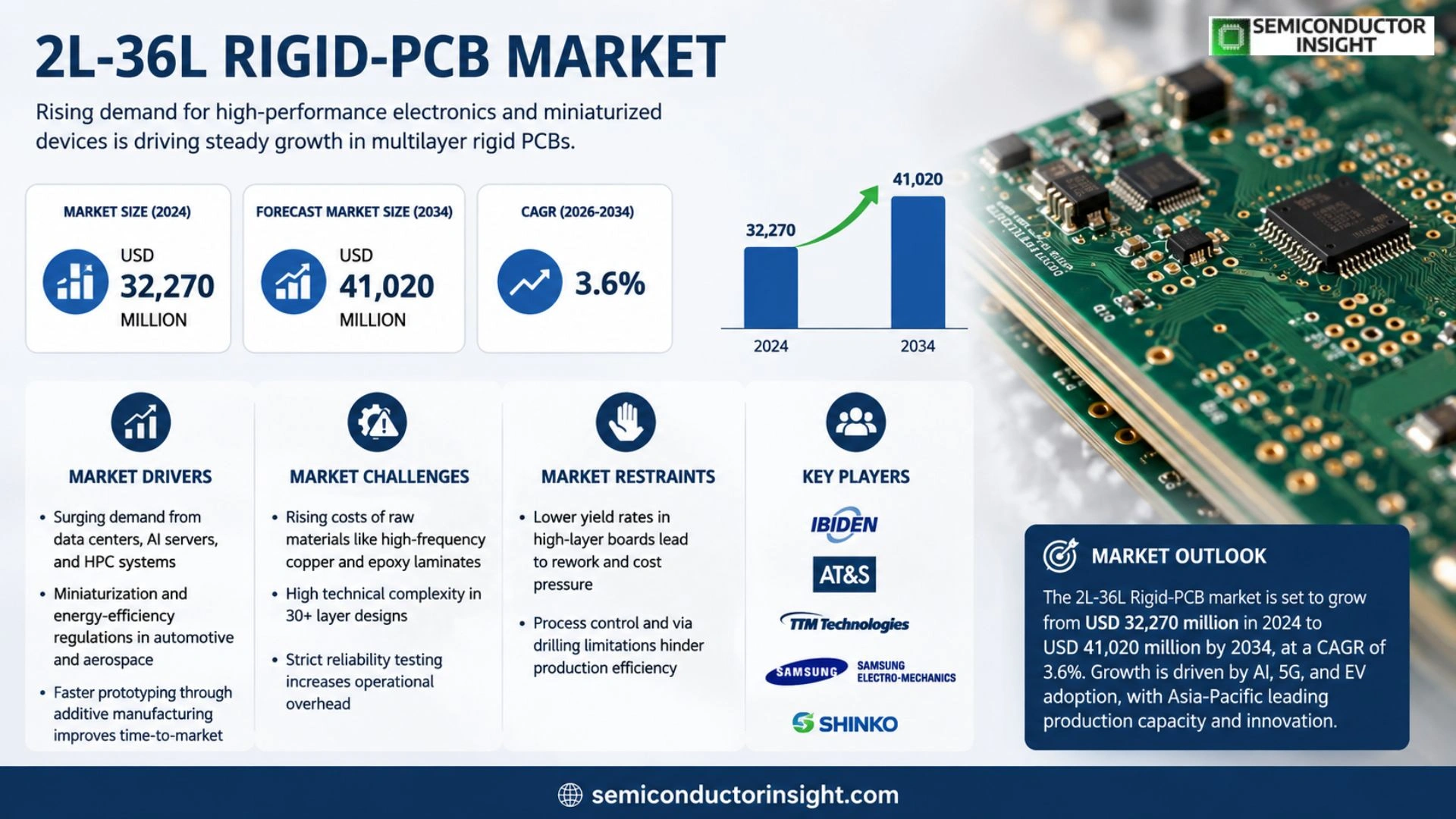
MARKET DRIVERS
Expanding Role in High‑Performance Computing
2L-36L Rigid-PCB Market is benefitting from the surge in demand for high‑density interconnects required by data‑center servers and AI accelerators. Manufacturers are favoring multilayer rigid boards because they enable tighter trace routing while preserving signal integrity, a prerequisite for next‑generation processing workloads.
Regulatory Incentives for Miniaturized Devices
Stringent energy‑efficiency standards in the automotive and aerospace sectors have forced designers to shrink component footprints. Multilayer rigid PCBs, ranging from 2 to 36 layers, deliver the requisite compactness without sacrificing reliability, prompting OEMs to revise bill‑of‑materials in favor of higher‑layer counts.
➤ Design engineers now cite multilayer rigidity as the primary enabler for meeting thermal constraints in compact modules.
Additionally, the rise of additive manufacturing techniques is lowering prototyping turnaround, allowing quicker iteration on complex stack‑up configurations. This agility translates into faster time‑to‑market for products that rely on sophisticated 2L-36L Rigid-PCB architectures.
MARKET CHALLENGES
Escalating Material Costs
Fiber‑reinforced epoxy laminates and high‑frequency copper foils have experienced price pressure due to supply bottlenecks. When material expenditures rise, margin compression becomes a tangible risk for contract manufacturers operating at scale.
Other Challenges
Technical Complexity
Designing stacks with 30+ layers demands advanced simulation tools and rigorous quality assurance, stretching engineering resources and extending development cycles.
Furthermore, the necessity for stringent reliability testing,especially in automotive safety‑critical applications,adds to the operational overhead, making it harder for new entrants to achieve cost competitiveness.
MARKET RESTRAINTS
Manufacturing Yield Sensitivity
Yield rates on boards exceeding 20 layers remain vulnerable to defects such as delamination and micro‑cracks. Each defect can necessitate costly rework, eroding the profitability of high‑layer products.
Process control constraints in thin‑film deposition and via drilling become more pronounced as layer count climbs, limiting the throughput of existing production lines without substantial capital infusion.
The steep learning curve associated with advanced stack‑up designs also deters smaller fabs from expanding their service offerings, concentrating market power among a handful of large players.
MARKET OPPORTUNITIES
Growth in Edge‑Computing Infrastructure
Edge devices demand rugged, high‑density PCBs to accommodate powerful processors within limited enclosures. 2L-36L Rigid-PCB Market can capture this niche by offering customized stack‑up solutions that balance thermal performance with mechanical robustness.
Emerging standards for 5G small‑cell deployments also create a tailwind for multilayer rigid boards, which provide the necessary frequency stability and reduced electromagnetic interference for dense antenna arrays.
Investments in autonomous vehicle platforms are opening avenues for boards with 24‑36 layers that integrate sensor fusion, power management, and communication modules on a single substrate, presenting a high‑margin opportunity for specialized manufacturers.
2L-36L Rigid-PCB Market Trends
Growth Fueled by Advanced Electronics
2L-36L Rigid-PCB Market recorded revenues of roughly 32,270 million USD in 2024 and is projected to climb to about 41,020 million USD by 2031, reflecting a modest compound annual increase of 3.6 %. This trajectory mirrors the broader expansion of the PCB industry, which generated an estimated 81 billion USD of output in 2022. The upward pressure originates from the escalating adoption of AI‑enabled devices, the rollout of 5G infrastructure, and the electrification of transportation fleets. Each of these technology waves demands higher‑performance interconnects, prompting designers to opt for multi‑layer rigid boards that can accommodate dense routing, signal integrity requirements, and thermal management challenges. As manufacturers adapt their process lines to produce four‑through‑ten‑layer stacks more efficiently, the value chain experiences tighter margins but also gains room for premium pricing on differentiated solutions.
Other Trends
Geographic Concentration in China
China’s mainland and Taiwan together host the majority of global 2L-36L Rigid-PCB capacity. Domestic firms benefit from vertically integrated material supply chains, aggressive cost structures, and near‑shore proximity to the world’s largest consumer‑electronics assemblers. This concentration enables Chinese producers to outpace competitors on volume, while simultaneously investing in high‑density lamination technologies that target automotive and industrial applications. For multinational players, the strategic implication is twofold: secure collaborative agreements with Chinese manufacturers to ensure access to low‑cost multilayer panels, and develop niche capabilities,such as high‑frequency substrate engineering,that are less prevalent in the region. The regional dominance also raises regulatory considerations, as trade policies and export controls could reshape sourcing decisions for OEMs operating across multiple continents.
Shift Toward Higher‑Layer Solutions
Customers are increasingly specifying board stacks beyond ten layers to meet the miniaturization targets of next‑generation products. The move toward 12‑layer, 20‑layer, and even more complex configurations reflects a need to integrate power distribution, high‑speed data paths, and embedded components within a single footprint. This trend elevates the importance of precision drilling, advanced dielectric materials, and tighter thickness tolerances,capabilities that differentiate the leading players from lower‑cost alternatives. Companies that have already invested in automated optical inspection (AOI) and laser direct imaging (LDI) stand to capture a larger share of the premium segment, as they can assure defect‑free yields at higher layer counts. Consequently, the market landscape is expected to bifurcate: volume‑driven producers will continue to dominate the 2‑10‑layer space, while a smaller cohort will command the high‑layer niche, shaping competitive dynamics for the remainder of the decade.
COMPETITIVE LANDSCAPE
Key Industry Players
Competitive Outlook for 2L‑36L Rigid‑PCB Market
2L‑36L Rigid‑PCB segment generated roughly US$32.3 billion in 2024 and is expected to climb to about US$41.0 billion by 2031, reflecting a modest 3.6 % annual increase. Growth is anchored by the proliferation of AI‑enabled devices, the rollout of 5G infrastructure, and the electrification of vehicles, all of which demand higher layer counts for signal integrity and miniaturisation. Production capacity remains geographically clustered: mainland China, Taiwan, Japan, South Korea, the United States and Europe dominate the supply chain, with Chinese manufacturers accounting for the largest market share. This concentration amplifies the impact of regional policy shifts and raw‑material cost fluctuations, compelling downstream users to scrutinise supplier resilience and pricing dynamics when shaping procurement strategies.
Competitive intensity is shaped by a handful of multinationals that collectively control a sizable portion of revenue. The top five firms,Zhen Ding Tech, TTM Technologies, Unimicron, Mektec and AT&S,exhibit diversified portfolios that span automotive, communication and consumer electronics, allowing them to leverage cross‑segment synergies. Mid‑tier players such as Compeq Manufacturing, Tripod and Kingboard are pursuing capacity expansions in high‑growth locales like Vietnam and Mexico to offset saturation in traditional Chinese hubs. Recent M&A activity, notably the acquisition of DSBJ’s high‑frequency line by a European consortium, signals a strategic tilt toward niche capabilities that command premium pricing. For customers, the evolving landscape underscores the importance of engaging suppliers with robust R&D pipelines and flexible manufacturing footprints to sustain product roadmaps.
List of Key Rigid‑PCB Companies Profiled
- Zhen Ding Technology
- TTM Technologies
- Unimicron
- Mektec
- DSBJ
- Compeq Manufacturing
- Tripod
- Shennan Circuits Company
- HannStar Board (GBM)
- SEMCO
- Kingboard
- Ibiden
- Wus
- Young Poong
- AT&S
- Meiko
Segment Analysis:
| Segment Category | Sub-Segments | Key Insights |
| By Type |
|
Advanced Multilayer Solutions drive strategic differentiation across the market.
|
| By Application |
|
Cross‑Sector Innovation fuels demand for robust multilayer boards.
|
| By End User |
|
Strategic Partnerships shape the competitive landscape.
|
| By Technology Adoption |
|
Technology‑Driven Differentiation is a core growth lever.
|
| By Value Chain Position |
|
Integrated Value‑Chain Strategies enhance market resilience.
|
Regional Analysis: 2L-36L Rigid-PCB Market
North America
Engineers are pushing layer counts to the upper end of the 2L‑36L spectrum to accommodate heterogeneous integration. This trend forces CAD tools to evolve, emphasizing signal‑integrity simulation and automated via stitching to maintain electrical performance across dense interconnects.
Post‑pandemic shifts have hardened the supply chain, with manufacturers diversifying laminate sources and investing in regional material stockpiles. The resulting flexibility reduces exposure to trans‑Atlantic logistics bottlenecks.
Tightening emissions standards for automotive electronics are compelling OEMs to adopt higher‑layer rigid boards that can consolidate functions, thereby meeting weight and efficiency targets without compromising durability.
Edge‑AI processors and quantum‑ready modules are nascent drivers; both require multilayer rigidity to host dense interposers and advanced thermal pathways within compact footprints.
Europe
European manufacturers are leveraging a strong tradition of precision engineering to capture niche segments of the 2L‑36L Rigid-PCB Market, particularly in aerospace and medical devices. Collaborative research programs funded by the EU encourage cross‑border innovation in low‑dielectric laminates, which are prized for high‑frequency applications. German and French fabs have embraced flexible financing models that allow smaller design houses to access state‑of‑the‑art multilayer capabilities, narrowing the gap with their North American counterparts. The region’s emphasis on sustainability is shaping material choices, with a gradual shift toward halogen‑free resins that still meet thermal‑conductivity benchmarks.
Asia‑Pacific
Asia‑Pacific remains the manufacturing powerhouse for the 2L‑36L Rigid-PCB Market, driven by massive investment in high‑volume factories across China, South Korea, and Taiwan. The sheer scale of production enables cost‑effective layer stacking, making the region attractive for consumer‑electronics and telecom equipment suppliers. However, rising labor costs in China are prompting a re‑allocation of advanced‑process lines to lower‑cost hubs such as Vietnam and the Philippines. Concurrently, governmental push for semiconductor self‑sufficiency is accelerating the adoption of higher‑layer boards for domestic AI accelerators.
South America
South America’s contribution to the 2L‑36L Rigid-PCB Market is anchored in Brazil’s growing automotive electronics sector, where local OEMs are seeking to reduce import reliance by cultivating domestic PCB assembly capabilities. While the overall volume is modest, the region’s strategic focus on lightweight, multi‑layer solutions aligns with emerging electric‑vehicle projects. Partnerships with European design firms are facilitating technology transfer, sharpening the competitive edge of regional suppliers.
Middle East & Africa
The Middle East & Africa is at an early stage of adoption for high‑layer rigid boards, yet strategic initiatives are laying groundwork for future participation. In the Gulf Cooperation Council, defense contracts increasingly specify multilayer rigid PCBs to meet stringent durability standards, prompting local manufacturers to upgrade their capabilities. In Africa, nascent smart‑city projects are creating a modest demand for robust boards that can survive harsh environmental conditions, encouraging a gradual build‑out of specialized production lines.
Report Scope
This market research report provides a comprehensive analysis of the 2L-36L Rigid-PCB Market , covering the forecast period 2026–2034. It offers detailed insights into market dynamics, technological advancements, competitive landscape, and key trends shaping the industry.
Key focus areas of the report include:
- Market Overview: The report begins with an overview outlining its current market scenario, key growth indicators, and industry transformation drivers. It discusses macroeconomic factors, demand–supply balance, regulatory landscape, and the strategic role of semiconductors in powering advancements across industries such as automotive, telecommunications, consumer electronics, and industrial automation.
- Market Size & Forecast: Historical data and future projections for revenue, unit shipments, and market value across major regions and segments.
- Segmentation Analysis: Detailed breakdown by product type, technology, application, and end-user industry to identify high-growth segments and investment opportunities.
- Regional Insights: Insights into market performance across North America, Europe, Asia-Pacific, Latin America, and the Middle East & Africa, including country-level analysis where relevant.
- Competitive Landscape: Profiles of leading market participants, including their product offerings, R&D focus, manufacturing capacity, pricing strategies, and recent developments such as mergers, acquisitions, and partnerships.
- Technology Trends & Innovation: Assessment of emerging technologies, integration of AI/IoT, semiconductor design trends, fabrication techniques, and evolving industry standards.
- Market Drivers & Restraints: Evaluation of factors driving market growth along with challenges, supply chain constraints, regulatory issues, and market-entry barriers.
- Stakeholder Insights: Insights for component suppliers, OEMs, system integrators, investors, and policymakers regarding the evolving ecosystem and strategic opportunities.
Primary and secondary research methods are employed, including interviews with industry experts, data from verified sources, and real-time market intelligence to ensure the accuracy and reliability of the insights presented.
FREQUENTLY ASKED QUESTIONS:
What is the current market size of 2L-36L Rigid-PCB Market?
-> Global 2L‑36L Rigid‑PCB market size will increase to USD 41,020 million by 2034, reflecting a CAGR of 3.6% over the period.
Which key companies operate in 2L-36L Rigid-PCB Market?
-> Key players include Zhen Ding Tech, TTM Technologies, Unimicron, Mektec, DSBJ, Compeq Manufacturing, Tripod, Shennan Circuits Company, HannStar Board (GBM), SEMCO, Kingboard, Ibiden, Wus, Young Poong, AT&S, Meiko.
What are the key growth drivers?
-> Key growth drivers include AI, 5G, new energy vehicles, and broader semiconductor demand driving PCB industry expansion.
Which region dominates the market?
-> Asia holds the largest market share, with China being the leading contributor, while Europe and North America also represent significant portions of the market.
What are the emerging trends?
-> Emerging trends include higher‑layer count PCBs, integration of AI and 5G technologies, and growing applications in electric vehicles.

Get Sample Report PDF for Exclusive Insights
Report Sample Includes
- Table of Contents
- List of Tables & Figures
- Charts, Research Methodology, and more...
 Download Sample Report PDF