TVS Thyristor Market Insights
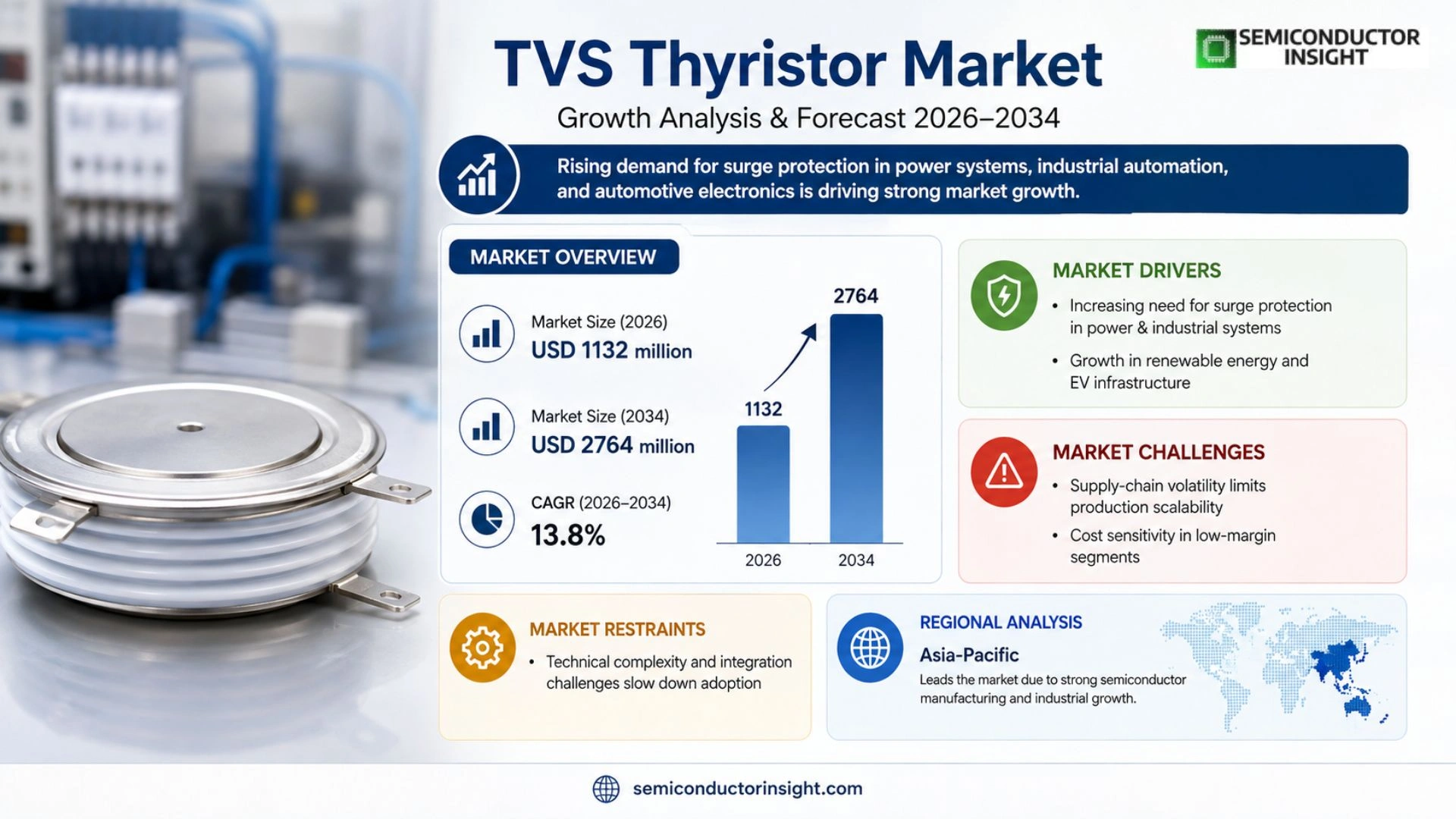
TVS Thyristor market is forecasted to increase from USD 1132 million in 2026 to USD 2764 million by 2034, exhibiting a CAGR of 13.8% during the forecast period.
TVS Thyristor, often called a thyristor surge suppressor or protection thyristor, is a semiconductor component that diverts transient over‑voltage and surge current away from sensitive circuitry. It is offered as a compact discrete device in surface‑mount or through‑hole packages such as SMA, SMB or DO‑15. Structurally it comprises a PNPN thyristor core with metal electrodes, passivation layers and molded housing, operating either unidirectionally or bidirectionally. Unlike a conventional TVS diode that clamps voltage, the thyristor enters a low‑on‑state crowbar mode once the breakover threshold is reached, conducting until the line current falls below the holding level.
The sector’s expansion stems from increasing adoption of industrial automation, smart‑grid deployments and edge‑connectivity solutions that demand robust interface protection. As automotive electronics and IoT devices proliferate, designers seek components capable of handling higher surge energies while maintaining low capacitance for high‑speed signals. Consequently, suppliers are shifting focus from pure price competition toward offering integrated design support, certification services and application‑specific engineering expertise. However, inconsistent terminology across the industry,terms such as TSS, SIDACtor or protection thyristor,creates procurement ambiguity and may slow adoption unless clarified through standardized specifications.
MARKET DRIVERS
Electronic Vehicle Adoption Accelerates Demand
The surge in electric vehicle (EV) production across Europe and Asia has heightened the need for robust protection devices. TVS Thyristor Market suppliers are witnessing increased orders as manufacturers integrate high‑voltage modules to safeguard drive‑train inverters. The trend stems from stricter emission standards and consumer incentives that push OEMs toward more reliable power‑stage components.
Industrial Automation Expands Power Management
Automation hubs in sectors such as robotics, semiconductor fabrication, and renewable‑energy converters rely on precise voltage clamping. The transition from legacy silicon to wider bandgap devices creates a niche where TVS thyristors deliver faster response and higher temperature tolerance. This technical advantage translates into premium pricing and longer product lifecycles for vendors.
➤ “The convergence of EV rollout and smart‑factory initiatives is reshaping component procurement strategies,” notes a senior analyst at a leading advisory firm.
Regulatory frameworks that mandate over‑voltage protection for critical infrastructure further cement market uptake. Companies that embed TVS Thyristor Market solutions into compliance‑driven designs can capitalize on recurring revenue streams from service contracts and after‑market replacements.
MARKET CHALLENGES
Supply‑Chain Volatility Limits Production Scalability
Global shortages of silicon carbide substrates and specialty alloys have introduced lead‑time extensions for TVS thyristor manufacturers. End users face higher inventory costs, prompting some to defer new project launches until component availability stabilizes. The ripple effect constrains quarterly growth despite underlying demand strength.
Other Challenges
Cost Sensitivity in Low‑Margin Segments
Commoditization pressures in consumer electronics drive buyers toward cost‑effective alternatives, such as TVS diodes, which can erode market share for higher‑priced thyristors. Suppliers must balance performance differentiation with pricing strategies to retain relevance in price‑driven applications.
MARKET RESTRAINTS
Technical Complexity Inhibits Rapid Adoption
Design engineers often encounter steep learning curves when integrating TVS thyristors into existing circuits. The necessity for precise gate‑drive timing and thermal management can deter smaller manufacturers lacking dedicated R&D resources. Consequently, project timelines lengthen, and some firms opt for simpler, albeit less robust, protection schemes.
MARKET OPPORTUNITIES
Emergence of Wide‑Bandgap Power Devices
Advancements in gallium nitride (GaN) and silicon carbide (SiC) technologies open avenues for hybrid protection architectures where TVS thyristors complement high‑frequency converters. Early adopters can leverage this synergy to offer differentiated solutions for aerospace and high‑speed rail sectors, unlocking premium‑price contracts.
Furthermore, the growing emphasis on predictive maintenance,driven by IoT analytics,creates demand for smart protection modules that embed diagnostics within TVS thyristors. Vendors that embed sensors and connectivity stand to capture a slice of the service‑oriented revenue model emerging in TVS Thyristor Market.
TVS Thyristor Market Trends
Shift Toward Interface‑Level Surge Management
TVS Thyristor is increasingly viewed as a front‑end protection element rather than a simple spare part. As automation networks, edge gateways and in‑vehicle communication links proliferate, designers demand a device that can divert high‑energy transients while preserving signal integrity. This shift pushes the component from a price‑driven commodity toward a differentiated solution that combines rapid crowbar action, low on‑state resistance and a robust mechanical package. Suppliers that can embed application engineering support, certification services and system‑level validation into their offering are beginning to command premium pricing and tighter customer lock‑in.
Other Trends
Terminology Alignment and Specification Rigor
Industry vocabularies such as TVS thyristor, TSS, SIDACtor and protection thyristor often overlap, creating ambiguity at the procurement stage. The lack of a unified specification framework hampers accurate demand forecasting and complicates cross‑supplier comparisons. Companies that publish clear datasheets, define breakover and holding current thresholds in consistent units, and participate in standard‑setting bodies are gaining credibility, which translates into preferred‑supplier status on large engineering projects.
Expanding End‑Use Landscape Beyond Traditional Telecom
Historically anchored in telephone and DSL line protection, the product is now finding traction in industrial control cabinets, renewable‑energy converters, smart‑building wiring and EV‑charging stations. In these environments, surge events are coupled with stringent electromagnetic‑compatibility requirements, prompting system architects to treat protection as an integral part of the reliability architecture. This broader adoption drives a need for multi‑line, bidirectional configurations and pushes manufacturers to diversify their product portfolios to address varying power levels and environmental ratings.
COMPETITIVE LANDSCAPE
Key Industry Players
TVS Thyristor Competitive Overview
STMicroelectronics dominates the high‑power segment, leveraging its deep silicon‑carbide expertise and a global application‑engineering network. The firm’s breadth of product families,from fixed‑breakover to gate‑programmable devices,allows customers to source a complete solution from a single supplier, which reduces design‑cycle risk in telecom and industrial automation projects. ST’s aggressive investment in reliability testing and certification across IEC and automotive standards has translated into premium pricing power, especially for bidirectional units used in harsh field environments. The company’s recent acquisition of a niche Chinese wafer fab has also expanded capacity, positioning it to meet the surge in demand from smart‑grid interfaces and in‑vehicle Ethernet gateways. Its extensive design‑for‑manufacturability guidelines and a portfolio of reference designs for industrial Ethernet routers have cemented its status among OEMs looking for long‑term component stability.
Beyond the market leader, a cluster of specialized manufacturers competes on niche performance attributes and regional support. onsemi and Littelfuse have captured substantial share in the medium‑power unidirectional class by offering low‑capacitance packages optimized for high‑speed Ethernet lines. Microchip’s entry into the low‑power segment reflects a strategic move to embed protection directly into its MCU families, creating a bundled value proposition for IoT device makers. Smaller players such as YAGEO, Diodes Incorporated, and Bourns differentiate through custom‑programmed breakover thresholds tailored for telecom‑DSL ports. Regional firms,Micro Commercial Co, ProTek Devices, JJMicroelectronics, WAYON, Shandong Xinnuo Electronic, SETsafe, SOCAY, and Semiware,provide localized supply chains and application assistance that appeal to European and Asian OEMs seeking rapid release cycles. These firms also invest in certification programs such as IEC 61000‑4‑2 and automotive ISO 26262, enabling them to win contracts in safety‑critical domains. The agility of smaller players in customizing device parameters to meet specific surge‑energy budgets often results in strategic partnerships with system integrators in Europe’s smart‑building sector.
List of Key TVS Thyristor Companies Profiled
- STMicroelectronics
- onsemi
- Microchip Technology
- Littelfuse
- YAGEO
- Diodes Incorporated
- Bourns
- Micro Commercial Co
- ProTek Devices
- JJMicroelectronics
- WAYON
- Shandong Xinnuo Electronic
- SETsafe
- SOCAY
- Semiware
Segment Analysis:
| Segment Category | Sub-Segments | Key Insights |
| By Type |
|
Fixed‑breakover TVS Thyristor
|
| By Application |
|
Industrial Control Interfaces
|
| By End User |
|
Industrial Automation OEMs
|
| By Polarity Configuration |
|
Bidirectional Configuration
|
| By Power Rating |
|
High‑Power TVS Thyristor
|
Regional Analysis: TVS Thyristor Market
Asia‑Pacific
Integrated fabs in Taiwan and South Korea anchor the production ecosystem, allowing swift material sourcing and process iteration for TVS thyristor components. The proximity to downstream assemblers curtails inventory buffers and enables just‑in‑time deliveries.
Accelerated rollout of electric mobility platforms and grid‑scale storage solutions heightens the need for reliable surge protection, prompting designers to prioritize TVS thyristors over conventional diodes.
Near‑shore logistics, coupled with region‑wide component pooling, mitigate the impact of global freight bottlenecks, ensuring a steadier flow of raw silicon to end‑product manufacturers.
Harmonized safety standards across ASEAN and India simplify certification pathways, allowing suppliers to scale across multiple markets without repetitive testing cycles.
North America
The North American segment reflects a mature adoption curve where utility providers and aerospace OEMs value the high‑precision characteristics of TVS thyristors. Investment in advanced grid resilience initiatives fuels incremental demand, while stringent UL and IEC standards shape product specifications. Vendors that couple engineered reliability with comprehensive warranty programs tend to secure long‑term contracts with utility firms. The region also benefits from a strong ecosystem of test labs, which accelerates validation cycles for new device architectures.
Europe
European markets exhibit a cautious yet progressive stance, driven by the continent’s emphasis on energy efficiency and safety compliance. Automotive manufacturers, especially those transitioning to electrified powertrains, are integrating TVS thyristors to safeguard high‑voltage modules. Divergent national regulations, however, require suppliers to maintain a flexible portfolio capable of meeting varying CE and VDE criteria. Companies that establish regional design‑center partnerships are better positioned to navigate these nuances and embed protection solutions early in product development.
South America
In South America, expanding renewable‑energy farms and intermittent grid conditions create a compelling case for robust surge‑protection devices. While overall market size remains modest, the trajectory is upward as governments incentivize modernizing transmission infrastructure. Local distributors that offer technical training on TVS thyristor benefits are gaining trust among utilities, which often rely on external expertise to specify protective components for new installations.
Middle East & Africa
The Middle East & Africa region presents a heterogeneous landscape where oil‑rich economies invest heavily in data‑center capacity, generating demand for high‑reliability TVS thyristors to protect critical IT assets. Conversely, African nations focus on extending electrification, with solar‑microgrid projects requiring durable voltage‑clamping solutions. Suppliers that can deliver ruggedized devices tolerant of extreme temperature swings and that provide on‑ground support are likely to outpace competitors in these emerging corridors.
Report Scope
This market research report provides a comprehensive analysis of the TVS Thyristor Market , covering the forecast period 2026–2034. It offers detailed insights into market dynamics, technological advancements, competitive landscape, and key trends shaping the industry.
Key focus areas of the report include:
- Market Overview: The report begins with an overview outlining its current market scenario, key growth indicators, and industry transformation drivers. It discusses macroeconomic factors, demand–supply balance, regulatory landscape, and the strategic role of semiconductors in powering advancements across industries such as automotive, telecommunications, consumer electronics, and industrial automation.
- Market Size & Forecast: Historical data and future projections for revenue, unit shipments, and market value across major regions and segments.
- Segmentation Analysis: Detailed breakdown by product type, technology, application, and end-user industry to identify high-growth segments and investment opportunities.
- Regional Insights: Insights into market performance across North America, Europe, Asia-Pacific, Latin America, and the Middle East & Africa, including country-level analysis where relevant.
- Competitive Landscape: Profiles of leading market participants, including their product offerings, R&D focus, manufacturing capacity, pricing strategies, and recent developments such as mergers, acquisitions, and partnerships.
- Technology Trends & Innovation: Assessment of emerging technologies, integration of AI/IoT, semiconductor design trends, fabrication techniques, and evolving industry standards.
- Market Drivers & Restraints: Evaluation of factors driving market growth along with challenges, supply chain constraints, regulatory issues, and market-entry barriers.
- Stakeholder Insights: Insights for component suppliers, OEMs, system integrators, investors, and policymakers regarding the evolving ecosystem and strategic opportunities.
Primary and secondary research methods are employed, including interviews with industry experts, data from verified sources, and real-time market intelligence to ensure the accuracy and reliability of the insights presented.
FREQUENTLY ASKED QUESTIONS:
What is the current market size of TVS Thyristor Market?
-> TVS Thyristor market is forecasted to increase from USD 1132 million in 2026 to USD 2764 million by 2034, exhibiting a CAGR of 13.8%
Which key companies operate in TVS Thyristor Market?
-> Key players include STMicroelectronics, onsemi, Microchip, YAGEO, Littelfuse, Diodes Inc., Bourns, Micro Commercial Co, ProTek Devices, JJMicroelectronics, WAYON, Shandong Xinnuo Electronic, SETsafe, SOCAY, Semiware.
What are the key growth drivers?
-> Key growth drivers include industrial automation, smart grids, edge connectivity, automotive electronics, and infrastructure digitalization.
Which region dominates the market?
-> Asia is the fastest‑growing region, while Europe remains a dominant market.
What are the emerging trends?
-> Emerging trends include integration of AI/IoT for predictive protection, higher‑reliability designs, and multi‑standard compliance.
Get Sample Report PDF for Exclusive Insights
Report Sample Includes
- Table of Contents
- List of Tables & Figures
- Charts, Research Methodology, and more...
 Download Sample Report PDF