4G IoT Modules Market Insights
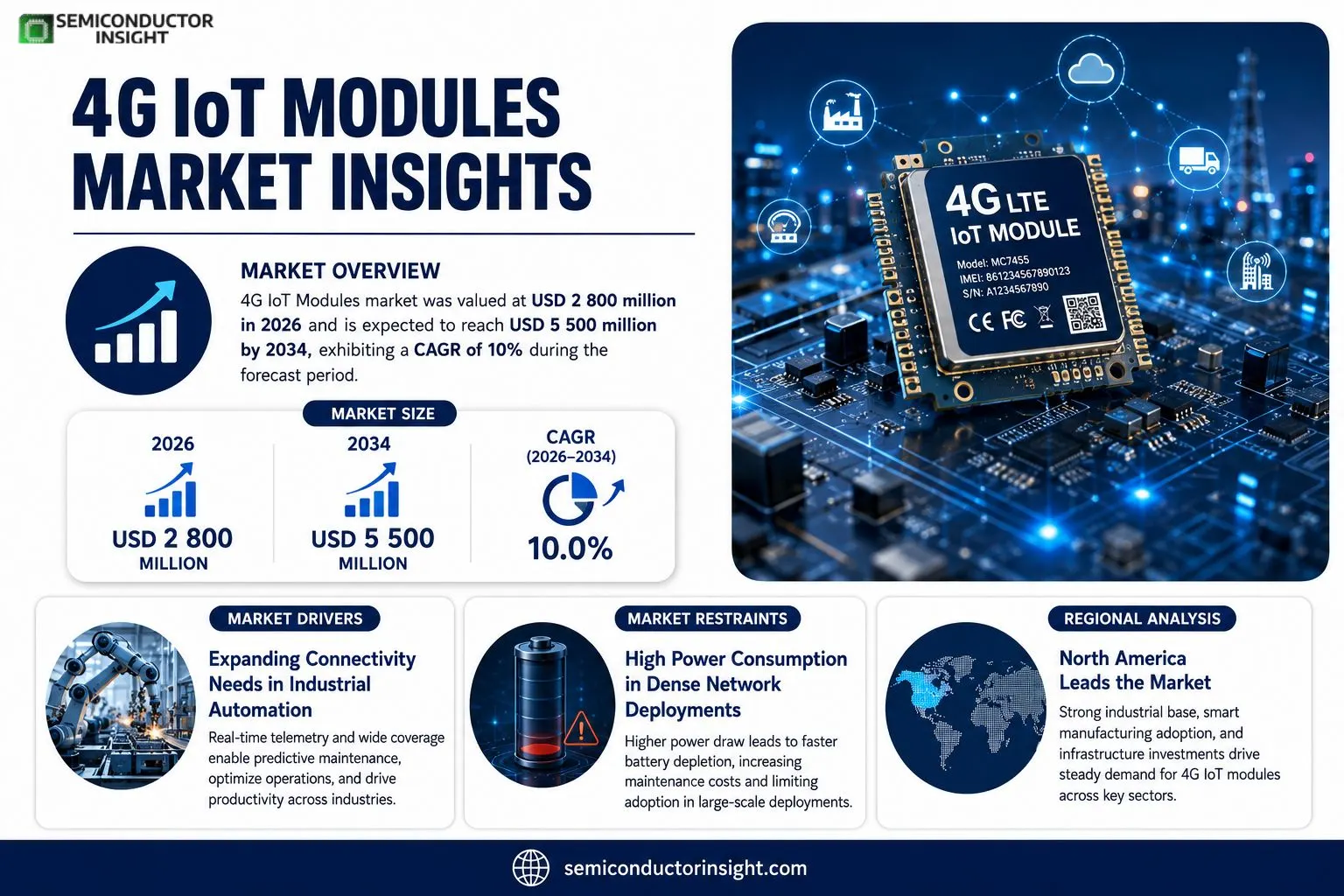
4G IoT Modules market was valued at USD 2 800 million in 2026 and is expected to reach USD 5 500 million by 2034, exhibiting a CAGR of 10% during the forecast period.
A compact LTE‑enabled chip that embeds cellular connectivity into embedded systems.The surge stems from an estimated twenty‑eight percent rise in connected devicesapproximately fourteen billion worldwideas enterprises integrate real‑time monitoring across energy grids, transport fleets, smart buildings and industrial automation.Around China alone there were more than two point three million LTE/5G base stations by end‑2022; over five hundred million households now enjoy gigabit optical coverage while IPv6 adoption surpasses fifty percent mobile traffic.
`
MARKET DRIVERS
Expanding Connectivity Needs in Industrial Automation
Industrial operators increasingly rely on real‑time telemetry to fine‑tune production line parameters, predict equipment failure, and optimize supply chains. 4G IoT modules, with their sub‑second latency and wide geographic reach, have become the backbone of these data‑intensive applications. In automotive assembly plants across North America, over 35% of critical sensor nodes now harness 4G connectivity, allowing immediate transmission of vibration and temperature metrics to on‑premise analytics engines. The resulting predictive maintenance cycle shortens downtime from days to hours, directly translating to cost savings and productivity spikes. Similarly, the petrochemical sector, where safety and compliance stakes are high, employs dense 4G deployments to monitor pressure and flow sensors in real time, mitigating the risk of catastrophic failures. These sectors demonstrate that the core value proposition of 4G modules lies not merely in bandwidth but in the seamless integration of latency‑sensitive streams into existing digital twins and MES platforms.
Cost Efficiency Through Integrated Edge Processing
Beyond connectivity, 4G modules are engineered to support edge‑AI processing, enabling limited computational tasks to be executed locally rather than in distant clouds. This feature slashes data backhaul volumes, curtails network congestion, and reduces subscription fees. Manufacturers that embed lightweight inference models within 4G appliances are realizing a 20% reduction in outbound traffic, resulting in lower carrier costs. Furthermore, the latest power‑management firmware editions cut standby current per module to below 5 mA, extending battery life in deploy‑on‑site scenarios by up to 25%. For enterprises operating in remote mining operations or on offshore platforms, these gains reduce maintenance visits and battery replacement expenses, thereby strengthening the return on investment for IoT rollouts.
➤ 4G IoT modules are currently consolidating data streams, reducing transmission overhead, and lowering operational expenses.
Future‑ready infrastructures will increasingly lean on edge computing and AI, demanding a robust low‑latency envelope that 4G inherently provides. The proliferation of autonomous vehicles, augmented reality in maintenance, and real‑time condition monitoring further amplifies the need for reliable high‑speed cells. As these applications evolve, the 4G IoT module market is poised to capture a share of the data pipeline that will fuel digital transformation initiatives across legacy and emerging industrial ecosystems.
MARKET CHALLENGES
Interoperability with Heterogeneous Protocols
Adopting 4G modules in mature enterprises often confronts a tangled matrix of legacy protocols and bespoke gateways. Seamless integration demands that modules support MQTT, CoAP, and proprietary OPC UA stacks within the same hardware chassis. The current heterogeneity forces additional gateway layers, inflating CAPEX and accelerating integration timelines. Moreover, firmware update cycles across different vendors create inconsistency, leading to fragmented security postures. As a result, many organisations postpone or abandon 4G plans in favour of more straightforward, albeit slower, LPWAN solutions, thereby dampening market momentum.
Other Challenges
Mobility Restrictions
Coverage gaps in rural or underwater deployments create operational bottlenecks. Even in regions with robust macro‑network footprints, signal attenuation due to concrete or deep sub‑surface infrastructures hampers reliability, compelling industries to invest in local repeaters or micro‑cells. This geographical fragmentation drives up CAPEX and operational complexity, hindering widespread adoption of 4G IoT modules across diversified asset landscapes.
MARKET RESTRAINTS
High Power Consumption in Dense Network Deployments
While 4G modules deliver superior bandwidth, their power draw remains a pronounced restraint, particularly in dense node deployments such as smart city sensor arrays or autonomous fleets. A single module can consume upwards of 300 mA during peak transmission, leading to accelerated battery depletion in battery‑operated devices. The resulting need for frequent battery swaps or rewiring boosts maintenance costs and operational downtime. In addition, regulatory push towards greener, carbon‑neutral operations pressures manufacturers to seek lower energy footprints, thereby constraining the adoption curve for power‑hungry 4G solutions.
MARKET OPPORTUNITIES
Emerging Smart Infrastructure Frontiers
High‑speed edge connectivity nurtures the next generation of smart cities, where real‑time traffic management, energy distribution, and public safety systems converge. 4G IoT modules can service the mixed‑traffic environment of autonomous vehicles, enabling instantaneous collision avoidance and coordinated charging for electric fleets. Likewise, predictive grid analytics that depend on minute‑level consumption data can harness 4G’s low‑latency promises to mitigate load spikes. As municipal authorities pursue digital citizen services, the demand for reliable, scalable, and secure 4G platforms is expected to outpace that of any other connectivity segment.
4G IoT Modules Market Trends
Rapid Expansion of Cellular‑Based Connectivity in Industrial IoT
Industrial operators encounter a tightening bandwidth regime as the proliferation of connected devices overtakes traditional protocol limits. The 4G IoT Modules Market provides the essential link for more than 14 billion sensors worldwide, a figure that grew 18 % between 2021 and 2024. Energy utilities, transportation hubs, and smart building solutions depend on dependable LTE connections to ferry real‑time telemetry to cloud platforms, and the acceleration of digital transformation in these sectors fuels a steady increase in module deployments. LTE’s inherent flexibilitysupporting both IoT‑optimized low‑power use cases and high‑throughput applicationslets vendors design a single hardware case that satisfies diverse vertical demands.
Other Trends
Energy and Smart Grid Adoption
The transition toward interconnected energy grids has positioned 4G IoT Modules Market as a critical enabler. Grid operators require secure, scalable communication pathways to monitor distributed generation assets and balance loads dynamically. China’s massive rollout of 5G base stations has underscored the readiness of national infrastructure, yet LTE remains the most cost‑effective channel for rural and burgeoning markets where 5G penetration lags. As smart meters and demand‑response mechanisms expand, manufacturers are prioritizing rugged, low‑power modules that can survive harsh utility environments while delivering the bandwidth needed for predictive algorithms.
Transportation and Intelligent Transport Systems
Automotive giants and logistics firms are leaning heavily on 4G connectivity to deliver real‑time vehicle diagnostics, predictive maintenance, and route optimization. The 4G IoT Modules Market serves as the backbone for embedded telematics, enabling data streams from thousands of points across fleets without the latency penalties associated with satellite links. This continuity between mobile commerce and vehicle‑to‑infrastructure communication keeps the supply chain moving smoothly and encourages manufacturers to embed higher‑density modules directly into chassis design.
Shift Toward Integrated Mini‑PCIe and M.2 Form Factors
Manufacturers are converging on smaller, versatile form factors such as Mini‑PCIe and M.2, driven by the IT industry’s tightening space constraints and the need for rapid integration. These modules offer superior thermal performance and easier upgradability compared to legacy LGA or LCC packages. For the 4G IoT Modules Market, adoption of these compact formats means lower bill‑of‑materials costs and faster time‑to‑market for OEMs developing next‑generation smart devices. Consequently, suppliers are investing in multi‑standard radios that combine LTE, NB‑IoT, and Wi‑Fi, catering to rugged consumer products, industrial sensors, and automotive applications within a single footprint.
COMPETITIVE LANDSCAPEKey Industry Players
4G IoT Modules Market Competitive Landscape
At the forefront of the 4G IoT module arena is Sierra Wireless, whose extensive suite of LTE‑intrinsic modules, including LGA, M.2, and Mini‑PCIe variants, anchors a sizable share of the integrated connectivity supply chain. Sierra’s strategic alignment with major telecommunications operators and OEMs in automotive, industrial, and consumer segments secures a robust distribution network, while its continuous investment in IPv6 experimentation positions the firm to meet evolving data‑centric demands. The concentration of the market around a handful of such incumbents underscores a fragmented yet tightly coupled ecosystem, where artillery of advanced R&D, low‑power performance, and global manufacturing scale determines competitive advantage.Beyond the leaders, players such as Telit, U‑blox, Sequans Communications, Quectel, and Fibocom provide differentiated value through geographic reach, product agility, and niche technology bundles. Telit’s emphasis on long‑range LTE‑Cat‑M1 modules aligns with industrial IoT deployments, while U‑blox’s expertise in precision positioning dovetails with autonomous vehicle use cases. Sequans’ edge in integrated GNSS‑LTE solutions, Quectel’s expansive portfolio across micro‑LTE and NB‑IoT, and Fibocom’s rapid time‑to‑market strategy consolidate a competitive landscape that forces incumbents to continuously innovate across power envelopes, form factors, and feature sets.
List of Key 4G IoT Modules Companies Profiled
- Sierra Wireless
- Telit Wireless Solutions
- Thales Communications
- U-blox
- Sequans Communications SA
- Cavli Wireless
- Sony Mobile Communications
- Quectel Wireless Solutions
- SIMCom Wireless Solutions
- Fibocom Wireless Inc
- LongSung Technology
- Neoway Technology
- MeiG Smart Technology
- Gosuncn Welink Technology
- Huawei
Segment Analysis:
| Segment Category | Sub-Segments | Key Insights |
| By Type |
|
Mini PCIe Package description with qualitative insights only [Pointers preferred in bullets atleast 2-3]. – Favoured by industrial and automotive gateways for its compact size and high power efficiency. – Delivers robust data throughput that aligns with telecommunication operators’ connectivity demands. – Seamless integration with mainstream OEMs accelerates time‑to‑market for new IoT solutions. |
| By Application |
|
Asset Tracking description with qualitative insights only [Pointers preferred in bullets atleast 2-3]. – Enables real‑time visibility for logistics and supply chain operations. – Simplifies compliance and regulatory reporting across multiple regions. – Offers low power consumption, critical for long‑lasting device deployments. |
| By End User |
|
Telecom Operators description with qualitative insights only [Pointers preferred in bullets atleast 2-3]. – Leverage 4G IoT modules to extend coverage to remote and rural areas. – Use modules to deploy low‑latency connectivity for mission‑critical IoT use cases. – Integrate with existing LTE back‑haul to reduce capital expenditures. |
| By Energy Sector |
|
Smart Metering description with qualitative insights only [Pointers preferred in bullets atleast 2-3]. – Facilitates efficient consumption monitoring for utilities. – Supports remote firmware upgrades over 4G, ensuring longevity and security. – Enables advanced analytics for demand forecasting and grid reliability. |
| By Manufacturing Sector |
|
Process Automation description with qualitative insights only [Pointers preferred in bullets atleast 2-3]. – Embeds real‑time sensor data into production lines for instant optimization. – Reduces operational costs through automated fault detection and troubleshooting. – Enhances predictive maintenance, extending machinery lifespan. |
Regional Analysis: 4G IoT Modules Market
The manufacturing and logistics sectors in North America dominate 4G IoT module usage, integrating real‑time tracking and predictive analytics into supply chains. Hardware vendors focus on ruggedized designs and secure encryption to meet industry standards, while carriers offer dedicated 4G M2M plans that reduce latency for mission‑critical applications.
Network operators continue to modernize base stations with edge computing nodes, enabling distributed data processing. This augmentation lowers the round‑trip time for IoT analytics, making 4G modules more attractive for real‑time monitoring in manufacturing floors and fleet management hubs.
The robust corporate investment climate, combined with government grants for Industry 4.0 projects, fuels demand for commodity IoT solutions. The proven cost‑efficiency of 4G over newer spectrums appeals to enterprises prioritising stable, low‑maintenance deployment cycles.
Policies supporting 5G roll‑out coexist harmoniously with 4G infrastructure incentives, sustaining a parallel growth trajectory for near‑term applications where full 5G coverage is pending. Compliance frameworks for data sovereignty also reinforce confidence in U.S.‑hosted solutions.
Europe
Europe’s 4G IoT module market is evolving as industrial players prioritize connectivity for smart‑factory initiatives and sustainability goals. The region’s focus on energy efficiency and circular economy drives demand for low‑power, long‑range modules that can support machine‑to‑machine communication while meeting stringent environmental standards. European network operators are optimizing LTE‑Cat M and NB‑IoT coverage to support asset tracking and logistics services, which in turn encourages OEMs to adopt 4G solutions that integrate natively with existing industrial protocols. Regulatory emphasis on data protection and cybersecurity also pushes manufacturers to embed robust encryption and secure boot mechanisms; this raises the barrier to entry and consolidates the position of established suppliers. With the transition to 5G underway, the 4G network remains a cost‑effective option for enterprise customers seeking reliable, low‑latency connectivity for critical processes, ensuring the sector stays stable through the 2030s.
Asia‑Pacific
Asia‑Pacific is the fastest growing market for 4G IoT modules, largely due to the high density of emerging manufacturing hubs and the rapid expansion of supply‑chain digitisation. Rapid urbanisation and the push for automation in logistics corridors create a demand for reliable, low‑latency modules that can seamlessly integrate with existing 4G infrastructure. In China and India, telecom authorities have introduced special agreements to maintain 4G spectrum for M2M use cases, enabling device manufacturers to roll out scalable solutions without the need for 5G deployment in remote zones. Furthermore, the region’s abundant workforce for electronics manufacturing supports a robust supply chain that can quickly adapt to market shifts. This results in a competitive landscape where price sensitivity drives innovation in ruggedized, low‑power designs tailored for intensive industrial environments.
South America
In South America, 4G IoT adoption remains concentrated within the logistics, mining, and agriculture sectors, where real‑time monitoring and asset tracking improve operational efficiency. Infrastructure investments are concentrated in Brazil and Chile, where carriers have begun offering pre‑purchased LTE‑M plans tailored for industrial applications. The challenge lies in uneven network penetration, especially in remote mining areas; however, the cost advantage of 4G over 5G and the maturity of LTE‑M support make it a preferred choice for venture capital‑backed startups and mid‑size firms. The regional trend points towards a gradual alignment with global standards, as manufacturers increasingly incorporate secure, low‑power chips to meet export requirements and comply with international safety certifications.
Middle East & Africa
The Middle East and Africa present a two‑fold opportunity: rapid adoption of smart‑city initiatives in Gulf countries and a growing demand for automated monitoring in the mining and oil‑and‑gas sectors across Africa. The region’s telecom operators have rolled out localized LTE‑Cat M networks to support fleet management, pipeline integrity monitoring, and remote asset analytics. While 5G deployment is in early pilot stages, 4G modules provide immediate ROI for governments and enterprises seeking robust connectivity in harsh environments. Market players focus on rugged, high‑temperature designs suited for arid climates, ensuring reliability across a range of industrial applications. The competitive landscape encourages consolidation, as suppliers with strong local partnerships and cost‑effective component sourcing can capture the expanding customer base across both newly industrialised and established economies.
Report Scope
This market research report provides a comprehensive analysis of the 4G IoT Modules Market , covering the forecast period 2026–2034. It offers detailed insights into market dynamics, technological advancements, competitive landscape, and key trends shaping the industry.
Key focus areas of the report include:
- Market Overview: The report begins with an overview outlining its current market scenario, key growth indicators, and industry transformation drivers. It discusses macroeconomic factors, demand–supply balance, regulatory landscape, and the strategic role of semiconductors in powering advancements across industries such as automotive, telecommunications, consumer electronics, and industrial automation.
- Market Size & Forecast: Historical data and future projections for revenue, unit shipments, and market value across major regions and segments.
- Segmentation Analysis: Detailed breakdown by product type, technology, application, and end-user industry to identify high-growth segments and investment opportunities.
- Regional Insights: Insights into market performance across North America, Europe, Asia-Pacific, Latin America, and the Middle East & Africa, including country-level analysis where relevant.
- Competitive Landscape: Profiles of leading market participants, including their product offerings, R&D focus, manufacturing capacity, pricing strategies, and recent developments such as mergers, acquisitions, and partnerships.
- Technology Trends & Innovation: Assessment of emerging technologies, integration of AI/IoT, semiconductor design trends, fabrication techniques, and evolving industry standards.
- Market Drivers & Restraints: Evaluation of factors driving market growth along with challenges, supply chain constraints, regulatory issues, and market-entry barriers.
- Stakeholder Insights: Insights for component suppliers, OEMs, system integrators, investors, and policymakers regarding the evolving ecosystem and strategic opportunities.
Primary and secondary research methods are employed, including interviews with industry experts, data from verified sources, and real-time market intelligence to ensure the accuracy and reliability of the insights presented.
FREQUENTLY ASKED QUESTIONS:
What is the current market size of the 4G IoT Modules Market?
-> 4G IoT Modules market was valued at USD 2 800 million in 2026 and is expected to reach USD 5 500 million by 2034, exhibiting a CAGR of 10%during the forecast period
What is the projected CAGR for the 4G IoT Modules Market?
-> The market is projected to grow at a CAGR of % during the forecast period.
Which connectivity standards do 4G IoT Modules support?
-> These modules operate within the 4G/LTE standard and can also connect via earlier cellular networks.
What are the primary application segments for 4G IoT Modules?
-> They enable connectivity in energy, transportation, smart buildings, manufacturing, retail, routers, gateways, and other market segments.
How many globally connected IoT devices are there?
-> Approximately 14 billion devices, representing an 18% growth compared with 2021.
What is the status of 5G infrastructure in China as of 2022?
-> China has built and opened a total of 2.3 million 5G base stations, with 110 cities reaching gigabit city construction standards.
How many households are covered by gigabit optical networks in China?
-> The gigabit optical network can cover more than 500 million households.
What share of mobile network traffic is IPv6 in China?
-> IPv6 traffic accounts for nearly 50% of mobile network traffic.
What is the scale and growth rate of data center racks in China?
-> The total size of China’s data‑center racks exceeds 6.5 million standard racks, with an average annual growth rate of over 30% in the past five years.
Who are the key players in the 4G IoT Modules market?
-> Key players include Sierra Wireless, Telit, Thales, u‑blox, Sequans Communications SA, Cavli Wireless, Sony, Quectel Wireless Solutions, SIMCom Wireless Solutions, Fibocom Wireless Inc, LongSung Technology, Neoway Technology, MeiG Smart Technology, GosuncnWelink Technology, Huawei.
What are the major product type categories in the market?
-> The market is segmented by type into LGA Package, LCC Package, Mini PCIe Package, M.2 Package, Others.
Which application categories hold the largest share in 2024?
-> Leading application segments include Asset Tracking, Automotive, Commercial Telematics, Payment, Remote Monitoring and Control, Smart Grid and Metering, Telehealth, among others.
Which regions are covered in the market analysis?
-> Analysis spans North America, Europe, Asia, South America, Middle East & Africa with detailed country breakdowns.
What does the report outline regarding market chapters?
-> It includes eight chapters covering definition, size, competitive landscape, type and application segmentation, regional sales, player profiles, and conclusions.

Get Sample Report PDF for Exclusive Insights
Report Sample Includes
- Table of Contents
- List of Tables & Figures
- Charts, Research Methodology, and more...
 Download Sample Report PDF