Z-Wave Long Range (LR) Chip Market Insights
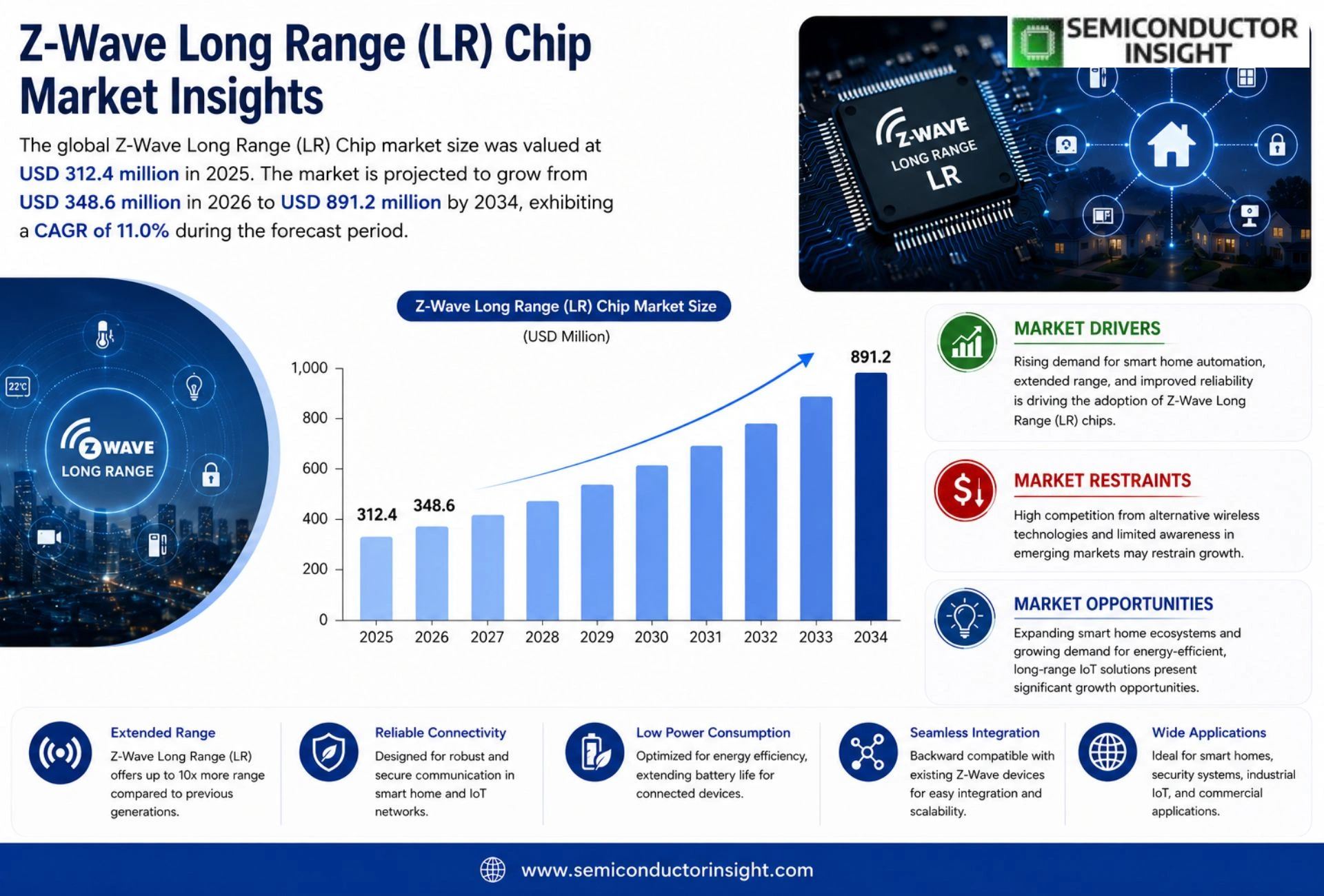
Z-Wave Long Range (LR) Chip Market size was valued at USD 312.4 million in 2025. The market is projected to grow from USD 348.6 million in 2026 to USD 891.2 million by 2034, exhibiting a CAGR of 11.0% during the forecast period.
Z-Wave Long Range (LR) chips are advanced semiconductor components designed to enable low-power, long-distance wireless communication in smart home and IoT ecosystems. Operating on the sub-GHz frequency band , primarily 908.42 MHz in North America , Z-Wave LR significantly extends the communication range up to 1,600 meters in open air compared to the approximately 100-meter range of classic Z-Wave, while maintaining backward compatibility with existing Z-Wave networks. These chips are embedded in a broad range of devices, including smart locks, sensors, lighting controls, thermostats, and security systems.
The market is gaining strong momentum due to the rapid expansion of smart home infrastructure, growing consumer demand for reliable and energy-efficient wireless connectivity, and increasing adoption of IoT devices across residential and commercial sectors. Furthermore, the Z-Wave Alliance’s certification of the Z-Wave LR standard and its integration into Silicon Labs’ ZG23 and EFR32ZG28 chip series have been pivotal in accelerating deployment. Silicon Labs, a leading player in the Z-Wave LR chip space, along with companies such as Sigma Designs and Nordic Semiconductor, continue to drive product innovation and ecosystem development across the global market.
MARKET DRIVERS
Accelerating Smart Home Adoption Fueling Demand for Z-Wave Long Range (LR) Chip Technology
The rapid global expansion of smart home ecosystems has emerged as one of the most significant drivers for Z-Wave Long Range (LR) Chip Market. Consumers and homebuilders alike are increasingly prioritizing connected devices that offer reliable, low-power wireless communication across larger premises. Z-Wave LR technology, with its extended range of up to 1 mile in open-air environments, addresses a critical limitation of conventional short-range protocols, making it particularly well-suited for large residential properties, multi-story homes, and sprawling commercial installations. This enhanced coverage capability directly supports the growing complexity of modern smart home networks, where dozens of devices must communicate seamlessly without signal degradation.
Energy Efficiency Standards and IoT Infrastructure Expansion Driving Z-Wave LR Chip Adoption
Stringent global energy efficiency regulations and the broader push toward sustainable building automation are reinforcing demand within the Z-Wave Long Range chip landscape. Z-Wave LR operates in the sub-GHz frequency band (around 908.42 MHz in North America), which inherently offers superior wall penetration and reduced interference compared to 2.4 GHz technologies such as Zigbee or Wi-Fi. This technical advantage aligns well with the requirements of smart energy management systems, including smart meters, HVAC controls, and automated lighting, all of which are increasingly mandated or incentivized by regulatory frameworks across North America and Europe. The expansion of IoT infrastructure in both residential and commercial segments continues to provide a stable and growing demand base for Z-Wave LR-enabled chipsets.
➤ Z-Wave Long Range technology supports networks of up to 4,000 nodes per controller, a substantial leap from the 232-node limitation of classic Z-Wave, enabling unprecedented scalability for large-scale smart building deployments.
The commercial building automation and hospitality sectors are also emerging as strong demand contributors for Z-Wave Long Range (LR) chips. Hotels, assisted living facilities, and enterprise campuses require robust, interference-resistant mesh-free communication for door locks, thermostats, occupancy sensors, and security systems. Z-Wave LR’s point-to-point architecture, which does not require intermediate mesh nodes, simplifies installation and reduces overall system cost, giving it a competitive edge in large-scale deployments. This structural advantage, combined with backward compatibility with existing Z-Wave infrastructure, ensures that system integrators and OEMs face a lower transition barrier when upgrading to LR-capable platforms.
MARKET CHALLENGES
Competitive Pressure from Alternative Wireless Protocols Posing Challenges to Z-Wave LR Chip Market Growth
Despite its technical merits, Z-Wave Long Range (LR) Chip Market faces significant competitive pressure from alternative wireless communication standards. Protocols such as Thread, Zigbee, Bluetooth Low Energy (BLE), and Wi-Fi HaLow (IEEE 802.11ah) are actively competing for design wins in smart home and building automation applications. The emergence of Matter, the unified smart home connectivity standard developed by the Connectivity Standards Alliance (CSA), has particularly intensified this competitive landscape. While Z-Wave has been integrated as an optional transport layer within some Matter-adjacent frameworks, the primary Matter protocol stack relies on Thread, Wi-Fi, and Bluetooth, which may limit Z-Wave LR’s visibility among new-generation device developers unfamiliar with its advantages.
Other Challenges
Limited Chipset Vendor Ecosystem
The Z-Wave LR chip ecosystem remains relatively concentrated, with Silicon Laboratories (Silicon Labs) serving as the primary chipset supplier following its acquisition of the Z-Wave intellectual property. This limited vendor diversity can create supply chain vulnerabilities and may constrain competitive pricing dynamics, potentially discouraging cost-sensitive OEMs from standardizing on Z-Wave LR platforms. Broadening the certified silicon ecosystem remains a strategic priority for industry stakeholders seeking long-term market resilience.
Developer Awareness and Certification Complexity
Achieving Z-Wave certification involves compliance with the Z-Wave Alliance’s technical and interoperability requirements, which can represent a time and cost burden for smaller device manufacturers. Combined with relatively lower developer awareness compared to Zigbee or BLE in certain regional markets, this creates an adoption friction point that Z-Wave Long Range (LR) Chip Market must actively address through education, streamlined certification pathways, and expanded developer tooling and support resources.
MARKET RESTRAINTS
Regulatory and Spectrum Fragmentation Limiting Global Scalability of Z-Wave Long Range (LR) Chips
One of the structural restraints affecting Z-Wave Long Range (LR) Chip Market is the geographic fragmentation of sub-GHz radio frequency allocations. Z-Wave LR operates on different frequency bands across regions , approximately 908.42 MHz in North America, 868.42 MHz in Europe, and varying allocations in Japan, Australia, and other markets. This frequency disparity necessitates region-specific chip variants or configurable hardware solutions, which increases design and certification costs for manufacturers targeting global distribution. Unlike protocols operating uniformly in the 2.4 GHz ISM band, Z-Wave LR vendors must manage a more complex multi-SKU product portfolio, adding logistical and regulatory overhead that can restrain market scalability.
Dependence on Smart Home Market Maturity and Consumer Awareness as a Growth Limiting Factor
The penetration rate of Z-Wave LR-enabled devices is intrinsically tied to the overall maturity of the smart home market in a given region. In emerging economies across Southeast Asia, Latin America, and parts of Africa, the smart home ecosystem remains nascent, with consumers and building developers prioritizing cost over connectivity sophistication. The relatively premium positioning of Z-Wave LR chipsets compared to generic RF modules or low-cost Zigbee alternatives can limit adoption in price-sensitive market segments. Furthermore, the lack of widespread consumer-level brand recognition for Z-Wave Long Range technology , as opposed to the more consumer-visible Wi-Fi or Bluetooth branding , may restrain pull-through demand from end users, even as the technology offers objectively superior performance for specific use cases.
MARKET OPPORTUNITIES
Expansion into Commercial, Industrial, and MDU Segments Creating New Avenues for Z-Wave LR Chip Market
Z-Wave Long Range (LR) Chip Market is well-positioned to capitalize on growing demand from multi-dwelling unit (MDU) developments, commercial real estate, and light industrial automation segments. Property managers of large apartment complexes, hotels, and assisted living facilities require scalable, low-maintenance wireless systems for access control, energy monitoring, and environmental sensing. Z-Wave LR’s ability to support thousands of nodes on a single controller without the complexity of a mesh network offers a compelling value proposition for these deployments. As building operators increasingly seek to leverage IoT data for operational efficiency and occupant experience enhancement, Z-Wave LR chipsets integrated into gateways and edge controllers represent a high-growth opportunity for silicon vendors and system integrators alike.
Strategic Integration with Security, Healthcare, and Energy Management Platforms Unlocking Long-Term Growth
Vertical market integration presents one of the most promising long-term opportunities for the Z-Wave Long Range chip ecosystem. In the professional security industry, Z-Wave LR’s reliable range and interference-resistant sub-GHz operation make it a preferred backbone for alarm panels, door and window sensors, and smart locks in both residential and commercial installations. In healthcare settings, particularly in remote patient monitoring and assisted living environments, Z-Wave LR can reliably connect wearable sensors, medication dispensers, and environmental monitors across large facilities without infrastructure-heavy Wi-Fi deployments. Additionally, utility companies and energy management platform providers are exploring Z-Wave LR as a last-mile connectivity option for advanced metering infrastructure (AMI) and demand-response systems, further broadening the addressable market for Z-Wave Long Range (LR) chip manufacturers and their downstream partners.
Z-Wave Long Range (LR) Chip Market Trends
Rising Smart Home Adoption Accelerating Z-Wave Long Range (LR) Chip Deployment
Z-Wave Long Range (LR) Chip Market is experiencing significant momentum driven by the rapid global expansion of smart home infrastructure. Consumers and enterprises alike are increasingly prioritizing reliable, energy-efficient wireless connectivity for residential and commercial IoT ecosystems. Z-Wave LR chips, operating on the sub-GHz frequency band , primarily 908.42 MHz in North America , offer a dramatically extended communication range of up to 1,600 meters in open air, compared to the approximately 100-meter range of classic Z-Wave technology. This leap in range capability is making Z-Wave LR chips a preferred choice for large-scale smart home and building automation deployments, where consistent signal coverage is critical.
Other Trends
Standardization and Certification Driving Market Confidence
A defining trend shaping Z-Wave Long Range (LR) Chip Market is the formal certification of the Z-Wave LR standard by the Z-Wave Alliance. This certification has provided manufacturers, integrators, and consumers with a validated technical framework, reducing fragmentation and boosting confidence in long-term product compatibility. The standard’s backward compatibility with existing Z-Wave networks ensures that new Z-Wave LR chip-enabled devices can coexist with legacy installations, lowering the barrier to adoption and encouraging incremental upgrades across residential and commercial environments.
Silicon Labs Leading Product Innovation
Silicon Labs has emerged as a central force in driving Z-Wave LR chip innovation through its ZG23 and EFR32ZG28 chip series. These platforms are purpose-built for low-power, long-range smart home applications and are embedded in a broad range of devices, including smart locks, sensors, lighting controls, thermostats, and security systems. The continued development of these chip lines reflects a broader industry trend toward highly integrated, application-specific semiconductor solutions that address both range and energy efficiency demands withZ-Wave Long Range (LR) Chip Market.
Expanding IoT Device Ecosystem Broadening Z-Wave LR Chip Applications
The growing adoption of IoT devices across residential and commercial sectors continues to broaden the application landscape for Z-Wave LR chips. Companies such as Sigma Designs and Nordic Semiconductor, alongside Silicon Labs, are actively contributing to ecosystem development, fostering interoperability and expanding the range of compatible end products. As smart security systems, environmental sensors, and intelligent lighting become mainstream components of connected buildings, demand for Z-Wave Long Range (LR) chips is expected to deepen across both established and emerging markets worldwide.
COMPETITIVE LANDSCAPE
Key Industry Players
Z-Wave Long Range (LR) Chip Market: Competitive Dynamics and Leading Innovators Shaping the Global Smart Home Ecosystem
Global Z-Wave Long Range (LR) Chip Market is characterized by a moderately consolidated competitive landscape, with Silicon Labs standing as the dominant force following its acquisition of the Z-Wave intellectual property portfolio from Sigma Designs in 2018. Silicon Labs has since become the primary custodian of the Z-Wave standard, driving the commercialization of Z-Wave LR technology through its ZG23 and EFR32ZG28 chip series , purpose-built to deliver extended communication ranges of up to 1,600 meters in open-air environments while sustaining backward compatibility with legacy Z-Wave networks. The company’s deep integration with the Z-Wave Alliance certification ecosystem and its robust developer support infrastructure have cemented its leadership position across North American and European markets. With the global market projected to grow from USD 348.6 million in 2026 to USD 891.2 million by 2034 at a CAGR of 11.0%, Silicon Labs is strategically positioned to capitalize on accelerating smart home and IoT adoption across residential and commercial verticals.
Beyond Silicon Labs, a broader ecosystem of semiconductor manufacturers, module vendors, and IoT platform providers contribute to competitive pressure and market diversification within the Z-Wave LR chip space. Companies such as Nordic Semiconductor bring competitive sub-GHz and low-power wireless expertise, while firms including Sigma Designs , prior to its divestiture of Z-Wave assets , laid critical foundational IP that continues to influence chip architecture. Established IoT device integrators such as Aeotec, Z-Wave.Me, and Qorvo actively participate in the Z-Wave Alliance and incorporate Z-Wave LR-compatible chipsets into certified end products, indirectly shaping chipset demand. Additionally, module manufacturers such as Fibar Group and Ring (Amazon) drive volume consumption of Z-Wave LR chips through large-scale smart lock, sensor, and security system deployments. The competitive landscape is further influenced by the entry of specialized semiconductor distributors and ODM partners who supply Z-Wave LR-enabled reference designs to device manufacturers globally, broadening market accessibility and intensifying competition on cost, integration complexity, and power efficiency benchmarks.
List of Key Z-Wave Long Range (LR) Chip Companies Profiled
- Silicon Laboratories Inc.
- Nordic Semiconductor
- Sigma Designs
- Qorvo Inc.
- Aeotec Group
- Z-Wave.Me
- Fibar Group (Fibaro)
- Ring (Amazon)
- Zooz (The Smartest House)
- HomeSeer Technologies
- Jasco Products Company (GE/Enbrighten)
- Leviton Manufacturing Co.
- Honeywell Home (Resideo Technologies)
- Schlage (Allegion plc)
- Yale Real Living (ASSA ABLOY)
Segment Analysis:
| Segment Category | Sub-Segments | Key Insights |
| By Type |
|
Z-Wave LR System-on-Chip (SoC) represents the leading segment within the Z-Wave LR chip market by type, driven by the broad adoption of Silicon Labs’ ZG23 and EFR32ZG28 chip series which integrate radio frequency capabilities, processing power, and memory into a single compact solution.
|
| By Application |
|
Security and Surveillance Systems emerge as the dominant application segment in the Z-Wave LR chip market, owing to the critical need for robust, interference-resistant wireless communication in safety-critical environments.
|
| By End User |
|
Residential End Users constitute the leading end-user segment for Z-Wave LR chips, fueled by accelerating smart home adoption and consumer appetite for seamless, energy-efficient home automation ecosystems.
|
| By Frequency Band |
|
908.42 MHz (North America) leads the frequency band segment, reflecting the maturity and scale of smart home markets in the United States and Canada where Z-Wave LR technology has achieved widespread regulatory acceptance and commercial traction.
|
| By Distribution Channel |
|
Direct OEM Sales represent the dominant distribution channel in the Z-Wave LR chip market, as leading semiconductor manufacturers such as Silicon Labs establish deep strategic partnerships with device makers to ensure seamless chip integration and accelerate product development cycles.
|
Regional Analysis: Z-Wave Long Range (LR) Chip Market
North America
North America’s extensive smart home infrastructure provides a natural growth corridor for Z-Wave Long Range (LR) Chip Market. Millions of connected devices already operating on Z-Wave Classic are being upgraded or supplemented with LR-capable chips, ensuring backward compatibility while substantially extending wireless range, improving network reliability, and reducing installation complexity in large residential and commercial properties.
The region benefits from proactive industry standards development led by the Z-Wave Alliance and active participation from North American technology firms. These frameworks ensure that Z-Wave LR chip-enabled products meet interoperability benchmarks, build consumer confidence, and create structured pathways for broader commercial deployment across security, energy management, assisted living, and hospitality verticals throughout the United States and Canada.
Beyond single-family homes, North America is witnessing accelerated Z-Wave Long Range chip integration in multi-dwelling units (MDUs) and enterprise environments. Property managers and building operators are leveraging the extended range and low-power characteristics of Z-Wave LR chips to deploy centralized access control, environmental monitoring, and energy optimization systems at scale, reducing operational costs and enhancing occupant experiences.
Silicon Labs and a growing network of North American hardware and software partners continue to expand the Z-Wave LR chip ecosystem through developer toolkits, reference designs, and cloud integration frameworks. This collaborative innovation environment accelerates time-to-market for new Z-Wave LR-enabled products, attracting startups and established consumer electronics brands alike to deepen their investment in the regional market.
Europe
Europe represents the second most significant region Z-Wave Long Range (LR) Chip Market, characterized by strong policy-driven momentum and a culturally receptive smart living environment. Western European nations , particularly Germany, the United Kingdom, France, and the Nordic countries , lead regional adoption, supported by government-backed smart city programs, ambitious energy efficiency mandates, and a mature retail channel for connected home products. The European Union’s focus on sustainable building practices and energy transition policies has created fertile ground for Z-Wave LR chip integration within smart thermostats, lighting controls, and automated shading systems. European consumers tend to prioritize data privacy and device security, attributes that align well with Z-Wave’s localized mesh architecture and encrypted communications. As residential renovation activity increases across the continent and developers embed smart home capabilities into new construction projects, demand for Z-Wave Long Range chips is expected to grow steadily, with Central and Eastern Europe emerging as promising secondary markets over the forecast horizon.
Asia-Pacific
The Asia-Pacific region presents a dynamic and rapidly evolving landscape for Z-Wave Long Range (LR) Chip Market, underpinned by rapid urbanization, expanding middle-class incomes, and government-led smart city initiatives across China, Japan, South Korea, and Australia. While competing wireless protocols such as Zigbee and proprietary platforms have traditionally dominated portions of the regional market, Z-Wave LR chips are gaining traction among premium smart home solution providers and security system integrators seeking differentiated, interference-resistant, long-range connectivity. Japan and Australia demonstrate particularly strong affinity for Z-Wave-based solutions due to established relationships with North American and European platform vendors. The region’s vast manufacturing base also positions Asia-Pacific as a future hub for Z-Wave LR chip production and component supply, potentially reshaping global supply chain dynamics and enabling more competitive pricing structures that could accelerate regional mass-market penetration.
South America
South America occupies a nascent but gradually emerging position within Global Z-Wave Long Range (LR) Chip Market. Brazil leads regional interest, supported by a growing urban middle class, expanding internet penetration, and rising awareness of smart home technologies among tech-forward consumer segments in major metropolitan areas such as São Paulo and Rio de Janeiro. While adoption remains constrained by economic volatility, currency fluctuations, and import cost pressures on semiconductor components, the long-term structural outlook is moderately positive. Regional system integrators and security service providers are beginning to evaluate Z-Wave LR chip-based platforms as viable alternatives to traditional wired security and automation infrastructure. As local distribution networks strengthen and regional partnerships with global Z-Wave ecosystem players develop, South America is anticipated to gradually transition from an awareness-building phase to early commercial deployment over the latter portion of the forecast period.
Middle East & Africa
The Middle East & Africa region represents the earliest stage of Z-Wave Long Range (LR) Chip Market development, yet meaningful pockets of opportunity are beginning to surface, particularly across Gulf Cooperation Council (GCC) nations including the UAE, Saudi Arabia, and Qatar. These markets are investing heavily in smart infrastructure as part of broader national diversification and urban modernization agendas, creating selective demand for advanced wireless connectivity technologies. Luxury residential developments, hospitality projects, and commercial real estate ventures in the region are incorporating smart automation solutions where Z-Wave LR chips offer compelling range and reliability advantages. In Sub-Saharan Africa, adoption remains limited by infrastructure constraints and cost sensitivities, though growing mobile connectivity and emerging smart building projects in economic hubs such as Nairobi and Lagos may create longer-term footholds for Z-Wave Long Range chip deployment as the ecosystem matures globally.
Report Scope
This market research report provides a comprehensive analysis of the Z-Wave Long Range (LR) Chip Market , covering the forecast period 2026–2034. It offers detailed insights into market dynamics, technological advancements, competitive landscape, and key trends shaping the industry.
Key focus areas of the report include:
- Market Overview: The report begins with an overview outlining its current market scenario, key growth indicators, and industry transformation drivers. It discusses macroeconomic factors, demand–supply balance, regulatory landscape, and the strategic role of semiconductors in powering advancements across industries such as automotive, telecommunications, consumer electronics, and industrial automation.
- Market Size & Forecast: Historical data and future projections for revenue, unit shipments, and market value across major regions and segments.
- Segmentation Analysis: Detailed breakdown by product type, technology, application, and end-user industry to identify high-growth segments and investment opportunities.
- Regional Insights: Insights into market performance across North America, Europe, Asia-Pacific, Latin America, and the Middle East & Africa, including country-level analysis where relevant.
- Competitive Landscape: Profiles of leading market participants, including their product offerings, R&D focus, manufacturing capacity, pricing strategies, and recent developments such as mergers, acquisitions, and partnerships.
- Technology Trends & Innovation: Assessment of emerging technologies, integration of AI/IoT, semiconductor design trends, fabrication techniques, and evolving industry standards.
- Market Drivers & Restraints: Evaluation of factors driving market growth along with challenges, supply chain constraints, regulatory issues, and market-entry barriers.
- Stakeholder Insights: Insights for component suppliers, OEMs, system integrators, investors, and policymakers regarding the evolving ecosystem and strategic opportunities.
Primary and secondary research methods are employed, including interviews with industry experts, data from verified sources, and real-time market intelligence to ensure the accuracy and reliability of the insights presented.
FREQUENTLY ASKED QUESTIONS:
What is the current market size of Z-Wave Long Range (LR) Chip Market?
-> Z-Wave Long Range (LR) Chip Market was valued at USD 312.4 million in 2025 and is expected to reach USD 891.2 million by 2034, growing at a CAGR of 11.0% during the forecast period.
Which key companies operate Z-Wave Long Range (LR) Chip Market?
-> Key players include Silicon Labs, Sigma Designs, and Nordic Semiconductor, among others. Silicon Labs is a leading player with its ZG23 and EFR32ZG28 chip series driving ecosystem development across the global market.
What are the key growth drivers?
-> Key growth drivers include rapid expansion of smart home infrastructure, growing consumer demand for reliable and energy-efficient wireless connectivity, and increasing adoption of IoT devices across residential and commercial sectors. The Z-Wave Alliance’s certification of the Z-Wave LR standard has also been pivotal in accelerating deployment.
Which region dominates the market?
-> North America is a prominent market, where Z-Wave LR chips operate primarily on the 908.42 MHz sub-GHz frequency band, while Asia-Pacific represents a key growth region driven by rising IoT adoption.
What are the emerging trends?
-> Emerging trends include extended communication range up to 1,600 meters in open air, backward compatibility with existing Z-Wave networks, integration into smart locks, sensors, lighting controls, thermostats, and security systems, and the continued evolution of low-power semiconductor design for smart home and IoT ecosystems.

Get Sample Report PDF for Exclusive Insights
Report Sample Includes
- Table of Contents
- List of Tables & Figures
- Charts, Research Methodology, and more...