X-ray Detector (CMOS, a-Si) Market Insights
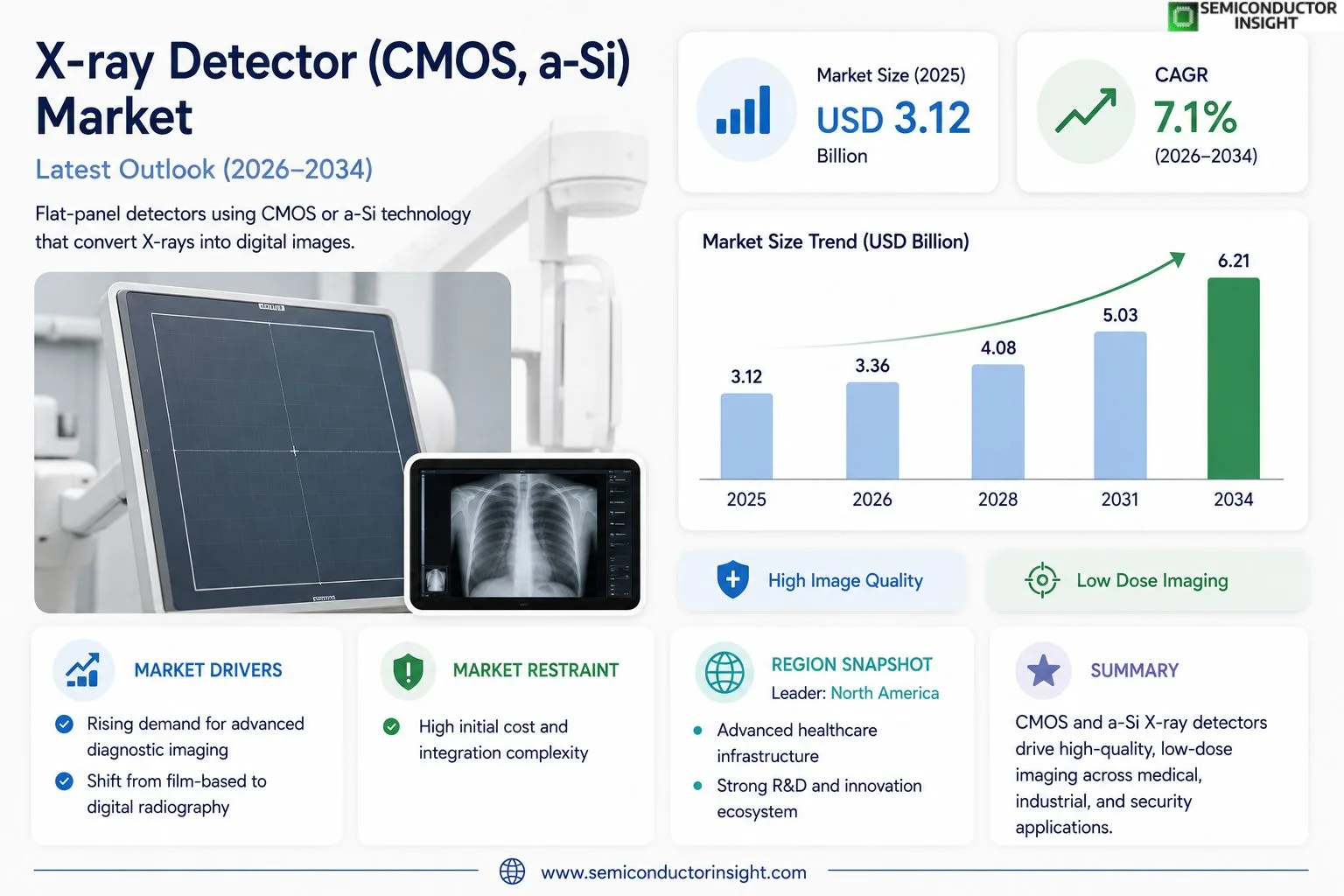
Global X-ray Detector (CMOS, a-Si) market size was valued at USD 3.12 billion in 2025. The market is projected to grow from USD 3.36 billion in 2026 to USD 6.21 billion by 2034, exhibiting a CAGR of 7.1% during the forecast period.
X-ray detectors based on Complementary Metal-Oxide-Semiconductor (CMOS) and amorphous Silicon (a-Si) technologies are advanced imaging devices designed to convert X-ray radiation into digital signals for diagnostic and analytical applications. CMOS-based detectors are recognized for their low noise performance, high spatial resolution, and energy efficiency, while a-Si flat-panel detectors offer large-area imaging capabilities and robust performance in dynamic radiography. These detectors are widely utilized across medical imaging, dental radiography, security screening, industrial non-destructive testing (NDT), and veterinary imaging.
The market is experiencing steady growth driven by rising global demand for advanced diagnostic imaging, increasing adoption of digital radiography systems in healthcare facilities, and a growing emphasis on early disease detection. Furthermore, the shift from traditional film-based X-ray systems to digital flat-panel detectors is accelerating across both developed and emerging economies. Key industry participants including Varex Imaging Corporation, Canon Inc., Teledyne Technologies, Fujifilm Holdings Corporation, and Analogic Corporation continue to expand their product portfolios and invest in next-generation detector technologies to strengthen their market positions.
MARKET DRIVERS
Rising Demand for Advanced Medical Imaging Solutions
X-ray Detector (CMOS, a-Si) Market is experiencing robust growth driven by the accelerating global demand for high-resolution, low-dose digital radiography systems. Complementary metal-oxide-semiconductor (CMOS) detectors have gained significant traction in medical imaging due to their superior image quality, lower radiation exposure, and compact form factor compared to conventional flat-panel technologies. Healthcare systems worldwide are investing heavily in upgrading legacy analog X-ray infrastructure to digital platforms, positioning both CMOS and amorphous silicon (a-Si) flat-panel detectors as cornerstone technologies in modern diagnostic radiology.
Expansion of Industrial Non-Destructive Testing (NDT) Applications
Beyond healthcare, X-ray Detector (CMOS, a-Si) Market is being propelled by widening adoption in industrial non-destructive testing and inspection sectors. Industries such as aerospace, automotive, electronics manufacturing, and oil and gas increasingly rely on digital X-ray detectors for quality assurance and structural integrity analysis. CMOS-based detectors, with their high frame rates and dynamic range, are particularly well-suited for inline inspection of complex assemblies, while a-Si flat-panel detectors continue to dominate large-area imaging applications due to their cost-effectiveness and scalability. This dual-sector demand is a powerful structural driver for the broader market.
➤ The shift from computed radiography (CR) to direct and indirect digital radiography (DR) systems based on CMOS and a-Si detector technologies is accelerating globally, fundamentally reshaping diagnostic imaging workflows and industrial inspection methodologies.
Government-led healthcare infrastructure investments across emerging economies in Asia-Pacific, Latin America, and the Middle East are further amplifying demand. Increased public health spending, growing diagnostic center networks, and rising awareness of early-stage disease detection are all contributing to a sustained expansion of X-ray Detector (CMOS, a-Si) Market. Additionally, the post-pandemic emphasis on strengthening healthcare resilience has encouraged procurement of portable and stationary digital X-ray systems equipped with advanced flat-panel detector technologies.
MARKET CHALLENGES
High Initial Capital Investment and Integration Complexity
One of the primary challenges confronting X-ray Detector (CMOS, a-Si) Market is the significant upfront capital expenditure associated with deploying advanced digital detector systems. While CMOS detectors offer long-term operational efficiencies, their initial procurement and integration costs remain prohibitive for smaller healthcare facilities and diagnostic centers, particularly in price-sensitive markets. Transitioning existing analog or CR-based systems to fully digital detector-based workflows also demands substantial investment in software integration, staff retraining, and facility modification, creating friction in adoption rates.
Other Challenges
Technological Obsolescence Risk
The rapid pace of innovation in detector materials, pixel architectures, and readout electronics means that systems procured today may face accelerated obsolescence. Manufacturers and end-users in X-ray Detector (CMOS, a-Si) Market must continuously evaluate upgrade pathways, increasing total cost of ownership and complicating long-term procurement planning for hospital networks and industrial operators alike.
Regulatory and Certification Barriers
Medical-grade X-ray detectors are subject to stringent regulatory approvals from bodies such as the U.S. FDA, the European CE marking framework, and equivalent national authorities. The complexity and duration of regulatory clearance processes can delay product commercialization, particularly for next-generation CMOS detector platforms incorporating novel pixel designs or scintillator materials, posing a persistent challenge for manufacturers seeking timely market entry.
MARKET RESTRAINTS
Supply Chain Vulnerabilities and Semiconductor Material Constraints
X-ray Detector (CMOS, a-Si) Market faces meaningful restraints stemming from supply chain dependencies in semiconductor fabrication. CMOS detector production relies on advanced silicon wafer processing and specialized foundry capabilities, making the supply chain susceptible to disruptions caused by geopolitical tensions, trade restrictions, and global semiconductor shortages. The events of recent years have highlighted how constrained access to leading-edge fabrication nodes and specialty materials can delay detector production timelines and inflate component costs, directly impacting manufacturers’ ability to fulfill growing demand.
Competition from Alternative Detector Technologies
While CMOS and a-Si technologies dominate the current flat-panel detector landscape, X-ray Detector (CMOS, a-Si) Market is increasingly exposed to competitive pressure from emerging alternatives. Direct conversion detectors utilizing amorphous selenium (a-Se) or cadmium telluride (CdTe) materials are being developed for applications requiring ultra-high spatial resolution, particularly in mammography and digital breast tomosynthesis. Although these technologies currently face their own cost and manufacturing challenges, continued research investment may erode the competitive positioning of conventional CMOS and a-Si platforms over the medium to long term, restraining overall market growth potential.
MARKET OPPORTUNITIES
Integration of Artificial Intelligence with Digital X-ray Detector Platforms
A transformative opportunity for X-ray Detector (CMOS, a-Si) Market lies in the convergence of AI-powered image analysis with advanced flat-panel detector systems. Leading detector manufacturers and imaging platform providers are actively developing AI-integrated workflows that leverage the high-resolution, low-noise output of CMOS and a-Si detectors to enable automated anomaly detection, diagnostic assistance, and workflow prioritization. This integration is particularly compelling in high-volume radiology environments where AI-assisted triage can significantly reduce reporting turnaround times and improve diagnostic consistency, creating a premium value proposition that drives upgrade cycles across both hospital and outpatient imaging settings.
Growth of Portable and Wireless Detector Systems in Point-of-Care Settings
The rising demand for portable, wireless flat-panel X-ray detectors represents a significant growth frontier within X-ray Detector (CMOS, a-Si) Market. Advances in battery technology, wireless data transmission protocols, and lightweight CMOS sensor design have enabled the development of truly mobile digital radiography solutions suitable for bedside imaging, emergency departments, field medical applications, and veterinary diagnostics. Emerging markets with underdeveloped fixed imaging infrastructure are particularly well-positioned to leapfrog traditional installation models by adopting portable wireless detector solutions, expanding the total addressable market considerably beyond traditional hospital-centric deployment models.
Increasing Penetration in Veterinary and Dental Imaging Segments
Specialized application segments, including veterinary imaging and digital dental radiography, present underexploited but rapidly expanding opportunities for CMOS and a-Si detector manufacturers. The veterinary diagnostics sector is undergoing significant digitization, with animal hospitals and specialty clinics transitioning to high-sensitivity digital radiography platforms. Similarly, the dental imaging segment continues to migrate toward compact, high-resolution intraoral and panoramic CMOS sensors that deliver superior diagnostic clarity at reduced radiation doses. These adjacent markets offer manufacturers the ability to diversify revenue streams and deploy existing detector technologies with targeted product adaptations, strengthening long-term positioning within the broader X-ray Detector (CMOS, a-Si) Market landscape.
Trends
Accelerating Shift from Film-Based to Digital Radiography Systems
One of the most significant trends shaping X-ray Detector (CMOS, a-Si) Market is the accelerating transition from conventional film-based X-ray systems to advanced digital flat-panel detectors. Healthcare facilities across both developed and emerging economies are prioritizing digital radiography upgrades to enhance diagnostic accuracy, reduce patient radiation exposure, and improve workflow efficiency. CMOS-based detectors, recognized for their low noise performance and high spatial resolution, are increasingly being integrated into modern diagnostic imaging systems, while amorphous Silicon (a-Si) flat-panel detectors continue to gain traction for their large-area imaging capabilities and reliability in dynamic radiography applications. This fundamental technology shift is a primary driver of sustained momentum in X-ray Detector (CMOS, a-Si) Market.
Other Trends
Rising Demand for Early Disease Detection and Preventive Diagnostics
Global emphasis on early disease detection is creating substantial demand for high-performance imaging solutions. Hospitals, diagnostic centers, and outpatient clinics are expanding their investment in advanced X-ray detector technologies to support timely and accurate identification of conditions ranging from cardiovascular disease to orthopedic disorders. X-ray Detector (CMOS, a-Si) Market is directly benefiting from these healthcare priorities, as both CMOS and a-Si detector platforms offer the image clarity and sensitivity required for precise clinical interpretation.
Expanding Applications Across Non-Medical Sectors
Beyond medical imaging, X-ray Detector (CMOS, a-Si) Market is witnessing growing adoption in industrial non-destructive testing (NDT), security screening, dental radiography, and veterinary imaging. Industrial manufacturers are deploying digital X-ray detectors to identify structural defects and ensure product quality without compromising material integrity. Security agencies are increasingly relying on flat-panel detectors for enhanced baggage and cargo inspection, further broadening the addressable market for CMOS and a-Si detector technologies.
Product Innovation and Portfolio Expansion by Key Industry Participants
Leading companies in X-ray Detector (CMOS, a-Si) Market, including Varex Imaging Corporation, Canon Inc., Teledyne Technologies, Fujifilm Holdings Corporation, and Analogic Corporation, are actively investing in next-generation detector technologies and expanding their product portfolios. Research and development efforts are focused on improving detector sensitivity, reducing form factor, and enabling wireless connectivity to meet the evolving needs of modern imaging environments. These innovation-driven strategies are expected to continue reinforcing competitive positioning and supporting long-term growth across X-ray Detector (CMOS, a-Si) Market.
COMPETITIVE LANDSCAPE
Key Industry Players
Global X-ray Detector (CMOS, a-Si) Market: Competitive Dynamics and Leading Manufacturers
Global X-ray Detector (CMOS, a-Si) market is characterized by a moderately consolidated competitive landscape, with a handful of technologically advanced multinational corporations commanding significant market share. Varex Imaging Corporation stands out as one of the foremost players, offering a comprehensive range of CMOS and amorphous silicon flat-panel detectors tailored for medical, industrial, and security imaging applications. Canon Inc. and Fujifilm Holdings Corporation leverage their deep-rooted expertise in imaging technologies to deliver high-resolution digital radiography solutions, continuously expanding their detector portfolios through sustained R&D investments. Teledyne Technologies and Hamamatsu Photonics further reinforce the competitive intensity by providing precision-engineered detectors with superior noise performance and spatial resolution, catering to both diagnostic imaging and scientific research verticals. The accelerating shift from analog film-based X-ray systems to digital flat-panel detectors , driven by demand for early disease detection and improved workflow efficiency , has prompted these leading players to aggressively pursue product innovation, strategic partnerships, and geographic expansion across developed and emerging markets alike.
Beyond the top-tier incumbents, a number of specialized and regionally significant manufacturers contribute meaningfully to X-ray Detector (CMOS, a-Si) Market’s competitive ecosystem. Companies such as Analogic Corporation, Carestream Health, Konica Minolta, and Agfa-Gevaert Group have carved out strong niches in dental radiography, veterinary imaging, and non-destructive testing (NDT) applications by offering differentiated detector solutions with competitive price-performance ratios. Emerging players including Rayence, Vieworks, and iRay Technology are gaining traction , particularly across the Asia-Pacific region , by delivering cost-effective a-Si flat-panel detectors suited for high-volume clinical environments. Meanwhile,Detectorplus (Dexela, a PerkinElmer company) and Thales Group continue to address industrial and security screening segments with ruggedized, large-area detector platforms. As technological advancements in CMOS sensor fabrication and thin-film transistor (TFT) array design lower production costs, competitive pressures are expected to intensify further, compelling established players to differentiate through software integration, AI-assisted imaging analytics, and after-sales service capabilities.
List of Key X-ray Detector (CMOS, a-Si) Companies Profiled
- Varex Imaging Corporation
- Canon Inc.
- Fujifilm Holdings Corporation
- Teledyne Technologies
- Hamamatsu Photonics K.K.
- Analogic Corporation
- Carestream Health
- Konica Minolta, Inc.
- Agfa-Gevaert Group
- Rayence Co., Ltd.
- Vieworks Co., Ltd.
- iRay Technology
- Thales Group
- PerkinElmer (Dexela)
- Shimadzu Corporation
Segment Analysis:
| Segment Category | Sub-Segments | Key Insights |
| By Type |
|
CMOS-Based X-ray Detectors represent the leading segment within the type category, driven by their distinctly superior technical attributes that align with the demands of modern diagnostic and analytical imaging environments.
|
| By Application |
|
Medical Imaging & Diagnostic Radiology stands as the dominant application segment, underpinned by the accelerating global transition from conventional film-based X-ray systems to advanced digital flat-panel detector platforms.
|
| By End User |
|
Hospitals & Diagnostic Imaging Centers constitute the leading end-user segment, reflecting the central role of institutional healthcare infrastructure in driving demand for advanced X-ray detector technologies.
|
| By Technology Platform |
|
Indirect Conversion Detectors currently lead the technology platform segment, owing to their well-established manufacturing maturity, broad clinical acceptance, and compatibility with the widely deployed a-Si flat-panel detector infrastructure.
|
| By Portability |
|
Portable / Wireless X-ray Detectors represent the most dynamically growing segment within the portability classification, reflecting a broader industry-wide shift toward flexible, patient-centric, and decentralized imaging solutions.
|
Regional Analysis: X-ray Detector (CMOS, a-Si) Market
North America
North America leads in the clinical integration of advanced CMOS-based detectors, which offer superior image resolution and lower power consumption compared to legacy systems. Ongoing innovation from regional manufacturers is focused on portable and wireless detector formats, enabling point-of-care imaging solutions that extend the utility of the X-ray Detector market beyond traditional radiology departments into emergency and ambulatory care settings.
A well-established regulatory framework governed by the FDA and complementary standards bodies ensures that X-ray detector technologies entering the North American market meet stringent safety and performance benchmarks. This regulatory clarity accelerates procurement decisions among healthcare institutions and reduces market entry uncertainty for manufacturers, fostering a competitive yet structured landscape for both CMOS and a-Si detector technologies.
The region’s expansive network of hospitals, outpatient imaging centers, and specialty clinics sustains consistent demand for high-performance flat-panel detectors. Rising prevalence of chronic conditions requiring frequent diagnostic imaging, combined with aging demographics, amplifies the need for reliable and high-throughput X-ray Detector solutions. Dental and veterinary imaging sectors represent emerging demand channels further diversifying regional market opportunity.
North America attracts substantial capital investment directed toward detector manufacturing, software integration, and AI-assisted image analysis platforms. Strategic alliances between imaging technology developers and leading hospital systems are facilitating real-world validation of next-generation CMOS and a-Si detectors, accelerating commercialization timelines and reinforcing the region’s position as a global innovation hub for the X-ray Detector market.
Europe
Europe represents the second most significant regional market for X-ray Detector (CMOS, a-Si) technologies, characterized by a mature healthcare ecosystem, strong public investment in diagnostic imaging modernization, and a well-coordinated regulatory environment under the European Medical Device Regulation framework. Germany, France, the United Kingdom, and the Netherlands serve as primary demand centers, each contributing through well-funded national health systems that prioritize radiation safety and image quality upgrades. The transition from analog to digital flat-panel detector systems has been actively supported through European Union health technology programs and national procurement initiatives. European manufacturers and research institutions are particularly active in advancing amorphous silicon detector efficiency and developing hybrid architectures that combine the advantages of both CMOS and a-Si platforms. Demand from industrial non-destructive testing applications, in addition to medical imaging, adds a distinctive dimension to the European market, broadening the commercial relevance of the X-ray Detector segment across sectors including aerospace, automotive, and materials inspection throughout the forecast period.
Asia-Pacific
Asia-Pacific is emerging as one of the most dynamic and rapidly expanding regions within Global X-ray Detector (CMOS, a-Si) Market, propelled by large-scale healthcare infrastructure investments, rising diagnostic imaging demand, and growing domestic manufacturing capabilities. China and Japan are central contributors, with China expanding its domestic production of flat-panel detectors and Japan driving innovation in high-resolution CMOS imaging technologies. South Korea, India, and Australia are also noteworthy participants, with India in particular experiencing accelerated adoption of digital X-ray systems through government-backed healthcare programs. The region’s expanding middle-class population and improving access to advanced medical diagnostics are key structural demand drivers. Local manufacturers are increasingly competitive on cost and quality, challenging established global players and reshaping supply chain dynamics. The Asia-Pacific X-ray Detector market is expected to sustain strong growth momentum through 2034, supported by rising clinical throughput requirements and expanding industrial inspection applications across semiconductor, electronics, and energy sectors.
South America
South America occupies a developing position within Global X-ray Detector (CMOS, a-Si) Market, with growth opportunities anchored in Brazil and, to a lesser extent, Argentina, Colombia, and Chile. Public and private healthcare modernization initiatives are gradually increasing the penetration of digital flat-panel detector systems, replacing outdated film-based and computed radiography technologies across hospital networks and outpatient facilities. Brazil’s sizable healthcare sector and active medical device import market make it the region’s primary demand center for CMOS and a-Si detector solutions. However, market expansion in South America is tempered by economic volatility, currency fluctuation, import dependency, and limited local manufacturing capabilities. International suppliers navigating the region must contend with complex regulatory approval processes and price sensitivity among institutional buyers. Despite these challenges, the long-term outlook for the X-ray Detector market in South America remains constructive as healthcare access improves and diagnostic imaging infrastructure continues to develop across urban and semi-urban markets through the forecast horizon.
Middle East & Africa
The Middle East and Africa region represents a nascent but progressively developing market for X-ray Detector (CMOS, a-Si) technologies, characterized by divergent growth trajectories between the Gulf Cooperation Council countries and the broader African continent. The GCC nations, particularly Saudi Arabia, the United Arab Emirates, and Qatar, are investing substantially in world-class healthcare infrastructure as part of national vision programs, creating demand for advanced flat-panel imaging systems including CMOS and a-Si detectors across newly constructed hospitals and specialty diagnostic centers. In contrast, sub-Saharan Africa faces significant structural barriers including limited healthcare budgets, infrastructure deficits, and acute shortages of trained radiology professionals, which constrain near-term market penetration of sophisticated detector technologies. Multilateral health development programs and mobile X-ray initiatives are beginning to address these gaps. The region’s overall market for X-ray detectors is expected to grow incrementally, with the Middle East leading adoption and Africa representing a longer-term developmental opportunity over the 2026–2034 forecast period.
Report Scope
This market research report provides a comprehensive analysis of X-ray Detector (CMOS, a-Si) Market, covering the forecast period 2026–2034. It offers detailed insights into market dynamics, technological advancements, competitive landscape, and key trends shaping the industry.
Key focus areas of the report include:
- Market Overview: The report begins with an overview outlining its current market scenario, key growth indicators, and industry transformation drivers. It discusses macroeconomic factors, demand–supply balance, regulatory landscape, and the strategic role of semiconductors in powering advancements across industries such as automotive, telecommunications, consumer electronics, and industrial automation.
- Market Size & Forecast: Historical data and future projections for revenue, unit shipments, and market value across major regions and segments.
- Segmentation Analysis: Detailed breakdown by product type, technology, application, and end-user industry to identify high-growth segments and investment opportunities.
- Regional Insights: Insights into market performance across North America, Europe, Asia-Pacific, Latin America, and the Middle East & Africa, including country-level analysis where relevant.
- Competitive Landscape: Profiles of leading market participants, including their product offerings, R&D focus, manufacturing capacity, pricing strategies, and recent developments such as mergers, acquisitions, and partnerships.
- Technology Trends & Innovation: Assessment of emerging technologies, integration of AI/IoT, semiconductor design trends, fabrication techniques, and evolving industry standards.
- Market Drivers & Restraints: Evaluation of factors driving market growth along with challenges, supply chain constraints, regulatory issues, and market-entry barriers.
- Stakeholder Insights: Insights for component suppliers, OEMs, system integrators, investors, and policymakers regarding the evolving ecosystem and strategic opportunities.
Primary and secondary research methods are employed, including interviews with industry experts, data from verified sources, and real-time market intelligence to ensure the accuracy and reliability of the insights presented.
FREQUENTLY ASKED QUESTIONS:
What is the current market size of X-ray Detector (CMOS, a-Si) Market?
-> Global X-ray Detector (CMOS, a-Si) Market was valued at USD 3.12 billion in 2025 and is projected to grow from USD 3.36 billion in 2026 to USD 6.21 billion by 2034, exhibiting a CAGR of 7.1% during the forecast period.
Which key companies operate in X-ray Detector (CMOS, a-Si) Market?
-> Key players include Varex Imaging Corporation, Canon Inc., Teledyne Technologies, Fujifilm Holdings Corporation, and Analogic Corporation, among others.
What are the key growth drivers?
-> Key growth drivers include rising global demand for advanced diagnostic imaging, increasing adoption of digital radiography systems in healthcare facilities, growing emphasis on early disease detection, and the accelerating shift from traditional film-based X-ray systems to digital flat-panel detectors across both developed and emerging economies.
Which region dominates the market?
-> Asia-Pacific is the fastest-growing region, while North America remains a dominant market, driven by advanced healthcare infrastructure and high adoption of digital radiography systems.
What are the emerging trends?
-> Emerging trends include next-generation CMOS and a-Si flat-panel detector technologies, integration of AI in diagnostic imaging, expansion of digital radiography in veterinary and dental applications, and growing use of X-ray detectors in industrial non-destructive testing (NDT) and security screening.

Get Sample Report PDF for Exclusive Insights
Report Sample Includes
- Table of Contents
- List of Tables & Figures
- Charts, Research Methodology, and more...
 Download Sample Report PDF