Wireless Endoscopic (WCE) Power Management IC Market Insights
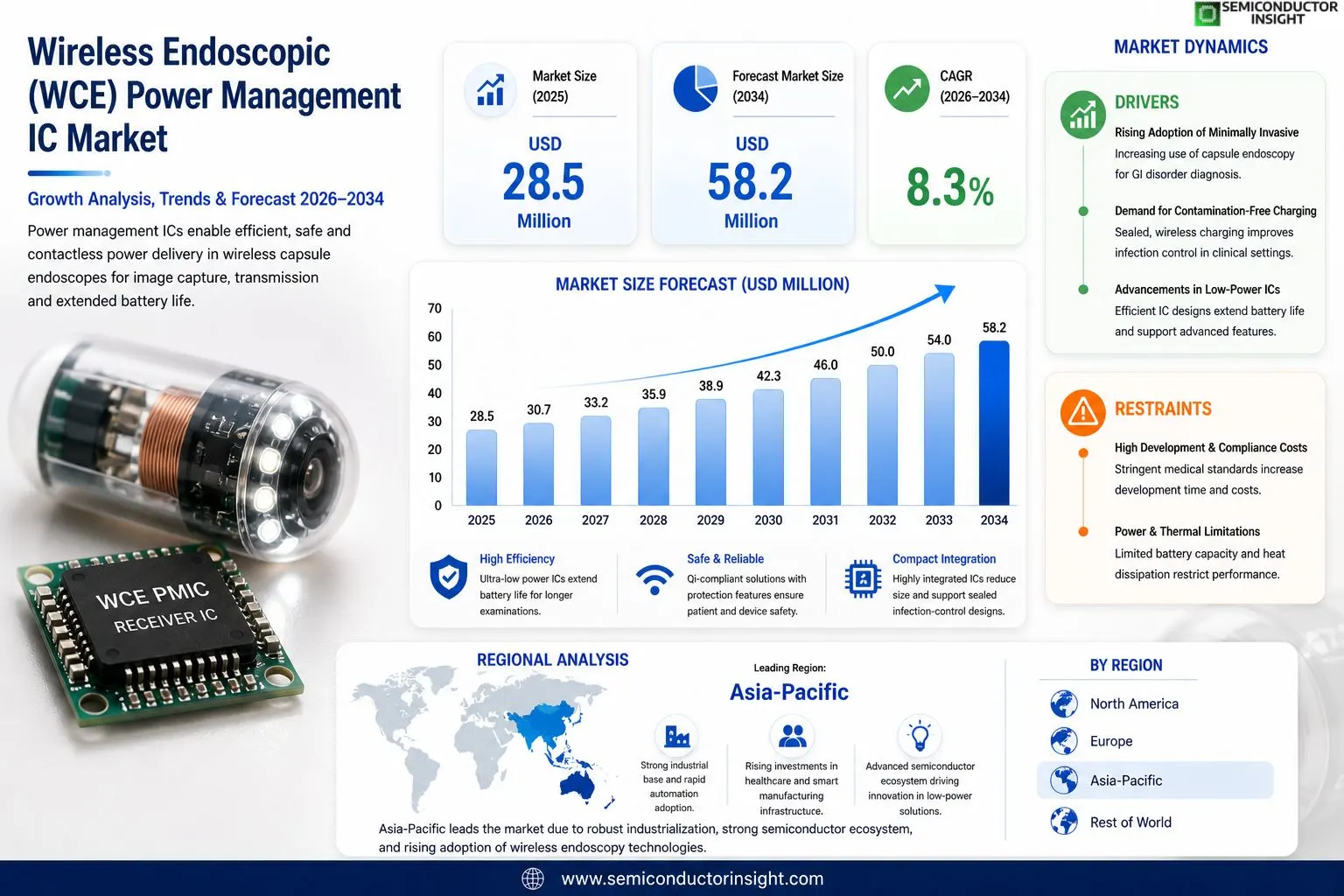
Global Wireless Endoscopic (WCE) Power Management IC market size was valued at USD 28.5 million in 2025. The market is projected to grow from USD 30.7 million in 2026 to USD 58.2 million by 2034, exhibiting a CAGR of 8.3% during the forecast period.
Wireless Endoscopic (WCE) Power Management ICs are specialized semiconductor components designed to efficiently regulate, distribute, and optimize power consumption within swallowable capsule endoscopes. These compact devices operate on limited battery resources while supporting critical functions such as image capture, LED illumination, data processing, wireless transmission, and signal conditioning. Key elements typically integrated include low-dropout regulators, DC-DC converters, battery management units, and power gating circuits that ensure ultra-low power operation to extend battery life during gastrointestinal tract examination.
The market is experiencing steady growth due to several factors, including the rising adoption of minimally invasive diagnostic procedures for gastrointestinal disorders and the continuous advancement in capsule endoscopy technology. Increasing prevalence of conditions such as obscure gastrointestinal bleeding, Crohn’s disease, and small bowel tumors has heightened demand for longer-duration, higher-resolution wireless capsules. Furthermore, the push toward more sophisticated features like multi-camera systems, enhanced imaging sensors, and real-time data transmission requires highly efficient power management solutions to maintain device performance without compromising size or safety. However, challenges remain around thermal management and energy harvesting integration in such constrained form factors.
While battery-powered capsules continue to dominate, ongoing research into wireless power transfer techniques and low-power ASIC designs is shaping innovation in this niche. Initiatives by semiconductor manufacturers focus on developing highly integrated power management ICs that combine multiple functions into single chips, reducing overall footprint and improving efficiency. Leading players in the broader semiconductor and medical device ecosystem are investing in custom solutions tailored for biomedical applications, supporting the expansion of Wireless Endoscopic (WCE) Power Management IC capabilities across global markets.
MARKET DRIVERS
Growing Demand for Minimally Invasive GI Diagnostics
Wireless Endoscopic (WCE) Power Management IC Market is propelled by the rising adoption of wireless capsule endoscopy procedures for examining the small bowel and gastrointestinal tract. Increasing prevalence of chronic digestive disorders, colorectal conditions, and the need for patient-friendly diagnostic tools without sedation drive demand for advanced, energy-efficient capsules. Power management ICs play a critical role in optimizing battery life and supporting continuous high-resolution imaging and data transmission over extended periods.
Technological Advancements in Low-Power Electronics
Progress in ultra-low power design and integration of efficient voltage regulators and battery management systems enable longer operational times for WCE devices. Manufacturers focus on PMICs that minimize consumption while powering cameras, LEDs, and wireless transmitters, addressing the constraints of miniature battery sizes typically used in swallowable capsules. These enhancements support higher frame rates and improved image quality without compromising device reliability.
➤ Integration of adaptive power techniques, such as dynamic frame rate adjustment based on capsule movement, significantly extends battery endurance in modern WCE systems.
The overall expansion of the capsule endoscopy market, driven by an aging population and preference for non-invasive procedures, creates sustained opportunities for specialized power management solutions tailored to the unique size and efficiency requirements of wireless endoscopic capsules.
MARKET CHALLENGES
Limited Battery Capacity and Operational Duration
Wireless capsule endoscopy devices operate within severe size constraints, relying on small coin-cell or silver-oxide batteries that must sustain imaging, illumination, and real-time data transmission for 8-15 hours. Power management ICs face the challenge of balancing multiple power-hungry components while preventing premature depletion, which can result in incomplete examinations of the gastrointestinal tract.
Other Challenges
Thermal and Efficiency Management
Maintaining high power conversion efficiency in a compact, biocompatible environment is difficult, as excess heat generation or inefficient energy use can impact patient safety and diagnostic performance.
Integration Complexity with Advanced Features
Incorporating higher-resolution sensors, potential active locomotion, or therapeutic capabilities increases power demands, requiring sophisticated PMIC architectures that are challenging to miniaturize without sacrificing reliability or increasing costs.
MARKET RESTRAINTS
High Development Costs and Regulatory Hurdles
Developing specialized power management ICs for Wireless Endoscopic (WCE) applications involves significant R&D investment to meet stringent medical device standards for safety, biocompatibility, and electromagnetic compatibility. These factors, combined with lengthy approval processes, restrain faster market penetration and limit the number of suppliers capable of delivering validated solutions.
Technical Limitations in Power Delivery
Current battery technologies and wireless power transfer methods for capsules still struggle with delivering stable, sufficient energy for emerging features like enhanced telemetry or extended monitoring. This restricts innovation in more complex WCE systems and slows the transition from passive diagnostic tools to multifunctional platforms, constraining overall segment growth.
MARKET OPPORTUNITIES
Advancements in Wireless Power Transfer and Energy Harvesting
Emerging wireless power transmission techniques and integration of energy-efficient PMICs present significant opportunities for Wireless Endoscopic (WCE) Power Management IC Market. These technologies could eliminate reliance on internal batteries entirely or extend operational windows, enabling longer examinations and more advanced capsule functionalities such as active control or real-time therapeutic interventions.
Expansion into AI-Enabled and Multi-Modal Capsules
As capsule endoscopy incorporates artificial intelligence for automated image analysis and higher-resolution multi-camera systems, demand grows for intelligent power management ICs capable of dynamic load balancing and sleep-mode optimization. This trend opens avenues for differentiated PMIC solutions that enhance diagnostic accuracy while maintaining the compact form factor essential for patient comfort and procedural success.
Wireless Endoscopic (WCE) Power Management IC Market Trends
Advancements in Ultra-Low Power ASIC Designs
Wireless Endoscopic (WCE) Power Management IC Market continues to evolve as semiconductor solutions address the stringent power constraints of swallowable capsule endoscopes. These specialized ICs integrate low-dropout regulators, DC-DC converters, battery management units, and power gating circuits to optimize energy distribution for image capture, LED illumination, data processing, and wireless transmission. With capsule devices relying on limited battery resources during extended gastrointestinal examinations, power management ICs enable ultra-low power operation that extends operational duration while supporting higher-resolution imaging and multi-camera configurations.Manufacturers are prioritizing highly integrated power management ICs that combine multiple functions into compact single-chip solutions. This approach reduces overall footprint, minimizes power losses, and enhances efficiency in space-constrained biomedical applications. The rising demand for sophisticated capsule features, including enhanced imaging sensors and real-time data transmission, drives the need for more efficient power regulation without compromising device safety or size.
Other Trends
Integration of Wireless Power Transfer Techniques
Ongoing research focuses on wireless power transfer methods, such as inductive coupling and magnetic resonant coupling, to supplement or reduce reliance on traditional batteries in Wireless Endoscopic (WCE) systems. Power management ICs are being adapted to work alongside these emerging techniques, enabling dynamic power delivery and improved stability during capsule transit through the GI tract. These developments help mitigate limitations related to battery life while supporting advanced diagnostic capabilities in minimally invasive procedures for conditions like obscure gastrointestinal bleeding and Crohn’s disease.
Focus on Thermal Management and Energy Efficiency
Thermal management remains a critical consideration in Wireless Endoscopic (WCE) Power Management IC Market due to the confined form factor of capsule devices. Efficient power gating and adaptive voltage scaling techniques allow selective activation of system components, conserving energy during less demanding phases of the examination. Semiconductor providers are investing in custom ASIC designs tailored for biomedical use, incorporating features that balance performance demands with heat dissipation constraints. As adoption of capsule endoscopy grows for diagnosing small bowel tumors and other GI disorders, these power optimization strategies play a pivotal role in enhancing device reliability and examination completeness. Continued innovation in low-power circuit architectures supports broader clinical utilization of wireless endoscopic technologies worldwide.
COMPETITIVE LANDSCAPE
Key Industry Players
Wireless Endoscopic (WCE) Power Management IC Market
Wireless Endoscopic (WCE) Power Management IC Market features a specialized competitive landscape where semiconductor suppliers collaborate closely with medical device manufacturers to deliver ultra-low-power solutions tailored for battery-constrained capsule endoscopes. Medtronic, through its PillCam portfolio, stands as a dominant force, leveraging integrated power management expertise to support extended imaging sessions with efficient DC-DC converters and power gating for image capture, LED illumination, and wireless data transmission. The market structure remains niche and technology-intensive, with leading players focusing on highly integrated PMICs that minimize footprint while maximizing battery life in the demanding gastrointestinal environment.Other significant players include semiconductor firms and emerging biomedical specialists developing custom power solutions, such as low-dropout regulators and energy-efficient ASICs. These companies address the growing need for advanced features like multi-camera support and real-time transmission by optimizing power distribution in compact form factors. Innovation centers on integration of multiple power functions into single chips, alongside research into wireless power transfer techniques to overcome traditional battery limitations.
List of Key Wireless Endoscopic (WCE) Power Management IC Companies Profiled
- Medtronic
- Medtronic
- Olympus Corporation
- Olympus Corporation
- CapsoVision, Inc.
- CapsoVision, Inc.
- IntroMedic Co., Ltd.
- Chongqing Jinshan Science & Technology (Group) Co., Ltd.
- AnX Robotica (Ankon)
- RF System lab
- Fujifilm Holding Corporation
- Check-Cap Ltd.
- BodyCap
- onsemi
- Advanced Energy Industries
Segment Analysis:
| Segment Category | Sub-Segments | Key Insights |
| By Type |
|
DC-DC Converters represent the leading segment in Wireless Endoscopic (WCE) Power Management ICs due to their critical role in stepping up or down voltage levels efficiently within the ultra-constrained capsule environment. These converters enable stable power delivery to high-demand components such as image sensors and wireless transmitters while minimizing energy losses. Their integration supports extended operational duration essential for complete gastrointestinal tract visualization. Manufacturers prioritize designs with high switching efficiency and minimal quiescent current to address the stringent power budget of swallowable devices. Furthermore, advanced DC-DC solutions facilitate seamless transitions between active imaging modes and low-power standby states, enhancing overall system reliability in a battery-limited setting. |
| By Application |
|
Wireless Data Transmission emerges as the leading application segment for WCE Power Management ICs. Efficient power allocation to radio frequency modules is vital for maintaining uninterrupted real-time video streaming from within the digestive tract to external receivers. Power management solutions in this segment focus on dynamic voltage scaling and burst-mode operation to handle peak transmission demands without draining the limited battery reserve prematurely. This ensures high-fidelity data transfer while preserving power for other essential functions. The emphasis on low-power transmission architectures also supports future integration of higher-resolution imaging and multi-camera systems without compromising device safety or patient comfort. |
| By End User |
|
Hospitals and Clinics constitute the leading end user segment for Wireless Endoscopic (WCE) Power Management ICs. These facilities demand highly reliable, long-duration capsule systems capable of supporting complex diagnostic procedures for conditions such as obscure gastrointestinal bleeding and inflammatory bowel diseases. Power management ICs tailored for hospital use emphasize robustness, thermal stability, and seamless compatibility with existing imaging infrastructure. Integration of sophisticated power-saving features allows clinicians to conduct thorough examinations with reduced risk of premature device failure. Moreover, the preference for advanced capsules with enhanced capabilities drives continuous innovation in power IC designs to meet stringent clinical performance and safety requirements. |
| By Technology Integration |
|
Integrated Single-Chip Solutions stand out as the leading segment within technology integration for WCE Power Management ICs. By combining multiple power functions such as voltage regulation, battery management, and power gating into a compact monolithic design, these solutions significantly reduce the overall footprint inside the swallowable capsule. This miniaturization is crucial for maintaining patient comfort and device swallowability while delivering optimal power efficiency. Single-chip architectures also simplify system-level design, lower parasitic losses, and improve thermal performance in the confined space of the capsule. Ongoing development efforts focus on enhancing functional density and energy optimization to support evolving requirements for higher-resolution imaging and extended operational times. |
| By Power Optimization Approach |
|
Dynamic Power Scaling is the leading power optimization approach in Wireless Endoscopic (WCE) Power Management IC Market. This technique allows real-time adjustment of voltage and current levels according to the instantaneous demands of different capsule subsystems, such as switching between high-power illumination during imaging and ultra-low power modes during transit. Dynamic scaling maximizes battery utilization efficiency, enabling longer examination periods critical for comprehensive small bowel assessment. It also contributes to reduced heat generation, enhancing device safety for internal use. Semiconductor developers continue to refine adaptive algorithms and control circuits to achieve finer granularity in power management, supporting the transition toward more feature-rich wireless capsules without increasing physical size. |
Regional Analysis: Wireless Endoscopic (WCE) Power Management IC Market
Asia-Pacific
Asia-Pacific stands as the leading region in Wireless Endoscopic (WCE) Power Management IC Market, driven by its robust medical device manufacturing ecosystem and accelerating adoption of advanced capsule endoscopy technologies. Countries such as China, Japan, South Korea, and India are witnessing strong momentum as healthcare providers increasingly integrate wireless capsule endoscopy systems that demand highly efficient, compact, and low-power management integrated circuits. The region’s focus on miniaturization and energy optimization aligns perfectly with the stringent requirements of Wireless Endoscopic (WCE) Power Management IC solutions, enabling longer battery life and improved image transmission reliability during gastrointestinal examinations.Local semiconductor manufacturers and medical technology firms are collaborating closely to develop next-generation power management ICs tailored for wireless endoscopic applications, emphasizing ultra-low power consumption while maintaining stable voltage regulation under varying operational conditions. Government initiatives supporting digital health transformation and medical innovation further catalyze demand, positioning Asia-Pacific as the innovation hub for Wireless Endoscopic (WCE) Power Management IC technologies. The region’s cost-competitive manufacturing capabilities combined with rising healthcare expenditure create a fertile environment for both established players and emerging companies to expand their presence in this specialized market.
Asia-Pacific leads in developing advanced power management architectures specifically optimized for wireless capsule endoscopy devices. Manufacturers are prioritizing innovations in dynamic voltage scaling and power gating techniques to extend operational duration of Wireless Endoscopic (WCE) Power Management IC solutions while preserving high-quality real-time imaging capabilities.
The region’s well-established electronics and semiconductor supply chain provides significant advantages for scaling production of Wireless Endoscopic (WCE) Power Management IC components. Close integration between IC designers and medical device assemblers accelerates time-to-market for new power-efficient endoscopic solutions.
Rapid modernization of healthcare infrastructure across key Asian economies is boosting demand for minimally invasive diagnostic tools, thereby increasing the need for sophisticated power management ICs in wireless endoscopy systems focused on patient comfort and procedural efficiency.
Collaborative efforts between regional technology giants, research institutions, and global medical device companies are fostering continuous improvement in Wireless Endoscopic (WCE) Power Management IC performance, particularly in thermal management and electromagnetic interference reduction.
North America
North America maintains a significant position in Wireless Endoscopic (WCE) Power Management IC Market through its emphasis on cutting-edge medical technology and strong regulatory standards for patient safety. The United States leads with advanced research institutions and medical device companies focused on enhancing power efficiency and reliability in wireless capsule endoscopy systems. Healthcare providers prioritize high-performance power management solutions that support extended diagnostic procedures while ensuring consistent power delivery to critical imaging and transmission components. The region’s focus on innovation encourages continuous refinement of Wireless Endoscopic (WCE) Power Management IC designs to meet evolving clinical requirements for minimally invasive diagnostics.
Europe
Europe exhibits steady growth in Wireless Endoscopic (WCE) Power Management IC Market, supported by its mature healthcare systems and increasing preference for wireless endoscopic procedures across major countries including Germany, France, and the United Kingdom. Regulatory frameworks emphasizing energy efficiency and device reliability drive demand for sophisticated power management integrated circuits. European manufacturers and research centers contribute to advancements in low-power design methodologies tailored for wireless capsule endoscopy applications. The region’s collaborative approach between medical professionals and technology providers supports the integration of advanced power management solutions that enhance procedural outcomes and patient experience in gastrointestinal diagnostics.
South America
South America is gradually expanding its presence in Wireless Endoscopic (WCE) Power Management IC Market as healthcare infrastructure modernizes and awareness of advanced diagnostic technologies increases. Countries such as Brazil and Argentina are witnessing growing adoption of wireless capsule endoscopy systems in urban medical centers. This creates opportunities for power management IC suppliers to address the specific requirements of emerging markets, including cost-effectiveness and robustness in varied clinical environments. Local stakeholders are focusing on adapting Wireless Endoscopic (WCE) Power Management IC technologies to support broader accessibility of minimally invasive endoscopic procedures across the region.
Middle East & Africa
The Middle East and Africa region shows emerging potential in Wireless Endoscopic (WCE) Power Management IC Market, fueled by investments in healthcare modernization and specialized medical facilities. Gulf Cooperation Council countries are particularly active in adopting state-of-the-art diagnostic equipment, driving demand for reliable power management solutions in wireless endoscopy applications. While the market is still developing, increasing focus on improving gastrointestinal healthcare services creates avenues for deployment of efficient Wireless Endoscopic (WCE) Power Management IC technologies. Regional players are working towards building capabilities that align with international standards for medical device performance and power optimization.
Report Scope
This market research report provides a comprehensive analysis of the Wireless Endoscopic (WCE) Power Management IC Market , covering the forecast period 2026–2034. It offers detailed insights into market dynamics, technological advancements, competitive landscape, and key trends shaping the industry.
Key focus areas of the report include:
- Market Overview: The report begins with an overview outlining its current market scenario, key growth indicators, and industry transformation drivers. It discusses macroeconomic factors, demand–supply balance, regulatory landscape, and the strategic role of semiconductors in powering advancements across industries such as automotive, telecommunications, consumer electronics, and industrial automation.
- Market Size & Forecast: Historical data and future projections for revenue, unit shipments, and market value across major regions and segments.
- Segmentation Analysis: Detailed breakdown by product type, technology, application, and end-user industry to identify high-growth segments and investment opportunities.
- Regional Insights: Insights into market performance across North America, Europe, Asia-Pacific, Latin America, and the Middle East & Africa, including country-level analysis where relevant.
- Competitive Landscape: Profiles of leading market participants, including their product offerings, R&D focus, manufacturing capacity, pricing strategies, and recent developments such as mergers, acquisitions, and partnerships.
- Technology Trends & Innovation: Assessment of emerging technologies, integration of AI/IoT, semiconductor design trends, fabrication techniques, and evolving industry standards.
- Market Drivers & Restraints: Evaluation of factors driving market growth along with challenges, supply chain constraints, regulatory issues, and market-entry barriers.
- Stakeholder Insights: Insights for component suppliers, OEMs, system integrators, investors, and policymakers regarding the evolving ecosystem and strategic opportunities.
Primary and secondary research methods are employed, including interviews with industry experts, data from verified sources, and real-time market intelligence to ensure the accuracy and reliability of the insights presented.
FREQUENTLY ASKED QUESTIONS:
What is the current market size of Wireless Endoscopic (WCE) Power Management IC Market?
-> Wireless Endoscopic (WCE) Power Management IC Market was valued at USD 28.5 million in 2025 and is expected to reach USD 58.2 million by 2034, growing at a CAGR of 8.3%.
Which key companies operate in Wireless Endoscopic (WCE) Power Management IC Market?
-> Key players include leading semiconductor manufacturers and medical device companies focused on developing customized low‑power ASICs and advanced power management solutions for wireless capsule endoscopy systems.
What are the key growth drivers?
-> Key growth drivers include the rising adoption of minimally invasive gastrointestinal diagnostics, advancements in capsule endoscopy technology, and increasing prevalence of GI disorders such as Crohn’s disease, small bowel tumors, and obscure GI bleeding.
Which region dominates the market?
-> No specific dominant region is identified in the available data; however, global demand is expanding as healthcare systems adopt advanced diagnostic imaging technologies.
What are the emerging trends?
-> Emerging trends include advancements in wireless power transfer, development of low‑power ASIC architectures, integration of high‑efficiency power management circuits, and increasing focus on energy harvesting and thermal optimization within miniaturized medical devices.

Get Sample Report PDF for Exclusive Insights
Report Sample Includes
- Table of Contents
- List of Tables & Figures
- Charts, Research Methodology, and more...
 Download Sample Report PDF