Wireless Bluetooth Speaker Chips Market Insights
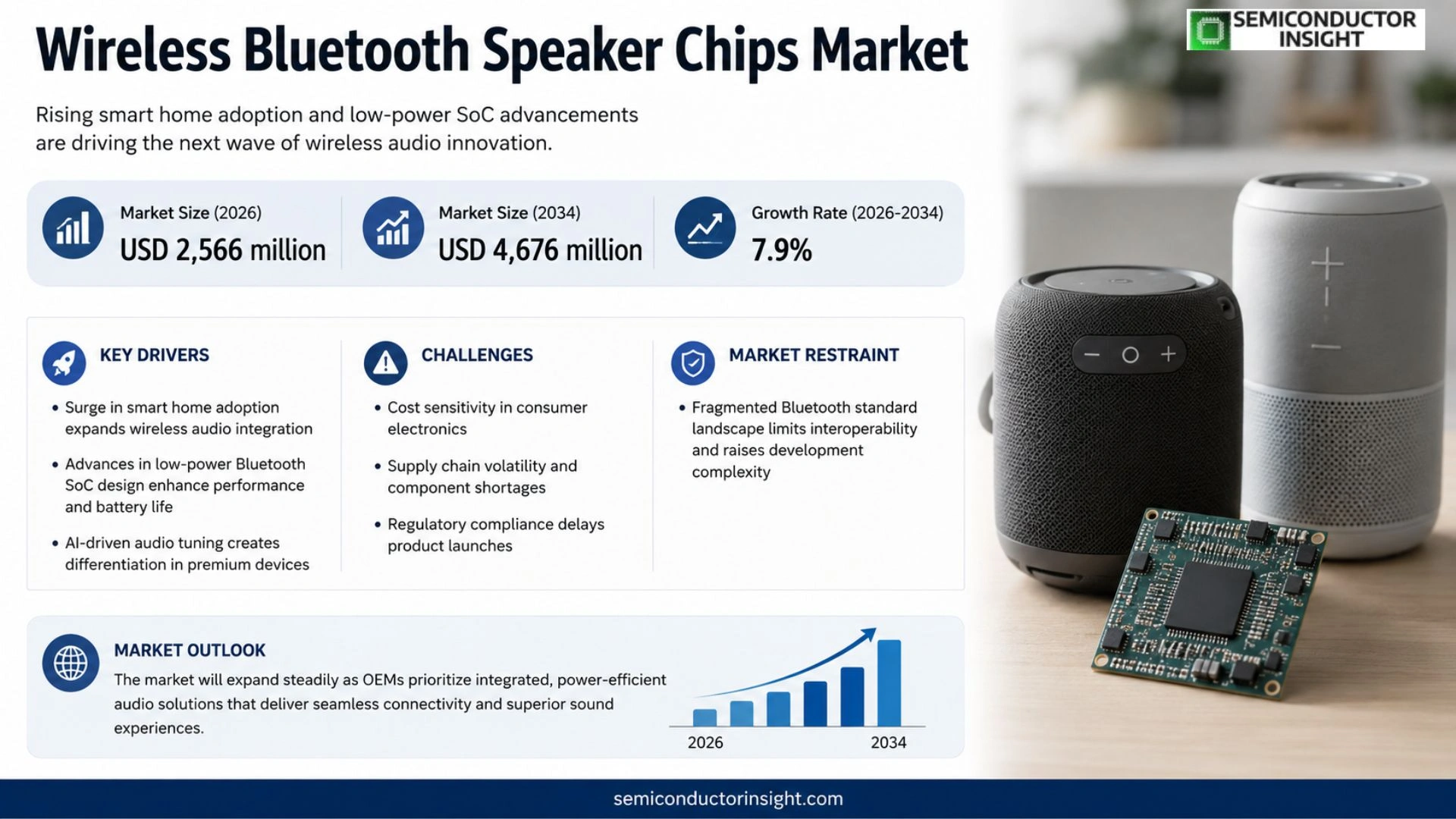
Wireless Bluetooth Speaker Chips market size was valued at USD 2,377 million in 2025. The market is projected to grow from USD 2,566 million in 2026 to USD 4,676 million by 2034, exhibiting a CAGR of 7.9% during the forecast period.
Wireless Bluetooth Speaker Chips are highly integrated semiconductor solutions that combine audio amplification, digital signal processing, power management and Bluetooth radio functions into a single package designed for portable speakers and smart‑audio devices. The latest generation supports Bluetooth 5.3, delivering higher data rates, lower latency and improved energy efficiency compared with earlier versions.
The sector benefits from rising consumer adoption of smart speakers, increased spending on premium portable audio accessories and manufacturers’ shift toward system‑on‑chip designs that reduce bill‑of‑materials costs. Leading suppliers such as Qualcomm, MediaTek, Realtek Semiconductor and Zhuhai Jieli Technology are expanding their portfolios with AI‑enhanced audio codecs and multi‑room synchronization features to capture growing demand.
MARKET DRIVERS
Surge in Smart Home Adoption
Wireless Bluetooth Speaker Chips Market is feeling the ripple of smart‑home penetration, as manufacturers embed voice‑enabled audio modules into thermostats, lighting hubs, and security panels. This integration expands the addressable base beyond traditional portable speakers, compelling chip designers to optimise for multi‑room mesh networking while preserving battery life.
Advances in Low‑Power Bluetooth SoC Design
Recent silicon breakthroughs have slashed active power draw by up to 30 %, enabling always‑on listening modes without draining portable power sources. The shift toward hybrid digital‑analog architectures also improves acoustic fidelity, positioning the chips as differentiators in premium product lines.
➤ Manufacturers that embed AI‑driven audio tuning gain a competitive edge.
Collectively, these dynamics compel OEMs to re‑engineer product roadmaps, allocating R&D budgets toward integrated Bluetooth audio SoCs that satisfy both connectivity and acoustic performance.
MARKET CHALLENGES
Cost Sensitivity in Consumer Electronics
Price pressure remains acute as retailers demand sub‑$10 components for volume‑priced smart speakers. Designers therefore balance feature sets against bill‑of‑materials constraints, often sacrificing advanced DSP capabilities to meet margin targets.
Other Challenges
Supply Chain Volatility
Geopolitical tensions and semiconductor fab capacity limits have introduced lead‑time fluctuations, forcing manufacturers to hold higher safety stocks and eroding cash flow efficiency.
Regulatory compliance, particularly electromagnetic emission standards across regions, adds an extra layer of testing and qualification that can postpone product launches.
MARKET RESTRAINTS
Fragmented Standardization Landscape
The coexistence of multiple Bluetooth audio profiles and proprietary extensions hampers seamless interoperability. OEMs must allocate engineering resources to support legacy versions while preparing for forthcoming updates, a situation that can deter smaller players from entering the space.
MARKET OPPORTUNITIES
Emerging Voice‑Assistant Ecosystems
As voice‑assistant platforms broaden their device ecosystems, demand for chips that combine low‑latency wake‑word detection with high‑definition audio streaming intensifies. Companies that bundle firmware‑level voice processing with power‑efficient Bluetooth modules are positioned to capture a growing slice of Wireless Bluetooth Speaker Chips Market.
Wireless Bluetooth Speaker Chips Market Trends
Adoption of Bluetooth 5.3 and Power‑Efficient Designs
The introduction of Bluetooth 5.3 chips has reshaped design priorities for OEMs. Compared with earlier generations, the new standard delivers lower latency, higher data‑rate efficiency and an extended range, all while drawing roughly 30 percent less power. Manufacturers that have already migrated to 5.3 report shorter battery‑drain cycles in portable speakers, which translates into stronger after‑sale sentiment among consumers who expect all‑day playback. This shift is not merely technical; it aligns with retail trends that favor devices capable of seamless multi‑room syncing and over‑the‑air updates, thereby reducing warranty claims and inventory obsolescence for brands.
Other Trends
Regional Pace and Supply‑Chain Adjustments
While the Americas recorded a 17 percent year‑on‑year surge in semiconductor sales, the Asia‑Pacific region posted a 2 percent contraction, reflecting softer consumer spending in its largest market. The divergence forces chip makers to recalibrate inventory buffers: North‑American distributors are expanding safety stock to meet rising demand for smart‑speaker modules, whereas Asian factories are trimming capacity to avoid excess. This geographic imbalance creates strategic opportunities for firms that can blend flexible logistics with localized production, especially in emerging hubs such as Southeast Asia where labor costs remain competitive.
Integration with Voice‑Activated Platforms
Smart speakers have become the primary growth engine for Wireless Bluetooth Speaker Chips Market, as voice‑assistant ecosystems demand chips that support simultaneous Bluetooth streaming and low‑power wake‑word detection. Companies that embed proprietary DSP cores alongside Bluetooth 5.3 see higher average selling prices because they can market differentiated sound‑processing capabilities. The competitive implication is clear: vendors that fail to offer a unified audio‑AI solution risk being priced out of premium contracts with ecosystem leaders, while those that pair robust connectivity with intelligent edge processing can command stronger margins and secure longer‑term supply agreements.
COMPETITIVE LANDSCAPE
Key Industry Players
Wireless Bluetooth Speaker Chips – Competitive Overview
Qualcomm continues to dominate the high‑performance segment of the Bluetooth speaker‑chip arena, leveraging its advanced Bluetooth 5.3 IP and deep integration with flagship mobile SoCs. Its portfolio couples low‑power audio codecs with robust radio calibration tools, enabling OEMs to ship premium smart‑speaker devices while meeting stringent battery‑life targets. The company’s extensive IP licensing model creates a tiered ecosystem where tier‑1 manufacturers gravitate toward Qualcomm for flagship designs, while downstream assemblers adopt its reference designs to accelerate time‑to‑market. Market concentration remains modest: the top three firms capture roughly 45 % of global shipments, reflecting both the technical barrier of entry and the strategic importance of ecosystem compatibility for end‑users.
Beyond the flagship tier, a cluster of specialists from East Asia and Europe fills niche opportunities. MediaTek has expanded its audio‑DSP line to serve cost‑sensitive smart‑home speakers, while Realtek’s integration of high‑fidelity DACs appeals to audiophile‑oriented brands. Meanwhile, Zhuhai Jieli Technology, Actions Technology, and Bluetrum pursue aggressive price points in emerging markets, often pairing their chips with localized firmware stacks. Smaller innovators such as Zgmicro Wuxi, Bestechnic, Beken, Lenze Technology, Amlogic, Yichip, Allwinner Technology, Intel, and Shanghai Mountain View Silicon diversify the supply base, each emphasizing unique value propositions,ranging from ultra‑compact form factors to AI‑enabled voice processing,thereby sustaining a competitive tempo that pressures incumbent pricing while fostering incremental feature sets.
List of Key Wireless Bluetooth Speaker Chips Companies Profiled
- Qualcomm
- MediaTek
- Realtek Semiconductor
- Zhuhai Jieli Technology
- Actions Technology
- Rockchip
- Bluetrum
- Zgmicro Wuxi
- Bestechnic
- Beken
- Lenze Technology
- Amlogic
- Yichip
- Allwinner Technology
- Intel
- Shanghai Mountain View Silicon
Segment Analysis:
| Segment Category | Sub-Segments | Key Insights |
| By Type |
|
Bluetooth 5.3 drives the market with its extended range and improved audio fidelity. – Enables richer user experiences in premium smart‑speaker designs. – Supports seamless multi‑device connectivity, fostering ecosystem lock‑in. – Offers power‑efficient operation that aligns with battery‑driven applications, encouraging broader adoption across portable audio products. |
| By Application |
|
Smart Speakers stand out as the pivotal application segment. – Their always‑on voice assistant functionality creates continuous demand for integrated Bluetooth chips. – The convergence of IoT connectivity and high‑definition sound pushes manufacturers to prioritize advanced codec support. – Home‑automation trends amplify the need for reliable, low‑latency wireless audio links, reinforcing the strategic importance of this segment. |
| By End User |
|
Consumer Electronics dominate end‑user adoption. – Mass‑market Bluetooth speakers and portable soundbars rely heavily on chip solutions that balance cost with performance. – Rapid product cycles in consumer gadgets demand flexible integration paths and quick time‑to‑market. – Brand‑driven differentiation through acoustic quality places premium on chips that support advanced audio processing. |
| By Integration Level |
|
System‑in‑Package (SiP) is emerging as the preferred integration approach. – Consolidates RF, baseband, and power management, reducing board space and simplifying design. – Enhances reliability for compact speaker form factors, which is critical for wearable and portable segments. – Enables manufacturers to accelerate differentiation by embedding custom DSP and AI‑enhanced audio algorithms within a single package. |
| By Power Consumption |
|
Low Power solutions are critical for battery‑driven speaker devices. – Extends usage time without compromising audio clarity, meeting consumer expectations for endurance. – Drives innovation in power‑save modes and adaptive streaming techniques. – Aligns with sustainability trends, prompting OEMs to prioritize eco‑friendly chip designs that minimize energy draw. |
Regional Analysis: Wireless Bluetooth Speaker Chips Market
North America
OEMs embed Bluetooth speaker chips into earbuds, wearables, and portable projectors, demanding architectures that balance size constraints with acoustic quality. The trend pushes suppliers toward system‑in‑package designs that reduce board space while preserving signal integrity.
Vendors differentiate by offering adaptive audio processing that reacts to ambient noise, enabling a smoother user experience in bustling environments. This capability is becoming a decisive factor in contract negotiations.
Recent disruptions have heightened focus on diversified silicon foundries. Companies that maintain multi‑source strategies are better positioned to meet fluctuating demand without compromising delivery timelines.
Evolving RF emission standards across North America require continuous certification updates, prompting chipset designers to embed compliance testing capabilities early in the development cycle.
Europe
European manufacturers place a premium on sustainability, influencing chipset selection toward low‑power designs that meet strict energy‑efficiency directives. The region’s dense urban centers drive demand for compact speaker solutions capable of delivering clear audio in reverberant spaces. Collaborative initiatives between telecom regulators and hardware firms are fostering the adoption of Bluetooth 5.3, which offers improved coexistence with emerging Wi‑Fi 6E bands. As consumer preference shifts toward eco‑friendly smart speakers, vendors that can certify their chips under the EU’s circular economy standards gain a competitive edge in securing design wins across the continent.
Asia‑Pacific
Asia‑Pacific remains a hotbed for volume production, with manufacturing hubs in China, Vietnam, and Malaysia underpinning cost‑effective supply chains. The region’s rapid urbanization fuels a growing middle class that seeks affordable wireless audio devices, prompting chipmakers to optimize price‑performance ratios. Simultaneously, a wave of domestic brands is investing in proprietary Bluetooth speaker architectures to reduce reliance on imported silicon. Intellectual property considerations are becoming more pronounced as regional players seek to protect home‑grown innovations while navigating complex licensing environments.
South America
In South America, market momentum is tied to the expansion of broadband infrastructure, which encourages the uptake of smart‑home audio ecosystems. Local distributors prioritize chips that offer robust connectivity in environments with intermittent network quality, leading to a preference for dual‑mode Bluetooth/Wi‑Fi solutions. Regulatory bodies are aligning with global standards, yet price sensitivity remains a decisive factor, incentivizing manufacturers to deliver cost‑efficient platforms without sacrificing core audio functionality.
Middle East & Africa
The Middle East & Africa region is characterized by a fragmented landscape where premium‑segment demand coexists with price‑driven markets. In Gulf nations, high disposable income drives adoption of luxury wireless speaker systems, prompting vendors to supply chips with advanced digital signal processing and seamless integration with voice assistants. Conversely, in many African markets, affordability drives the selection of simplified chipsets that still meet baseline performance expectations. Infrastructure projects aimed at expanding 5G coverage are also creating opportunities for next‑generation Bluetooth speaker chips that can leverage low‑latency links for immersive audio experiences.
Report Scope
This market research report provides a comprehensive analysis of the Wireless Bluetooth Speaker Chips Market , covering the forecast period 2026–2034. It offers detailed insights into market dynamics, technological advancements, competitive landscape, and key trends shaping the industry.
Key focus areas of the report include:
- Market Overview: The report begins with an overview outlining its current market scenario, key growth indicators, and industry transformation drivers. It discusses macroeconomic factors, demand–supply balance, regulatory landscape, and the strategic role of semiconductors in powering advancements across industries such as automotive, telecommunications, consumer electronics, and industrial automation.
- Market Size & Forecast: Historical data and future projections for revenue, unit shipments, and market value across major regions and segments.
- Segmentation Analysis: Detailed breakdown by product type, technology, application, and end-user industry to identify high-growth segments and investment opportunities.
- Regional Insights: Insights into market performance across North America, Europe, Asia-Pacific, Latin America, and the Middle East & Africa, including country-level analysis where relevant.
- Competitive Landscape: Profiles of leading market participants, including their product offerings, R&D focus, manufacturing capacity, pricing strategies, and recent developments such as mergers, acquisitions, and partnerships.
- Technology Trends & Innovation: Assessment of emerging technologies, integration of AI/IoT, semiconductor design trends, fabrication techniques, and evolving industry standards.
- Market Drivers & Restraints: Evaluation of factors driving market growth along with challenges, supply chain constraints, regulatory issues, and market-entry barriers.
- Stakeholder Insights: Insights for component suppliers, OEMs, system integrators, investors, and policymakers regarding the evolving ecosystem and strategic opportunities.
Primary and secondary research methods are employed, including interviews with industry experts, data from verified sources, and real-time market intelligence to ensure the accuracy and reliability of the insights presented.
FREQUENTLY ASKED QUESTIONS:
What is the current market size of Wireless Bluetooth Speaker Chips Market?
-> Wireless Bluetooth Speaker Chips market is projected to grow from USD 2,566 million in 2026 to USD 4,676 million by 2034, exhibiting a CAGR of 7.9%
Which key companies operate in Wireless Bluetooth Speaker Chips Market?
-> Key players include Qualcomm, MediaTek, Zhuhai Jieli Technology, Realtek Semiconductor, Actions Technology, Rockchip, Bluetrum, Zgmicro Wuxi, Bestechnic, Beken, Lenze Technology, Amlogic, Yichip, Allwinner Technology, Intel, Shanghai Mountain View Silicon.
What are the key growth drivers?
-> Key growth drivers include rising demand for smart and ordinary Bluetooth speakers, adoption of the latest Bluetooth 5.3 technology, expanding IoT ecosystem, and increasing consumer expenditure on portable audio devices.
Which region dominates the market?
-> Asia-Pacific remains the largest region for Wireless Bluetooth Speaker Chips, despite a modest decline of 2.0% in 2022, driven by strong demand in China, Japan, and South Korea.
What are the emerging trends?
-> Emerging trends include the rollout of Bluetooth 5.3 chips, integration of AI-driven audio enhancement, and growth of voice‑activated smart speaker platforms.
Get Sample Report PDF for Exclusive Insights
Report Sample Includes
- Table of Contents
- List of Tables & Figures
- Charts, Research Methodology, and more...
 Download Sample Report PDF