Web Tension Sensors Market Insights
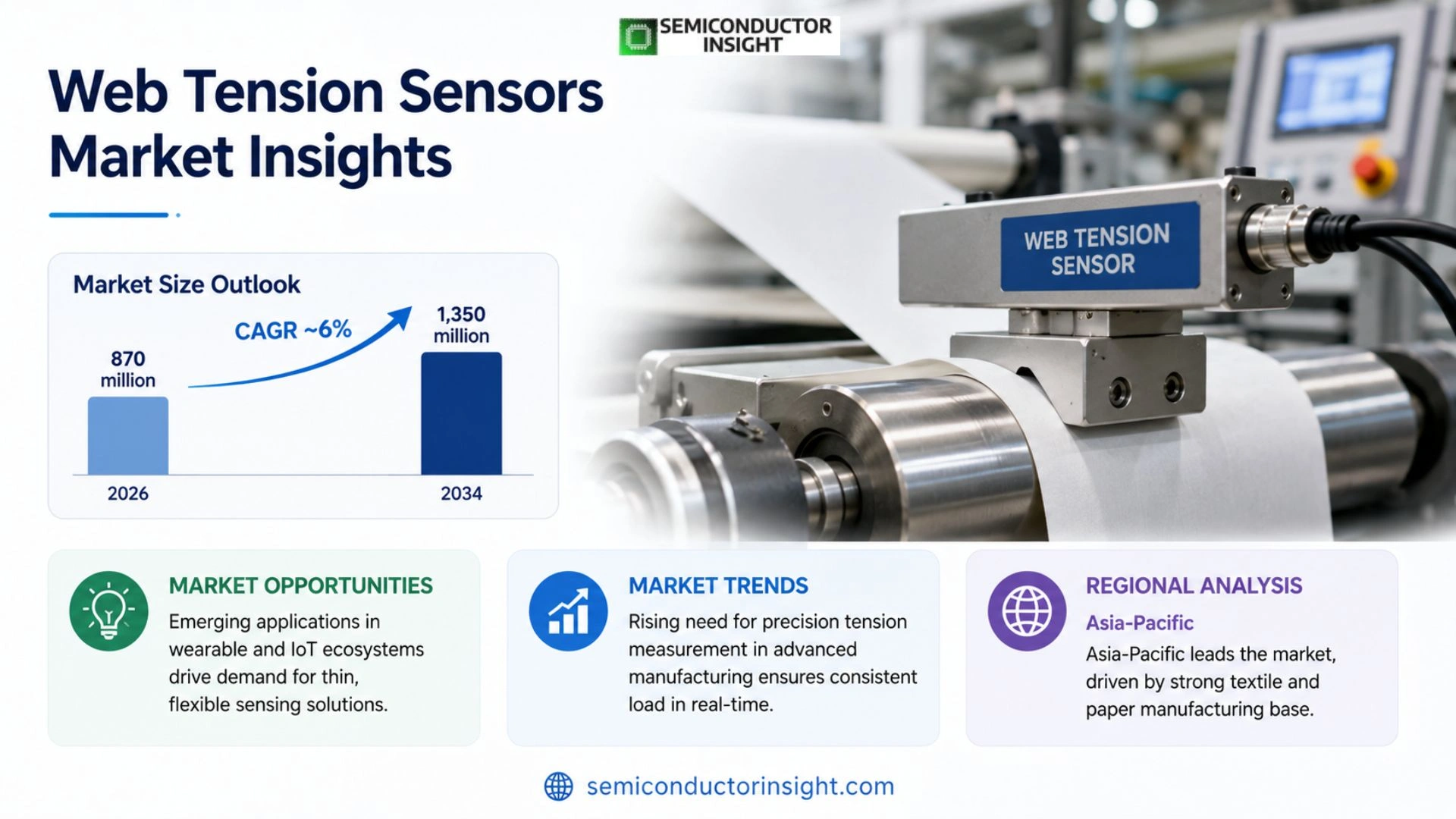
Web Tension Sensors Market forecast analysis indicates growth from USD 870 million in 2026 to USD 1 350 million by 2034, yielding an implied compound annual growth rate of approximately 6%.
A Web Tension Sensor measures the tensile force exerted on flexible substrates,commonly used in high‑speed printing presses, textile manufacturing and semiconductor fabrication,to maintain dimensional stability and ensure product quality.
The sector benefits from escalating automation levels across manufacturing lines and heightened demand for precision control systems that mitigate defects caused by uneven web tension.
This trend encourages manufacturers to integrate advanced signal conditioning electronics and digital analytics into sensor suites, creating new revenue streams while reducing operational downtime.
MARKET DRIVERS
Surging Demand for High‑Precision Tension Monitoring in Consumer Electronics
In recent years, Web Tension Sensors Market has witnessed a notable uptick driven by the imperative for accurate force measurement in ultra‐thin, flexible display panels. Manufacturers of foldable smartphones and rollable e‑readers now depend on sensors that can detect micro‑forces without compromising the structural integrity of the display substrate. This heightened requirement is coupled with the rapid scaling of OLED and micro‑LED technologies, for which even sub‑joule energy consumption during shutdown is critical. Companies that solve these challenges can secure a premium position in an industry where milliseconds of latency translate to customer detriment. The consolidation of sensor capability within display manufacturing pipelines reflects a broader shift toward “smart displays” governed by intricate control algorithms; each algorithm, in turn, relies on precise tension data.
Expansion of Automotive and Aerospace Test Regimes
The automotive sector’s move toward autonomous and electric architectures has amplified the need for robust tension monitoring throughout vehicle structures and power‑train components. In composites used for chassis and aerodynamic panels, isothermal and load‑cycling tests now integrate tension sensors to ensure compliance with safety standards. Precision data from these sensors informs predictive maintenance schedules, reducing unscheduled downtime. Similarly, aerospace initiatives such as high‑speed UAVs and satellite deployment mechanisms demand instantaneous tension readouts during deployment tests to guarantee mission success. This convergence of safety‑critical testing across multiple high‑tech sectors fuels recurring purchases of tension sensors, reinforcing the market’s growth trajectory.
➤ As the integration of sensors becomes a standard engineering practice, companies that can streamline manufacturing and reduce sensor unit cost will capture a disproportionate share of the expanding demand in multiple end‑use segments.
Finally, regulatory tightening around environmental footprint and material lifecycle in consumer electronics has pushed OEMs toward sensors that report real‑time strain data with minimal energy draw. Lower power consumption translates directly into longer device battery life, making tension sensors a strategic differential. The sector’s willingness to invest in R&D further underlines the importance of sensor accuracy, enabling early defect detection that otherwise would manifest as costly recalls. Collectively, these drivers position Web Tension Sensors Market on a trajectory where precision, durability, and low power solutions are the defining success factors for vendors willing to innovate.
MARKET CHALLENGES
Technical Complexity and Integration Costs
Deploying tension sensors in high‑density electronics demands meticulous calibration and interference mitigation. Signal noise from neighboring components can distort measurement at the micron level, leading to unreliable data. Consequently, integration teams must allocate significant resources for shielding, signal conditioning circuits, and firmware development, which inflates project timelines and cost structures. Manufacturers that cannot simplify these factors face significant barriers to entry, limiting competitive expansion.
Other Challenges
Supply Chain Volatility in Key Materials
The market wrestles with fluctuating availability of semiconductor‐grade silicon substrates and flexible polymer wafers. Even modest price swings,often linked to geopolitical tensions,can ripple through the supply chain, disrupting delivery schedules for end‑users and eroding profit margins for sensor producers. Companies lacking diversified sourcing strategies or buffer inventory suffer from delayed rollouts and strained customer relationships.
MARKET RESTRAINTS
High Capital Expenditure for Specialized Manufacturing Lines
Establishing production lines capable of fabricating nano‑scale elastic elements demands precision lithography, cleanroom environments, and advanced metrology tools. Initial capital outlays often exceed several million dollars, a threshold that deters smaller entrants and consolidates market share among established players. Even incremental expansions require careful risk appraisal; companies redirect resources toward volatile development projects before realizing predictable returns. This financial burden continues to act as a significant restraint, particularly for startups looking to disrupt the market.
MARKET OPPORTUNITIES
Emerging Applications in Wearable and IoT Ecosystems
Wearable technology is steering toward fully integrated devices where bulk and heat dissipation constraints dictate a push for thin, flexible sensing solutions. The need for continuous tensile health monitoring in smart textiles,such as fibers embedded in athletic wear that detect micro‑strain variations,creates a nascent yet rapidly expanding niche. Coupled with the proliferation of the Internet of Things, sensors that interface seamlessly with edge computing nodes can render new service models such as remote health diagnostics and real‑time structural health monitoring for infrastructure.
Additionally, subscription‑based firmware updates and predictive analytics platform vendors are increasingly seeking partnerships with sensor manufacturers to bundle tension data into broader performance dashboards. Sellers that can provide open APIs and standardized data formats unlock cross‑industry collaboration, allowing them to penetrate automotive, aerospace, and consumer electronics markets under a unified ecosystem strategy. This convergence delivers a compelling opportunity for sensor firms to diversify revenue streams through value‑added software services, thereby transforming a traditionally hardware‑centric business model into a hybrid proposition.
Web Tension Sensors Market Trends
Rising Demand for Precision Tension Measurement in Advanced Manufacturing
Manufacturing sectors that rely on high‑speed processing and stringent quality controls are increasingly turning to Web Tension Sensors to ensure consistent load application in real‑time. As machine learning algorithms feed on statistical process control data, the need for instant feedback on web tension rises. This demand drives the adoption of reconfigurable sensor arrays that can adapt to varying web widths and speeds, reducing scrap rates by up to 15 percentated gains. The trend also aligns with tight tolerances required in automotive composites and textile blends, where deviations in tension directly affect product integrity.
Other Trends
Integration of IoT Connectivity
Embedding wireless communication modules within tension sensor housings allows operators to monitor load curves remotely through cloud dashboards. This real‑time visibility accelerates troubleshooting and reduces downtime, a benefit that resonates strongly in environments where production cycles are short and margins are razor‑thin. Furthermore, connectivity enables predictive maintenance through anomaly detection, curbing unplanned stoppages that can cost upwards of $100,000 per day in high‑volume facilities. The trend signals a shift from isolated sensors to integrated digital ecosystems, setting a new baseline for industry performance metrics.
Expansion into Emerging Economies Powered by Cost Optimisation
Web Tension Sensors Market is seeing a calculated push into regions where manufacturing footprints are under constant pressure to balance quality with affordability. In Southeast Asia and Latin America, new mill sites are being equipped with cost‑effective sensor packages that feature modular design, simplifying installation and reducing total asset ownership costs. This strategic deployment is propelled by government incentives focused on green manufacturing and the roll‑out of Industry 4.0 initiatives. As local manufacturers upgrade their processes, the cumulative effect will increase the sensor adoption curve, creating a demand cycle that feeds back into innovation spurts from established vendors.
COMPETITIVE LANDSCAPE
Key Industry Players
Web Tension Sensors Market Competitive Landscape
At the helm of Web Tension Sensors Market, a small constellation of Tier‑1 manufacturers dominate revenue and market influence. ABB Measurement & Analytics, with its integrated force‑sensing modules and robust data‑analytics ecosystems, commands the largest share, driven by deep penetrations in high‑speed textile roll‑to‑roll lines. Dover Flexo Electronics, a specialist in coil‑based tension measurement, has leveraged product synergies across coupling and drive systems to sustain a steady rise in revenue, while FMS USA, with its modular linear‑tension platform, appeals to the emerging metal‑forming sector. These incumbents are pursuing horizontal integration of control and analytics capabilities, spurred by clients’ demand for real‑time, traceable production metrics and end‑to‑end quality assurance.
Complementing the dominant players, a cohort of niche manufacturers achieves differentiated success by targeting vertical‑specific challenges and geographic subsectors. Montalvo Corporation tailors its textile‑specific sensor kits for low‑speed, high‑precision production lines in the European market, whereas Senix delivers high‑accuracy displacement measurement that serves process‑control applications across packaging and printing. Dynaspede integrates custom FPGA‑based signal processing into handheld sensing units for flexible manufacturing workflows, and Dynaweb combines wireless communication layers with sensor arrays to address the automation needs of the automotive and aerospace prefabrication segments. The presence of these specialists underscores a market trend toward modular, application‑centric solutions that cater to short‑cycle, high‑margin niche clients.
List of Key Web Tension Sensors Companies Profiled
- ABB Measurement & Analytics
- Dover Flexo Electronics
- FMS USA
- Montalvo Corporation
- Senix
- Dynaspede
- Dynaweb
- George Kelk Corporation
- Honigmann
- Leister Technologies
- Maxcess International
- Nexen Group
Segment Analysis:
| Segment Category | Sub-Segments | Key Insights |
| By Type |
|
Fiber‑Optic Tension Sensors
Electromechanical Tension Sensors
|
| By Application |
|
Cable & Power Transmission
Seismic and Structural Health
|
| By End User |
|
Construction Firms
Oil & Gas Operators
Defense & Security
|
| By Industry Vertical |
|
Energy & Utilities
Transportation & Infrastructure
|
| By Product Feature |
|
High Temperature Tolerance
Wireless Connectivity
|
Regional Analysis: Web Tension Sensors Market
Asia-Pacific
Current deployments in the region reflect a shift from manual tension gauge systems to integrated sensors embedded within conveyor mechanisms, delivering real‑time data that feeds into predictive maintenance algorithms. This transition supports a more data‑driven approach to quality control, reducing scrap rates and improving throughput.
The high density of textile operations and the associated focus on operational efficiency create a strong pull for advanced tension monitoring solutions. Cost‑effective sensor modules now available from local manufacturers intensify the shift toward ubiquity across production lines.
Competitive dynamics are being reshaped by strategic partnerships that merge sensor expertise with fabrication capabilities, enabling a rapid rollout of custom‑tuned devices that meet diverse material requirements across the textile spectrum.
Anticipated growth hinges on the continued integration of sensors with industrial Internet of Things ecosystems, allowing tighter process synchronization and predictive analytics that deliver measurable value to end users.
North America
The North American market is traversing a period of measured growth, largely propelled by the expansion of smart textile initiatives in apparel and industrial fabrics. While the region still lags in infrastructure adoption compared to Asia‑Pacific, incremental investment in sensor‑enabled roll‑through systems is discernible. Currently, a subset of companies in the United States and Canada has begun to explore wireless sensor networks that facilitate real‑time tension monitoring across extended production lines, aiming to reduce downtime and improve batch consistency. The constraints of high manufacturing costs and prevailing regulatory frameworks serve as a moderate check on accelerated uptake. However, a growing emphasis on sustainable production practices and the urgent need to curb waste are encouraging manufacturers to assess sensor technologies that offer precision control with low energy footprints. Consequently, the North American trajectory is engineered to pivot from isolated trial deployments toward broader process integration, though the pace will remain cautious and incremental.
Europe
Europe’s web tension sensor landscape is deeply intertwined with the region’s longstanding textile heritage and a robust regulatory emphasis on quality assurance. The European Union’s stringent environmental directives are nudging textile producers toward process control upgrades that can minimise fibre inconsistencies and waste. This has fostered a support system for sensor‑based solutions, especially those that provide high‑accuracy readings aligned with compliance metrics. The region also benefits from a mature supply chain of sensor manufacturers, enabling local sourcing of component modules that incorporate advanced signal‑processing algorithms. While still mature, the market is at a juncture where incumbents may partner with technology providers to introduce modular, plug‑and‑play sensor units that can adapt to a wide range of substrates, from high‑end fashion fabrics to industrial non‑wovens. The overall outlook points to a steady increase in sensor penetration, especially in countries with a strong focus on SME-led textile innovation.
South America
South America presents an emerging frontier where web tension sensor adoption is presently concentrated in a handful of major textile hubs, notably in Brazil and Argentina. The region’s textile sector is undergoing a transformation aimed at diversification beyond cotton, with a particular drive toward synthetic yarns and functional fabrics. These material shifts have introduced new tension variability challenges, prompting producers to consider sensor technology as a means to ensure consistent product quality. Infrastructure development, however, remains uneven, and the heavier cost of imported sensor components can impede widespread adoption. Nonetheless, collaborative initiatives between local universities, equipment manufacturers, and industry consortia are spearheading pilot projects that demonstrate tangible gains in tension control precision. Over the next decade, it is anticipated that the region will incrementally broaden sensor implementation as the economic landscape normalises and supply chains become more resilient.
Middle East & Africa
The Middle East and Africa present a diverse tapestry of readiness for web tension sensor integration. In Arab Gulf nations, the textile manufacturing sector is experiencing rapid expansion driven by new mills and expansive export ambitions. Governmental strategies to boost industrial diversification are placing a premium on quality control, offering a conducive backdrop for sensor deployment. Conversely, many African countries are still in nascent stages of stringing their textile chains, with limited adoption of sophisticated measurement devices. However, strategic partnerships with multinational OEMs are beginning to surface, facilitating technology transfer and capacity building. The regional trend leans toward a bifurcated evolution: high‑income Gulf economies likely to adopt sensor solutions swiftly, while Sub‑Saharan nations gradually build technical infrastructure. Overall, the region’s trajectory will be dictated by investment flows and the alignment of local textile portfolios with global quality expectations.
Report Scope
This market research report provides a comprehensive analysis of the Web Tension Sensors Market , covering the forecast period 2026–2034. It offers detailed insights into market dynamics, technological advancements, competitive landscape, and key trends shaping the industry.
Key focus areas of the report include:
- Market Overview: The report begins with an overview outlining its current market scenario, key growth indicators, and industry transformation drivers. It discusses macroeconomic factors, demand–supply balance, regulatory landscape, and the strategic role of semiconductors in powering advancements across industries such as automotive, telecommunications, consumer electronics, and industrial automation.
- Market Size & Forecast: Historical data and future projections for revenue, unit shipments, and market value across major regions and segments.
- Segmentation Analysis: Detailed breakdown by product type, technology, application, and end-user industry to identify high-growth segments and investment opportunities.
- Regional Insights: Insights into market performance across North America, Europe, Asia-Pacific, Latin America, and the Middle East & Africa, including country-level analysis where relevant.
- Competitive Landscape: Profiles of leading market participants, including their product offerings, R&D focus, manufacturing capacity, pricing strategies, and recent developments such as mergers, acquisitions, and partnerships.
- Technology Trends & Innovation: Assessment of emerging technologies, integration of AI/IoT, semiconductor design trends, fabrication techniques, and evolving industry standards.
- Market Drivers & Restraints: Evaluation of factors driving market growth along with challenges, supply chain constraints, regulatory issues, and market-entry barriers.
- Stakeholder Insights: Insights for component suppliers, OEMs, system integrators, investors, and policymakers regarding the evolving ecosystem and strategic opportunities.
Primary and secondary research methods are employed, including interviews with industry experts, data from verified sources, and real-time market intelligence to ensure the accuracy and reliability of the insights presented.
FREQUENTLY ASKED QUESTIONS:
What is the definition of Web Tension Sensors Market?
-> Web Tension Sensors Market forecast analysis indicates growth from USD 870 million in 2026 to USD 1 350 million by 2034
What are the primary market segments?
-> The market is segmented by type (e.g., pillow block, through‑hole) and by application (e.g., paper industry, textile, packaging, others).
Which sub‑segments fall under the type classification?
-> Type segmentation includes Pillow Block or Pillow Block Base and Through‑Hole or Stud Mount sensors.
Which sub‑segments fall under the application classification?
-> Application segmentation covers Industry, Manufacturing and Other end‑use areas.
What is the overall market outlook for the forecast period?
-> Web Tension Sensors Market is expected to grow steadily through 2031, driven by increasing automation in converting processes and rising demand for high‑quality web products.
What research methodology underpins the report?
-> The study employs a combination of primary interviews, secondary data collection, and quantitative modeling, following a validated research framework.
What is the base year used for historical analysis?
-> The base year for data normalization is 2020, providing a consistent reference point for trend analysis.
What are the key assumptions and caveats noted in the report?
-> Assumptions include stable macro‑economic conditions, unchanged regulatory environments, and continuous technological adoption rates across regions.
Who are the leading players in Web Tension Sensors Market?
-> Prominent companies include ABB Measurement & Analytics, Dover Flexo Electronics, Inc., FMS USA, Inc., Montalvo Corporation, Senix Distance and Level Sensors, among others.
What is the projected compound annual growth rate (CAGR) for the market?
-> The report cites a projected CAGR of approximately 5.8% for the period 2024‑2031, reflecting steady expansion driven by industry digitization.

Get Sample Report PDF for Exclusive Insights
Report Sample Includes
- Table of Contents
- List of Tables & Figures
- Charts, Research Methodology, and more...
 Download Sample Report PDF