Wearable PPG (Photoplethysmography) Sensor for HR Market Insights
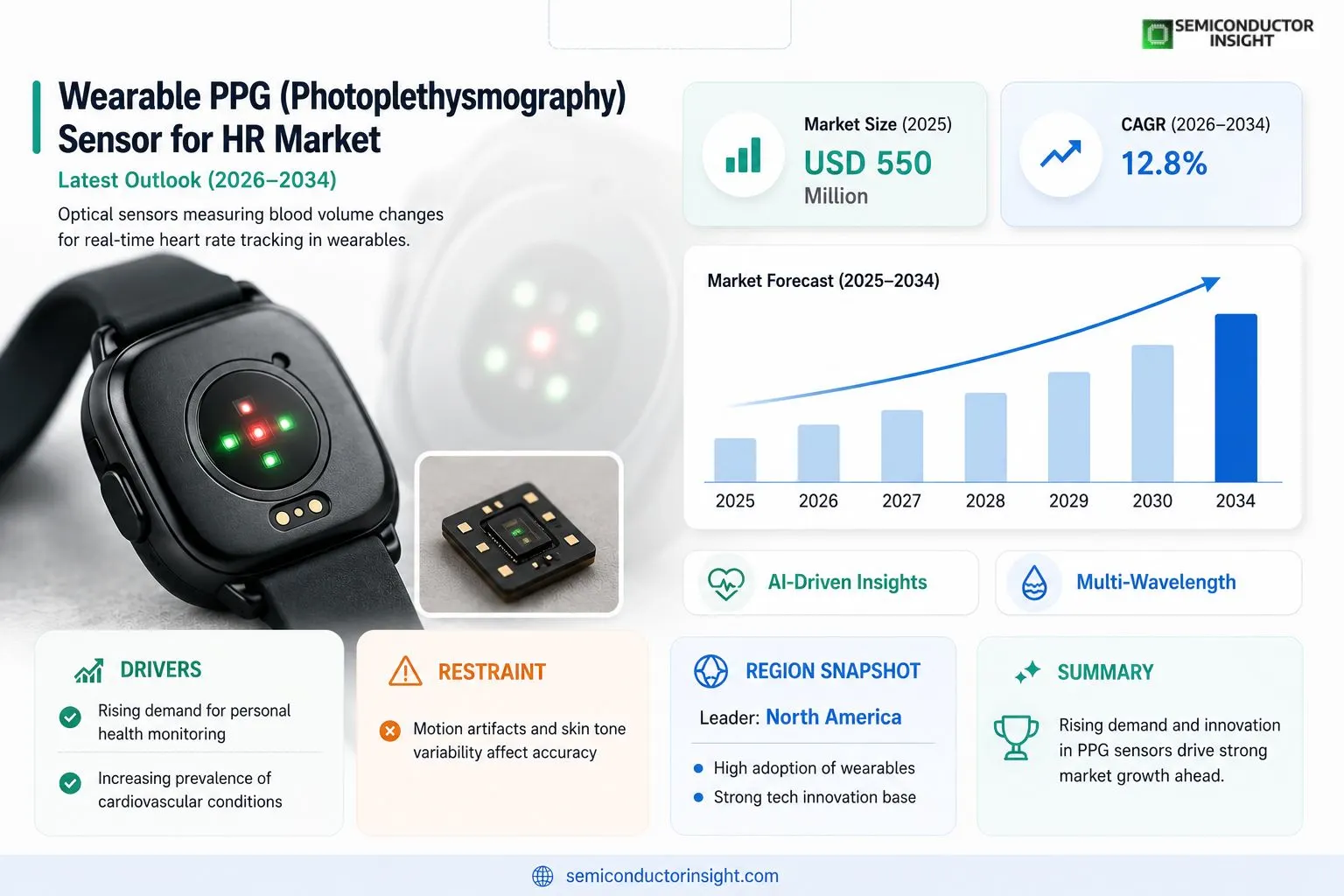
Global Wearable PPG (Photoplethysmography) Sensor for HR Market size was valued at USD 550 million in 2025. The market is projected to grow from USD 620 million in 2026 to USD 1.45 billion by 2034, exhibiting a CAGR of 12.8% during the forecast period.
Wearable PPG (Photoplethysmography) sensors for heart rate monitoring are optical devices that use light to measure blood volume changes in the microvascular bed of tissue. These sensors emit light into the skin and detect the reflected or transmitted light variations caused by pulsatile blood flow, enabling accurate, non-invasive heart rate tracking in real time. They have become essential components in smartwatches, fitness bands, rings, and patches due to their compact size, low power consumption, and ability to provide continuous monitoring without the need for chest straps or electrodes.
The market is experiencing robust growth due to several factors, including rising consumer demand for personal health monitoring, increasing prevalence of cardiovascular conditions, and rapid advancements in wearable technology. Furthermore, the integration of PPG sensors with AI-driven analytics has enhanced accuracy and expanded applications beyond basic heart rate to include blood oxygen saturation and stress level assessment. While challenges such as motion artifacts and skin tone variability persist, ongoing innovations in multi-wavelength LEDs and advanced signal processing algorithms continue to improve reliability. Key players are actively investing in research and development to address these issues and expand market reach through strategic collaborations and product launches focused on medical-grade accuracy and seamless device integration.
MARKET DRIVERS
Rising Demand for Continuous Health Monitoring in Wearables
Wearable PPG (Photoplethysmography) Sensor for HR Market is experiencing robust growth driven by the widespread adoption of smartwatches and fitness trackers. These devices leverage PPG technology for real-time, non-invasive heart rate monitoring, appealing to consumers focused on fitness, wellness, and preventive healthcare. Market projections indicate strong expansion, with PPG biosensors supporting heart rate applications that represent a significant share of wearable sensor revenues.
Increasing Prevalence of Cardiovascular Conditions
Growing awareness of cardiovascular diseases has accelerated the integration of PPG sensors into consumer and medical-grade wearables. PPG technology offers cost-effective, flexible deployment across wrist-worn devices, rings, and patches, enabling continuous tracking that supports early detection and remote patient monitoring. This trend aligns with post-pandemic emphasis on digital health solutions.
➤ The shift toward preventive healthcare and integration of PPG sensors in everyday wearables continues to fuel double-digit market growth.
Advancements in sensor miniaturization and battery efficiency further enhance user adoption, positioning PPG-based heart rate monitoring as a core feature in next-generation wearable ecosystems.
MARKET CHALLENGES
Accuracy Limitations Due to Motion Artifacts
Motion artifacts remain a primary technical hurdle for Wearable PPG (Photoplethysmography) Sensor for HR Market, as physical activity can distort optical signals and lead to unreliable heart rate readings. This challenge is particularly pronounced during dynamic exercises, limiting clinical-grade reliability in ambulatory settings.
Other Challenges
Signal Quality Variability
Factors such as skin tone, sensor placement, and ambient conditions introduce variability in PPG signal quality, affecting measurement consistency across diverse user populations.
Integration and Power Constraints
Balancing high-fidelity heart rate monitoring with device battery life and compact form factors continues to challenge manufacturers in competitive wearable markets.
MARKET RESTRAINTS
Technical and Environmental Sensitivities
Wearable PPG (Photoplethysmography) Sensor for HR Market faces restraints from inherent sensitivities of optical sensing technology. PPG signals can be impacted by motion artifacts, varying skin perfusion, and external lighting conditions, which compromise accuracy during real-world use and slow adoption in high-precision medical applications. Regulatory requirements for clinical validation and data privacy concerns in connected health devices further constrain rapid market scaling, requiring significant investment in signal processing algorithms and validation studies.
MARKET OPPORTUNITIES
Technological Advancements and AI Integration
Significant opportunities exist in Wearable PPG (Photoplethysmography) Sensor for HR Market through AI-driven signal processing and multi-wavelength sensors that improve motion artifact rejection and enable additional vital sign monitoring. These innovations expand applications into clinical remote monitoring and advanced fitness analytics. Expansion into emerging markets, integration with broader health ecosystems, and development of clinical-grade wearable solutions present avenues for sustained growth amid rising demand for personalized health insights.
Wearable PPG (Photoplethysmography) Sensor for HR Market Trends
Advancements in Optical Sensor Technology
Wearable PPG (Photoplethysmography) sensors for heart rate monitoring continue to evolve as essential optical components in modern wearable devices. These sensors utilize light emission into the skin to detect blood volume changes through variations in reflected or transmitted light, enabling real-time, non-invasive heart rate tracking. Their compact design, energy efficiency, and seamless integration into smartwatches, fitness bands, rings, and patches have driven widespread adoption for continuous monitoring without traditional chest straps or electrodes.
Other Trends
Rising Demand for Personalized Health Monitoring
Consumer interest in proactive health management has significantly boosted Wearable PPG (Photoplethysmography) Sensor for HR Market. Individuals increasingly seek devices that provide continuous insights into cardiovascular health, supported by the growing prevalence of heart-related conditions globally. This trend encourages manufacturers to prioritize user-friendly interfaces and reliable performance in everyday environments.
Integration with AI-Driven Analytics
Modern PPG sensors now frequently incorporate artificial intelligence to enhance measurement accuracy and expand functionality. AI algorithms help filter noise and improve data interpretation, allowing these sensors to support additional metrics such as blood oxygen saturation and stress assessment alongside primary heart rate monitoring. This convergence of hardware and software represents a key development in Wearable PPG (Photoplethysmography) Sensor for HR Market.
Addressing Technical Challenges Through Innovation
Despite strong momentum, Wearable PPG (Photoplethysmography) Sensor for HR Market faces ongoing hurdles including motion artifacts and performance variations across different skin tones. Industry leaders respond with multi-wavelength LED implementations and sophisticated signal processing techniques that substantially improve reliability under diverse conditions. These technical refinements support the transition toward medical-grade accuracy in consumer wearables.
Strategic collaborations and focused research initiatives among key players further accelerate progress in device integration and performance optimization. As wearable technology advances, PPG sensors remain central to delivering actionable heart rate data that empowers users and healthcare providers alike. The combination of hardware innovation, algorithmic improvements, and expanding application scope positions this technology for sustained relevance in the health monitoring ecosystem.
COMPETITIVE LANDSCAPE
Key Industry Players
Innovative PPG Sensor Technologies Powering Next-Generation Wearable Heart Rate Monitoring
Wearable PPG (Photoplethysmography) Sensor for HR Market is dominated by a mix of consumer electronics giants and specialized semiconductor manufacturers. Apple Inc. stands as a leading player through its highly integrated PPG solutions in the Apple Watch series, which have set industry benchmarks for accuracy, user experience, and seamless ecosystem integration. The market structure features strong vertical integration by device OEMs alongside component suppliers providing advanced optical sensor modules, driving competition through continuous improvements in multi-wavelength LEDs, signal processing algorithms, and power efficiency.
Other significant players include established fitness and medical device companies alongside fabless semiconductor firms specializing in optical biosensors. These niche participants focus on clinical-grade accuracy, motion artifact reduction, and specialized applications such as ear-worn or ring-based form factors, often supplying core PPG technology to broader wearable ecosystems through partnerships and licensing agreements.
List of Key Wearable PPG Sensor Companies Profiled
- Apple Inc.
- Samsung Electronics Co., Ltd.
- Garmin Ltd.
- Fitbit Inc. (Google)
- Valencell, Inc.
- Analog Devices, Inc. (Maxim Integrated)
- ams-OSRAM AG
- Masimo Corporation
- Omron Healthcare, Inc.
- Texas Instruments Incorporated
- Huawei Technologies Co., Ltd.
- Xiaomi Corporation
- Rockley Photonics
- Philips Healthcare
- Withings
Segment Analysis:
| Segment Category | Sub-Segments | Key Insights |
| By Type |
|
Multi-Wavelength PPG Sensors stand out as the leading type due to their superior capability in handling diverse skin tones and reducing motion artifacts through layered light penetration. These sensors deliver more consistent readings during dynamic activities by combining different light sources for comprehensive blood volume analysis. Their integration supports expanded health metrics beyond basic heart rate, fostering greater user trust in continuous monitoring scenarios. Manufacturers prioritize these for premium devices where reliability during exercise and daily wear is paramount. |
| By Application |
|
Fitness and Activity Tracking emerges as the dominant application, driven by consumer enthusiasm for real-time performance insights during workouts and daily routines. PPG sensors excel here by providing seamless, unobtrusive heart rate data that enhances training efficiency and motivational feedback. The technology’s compact nature allows effortless incorporation into lifestyle-oriented wearables, encouraging prolonged user engagement. Innovations in signal processing further refine accuracy for high-intensity movements, making this segment central to mass-market adoption and product differentiation. |
| By End User |
|
Individual Consumers represent the leading end-user group, fueled by widespread interest in proactive personal wellness and convenient health tracking. Wearable PPG sensors cater perfectly to this demographic by offering user-friendly, everyday monitoring without clinical complexity. Their low-power design supports all-day usage in popular devices, building habits around heart health awareness. This segment benefits from intuitive interfaces that translate raw data into actionable lifestyle recommendations, driving sustained demand and innovation in accessible consumer electronics. |
| By Form Factor |
|
Smartwatches lead this segment owing to their versatile design that combines PPG sensors with comprehensive display and connectivity features. This form factor allows natural, continuous wear while maintaining aesthetic appeal for broad demographics. The integration enables multi-functionality where heart rate data complements notifications and other utilities, enhancing overall user experience. Ongoing refinements in sensor placement and ergonomics ensure comfort during extended periods, positioning smartwatches as the preferred choice for holistic daily monitoring. |
| By Technology |
|
AI-Enhanced Signal Processing is the leading technology, significantly improving the reliability of PPG readings by intelligently filtering noise and adapting to individual user patterns. This approach addresses common challenges like variable skin contact and movement interference through sophisticated algorithms that refine raw optical data in real time. It paves the way for more accurate personalized insights, elevating the sensors from basic trackers to intelligent health companions. Collaboration between hardware and software developers continues to unlock new potential in predictive monitoring and seamless integration. |
Regional Analysis: Wearable PPG (Photoplethysmography) Sensor for HR Market
North America
North America stands as the leading region in Wearable PPG (Photoplethysmography) Sensor for HR Market, driven by its advanced healthcare ecosystem and strong emphasis on personal wellness technologies. Consumers in the United States and Canada actively integrate wearable devices into daily health monitoring routines, favoring seamless heart rate tracking through optical sensor technology. Innovation hubs in Silicon Valley and other tech centers accelerate development of next-generation PPG sensors that deliver higher accuracy and better power efficiency for continuous monitoring.Major brands collaborate closely with fitness enthusiasts, athletes, and medical professionals to refine sensor performance in real-world conditions. The region’s robust intellectual property framework encourages investment in advanced signal processing algorithms that filter motion artifacts effectively. Growing awareness of preventive healthcare further supports adoption of PPG-enabled wearables for early detection of irregularities. Strategic partnerships between technology firms and lifestyle brands create compelling user experiences that blend fashion with functionality, expanding market reach across demographics.
North America leads in refining PPG sensor precision through sophisticated AI-driven noise cancellation and multi-wavelength light integration. Companies prioritize miniaturization while maintaining clinical-grade performance, enabling smaller form factors without sacrificing heart rate data reliability for active users.
High health consciousness and disposable income drive widespread integration of PPG sensors into smartwatches and fitness bands. Users value real-time insights during workouts and daily activities, creating strong demand for intuitive interfaces that translate complex optical data into actionable wellness metrics.
Supportive yet rigorous standards from health authorities encourage manufacturers to meet stringent accuracy requirements. This environment fosters trust among both consumers and healthcare providers, positioning PPG technology as a reliable tool for personal cardiac monitoring.
Intense competition among established tech giants and innovative startups accelerates product differentiation through enhanced battery life and seamless ecosystem integration, benefiting end-users with more sophisticated wearable solutions for heart rate management.
Europe
Europe demonstrates mature growth in Wearable PPG (Photoplethysmography) Sensor for HR Market, supported by strong emphasis on wellness and aging population needs. Countries like Germany, the UK, and France show increasing adoption of smart wearables for continuous health tracking in both fitness and clinical contexts. Regulatory harmonization across the EU facilitates smoother market entry for devices featuring advanced PPG technology. Focus on data privacy and ethical AI usage shapes product development, building consumer confidence. Collaborations between universities and manufacturers drive research into more accurate optical sensing for diverse skin tones and activity levels, enhancing overall market sophistication.
Asia-Pacific
Asia-Pacific emerges as a dynamic force in Wearable PPG (Photoplethysmography) Sensor for HR Market with rapid urbanization and rising middle-class interest in health technology. Markets in China, Japan, South Korea, and India witness expanding manufacturing capabilities and local innovation tailored to regional preferences. Consumers appreciate affordable yet feature-rich wearables that combine PPG heart rate monitoring with lifestyle applications. Government initiatives promoting digital health further accelerate integration of sensor technology into everyday devices. The region benefits from strong supply chain networks that support scalable production of high-quality optical components.
South America
South America shows promising expansion in Wearable PPG (Photoplethysmography) Sensor for HR Market as awareness of preventive healthcare grows across Brazil, Mexico, and other key countries. Urban professionals increasingly adopt wearable devices to monitor heart rate during fitness activities and daily routines. Local distributors partner with global brands to make PPG-enabled technology more accessible. Challenges related to economic variability encourage development of cost-effective solutions without compromising core sensor performance. Growing sports culture and fitness trends create natural demand for accurate, motion-resistant heart rate tracking capabilities in tropical climates.
Middle East & Africa
The Middle East and Africa region presents emerging opportunities in Wearable PPG (Photoplethysmography) Sensor for HR Market, particularly in Gulf countries where luxury wellness and health tech adoption rates are rising. UAE and Saudi Arabia lead with investments in smart city health initiatives that incorporate wearable monitoring. PPG sensors appeal to active populations engaged in desert sports and fitness programs. While infrastructure development varies, increasing smartphone penetration supports connected wearable ecosystems. Focus on chronic condition management drives interest in reliable optical heart rate technology among healthcare providers and tech-savvy consumers seeking convenient monitoring tools.
Report Scope
This market research report provides a comprehensive analysis of the Wearable PPG (Photoplethysmography) Sensor for HR Market , covering the forecast period 2026–2034. It offers detailed insights into market dynamics, technological advancements, competitive landscape, and key trends shaping the industry.
Key focus areas of the report include:
- Market Overview: The report begins with an overview outlining its current market scenario, key growth indicators, and industry transformation drivers. It discusses macroeconomic factors, demand–supply balance, regulatory landscape, and the strategic role of semiconductors in powering advancements across industries such as automotive, telecommunications, consumer electronics, and industrial automation.
- Market Size & Forecast: Historical data and future projections for revenue, unit shipments, and market value across major regions and segments.
- Segmentation Analysis: Detailed breakdown by product type, technology, application, and end-user industry to identify high-growth segments and investment opportunities.
- Regional Insights: Insights into market performance across North America, Europe, Asia-Pacific, Latin America, and the Middle East & Africa, including country-level analysis where relevant.
- Competitive Landscape: Profiles of leading market participants, including their product offerings, R&D focus, manufacturing capacity, pricing strategies, and recent developments such as mergers, acquisitions, and partnerships.
- Technology Trends & Innovation: Assessment of emerging technologies, integration of AI/IoT, semiconductor design trends, fabrication techniques, and evolving industry standards.
- Market Drivers & Restraints: Evaluation of factors driving market growth along with challenges, supply chain constraints, regulatory issues, and market-entry barriers.
- Stakeholder Insights: Insights for component suppliers, OEMs, system integrators, investors, and policymakers regarding the evolving ecosystem and strategic opportunities.
Primary and secondary research methods are employed, including interviews with industry experts, data from verified sources, and real-time market intelligence to ensure the accuracy and reliability of the insights presented.
FREQUENTLY ASKED QUESTIONS:
What is the current market size of Wearable PPG (Photoplethysmography) Sensor for HR Market?
-> Wearable PPG (Photoplethysmography) Sensor for HR Market was valued at USD 550 million in 2025 and is expected to reach USD 1.45 billion by 2034.
Which key companies operate in Wearable PPG (Photoplethysmography) Sensor for HR Market?
-> Key players include ams-OSRAM, Analog Devices, Silicon Laboratories, Valencell, Maxim Integrated, among others.
What are the key growth drivers?
-> Key growth drivers include rising consumer demand for personal health monitoring, increasing prevalence of cardiovascular conditions, and rapid advancements in wearable technology.
Which region dominates the market?
-> Asia-Pacific is the fastest-growing region, while North America remains a dominant market.
What are the emerging trends?
-> Emerging trends include integration of AI-driven analytics, multi-wavelength LEDs, and advanced signal processing algorithms.

Get Sample Report PDF for Exclusive Insights
Report Sample Includes
- Table of Contents
- List of Tables & Figures
- Charts, Research Methodology, and more...