Wearable Drug Delivery Patch (Iontophoresis) IC Market Insights
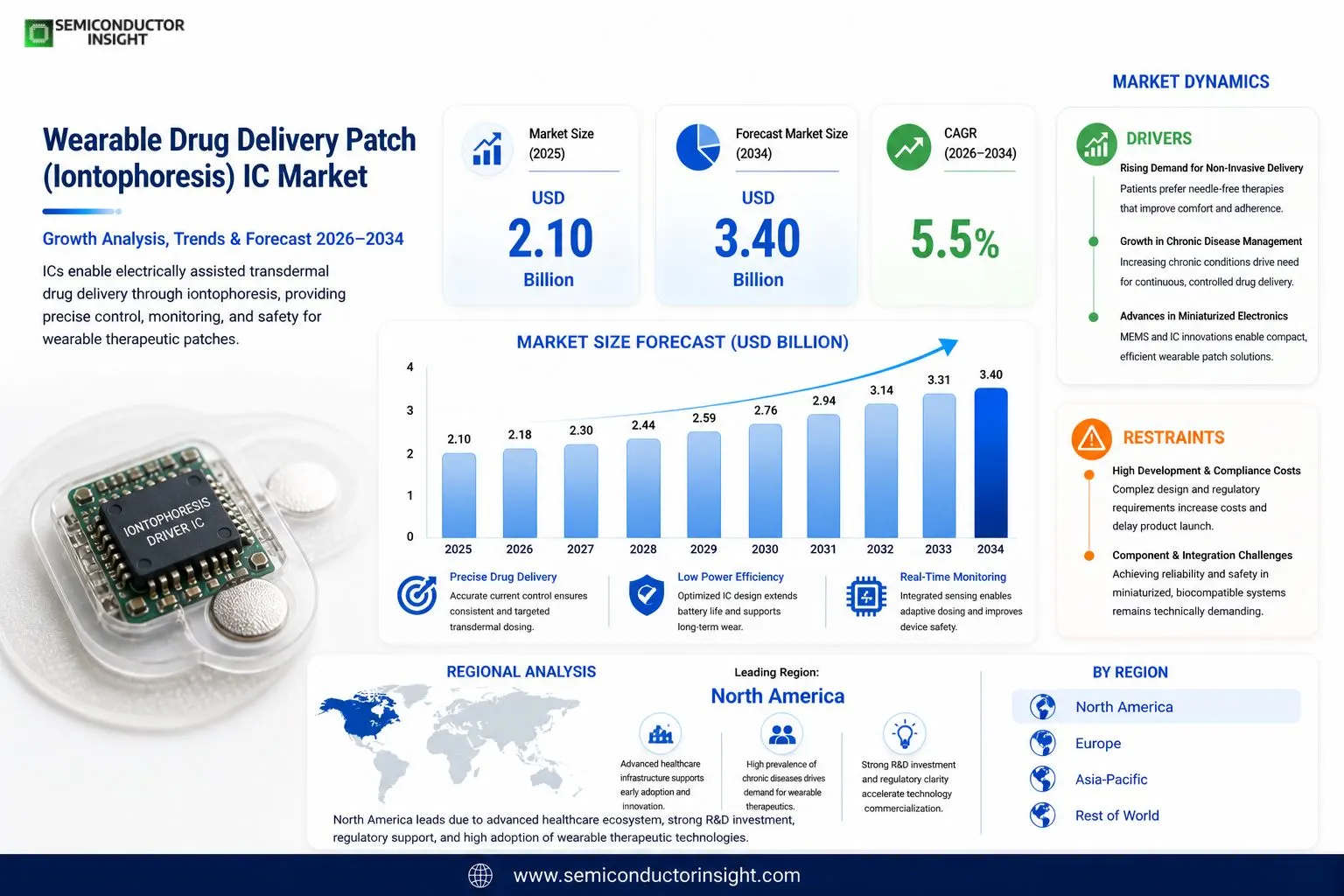
Global Wearable Drug Delivery Patch (Iontophoresis) IC Market size was valued at USD 2.10 billion in 2025. The market is projected to grow from USD 2.18 billion in 2026 to USD 3.40 billion by 2034, exhibiting a CAGR of 5.5% during the forecast period.
Wearable drug delivery patch (iontophoresis) ICs are integrated circuits designed to enable electrically assisted transdermal delivery of pharmaceutical compounds. These chips regulate current flow, monitor skin impedance, and ensure consistent drug permeation through the skin using low-intensity electrical currents. The systems often incorporate microcontrollers, sensors, power management units, and safety circuits, creating a reliable platform for controlled and targeted drug administration. Because these ICs support needle-free delivery, they are widely used for pain management therapies, localized anesthesia, anti-inflammatory treatments, and chronic disease drug regimens.
The market is gaining momentum because of rising demand for non-invasive drug delivery technologies, increasing adoption of wearable healthcare devices, and growing investment in digital therapeutics. Furthermore, advancements in miniaturized semiconductor components and flexible electronics are enabling more compact and efficient iontophoresis patch designs. Recent innovations, such as next-generation patches integrating real-time monitoring and adaptive dosing algorithms, are strengthening market expansion. Several semiconductor and medical technology companies are actively enhancing their portfolios to meet regulatory standards and expand production capabilities, supporting steady global growth.
MARKET DRIVERS
Rising Adoption of Non‑Invasive Therapeutic Delivery
The growing demand for non-invasive medication administration is a central driver shaping Wearable Drug Delivery Patch (Iontophoresis) IC Market. Healthcare providers are increasingly prioritizing solutions that reduce patient discomfort and improve adherence, leading to wider evaluation and integration of iontophoresis-based wearable systems in clinical and consumer health applications. This momentum is further supported by advancements in microelectronics, enabling smaller, more energy-efficient ICs optimized for controlled transdermal delivery.
Increasing Focus on Chronic Disease Management
The market is also influenced by the expanding global patient population managing chronic conditions requiring repetitive dosing. Wearable iontophoresis patches allow precise, programmable drug release, aligning with the shift toward personalized care models. As remote patient monitoring technologies continue to scale, integrated ICs designed for real-time dose regulation and system diagnostics are experiencing heightened demand across both medical device and pharmaceutical ecosystems.
➤ Demand for connected, self-administered therapeutic systems continues to rise as healthcare infrastructures emphasize home‑based care.
Additionally, continuous R&D investments targeting improved biocompatibility, longer battery life, and enhanced electronic control modules are reinforcing industry growth, making iontophoresis-based wearable patches increasingly viable for mainstream therapeutic applications.
MARKET CHALLENGES
Complexity of Multi‑Layer Device Integration
One of the key challenges for Wearable Drug Delivery Patch (Iontophoresis) IC Market is the intricate integration of electronics, drug reservoirs, skin-contact materials, and delivery mechanisms. Ensuring consistent electrical performance while maintaining patient comfort and safety places significant pressure on IC design, thermal management, and compliance testing. Manufacturers must navigate these engineering constraints without compromising functionality or form factor.
Other Challenges
Regulatory Alignment and Compliance
Achieving regulatory clearance for iontophoresis-based systems requires extensive validation, particularly for IC modules responsible for current control, safety cut-offs, and dose accuracy. This extends development timelines and may limit the pace at which new embedded electronics technologies are commercially deployed.
MARKET RESTRAINTS
High Development Costs and Component Constraints
The market faces restraints tied to the high development cost of wearable drug delivery patches incorporating iontophoresis ICs. Designing robust circuits capable of providing controlled current output while maintaining ultra-low power consumption requires advanced semiconductor materials and specialized manufacturing processes. These costs, combined with the need for rigorous reliability testing, can limit broader commercialization. Additionally, the availability of compact, medical-grade components that meet stringent safety requirements continues to challenge supply chains, especially for emerging applications requiring miniaturized controllers.
MARKET OPPORTUNITIES
Growth of Connected Health and Digital Therapeutics
Expanding digital health ecosystems present substantial opportunities for Wearable Drug Delivery Patch (Iontophoresis) IC Market. As remote monitoring and smart therapeutics adoption accelerates, there is a growing need for ICs that enable wireless connectivity, data logging, and adaptive dose control. This shift supports the development of next-generation patches capable of synchronizing with mobile platforms and clinical dashboards. Moreover, opportunities are emerging for IC manufacturers to collaborate with pharmaceutical companies to co-develop integrated therapeutics, promoting customized specifications and long-term strategic partnerships within the wearable drug delivery segment.
Trends
Growing Demand for Non-Invasive Drug Delivery Technologies
Wearable Drug Delivery Patch (Iontophoresis) IC Market is progressing steadily as healthcare systems increasingly emphasize non-invasive therapeutic solutions. Iontophoresis ICs play a central role in this shift by enabling controlled, electrically assisted transdermal delivery that supports consistent and targeted administration of pharmaceutical compounds. The rise in chronic disease management needs, alongside increasing patient preference for needle-free options, continues to influence device integration trends. Manufacturers are improving designs with advanced power management units, optimized sensors, and reliable safety circuits to ensure precise current regulation and enhanced patient comfort.
Other Trends
Integration of Miniaturized Semiconductor Components
Miniaturization is accelerating across wearable healthcare technologies, and iontophoresis ICs are benefiting from these advancements. Compact microcontrollers and flexible electronic substrates now allow patches to fit seamlessly on the skin while maintaining stable output performance. These component-level improvements support longer device wear times and help manufacturers address form-factor constraints. The trend is also fostering greater adoption among providers who require efficient drug delivery tools that do not compromise patient mobility or usability.
Enhanced Real-Time Monitoring Capabilities
Another major trend involves embedding monitoring functions directly into iontophoresis patch ICs. Newer platforms integrate skin impedance tracking and responsive dosing logic, enabling the system to adjust electrical output automatically. This helps maintain consistent drug permeation even when external variables shift. The inclusion of such adaptive capabilities aligns with broader digital therapeutics developments, where treatment personalization and continuous patient insights are becoming more prominent.
Increasing Investment in Wearable Healthcare Innovations
Growing investment in wearable medical technology is reinforcing development pipelines for iontophoresis chip solutions. Companies working in semiconductors and medical device engineering are expanding production capacity to meet regulatory requirements and rising device demand. These investments are strengthening global supply chains and supporting the introduction of more advanced patch designs, especially for applications such as pain management, localized anesthesia, and specialized therapeutic regimens.
Advancements in Adaptive Drug Delivery Platforms
The evolution of adaptive dosing systems is emerging as one of the most significant overarching trends in Wearable Drug Delivery Patch (Iontophoresis) IC Market. By combining sensor-driven data collection with refined current control mechanisms, manufacturers are creating solutions capable of responding dynamically to patient physiology. This progression reflects a market-wide shift toward personalized therapy, improved treatment adherence, and integrated wearable ecosystems that provide clinicians with meaningful real‑time insights. The continued emphasis on reliability, flexibility, and user-centered design is expected to shape upcoming innovations across transdermal drug delivery patches incorporating iontophoresis ICs.
COMPETITIVE LANDSCAPE
Key Industry Players
Competitive Dynamics in Wearable Drug Delivery Patch (Iontophoresis) IC Market
Wearable Drug Delivery Patch (Iontophoresis) IC Market is shaped by a mix of leading semiconductor manufacturers and specialized medical technology developers that supply integrated circuits for controlled transdermal drug administration. Major IC suppliers such as Texas Instruments, Analog Devices, STMicroelectronics, and Onsemi dominate the competitive arena by offering power management units, microcontrollers, current regulators, and sensor interfaces tailored for iontophoresis patch systems. Their strong portfolio breadth, extensive R&D investment, and proven reliability in medical-grade electronics position them as key enablers of next-generation wearable drug delivery solutions. These companies are also expanding partnerships with medical device OEMs to accelerate the commercialization of miniaturized, energy‑efficient IC platforms optimized for continuous skin‑contact operation.
In addition to top semiconductor vendors, several niche players contribute specialized components, flexible electronics, and proprietary iontophoresis technologies. Companies such as Travanti Pharma, IontoPatch, and TheraBond innovate around patch design, safety circuitry, and integration of adaptive dosing features. Renesas Electronics, Microchip Technology, and Infineon Technologies support the market with application‑specific ICs that enhance precision, user safety, and real‑time monitoring capabilities. Together, these firms collectively strengthen supply chain resilience and foster a competitive environment focused on reliability, regulatory compliance, and device miniaturization for emerging wearable drug delivery platforms.
List of Key Wearable Drug Delivery Patch (Iontophoresis) IC Market Companies Profiled
- Texas Instruments
- Analog Devices
- STMicroelectronics
- Onsemi
- Renesas Electronics
- Infineon Technologies
- Microchip Technology
- ROHM Semiconductor
- Travanti Pharma (IontoPatch)
- Maxim Integrated (Analog Devices)
- NXP Semiconductors
- TDK Corporation
- Medtronic (Wearable Therapeutic Devices)
- TheraBond
- Blue Spark Technologies
Segment Analysis:
| Segment Category | Sub-Segments | Key Insights |
| By Type |
|
Microcontroller-Based ICs dominate due to their adaptability and ability to manage real-time current regulation.
|
| By Application |
|
Pain Management remains the leading application owing to the need for needle-free, non-invasive drug administration.
|
| By End User |
|
Home Healthcare Users emerge as the primary end-user category due to increasing adoption of personal wellness and self-managed therapeutic devices.
|
| By Device Integration Level] |
|
Fully Integrated Smart Patch ICs lead, supported by growing demand for compact designs capable of real-time monitoring.
|
| By Technology Level] |
|
Next-Generation Adaptive ICs represent the leading segment, benefiting from enhanced precision and safety functions.
|
Regional Analysis: Wearable Drug Delivery Patch (Iontophoresis) IC Market
North America
The U.S. FDA’s progressive stance on combination drug-device products has meaningfully accelerated the approval pipeline for iontophoresis-enabled wearable patches. With dedicated regulatory pathways and pre-submission consultation programs, North American developers benefit from a structured environment that reduces time-to-market while maintaining rigorous safety standards, supporting continued market maturation.
North American semiconductor and IC design firms are at the forefront of developing ultra-low-power, miniaturized control chips tailored for iontophoresis wearable platforms. Partnerships between fabless IC designers and medical device OEMs are producing flexible, skin-conformable solutions that enable precise electrokinetic drug delivery, enhancing therapeutic reliability and enabling remote patient monitoring integration.
Growing patient preference for painless, self-administered therapies is a significant behavioral driver across North America. The shift away from needle-based delivery toward wearable patch formats is particularly pronounced among aging demographics and those managing long-term chronic illnesses. Healthcare systems increasingly advocate for solutions that reduce clinical visits while maintaining therapeutic efficacy and adherence.
A vibrant ecosystem of strategic investors, specialized contract manufacturers, and academic research institutions in North America fosters continuous innovation in Wearable Drug Delivery Patch (Iontophoresis) IC Market. Leading pharmaceutical companies are entering licensing and co-development agreements with iontophoresis IC startups, reflecting strong commercial confidence in the region’s long-term market trajectory through 2034.
Europe
Europe represents a strategically significant region in Wearable Drug Delivery Patch (Iontophoresis) IC Market, underpinned by its world-class pharmaceutical industry, progressive medical device regulations, and strong public healthcare networks. Germany, the United Kingdom, France, and the Netherlands emerge as key national markets, each contributing distinct strengths in manufacturing excellence, clinical research, and digital health adoption. The European Medicines Agency’s evolving regulatory guidelines for combination drug-device products have provided greater clarity for iontophoresis-based wearable developers, reducing market entry uncertainty. European healthcare systems’ strong emphasis on preventive medicine and patient quality of life aligns well with the value proposition of transdermal wearable patch technologies. Additionally, growing cross-border collaboration among EU member states on digital health infrastructure and interoperability is creating favorable conditions for connected iontophoresis patch platforms. Investment in medtech innovation clusters across Scandinavia and Central Europe further diversifies the region’s contribution to the global Wearable Drug Delivery Patch (Iontophoresis) IC Market landscape.
Asia-Pacific
Asia-Pacific is emerging as one of the fastest-evolving regions in Wearable Drug Delivery Patch (Iontophoresis) IC Market, propelled by rapidly expanding healthcare access, surging chronic disease burden, and aggressive government investment in pharmaceutical and semiconductor industries. China, Japan, South Korea, and India are the principal contributors, each demonstrating unique market characteristics. Japan’s deep expertise in precision electronics and miniaturized medical devices positions it as a key IC manufacturing and innovation hub for iontophoresis platforms. South Korea’s advanced semiconductor ecosystem provides critical foundry capabilities for next-generation wearable patch ICs. China’s scale, growing domestic medtech ecosystem, and supportive national health initiatives are accelerating local product development and commercialization. India, with its large patient population and expanding private healthcare sector, presents a high-volume adoption opportunity. Rising consumer health awareness and increasing disposable incomes across the region are further broadening the addressable market for Wearable Drug Delivery Patch (Iontophoresis) IC solutions.
South America
South America occupies a developing but increasingly relevant position in the global Wearable Drug Delivery Patch (Iontophoresis) IC Market. Brazil and Argentina serve as the region’s primary market anchors, supported by expanding healthcare infrastructure and growing awareness of advanced drug delivery modalities. While economic volatility and inconsistent regulatory harmonization across countries have historically constrained market penetration, improving public health investment and rising demand for chronic disease management solutions are creating fresh opportunities. Local pharmaceutical manufacturers are beginning to explore partnerships with global iontophoresis IC platform developers as a pathway to offer differentiated, technology-enabled therapies. The region’s significant prevalence of metabolic and cardiovascular conditions represents a strong clinical rationale for the adoption of wearable transdermal drug delivery solutions. As healthcare systems mature and regulatory frameworks become more aligned with international standards, South America is expected to contribute meaningfully to global Wearable Drug Delivery Patch (Iontophoresis) IC Market growth through 2034.
Middle East & Africa
The Middle East & Africa region presents a nascent yet strategically noteworthy opportunity within Wearable Drug Delivery Patch (Iontophoresis) IC Market. Gulf Cooperation Council nations, particularly the UAE and Saudi Arabia, are investing heavily in transforming their healthcare systems, with a clear push toward digital health technologies and patient-centric care models. These initiatives create a receptive environment for advanced wearable drug delivery innovations, including iontophoresis-based patch platforms. In sub-Saharan Africa, infrastructure limitations remain a barrier, though mobile health integration and increasing NGO-driven healthcare access initiatives are gradually expanding the footprint of advanced medical technologies. South Africa stands out as a regional leader in medtech adoption and regulatory capacity. Across the broader region, growing pharmaceutical market sophistication and partnerships with multinational medical device companies are laying the groundwork for meaningful long-term participation in Wearable Drug Delivery Patch (Iontophoresis) IC Market as the forecast period through 2034 unfolds.
Report Scope
This market research report provides a comprehensive analysis of the Wearable Drug Delivery Patch (Iontophoresis) IC Market , covering the forecast period 2026–2034. It offers detailed insights into market dynamics, technological advancements, competitive landscape, and key trends shaping the industry.
Key focus areas of the report include:
- Market Overview: The report begins with an overview outlining its current market scenario, key growth indicators, and industry transformation drivers. It discusses macroeconomic factors, demand–supply balance, regulatory landscape, and the strategic role of semiconductors in powering advancements across industries such as automotive, telecommunications, consumer electronics, and industrial automation.
- Market Size & Forecast: Historical data and future projections for revenue, unit shipments, and market value across major regions and segments.
- Segmentation Analysis: Detailed breakdown by product type, technology, application, and end-user industry to identify high-growth segments and investment opportunities.
- Regional Insights: Insights into market performance across North America, Europe, Asia-Pacific, Latin America, and the Middle East & Africa, including country-level analysis where relevant.
- Competitive Landscape: Profiles of leading market participants, including their product offerings, R&D focus, manufacturing capacity, pricing strategies, and recent developments such as mergers, acquisitions, and partnerships.
- Technology Trends & Innovation: Assessment of emerging technologies, integration of AI/IoT, semiconductor design trends, fabrication techniques, and evolving industry standards.
- Market Drivers & Restraints: Evaluation of factors driving market growth along with challenges, supply chain constraints, regulatory issues, and market-entry barriers.
- Stakeholder Insights: Insights for component suppliers, OEMs, system integrators, investors, and policymakers regarding the evolving ecosystem and strategic opportunities.
Primary and secondary research methods are employed, including interviews with industry experts, data from verified sources, and real-time market intelligence to ensure the accuracy and reliability of the insights presented.
FREQUENTLY ASKED QUESTIONS:
What is the current market size of Wearable Drug Delivery Patch (Iontophoresis) IC Market?
-> Global Wearable Drug Delivery Patch (Iontophoresis) IC Market size was valued at USD 2.10 billion in 2025 and is expected to reach USD 3.40 billion by 2034, exhibiting a CAGR of 5.5% during the forecast period.
Which key companies operate in Wearable Drug Delivery Patch (Iontophoresis) IC Market?
-> Key players in Wearable Drug Delivery Patch (Iontophoresis) IC Market include leading semiconductor manufacturers and medical technology companies that are actively enhancing their portfolios to meet regulatory standards and expand production capabilities, supporting steady global growth.
What are the key growth drivers?
-> Key growth drivers include rising demand for non-invasive drug delivery technologies, increasing adoption of wearable healthcare devices, growing investment in digital therapeutics, and advancements in miniaturized semiconductor components and flexible electronics enabling more compact and efficient iontophoresis patch designs.
Which region dominates the market?
-> Asia-Pacific is among the fastest-growing regions driven by expanding healthcare infrastructure and wearable device adoption, while North America remains a dominant market supported by strong investment in digital therapeutics and regulatory frameworks.
What are the emerging trends?
-> Emerging trends include next-generation patches integrating real-time monitoring and adaptive dosing algorithms, miniaturized semiconductor components, flexible electronics, needle-free transdermal drug delivery systems, and the integration of microcontrollers, sensors, power management units, and safety circuits for controlled and targeted drug administration.

Get Sample Report PDF for Exclusive Insights
Report Sample Includes
- Table of Contents
- List of Tables & Figures
- Charts, Research Methodology, and more...
 Download Sample Report PDF